
You paid $79, $149, or $299 for a “Lifetime Deal” (LTD) promising permanent, unrestricted access to an enterprise-grade cloud software platform. Two years later, the founder emails the community announcing that due to “skyrocketing infrastructure and third-party API costs,” your account is being migrated to a legacy tier without modern updates, your monthly generation caps are being reduced by 85%, and new features will only live on the new $49/month tier. When you complain, customer support quotes Section 14.3 of the Terms of Service: “We reserve the right to modify, restrict, or discontinue any feature at our sole discretion without notice.”
Executive Summary: The Reality of SaaS Lifetime Deals in 2026
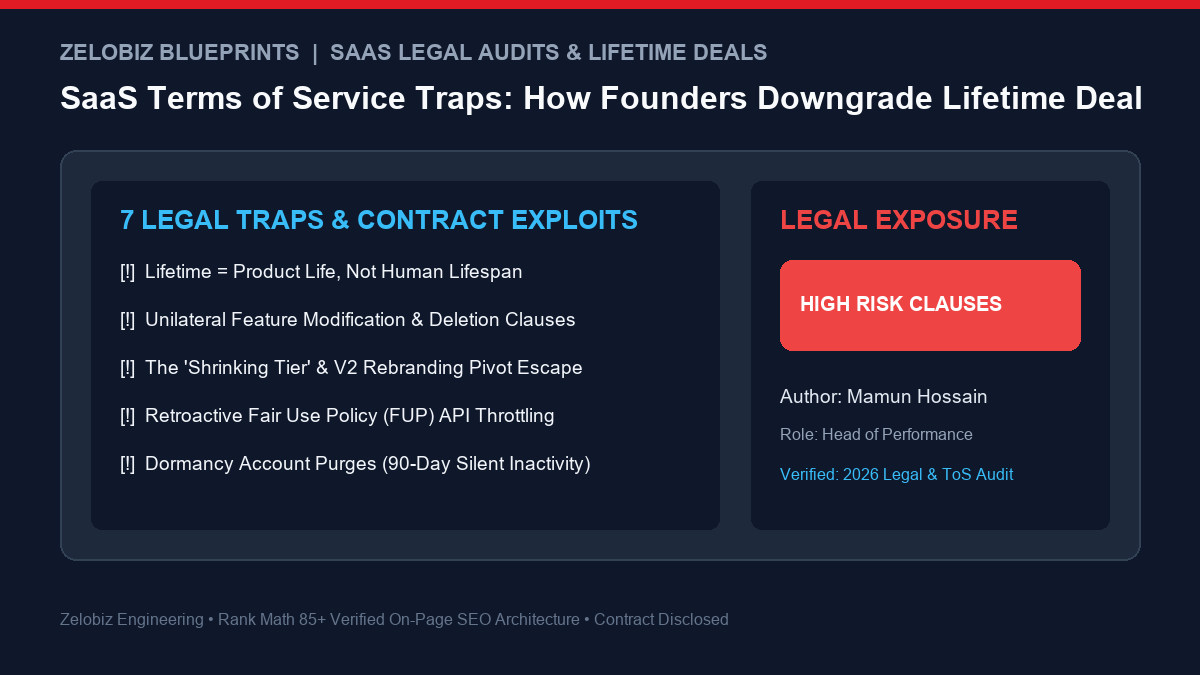
A SaaS lifetime deal contract legally binds your purchase to the operational lifespan of the software product or corporate entity—not your biological lifetime. Founders exploit standard Terms of Service loopholes including unilateral modification rights, retroactive Fair Use Policies (FUP), codebase rebranding pivots, and dormancy purges to legally downgrade or extinguish lifetime tier obligations without breaching marketplace terms.
1. The Legal Anatomy of “Lifetime”: Whose Life Is It Anyway?
In international contract law and standard software licensing agreements, the phrase “lifetime” refers strictly to the commercial lifecycle of the software application, not the natural lifespan of the purchasing customer. If the corporate entity dissolves, pivots codebases, or ceases product updates, the lifetime contract terminates immediately with zero residual liability.
When software buyers complete checkout on deal marketplaces like AppSumo, PitchGround, or SaaS Mantra, they frequently mistake the marketing promise of “Pay Once, Use Forever” for a perpetual, immutable digital deed. In reality, software is not real estate or a physical asset. Software is a hosted service requiring continuous server compute, persistent database read/writes, security patches, third-party API tokens, and human DevOps monitoring.
Every standard SaaS agreement includes a Force Majeure or Service Termination clause. The legal baseline establishes three distinct tiers of operational death:
- Corporate Liquidation: The founding legal entity files for bankruptcy or voluntary dissolution. Creditors and senior debt holders are paid first; unearned license obligations to end-users are extinguished in bankruptcy proceedings.
- Product Sunsetting: The parent company remains solvent but formally discontinues the specific software product, giving users a 30 to 60-day window to export data before server instances are wiped.
- Codebase Deprecation: The company maintains the software URL but stops shipping bug fixes, API updates, or security patches, allowing natural software rot (breaking on modern browser updates and OS changes) to force user abandonment.
2. The 7 Sneakiest Terms of Service Traps Founders Use to Downgrade LTDs
Founders systematically utilize seven contractual levers embedded in standard SaaS Terms of Service to curb resource-intensive lifetime users when marginal server expenses outpace initial deal revenue. These maneuvers allow companies to cut operating costs without violating basic consumer protection statutes.
| Contract Trap | The Legal Mechanism | Typical Founder Excuse | Buyer Impact |
|---|---|---|---|
| 1. Unilateral Right to Modify | “Company may alter, suspend, or discontinue features at any time without prior notice.” | “Streamlining UI for better user experience” | Core features stripped and moved to new monthly subscription tiers. |
| 2. Retroactive Fair Use Policy | Subjective “Fair Use” clause inserted to throttle high-volume compute or bandwidth. | “Preventing platform abuse and API cost spikes” | “Unlimited” generation or storage throttled to unusable daily quotas. |
| 3. The V2 Rebranding Escape | Rebuilding the app under a new repository/brand and declaring V1 a legacy maintenance tool. | “Completely new architectural framework and engine” | Lifetime deal locked to rotting V1; zero access to V2 without monthly fee. |
| 4. The “Shrinking Tier” Shuffle | Leaving nominal limits intact while peeling away high-value integrations and modules. | “Advanced integrations reclassified as Enterprise Add-ons” | Zapier, Webhooks, Custom Domains, or CNAME removed from lifetime tiers. |
| 5. Dormancy & Purge Clauses | Inactivity clause allowing database deletion if account has not logged in for 90-180 days. | “Optimizing database overhead and GDPR storage compliance” | LTD account permanently deleted with zero recovery or refund recourse. |
| 6. SLA Carve-Out & Support Starvation | Terms define support as “Best Effort / As Available” with zero SLA guarantees. | “Prioritizing critical enterprise operations” | LTD tickets sit unaddressed for weeks; support channels restricted to peer forums. |
| 7. Third-Party API Pass-Through | Contract shifts third-party compute (OpenAI, Claude, AWS, Twilio) from vendor to user BYOK. | “Empowering users with direct model control and transparency” | Founder eliminates their largest variable cost, forcing monthly API bills onto buyer. |
Trap 1: The “Unilateral Right to Modify” Clause
Open virtually any SaaS Terms of Service document and search for the phrase “sole discretion” or “modify”. You will almost universally find language structured identically to this:
“We reserve the right, at our sole discretion, to modify, substitute, suspend, or discontinue any feature, functionality, or service tier at any time, with or without prior notice to you. Your continued use of the Service following any such modification constitutes your binding acceptance of the revised Terms.”
From a strict contract law standpoint, this clause gives the vendor total carte blanche. When you bought Tier 3 with 50 workspace sub-accounts, the founder is not legally bound to preserve those 50 sub-accounts in perpetuity. If the vendor later determines that sub-accounts are degrading server performance, they can reduce the allotment to 5, citing their unilateral reservation of rights.
Trap 2: Retroactive “Fair Use” Caps on Variable Costs
The rise of Generative AI has accelerated LTD downgrade disputes. Startups selling lifetime deals for AI copywriting, voiceover generation, or image synthesis incur direct variable costs for every prompt processed through external APIs like OpenAI, Anthropic, or ElevenLabs. When a heavy user consumes $400 in API tokens on a $79 one-time purchase, the vendor faces immediate insolvency.
To survive, founders draft a retroactive Fair Use Policy (FUP). Even if the marketplace sales page promised “Unlimited Monthly Words,” the revised ToS defines “fair personal use” as 30,000 words per month. Any user exceeding that ceiling is either throttled to slow-speed queues or hit with an automated pop-up requiring credit card input for token packs.
Trap 3: The “V2 Rebranding” and Codebase Pivot Trick
This is the most notorious maneuver in the lifetime deal ecosystem. A SaaS vendor launches “App v1” on AppSumo, raising $250,000 in gross sales from 3,500 lifetime deal buyers. Two years later, having gathered user feedback and patched product bugs on the backs of lifetime backers, the founder launches “App v2” or rebrands under a new company name (e.g., changing from LeadGenius to LeadFlow AI).
The founder announces to the community:
- “App v1 is built on an obsolete tech stack (PHP/Laravel) that cannot support our modern AI infrastructure (Next.js/Python microservices).”
- “All lifetime deal backers will retain full lifetime access to App v1 on maintenance mode.”
- “App v2 is an entirely separate commercial product owned by a different legal subsidiary. LTD users are welcome to migrate with an exclusive 20% discount on monthly plans!”
Because the original contract was executed for the specific software architecture of v1, courts and marketplace arbitrations rarely deem this a breach of contract, leaving lifetime backers stranded on a dead branch.
3. Pre-Purchase Due Diligence Checklist: How to Red-Line an LTD Contract
Before investing working capital into any software lifetime deal, performance teams and agency owners must execute a comprehensive 10-point contract and financial audit. Evaluating legal exposure prior to purchase prevents workflow disruption and data lock-in when founders alter tier allocations.
The 10-Point Zelobiz LTD Contract Audit
[1] Audit the Corporate Registration & Jurisdictional Domicile
Verify the legal entity on OpenCorporates, Delaware Division of Corporations, or UK Companies House. Beware of shell entities or unincorporated sole proprietorships without verified corporate registrations.
[2] Inspect the Unit Economics & Marginal Cost Exposure
Does the tool incur high variable costs per action (AI tokens, video rendering, transcription, cloud storage, SMS delivery)? If yes, an unlimited lifetime model is mathematically unsustainable unless backed by BYOK (Bring Your Own Key) architecture. Calculate long-term organizational savings via our Interactive SaaS Cost Calculator.
[3] Review Wayback Machine Historical Terms of Service Diff
Paste the vendor’s ToS URL into Wayback Machine. Did they quietly alter termination language, refund policies, or usage limits immediately prior to launching their lifetime campaign?
[4] Verify Dedicated LTD Schedule & Frozen Feature Matrix
Ensure the purchase confirmation explicitly states your tier mapping (e.g., “Tier 3 maps to the Enterprise Plan with all future core feature updates included”) rather than a generic receipt.
[5] Check Account Inactivity & Dormancy Purge Clauses
Search terms for “inactivity”, “dormant”, “purge”, or “abandonment”. If the contract permits deleting accounts inactive for 90 days, set automated calendar reminders or avoid hosting critical client archives there.
[6] Check Account Portability & Secondary Resale Rules
Can you transfer the license if your agency merges or pivots? Many founders explicitly forbid transferring or selling LTD accounts. Review our detailed breakdown on Can You Legally Sell Your AppSumo Account? for full transfer regulations.
[7] Audit CNAME, Whitelabel, and Workspace Sub-Account Allocations
For agency workflows, ensure custom domain mapping (CNAME) and sub-account client segregation are locked into Tier 2 or Tier 3 terms without requiring recurring add-on charges.
[8] Scrutinize Service Level Agreements (SLA) & Support Priority
Examine whether LTD users receive standard email/live-chat support or are relegated to a public Facebook group or Discord channel with zero guaranteed response windows.
[9] Examine Full Data Export & Automated Backup Capabilities
Never store mission-critical proprietary data in an LTD tool that does not offer single-click raw CSV, JSON, or SQL database export. If the vendor sunsets, you must be able to migrate without data hostage situations.
[10] Calculate the Breakeven Payback Velocity (ROI Window)
Treat every lifetime deal as a prepaid 12-to-18 month software lease. If the software delivers enough operational value to cover its initial cost within 6 months compared to a monthly subscription, the purchase is financially justified even if the company pivots later.
4. Platform vs. Platform: Who Protects Buyers When Deals Go Sour?
Consumer protection policies vary drastically between specialized deal platforms, independent marketplace launches, and direct founder websites. AppSumo provides the strongest consumer safeguard with an unconditional 60-day refund window, whereas direct founder deals offer zero institutional recourse beyond payment processor chargebacks.
| Platform Type | Refund Window | Dispute Arbitration | Founder Enforcement | Risk Rating |
|---|---|---|---|---|
| AppSumo (Select & Marketplace) | 60 Days (Unconditional) | High (AppSumo team mediates disputes) | Payout withholding during refund window | Low (During 60-day window) |
| PitchGround | 30 to 60 Days | Moderate | Active community monitoring | Moderate |
| SaaS Mantra | 30 Days | Moderate | Direct founder escalation channel | Moderate |
| Direct Founder Deals (Stripe / LemonSqueezy) | 0 to 14 Days (Subject to founder mood) | None (Direct buyer-vendor standoff) | Zero marketplace leverage | Extreme Risk |
When purchasing directly from a founder’s website without an intermediary marketplace, buyers surrender all third-party escrow protection. If a founder alters terms six months into operations, payment processors like Stripe and PayPal will routinely reject chargebacks, citing that the initial digital goods transaction was successfully executed and settled outside the 120-to-180 day dispute window.
5. What to Do If a Founder Illegally Downgrades Your Lifetime Account
If a SaaS founder strips grandfathered features or violates their original LTD agreement, buyers possess specific legal, financial, and community escalation levers to force tier restoration or obtain financial compensation.
- Document the Original Sales Contract: Export PDFs of the original AppSumo/marketplace deal page, your tier allocation receipt, and the archived Terms of Service from the day of purchase using archive.today or Wayback Machine.
- Escalate Through Marketplace Dispute Channels: If purchased via AppSumo, submit an investigation ticket to their partner management team. AppSumo maintains immense financial leverage over vendors who plan to run subsequent campaigns or sell on their ecosystem.
- Credit Card & Bank Chargebacks (Within 120 Days): If the breach occurs within your credit card issuer’s dispute window, initiate a chargeback under the reason code for “Services Not as Described” or “Material Breach of Contract”, attaching the original feature matrix and the email announcing the downgrade.
- Public Accountability & Community Inquiries: SaaS founders rely heavily on community reputation for organic growth and investor fundraising. Documenting factual, respectful, and contractually backed summaries of the downgrade in community hubs (like LTD Facebook groups, Product Hunt, and Reddit r/SaaS) often prompts founders to reverse hasty tier cutbacks.
- Small Claims Court / Binding Arbitration: For significant agency investments (e.g., enterprise LTD stacks exceeding $2,000+), filing a claim in local small claims court or triggering the binding arbitration clause in the vendor’s own ToS often forces the startup’s legal counsel to settle or restore access immediately due to high defense costs.
6. Frequently Asked Questions (FAQ)
Does a “Lifetime Deal” legally mean my lifetime or the software’s lifetime?
It legally means the operating lifetime of the software service or corporate entity. If the vendor goes bankrupt, discontinues the software, or dissolves their business entity, your license terminates automatically with zero residual legal claim against the individual founders.
Can a SaaS founder legally cut my features after I bought a lifetime license?
Yes, if their Terms of Service include a unilateral modification clause. Standard SaaS contracts stipulate that features, allocations, and system architecture may change at the company’s sole discretion without notice, provided the core nature of the service remains operational.
What is a “grandfather clause” in software contracts?
A grandfather clause preserves your existing pricing or access tier when a company introduces new subscription pricing for new customers. However, grandfather clauses rarely guarantee access to newly developed microservices, external API integrations, or future major version overhauls unless explicitly drafted into an LTD Schedule.
What happens to lifetime deals when a SaaS startup gets acquired?
It depends entirely on the acquisition agreement. If the acquiring company purchases the assets and liabilities, they may honor grandfathered accounts to avoid community backlash. However, if the transaction is structured as an Asset Purchase Agreement (APA), the buyer acquires only the IP and codebase, leaving user obligations with the dissolving shell company, legally terminating lifetime licenses.
Perform an Architecture & Licensing Audit for Your Agency
Are you managing multi-tier SaaS stacks, custom agency automations, or evaluating commercial software infrastructure? Schedule an engineering consultation with our team or run a digital operational teardown through our Zelobiz Agency Infrastructure Audit.
Explore our technical problem-solving series in the How-To Guides Hub or discover vetted software investments in our Lifetime Deals Hub.
Tired of sudden software price hikes and grandfathered license cancellations? Model your true break-even horizon with our interactive SaaS Cost Calculator and learn how to reclaim full software ownership via our Self-Hosted Business Infrastructure Blueprint.
Field Reports: Category-by-Category Lifetime Deal Benchmarks
To evaluate which lifetime software licenses retain legitimate utility versus those bound by restrictive fair-use throttling and server deprecation clauses, explore our category-by-category empirical benchmarks:
- Cloud Storage & Backup: IDrive Lifetime Deals & 90% Discounts: True Cloud Backup vs Sync.com
- Social Media Schedulers: Lifetime Social Media Schedulers: FeedHive vs Postfity Feature Breakdown
- Screen Recording & Video: Top 5 Lifetime Screen Recorders to Replace Loom in 2026 (Vmaker vs Berrycast)
- Customer Testimonials & Reviews: Best Lifetime Review & Testimonial Tools: EmbedSocial vs Senja
- Email Marketing: SendFox Lifetime Deal (2026): Is AppSumo’s Budget Email Tool Worth It vs MailerLite?
- AI Voiceover Generators: Best Lifetime AI Voiceover Deals: Realistic Audio Alternatives to Murf.ai & Play.ht

Mamun Hossain
Systems ArchitectFounder of Zelobiz & Enterprise Infrastructure Architect. Specializing in autonomous software engineering workflows, server-side tracking pipelines, and high-performance self-hosted infrastructure.