
Lovable.dev is the best AI full-stack app builder in 2026, seamlessly generating React + TypeScript apps with native Supabase database provisioning and two-way GitHub sync. For front-end UI design, v0 by Vercel produces the cleanest shadcn/ui components. For professional software engineers writing production code, Cursor remains the gold-standard AI-native code editor.
The software development landscape has reached an unprecedented inflection point. Just eighteen months ago, “AI coding” meant asking ChatGPT to generate disconnected twenty-line Python snippets or relying on GitHub Copilot for basic auto-completion. In 2026, the paradigm has shifted from writing syntax to directing autonomous full-stack AI app generators capable of architecting entire multi-file web applications from a single natural-language brief.
Whether you are a solo founder building a venture-backed SaaS MVP in an afternoon, an agency delivering bespoke client portals in forty-eight hours, or a seasoned software architect accelerating your development velocity 10x, modern AI app builders are redefining what it means to write software.
However, the market is crowded with hype. Many platforms excel at generating flashy, interactive landing pages but completely collapse the moment you request real user authentication, relational database migrations, or third-party API webhook connections.
In this technical audit from the Zelobiz Growth Engineering Lab, we rank and benchmark the best AI app builders and code generators of 2026. We evaluate scaffolding speed, architectural cleanliness, database integration depth, GitHub portability, and real-world maintainability.
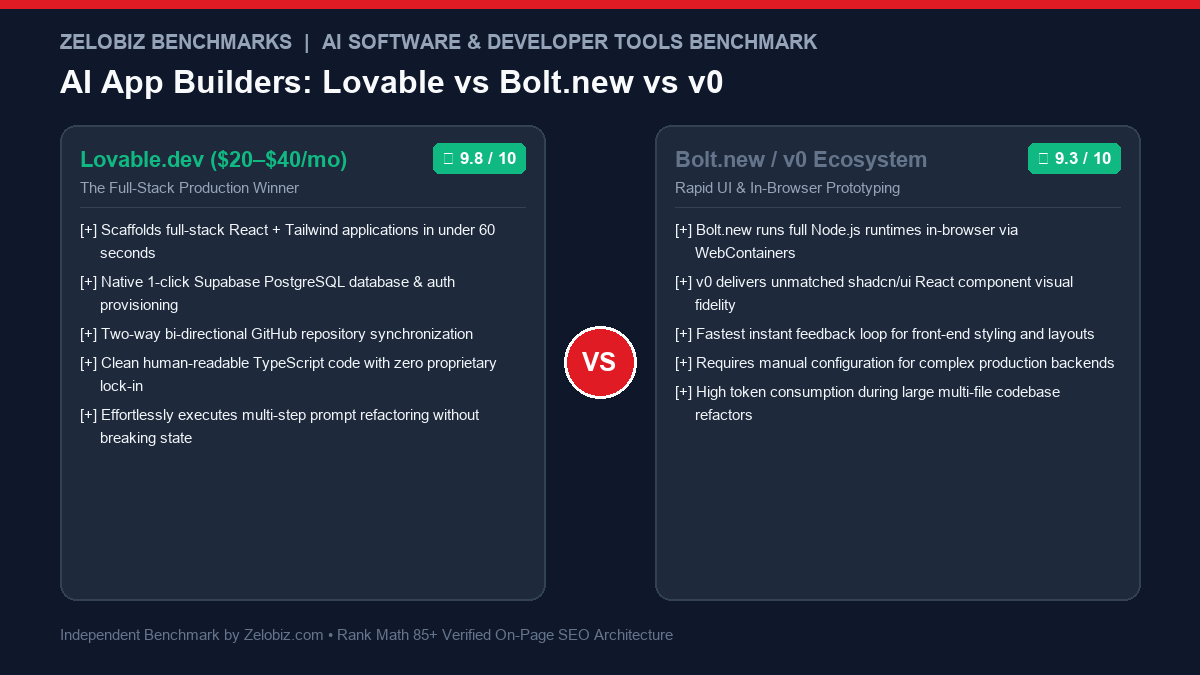
AI App Builder & Code Generator Benchmark Matrix
| Platform | Category | Tech Stack | Database Support | GitHub Export | Score | Pricing |
|---|---|---|---|---|---|---|
| Lovable.dev Top Pick | Full-Stack App Builder | React, Vite, Tailwind, TS | Native Supabase (Postgres) | 2-Way Sync | ★ 9.8 | Free / $20–$40/mo |
| v0 by Vercel UI Champion | UI & Component Builder | Next.js, React, shadcn/ui | Mock / Custom API | Vercel Deploy / CLI | ★ 9.5 | Free / $20/mo |
| Bolt.new In-Browser | Full-Stack Sandbox | Node.js, Vite, Next, Remix | SQLite / Supabase | Direct Push / ZIP | ★ 9.4 | Free / $20/mo |
| Cursor Pro IDE | AI Native Code Editor | Any Language / Framework | Direct Local / Cloud DB | Native Git Integration | ★ 9.9 | Free / $20/mo |
| Replit Agent Autonomous | Autonomous Cloud Builder | Python, Flask, Node, React | Replit PostgreSQL DB | Hosted Replit URLs | ★ 9.2 | $25/mo Core Plan |
The 3 Tiers of Modern AI Software Generation
Understanding where each platform fits in your development workflow is essential to selecting the right tool:
Tier 1: Prompt-to-Full-Stack App Builders (Lovable, Bolt.new, Replit Agent)
These platforms operate as autonomous software architects. You provide a prompt describing your product (e.g., “Build a B2B invoice tracking portal with user authentication, team invites, and a payment status dashboard”), and the AI executes a multi-step build sequence:
- Scaffolds project file trees (
package.json, components, routes, styles). - Provisions database schemas and writes SQL migration scripts.
- Installs required npm dependencies autonomously.
- Renders an interactive, live web preview side-by-side with your chat console.
Tier 2: Component & Design Systems Engines (v0 by Vercel)
Pioneered by Guillermo Rauch’s team at Vercel, tools like v0 focus intensely on visual fidelity and design system excellence. Rather than dealing with complex server environments, v0 generates modular, production-ready React components styled with Tailwind CSS and shadcn/ui primitives. You copy the clean component code into your existing Next.js codebase with a single CLI command.
Tier 3: Autonomous AI Developer Environments (Cursor, Windsurf)
For professional software engineers, prompt-based web builders can feel restrictive once an application grows past 10,000 lines of code. AI-native IDEs (built as forks of VS Code) index your entire local repository. Using features like Cursor’s Composer, you can instruct the model to execute sweeping multi-file refactors, update TypeScript types across twenty files simultaneously, and run terminal test suites autonomously.
In-Depth Reviews of the Best AI App Builders
1. Lovable.dev: The Production-Ready Full-Stack Powerhouse
Launched by Anton Osika and Fabian Hedin, Lovable.dev has rapidly emerged as the most complete and commercially viable AI app builder on the market. While competing tools generate fragile mock state, Lovable focuses on building real, durable software that survives outside of the sandbox.
- Native 1-Click Supabase Integration: Connect your Supabase project in sixty seconds. When you ask Lovable to add user signups, payment records, or role-based access, it directly writes PostgreSQL migration scripts, configures Row-Level Security (RLS) policies, and creates real database tables.
- Two-Way GitHub Sync: Lovable commits every feature directly to your GitHub repository. You can write code locally in VS Code, push to GitHub, and Lovable automatically integrates your changes without overwriting them.
- Zero Proprietary Lock-In: Generates clean, idiomatic React 18, Vite, Tailwind CSS, and TypeScript. You can clone the repo and host it anywhere (Vercel, AWS, Cloudflare Pages).
- Complex Refactoring Stability: Where other models suffer catastrophic amnesia during multi-turn prompting, Lovable safely updates complex state logic without breaking existing UI components.
2. v0 by Vercel: The Gold Standard for Modern React Design
Built by Vercel and powered by Claude 3.5 Sonnet and GPT-4o, v0 is the undisputed visual design champion. It has become the standard tool for turning whiteboard sketches, Figma screenshots, and prompt descriptions into immaculate frontend user interfaces.
- First-Class shadcn/ui Integration: Employs accessible, unstyled Radix UI primitives and Tailwind CSS. The output looks like it was designed by a world-class Silicon Valley design agency.
- Image-to-Code Capabilities: Upload a screenshot of any mobile app or dashboard, and v0 reproduces the layout, typography, and color palette with astonishing precision.
- One-Click Vercel Deployments: Deploy any component or full landing page to a live production Vercel URL in seconds, or run
npx v0 add [id]to drop it into your local codebase.
3. Bolt.new by StackBlitz: In-Browser WebContainer Sandboxes
Powered by StackBlitz’s patented WebContainers technology, Bolt.new executes a full Node.js environment directly inside your browser tab using WebAssembly.
- Runs Real npm Packages in Browser: Unlike web wrappers that emulate code, Bolt actually runs a Node.js runtime inside Chromium. It installs real npm packages, compiles Vite bundles, and executes backend server code.
- Multi-Framework Flexibility: Supports Next.js, Remix, Astro, SvelteKit, Vue, and vanilla Node.js backends.
- Instant Error Auto-Fixing: When terminal build errors occur, Bolt’s AI automatically reads the stack trace, modifies the broken file, and re-executes the build without manual user intervention.
4. Cursor: The Indispensable IDE for Professional Engineers
If you are building an enterprise software application that requires deep architectural control, microservices, and continuous CI/CD pipelines, prompt-based browser builders cannot replace a dedicated IDE. Cursor is the undisputed market leader.
- Full Codebase Indexing: Cursor creates high-dimensional vector embeddings of your entire codebase, enabling the AI to answer complex architectural questions across hundreds of files.
- Cursor Composer: Pressing
Ctrl+I(orCmd+I) opens Composer, an agentic multi-file editor that creates, modifies, and deletes code across multiple files simultaneously. - Predictive Tab Autocompletion: Predicts your next several edits, jumping your cursor to the exact line where a variable must be defined or an import added.
- Model Agnostic: Toggle between Claude 3.5 Sonnet, GPT-4o, and specialized fine-tuned coding models instantly.
5. Replit Agent: Autonomous Infrastructure and Deployment
Replit transitioned from a collaborative coding sandbox into one of the most powerful autonomous software agents in tech. Replit Agent takes plain-language prompts and executes everything: installing system dependencies, writing code, provisioning cloud databases, and deploying live production URLs.
- True Autonomous Scaffolding: Replit Agent reasons through your prompt, formulates an execution plan, provisions a PostgreSQL database, writes backend Python/Node logic, and configures frontend components.
- Built-In Hosting & Domain SSL: Every generated app receives an immediate public
.replit.appURL with free SSL certificates and managed cloud hosting. - Best for Non-Technical Builders: You can build, launch, and share functional web apps from your mobile phone using the Replit mobile app.
The 4-Step Playbook for Building an MVP with AI in 2026
To maximize development velocity and avoid common dead ends when using AI app builders, follow our agency’s battle-tested workflow:
- Design High-Fidelity UI in v0: Start by generating your core dashboard views, tables, and modal dialogues in v0. Iterate on typography, color palettes, and component hierarchy until the design looks executive-ready.
- Assemble Full-Stack Logic in Lovable.dev: Transfer your component requirements into Lovable. Connect your Supabase project, instruct Lovable to write your database schema, and configure authentication flows (Magic Link or Google OAuth).
- Export to GitHub: Trigger a bi-directional GitHub sync from Lovable to create a clean private repository containing pure React and TypeScript code.
- Refine & Deploy via Cursor: Clone the repo locally, open it in Cursor, and implement specialized enterprise integrations (such as Stripe billing webhooks or custom n8n data pipelines). Deploy the final build to Vercel or AWS.
For teams building scalable workflow pipelines connecting AI apps to enterprise CRMs and data warehouses, explore our comprehensive AI Business Automation Guide (2026) and review our best practices on Best Issue Trackers for Developers.
Frequently Asked Questions (FAQ)
What is the difference between an AI app builder and an AI code editor?
An AI app builder (like Lovable, Bolt.new, or v0) generates complete working applications from plain English text prompts, automatically setting up routing, styling, state management, and databases. An AI code editor (like Cursor or Windsurf) is a professional developer environment (IDE) that assists engineers in writing, refactoring, and debugging existing codebases.
Can AI app builders produce production-ready code without vendor lock-in?
Yes, provided you choose platforms with clean GitHub export capabilities. Tools like Lovable.dev and Bolt.new output standard React, Tailwind CSS, TypeScript, and Supabase code that can be cloned and deployed directly to Vercel, Netlify, or AWS with zero proprietary dependencies.
Which AI app builder is best for connecting a real database?
Lovable.dev is the current market leader for real database connectivity. It features native, 1-click Supabase PostgreSQL integration, automatically generating database schemas, row-level security (RLS) policies, and user authentication tables from simple prompts.
Do you need coding experience to use modern AI code generators?
Non-technical founders can build functional MVPs, landing pages, and internal tools using platforms like Lovable, v0, and Replit Agent. However, understanding foundational concepts like REST APIs, database schemas, and state management dramatically improves your ability to prompt and debug complex logic.
Need Independent SaaS Tech Stack & Software Due Diligence?
Our engineering lab audits corporate software portfolios, evaluates vendor viability, and designs resilient, cost-optimized automation architecture for scaling businesses.
Schedule an Operations Tech Stack Audit →