
The “Vibe Coding” revolution of 2026 has made it possible to build, test, and ship complete full-stack web applications entirely through natural language prompts. Two platforms dominate this browser-based app builder space: Lovable.dev and Bolt.new (by StackBlitz). While both allow founders and product managers to prompt ideas into working web apps in minutes, they approach full-stack architecture from opposite angles. Lovable is a design-first, opinionated powerhouse with automated Supabase database wiring, while Bolt.new is an in-browser WebContainer developer sandbox with multi-framework freedom. Here is the definitive benchmark comparing code quality, database architecture, GitHub sync, and true production readiness.
Executive Verdict: Lovable.dev vs. Bolt.new in 2026
Lovable.dev is the superior choice for shipping real commercial web applications due to its automated Supabase backend provisioning, authentication flows, and polished shadcn/ui components. Bolt.new is the superior developer sandbox for rapid multi-framework prototyping (React, Vue, Svelte) and deep browser terminal control via WebContainers.
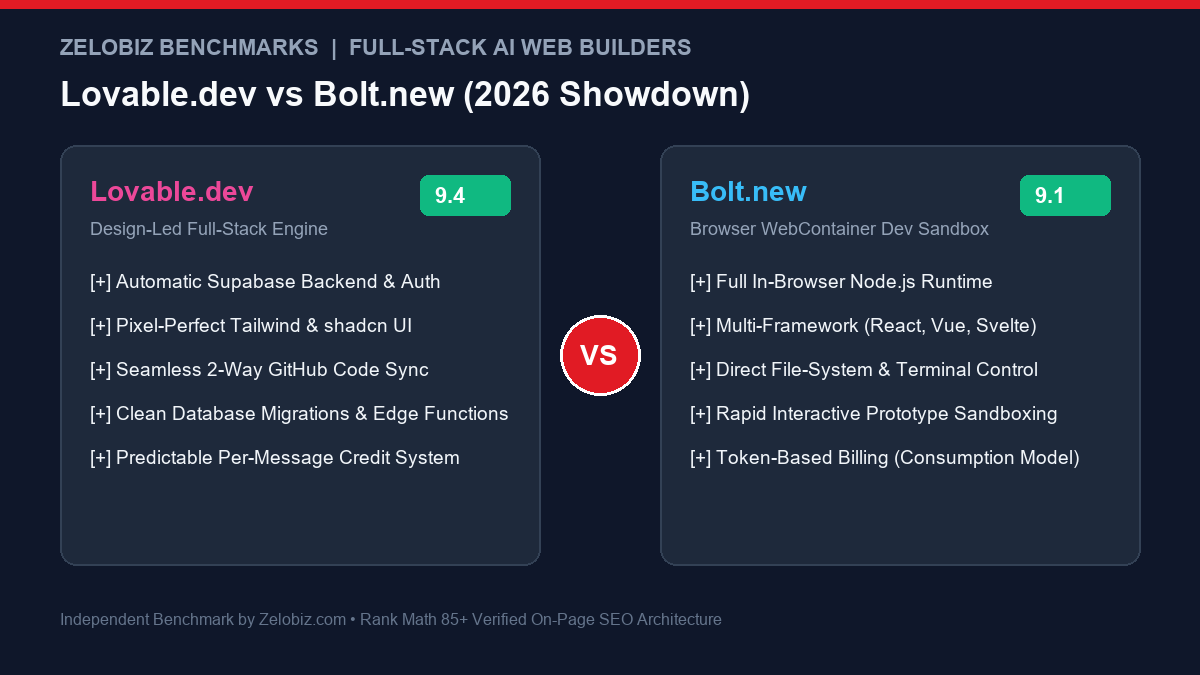
1. Architectural Comparison: Design-Led Engine vs. WebContainer Sandbox
Understanding how each platform compiles and executes code in the browser reveals their operational strengths:
| Platform Feature | Lovable.dev | Bolt.new (StackBlitz) |
|---|---|---|
| Runtime Architecture | Cloud-hosted preview with live HMR | WebContainer (Full Node.js in browser tab) |
| Database & Backend | Native 1-Click Supabase Integration & Auth | Manual / Custom API integration |
| UI Design System | Tailwind CSS + shadcn/ui (Enterprise polish) | Flexible (Tailwind, Vanilla CSS, Any library) |
| Framework Support | React / Vite / TypeScript (Specialized) | React, Vue, Svelte, Astro, Angular, Node |
| GitHub Portability | 2-Way Bi-Directional GitHub Sync | Direct GitHub Export & ZIP Download |
| Pricing Model | $25 / month (~100 Generation Credits) | $20 / month (~10M Token pool) |
2. Backend & Database: The Supabase Advantage
The single biggest point of friction in AI app generators is the backend. Most tools generate pretty mock interfaces with static hardcoded JSON arrays. Turning a mock into a real SaaS requires database schemas, migrations, row-level security (RLS), and user authentication.
Lovable eliminates this friction entirely. Through its deep native partnership with Supabase, you can prompt: “Create a customer feedback portal with user authentication, upvoting, and admin roles.” Lovable automatically:
- Creates the PostgreSQL tables and foreign key relationships in Supabase.
- Applies Row Level Security (RLS) policies so users can only edit their own feedback.
- Sets up email/password and OAuth login flows.
- Generates edge functions for server-side business logic.
In Bolt.new, while you can manually configure Supabase by pasting environment variables into a .env file, the AI frequently struggles with complex database migrations and often reverts to mock local storage when prompt complexity increases.
3. UI/UX & Code Quality: shadcn/ui vs. Raw Flexibility
Lovable produces applications that look like they were built by a senior product designer. By strictly standardizing on Tailwind CSS and shadcn/ui components, every button, dialog modal, dropdown menu, and data table adheres to clean accessibility standards and visual consistency.
Bolt.new, by contrast, gives you raw developer freedom. Because it runs a full Node.js container inside WebContainers, you can open an interactive terminal, run npm install on arbitrary packages, switch between SvelteKit, Vue, or Next.js, and inspect network logs directly in your browser console. For experienced developers who want to test experimental npm packages without setting up a local repo, Bolt.new is extraordinarily powerful.
4. Pricing & Token Burn Velocity
The billing models represent two different philosophies:
- Lovable’s Credit Model: You pay per prompt/generation cycle ($25/mo for ~100 credits). Each prompt executes a complete agent loop (generating code, updating schemas, fixing errors). This provides predictable budgeting.
- Bolt.new’s Token Model: You pay for raw input/output AI tokens. While cheap for simple fixes, a heavy debugging session on an existing project reads the entire codebase on every turn, rapidly burning through your monthly token quota.
5. Frequently Asked Questions (FAQ)
Can I export my code from Lovable and host it on my own Vercel account?
Yes, 100%. Lovable maintains a two-way sync with GitHub. Any changes you make in Lovable push to your GitHub repo, and any commits you push to GitHub reflect back in Lovable. You can deploy the repo directly to Vercel, Netlify, or AWS with zero lock-in.
Can Bolt.new run Python or Go backends?
Currently no. Bolt.new relies on WebContainers, which run Node.js WebAssembly environments in the browser. Backend execution is limited to Node/JavaScript frameworks.
Which tool should a non-technical founder choose to build an MVP?
Lovable.dev without question. Its automated database creation, built-in authentication, and polished design components make it the fastest path from an idea to a live, paying customer product.
Engineer Modern Web Stacks for Your Agency
Building high-converting SaaS MVPs, automated client portals, or evaluating full-stack AI development tools? Consult with our development engineering team or schedule a technical infrastructure audit via our Zelobiz Agency Infrastructure Audit.
Explore more technical reviews in our Software Comparisons Hub or calculate cloud software ROI via our SaaS Cost Calculator.
Evaluating UI generator tools alongside full-stack app builders? Check out our direct showdown on v0.dev vs Lovable (2026) and read our master blueprint on AI Coding Agents & Developer Productivity (2026).

Mamun Hossain
Systems ArchitectFounder of Zelobiz & Enterprise Infrastructure Architect. Specializing in autonomous software engineering workflows, server-side tracking pipelines, and high-performance self-hosted infrastructure.