
The demand for generative AI web development has bifurcated into two distinct requirements: developers who need pixel-perfect, copy-pasteable React UI components to drop into existing repositories, and founders who need a living, database-backed web application complete with user authentication in minutes. v0.dev (by Vercel) and Lovable represent the pinnacle of these two respective philosophies. While v0 uses Next.js and shadcn/ui to produce breathtaking frontend interfaces, Lovable acts as an autonomous full-stack product engineer that provisions PostgreSQL databases and authentication via Supabase. Here is the definitive benchmark comparing design fidelity, database integration, code portability, and true production readiness.
Executive Verdict: v0.dev vs. Lovable in 2026
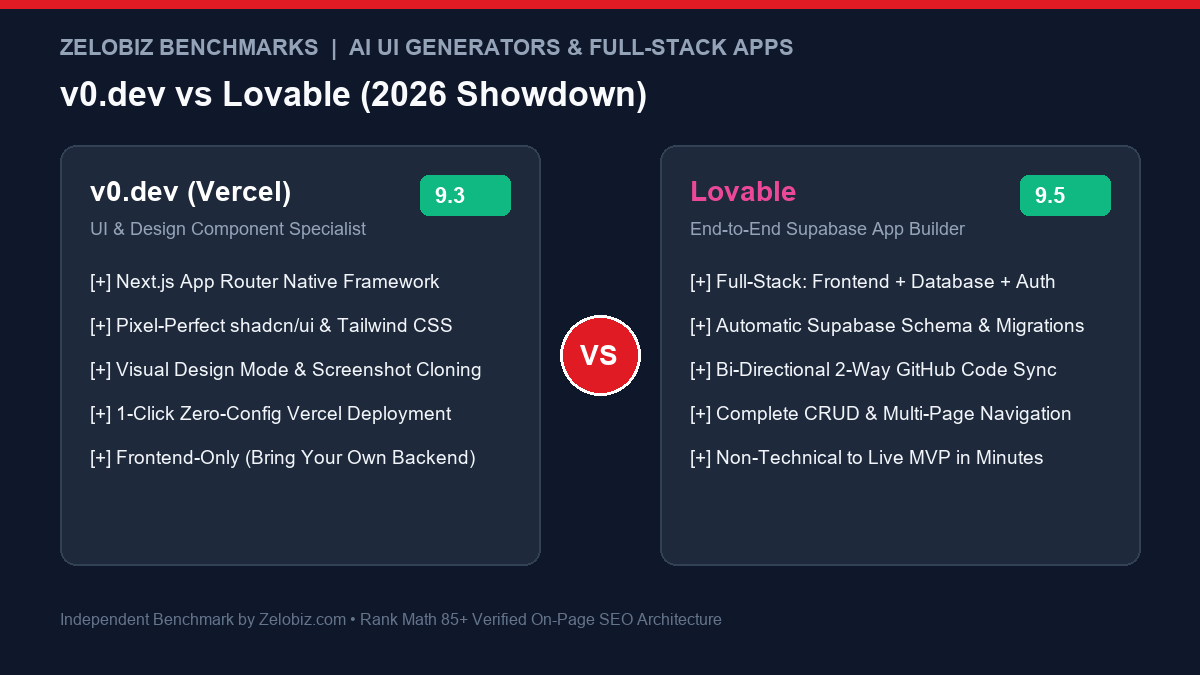
v0.dev is the undisputed winner for developers seeking world-class React frontend components and design systems built on Next.js, Tailwind CSS, and shadcn/ui. Lovable is the clear winner for shipping functional web applications and MVPs because it automatically builds the entire Supabase backend, database tables, Row Level Security, and user authentication out of the box.
1. The Core Divide: Component Specialist vs. Full-Stack Product Engine
Choosing between v0 and Lovable requires identifying whether your project needs a frontend component library or a complete database-driven software platform.
| Feature Dimension | v0.dev (Vercel) | Lovable |
|---|---|---|
| Primary Output | Modular React / Next.js UI Components | Full-Stack Web Applications (Frontend + Backend) |
| Design Polish & Aesthetics | World-Class shadcn/ui & Tailwind Polish | Clean, functional, standard SaaS layouts |
| Database Integration | None (Requires manual API configuration) | Automatic Supabase PostgreSQL & Auth Wiring |
| Multi-Page Architecture | Component & single view focused | Multi-page routing with state management |
| Deployment Target | 1-Click Native Vercel Deployment | Lovable Managed Cloud or 2-Way GitHub Sync |
| Target User | Developers & Designers building custom stacks | Founders, agencies, and PMs shipping MVPs |
2. Design Aesthetics & Component Modularity: Why v0 Leads Frontend
Because v0 is built directly by Vercel—the corporate stewards of Next.js and the creators of the open-source shadcn/ui standard—it possesses an unmatched understanding of modern web aesthetics. When you prompt v0 with a complex request (such as an analytics dashboard with interactive charts, dark mode toggles, and animated dialogs), the generated TypeScript code is clean, modular, and directly importable via the npx shadcn@latest add CLI workflow.
For engineering teams working inside existing large-scale Next.js repositories, v0 serves as an on-demand UI design agency. You can screenshot any design inspiration or competitor UI, upload it to v0, and receive a 95% accurate, accessible Tailwind component in seconds without rewriting backend logic.
3. End-to-End Application Delivery: Why Lovable Leads Product Creation
While v0 gives you the frontend shell, building a working SaaS requires a backend. A user cannot log in, submit a form, or update a database using a static React component. This is where Lovable dominates:
- Automatic Schema Creation: When you describe your product requirements, Lovable designs the relational database tables, foreign keys, and indexes in PostgreSQL.
- Authentication Out of the Box: User registration, login screens, password resets, and session tokens are configured automatically via Supabase Auth.
- Row Level Security (RLS): Lovable writes Postgres RLS policies, ensuring multi-tenant data privacy so Organization A cannot read data belonging to Organization B.
- 2-Way Bi-Directional GitHub Sync: Lovable pushes code directly to a connected GitHub repository. If your developers want to add custom Python microservices or Stripe webhooks, they can pull the repo locally, push commits, and Lovable synchronizes automatically.
4. The Production Hybrid Workflow
The most efficient modern web teams do not choose between them—they chain both tools together:
- Use v0.dev to generate bespoke, ultra-polished hero sections, pricing calculators, and landing page layouts.
- Export the JSX/Tailwind code into your Lovable project, where Lovable connects those components to real Supabase tables, user sessions, and database mutations.
5. Frequently Asked Questions (FAQ)
Can I use v0.dev code in non-Next.js projects?
Yes. While v0 defaults to Next.js App Router conventions, its components are standard React and Tailwind CSS. You can easily adapt them to Vite, Remix, or Astro.
Does Lovable charge per database query?
No. Lovable connects to Supabase, which offers a generous free tier (500MB database, 50,000 monthly active users). You only pay Lovable for generation credits.
How do I estimate SaaS development software savings?
Calculate developer productivity multipliers and SaaS savings using our Interactive SaaS Cost Calculator.
Perform an Engineering Infrastructure Teardown
Looking to accelerate development velocity, integrate agentic AI coding workflows, or audit developer toolchains? Consult with our engineering team or schedule a technical review through our Zelobiz Agency Infrastructure Audit.
Discover more technical comparisons in our Software Comparisons Hub or explore automation guides in the How-To Guides Hub.
Looking to integrate generative AI UI tools with an end-to-end coding agent stack? Explore our master architectural guide on AI Coding Agents & Developer Productivity (2026) or model your team’s API token overhead with our interactive SaaS Cost Calculator.

Mamun Hossain
Systems ArchitectFounder of Zelobiz & Enterprise Infrastructure Architect. Specializing in autonomous software engineering workflows, server-side tracking pipelines, and high-performance self-hosted infrastructure.