
Affiliate disclosure: This post contains an affiliate link. If you buy through it, Zelobiz may earn a commission at no extra cost to you. That doesn’t change what we say below.
SalesNexus is a CRM and marketing automation platform aimed at sales teams that have outgrown a spreadsheet but don’t want to pay enterprise HubSpot or Salesforce pricing. It sold as an AppSumo lifetime deal in 2025, and we went back in 2026 to check what’s still true: whether the deal is buyable, what it costs now, and how it held up once real sales teams put it to work over the following year.
What SalesNexus actually does
SalesNexus tracks leads, deals, and customers automatically, logging emails, proposals, quotes, notes, and contracts against each contact so a salesperson isn’t reconstructing a relationship’s history from memory or a scattered inbox. On top of basic contact management, it includes marketing automation: sequences that combine emails, text follow-ups, and call reminders, along with engagement tracking to see whether a given prospect actually opened or clicked anything sent to them. Custom dashboards let a sales manager track KPIs, pipeline stages, and progress toward goals without exporting data into a separate spreadsheet or reporting tool.
Integrations cover Gmail, Google Calendar, Outlook, and Zapier, which is enough for most small and mid-size sales teams to plug SalesNexus into an existing email and calendar workflow rather than replacing that workflow outright and forcing everyone to relearn how they already work day to day. The platform also includes a contact enrichment feature that fills in missing details on a lead using its own database, which saves time compared to manually researching every new contact by hand.
The category SalesNexus competes in is a crowded one, and the pitch behind most of these tools is similar: stop losing deals because follow-up fell through the cracks, and stop losing institutional knowledge every time a salesperson leaves the company and takes their contact history with them in a personal spreadsheet. A CRM that actually gets used consistently by a sales team is worth more than a more feature-rich one that sits half-configured because the team found it too complicated to adopt, which is part of why ease of onboarding matters as much as the feature list on paper.
Is the AppSumo deal still available?
No. SalesNexus shows “This deal is unavailable” on AppSumo, the standard notice once a lifetime deal sells out. There’s no live purchase option, only an email notification signup for a possible restock.
The deal’s current listing on AppSumo shows three license tiers, down from the four in the original listing:
| Tier | Users | Emails/month | Notable inclusions |
|---|---|---|---|
| Tier 1 | 1 | 5,000 | Core CRM and contact enrichment |
| Tier 2 | 3 | 30,000 | Automation rules, Zapier/API access |
| Tier 3 | 5 | 75,000 | Automation rules, full integrations |
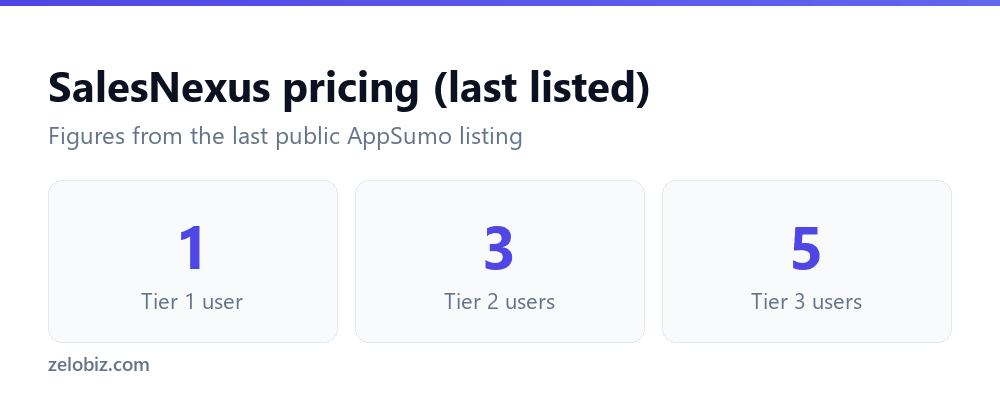
All tiers included unlimited contacts, so the real differentiator between tiers is the number of user seats and the monthly email sending volume, not any hard cap on how large a total contact database a team can build and maintain over time as the business grows and old leads accumulate alongside new ones. The standard 60-day AppSumo refund window applied across all tiers.
Setting it up in practice
Onboarding typically starts with connecting your Gmail or Outlook account, importing an existing contact list, and configuring the fields you want tracked against each lead. Reviewers who documented the process described the core CRM setup as intuitive once you understand the layout, with customizable fields letting teams tailor the system to their specific sales process rather than forcing a generic template onto every business. Several reviewers specifically praised SalesNexus’s support team during onboarding, describing help that was fast, thorough, and genuinely useful for getting unfamiliar features configured correctly on the first attempt.
One recurring complaint is worth flagging clearly for anyone outside the United States. A UK-based reviewer reported that certain address fields, specifically State and Zip, were locked to US formatting and couldn’t be relabeled to County and Postcode, a real limitation for any team whose contact records don’t fit the American address structure by default. If your business operates primarily outside the US, this is worth testing during the refund window before committing further.
Beyond that specific complaint, most onboarding reports followed a familiar pattern for CRM software generally: the first week is spent importing data and configuring fields, the second week is spent getting the team to actually log activity inside the tool instead of falling back on old habits, and by the third or fourth week the dashboards and automation start producing enough value that the initial setup effort feels worthwhile. That adoption curve isn’t unique to SalesNexus, but it’s worth budgeting for regardless of which CRM a team picks, since the software itself doesn’t create the discipline of consistent use.
Key features
The automation sequences let a sales rep set up a series of touches, an email, then a text follow-up a few days later, then a call reminder if there’s still no response, without manually tracking each step in a separate to-do list. That kind of structured follow-up is one of the more measurable ways a CRM actually improves close rates, since inconsistent follow-up is one of the most common, avoidable reasons a warm lead goes cold instead of turning into a closed deal. Sales teams frequently know this in the abstract and still fail to execute it consistently without a system forcing the next step to happen on schedule rather than depending on a rep remembering to check back in three days later. Custom dashboards give a sales manager visibility into pipeline health without pulling a manual report, which matters more as a team grows past the size where a manager can track every deal from memory.
How it compares to the alternatives
| Tool | Pricing model | Best for |
|---|---|---|
| SalesNexus | One-time payment (when available) | Small teams wanting CRM plus built-in outreach automation |
| HubSpot CRM | Free tier, paid add-ons | Teams wanting the most widely integrated ecosystem |
| Pipedrive | Monthly subscription, per-user | Visual, pipeline-first sales tracking |
| Close CRM | Monthly subscription, per-user | Built-in calling and heavier outbound sales focus |
Pipedrive is the closest match in spirit, a CRM built around a visual pipeline rather than a document-heavy record system, though it runs on a recurring per-user subscription that adds up for a growing team. Close CRM leans harder into outbound calling specifically, which overlaps with some of what SalesNexus offers through its call reminder sequences, but at a higher monthly cost aimed at dedicated outbound sales teams. HubSpot’s free tier is worth trying first if you’re unsure whether you need a dedicated CRM at all, though its more advanced automation features sit behind a paid upgrade that gets expensive quickly once you need them.
Where SalesNexus’s lifetime pricing had the clearest advantage was against Pipedrive and Close specifically, both of which charge per user per month, meaning the total cost scales directly with headcount and keeps climbing for as long as the team keeps using the tool. A five-person sales team on a $40-per-user monthly plan is paying $2,400 a year and every year after that, a cost that a one-time SalesNexus purchase, even at its higher tiers, was built to undercut within the first year or two of use, assuming the fit was right for the team’s needs and location.
What users say
SalesNexus holds a strong rating around 4.56 out of 5 from 34 verified AppSumo reviews. The recurring praise across reviews centers on customer support, described repeatedly as fast, attentive, and willing to walk buyers through configuration questions rather than pointing them at a generic help article. Reviewers also praised the flexibility of customizable fields for tailoring the CRM to their specific sales process. The main documented complaints are the US-centric address field limitation mentioned above, and a learning curve that a few reviewers found steeper than expected, compounded by tutorial materials some described as outdated relative to the current interface. None of the negative reviews we found described the core CRM as broken or unreliable, which is a meaningfully different pattern than the more split reception some other tools in this batch received.
It’s worth noting that a 4.56 rating built from 34 reviews is a smaller sample than the hundreds a mature, widely used CRM might accumulate, so treat it as a strong but not definitive signal. The consistency of the specific praise, support quality coming up again and again in independent reviews rather than a single glowing outlier, is the more meaningful pattern here than the headline number by itself.
Pros
- Strong review score (4.56/5) with consistent praise for customer support
- Unlimited contacts across every tier, with user seats and email volume as the real differentiator
- Built-in automation sequences combining email, text, and call reminders
- Custom dashboards for pipeline and KPI visibility without manual reporting
- One-time payment undercut comparable per-user subscription CRMs
Cons
- Currently sold out, with no confirmed restock date
- Address fields locked to US formatting, a real limitation for non-US teams
- Learning curve reported as steeper than expected by some reviewers
- Some tutorial materials described as outdated relative to the current interface
- Automation rules and full integrations require Tier 2 or higher
Who it’s for
SalesNexus made the most sense for a US-based small or mid-size sales team wanting a CRM with genuine built-in outreach automation rather than a bare-bones contact list, and one willing to invest a bit of time up front learning the interface in exchange for avoiding a recurring per-user subscription. It was a weaker fit for teams outside the US given the address field limitation, and for anyone expecting a fully polished, zero-learning-curve experience straight out of the box. A team of one to five people handling a moderate volume of leads is the sweet spot for the lower tiers; a larger team needing more than five seats or a heavier monthly email volume would need to weigh the higher, less commonly discussed tiers against what a subscription competitor charges at that same scale.
Verdict: is SalesNexus worth it?
With the deal sold out, this is mainly useful for people weighing whether to wait for a restock. The 4.56 rating and consistent support praise are strong signals for a US-based team, and the built-in automation is a real, measurable differentiator against a bare-bones CRM at a similar price point. The address field limitation is a real dealbreaker for non-US buyers specifically, not a minor cosmetic issue, so confirm that before assuming this fits your team if you operate outside the United States. If it returns and you’re a good fit for its US-centric design, it’s a reasonable lifetime alternative to a recurring Pipedrive or Close subscription that a growing sales team would otherwise keep paying for indefinitely.
Frequently asked questions
How long does it typically take a team to fully adopt SalesNexus?
Reviewers describe a rough adoption curve of three to four weeks: importing data and configuring fields in the first week or two, then building the habit of consistent daily use before the automation and dashboards start delivering their full value.
Is SalesNexus still available on AppSumo?
No, it’s currently marked unavailable on AppSumo with no confirmed restock date.
Does SalesNexus work well for teams outside the United States?
Not fully. At least one reviewer reported address fields locked to US State and Zip formatting, which can’t be relabeled for other countries’ address formats.
Is there a limit on how many contacts I can store?
No, all tiers include unlimited contacts. The differentiator between tiers is the number of user seats and monthly email sending volume.
How does SalesNexus compare to Pipedrive?
Pipedrive focuses on a visual pipeline interface on a recurring per-user subscription, while SalesNexus bundles CRM and outreach automation together, sold as a one-time lifetime payment when available.
What’s the biggest complaint in SalesNexus reviews?
Beyond the US-address limitation, some reviewers described a steeper-than-expected learning curve and tutorial materials that hadn’t kept pace with interface updates.
Check the live status of the deal on AppSumo’s SalesNexus page before assuming availability has changed.