

Squirrly SEO is an AI-assisted WordPress SEO plugin built specifically for people who aren’t trained SEO specialists but still need their content to rank well in search results without hiring outside help. It sold as an AppSumo lifetime deal in 2025, and we checked back in 2026 on whether the deal is still buyable, what it costs now, and what independent reviews outside AppSumo say about the plugin after years on the market.
What Squirrly SEO actually does
Squirrly SEO combines keyword research, on-page content optimization, and rank tracking into one WordPress plugin, wrapped around an AI layer that turns generic SEO advice into specific, prioritized to-do items for each piece of content. Instead of a generic checklist telling you to “add your keyword to the title,” the AI SEO consultant is meant to generate tasks relevant to your actual site and current rankings. The keyword research tool surfaces search volume, competition, and topic relevance data to help pick which keywords are worth targeting before you write anything.
Content optimization happens live inside the WordPress editor through the SEO Live Assistant, giving real-time feedback as you type rather than requiring a separate, slower save-and-check cycle every time you want to see how a change affects your score. Focus Pages let you flag specific URLs for closer tracking and targeted improvement tasks, and performance tracking monitors clicks, impressions, social shares, and keyword rankings across more than 170 search engines, a notably broader net than tools that only track Google.
The AI framing here is worth putting in context. Squirrly launched years before generative AI became a marketing buzzword attached to every SEO tool on the market, and its AI SEO consultant is closer to a rules-and-data-driven recommendation engine than a chatbot generating written content for you. That distinction matters for anyone evaluating it in 2026 expecting an AI writing assistant bolted onto an SEO plugin; the value here is in prioritization and guidance, not in generating articles for you the way some newer competitors market themselves.
Is the AppSumo deal still available?
No. Squirrly SEO shows “This deal is unavailable” on AppSumo, the standard sold-out notice. There’s no live purchase path currently, only an email signup for restock notifications.
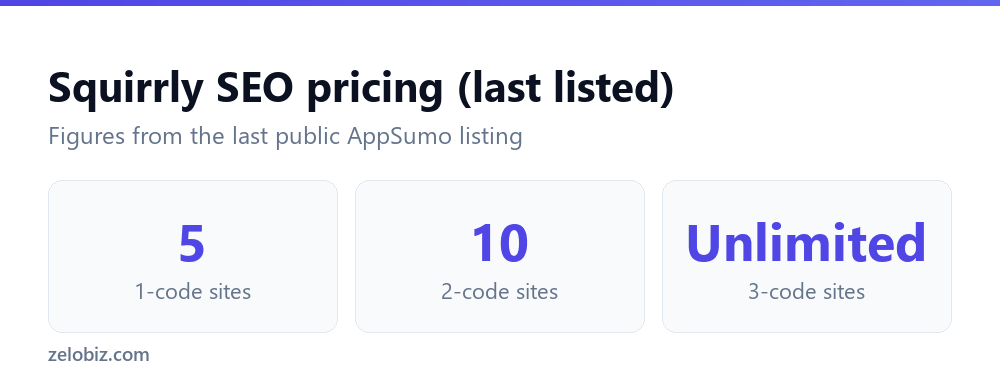
The deal sold across four plans:
| Plan | Sites | Keyword searches/month | New keyword ideas/month |
|---|---|---|---|
| 1 code | 5 | 300 | 15,000 |
| 2 codes | 10 | 600 | 30,000 |
| 3 codes | Unlimited | 900 | 45,000 |
Buyers could stack up to 10 codes for higher limits beyond the base plans shown here, a common AppSumo mechanic that lets a buyer scale their purchase incrementally as their needs grow, without a separate enterprise sales negotiation the way most subscription SaaS tools require once you outgrow the published tiers. All plans carried the standard 60-day AppSumo money-back guarantee, along with the usual requirement that a purchased license be activated within that same 60-day window after checkout, which is standard practice across nearly every AppSumo lifetime software listing rather than anything specific to this particular product.
Setting it up in practice
After installing the plugin and connecting it to a WordPress site, Squirrly runs an initial audit and starts generating its prioritized task list. From there, the day-to-day workflow centers on the SEO Live Assistant, which sits alongside the WordPress editor and updates its feedback as you type, flagging things like missing internal links, weak keyword density, or a meta description that’s too short. Reviewers on independent platforms generally described the learning curve as gentle compared to more data-dense tools like Ahrefs or SEMrush, which was the entire point of the product’s positioning toward non-experts.
The keyword research workflow is where a lot of the AI framing shows up most directly: rather than dumping a table of raw search volume numbers and leaving you to interpret them, Squirrly attaches a relevance score and suggested next steps to each keyword idea. That’s useful for someone new to SEO who doesn’t yet have the instinct for which keyword opportunities are actually worth pursuing versus which ones look good on paper but carry too much competition for a smaller site to realistically rank for.
That guidance layer is also where the product earns its price relative to a free plugin. Yoast and Rank Math will both tell you whether a specific page is optimized for a chosen keyword, but neither one tells you which keyword to choose in the first place, or how to prioritize your limited writing time across a growing list of possible topics. Squirrly’s positioning fills that specific gap: it’s less a technical SEO checker and more a decision-support layer sitting on top of the same underlying WordPress SEO mechanics every plugin in this category ultimately has to handle.
Key features
Focus Pages are one of the more distinctive features here: rather than treating every page on a site equally, you flag your highest-priority pages, a cornerstone blog post, a service page, a product category, and Squirrly concentrates its task generation and tracking specifically on those. That matches how SEO actually tends to work in practice, since a handful of pages usually drive the bulk of a site’s organic traffic, and spreading equal attention across every page on a large site is rarely the best use of limited time.
The 170-plus search engine tracking is broader than most competitors bother with, since the overwhelming majority of SEO tools focus almost entirely on Google. For a site with meaningful traffic from Bing, Yahoo, or regional search engines, that wider tracking net gives visibility competitors don’t offer by default. GDPR compliance and integrations with Facebook Pixel, Google Analytics, and Pinterest round out the feature set for anyone running paid or social traffic alongside organic search.
Performance tracking ties this all together by closing the loop between the tasks Squirrly generates and whatever actually happens afterward in search results. Watching clicks and impressions change over time against a specific Focus Page, rather than just trusting that completing a checklist of tasks automatically translates into more traffic, is the kind of feedback loop that helps a non-expert actually learn what’s working for their specific site rather than following generic advice indefinitely without ever checking whether it’s paying off.
How it compares to the alternatives
| Tool | Pricing model | Best for |
|---|---|---|
| Squirrly SEO | One-time payment (when available) | Non-experts wanting AI-guided, prioritized tasks |
| Yoast SEO | Free core, paid Premium subscription | The most widely used, well-documented baseline plugin |
| Rank Math | Free core, paid Pro subscription | Deeper free feature set, schema-heavy sites |
| All in One SEO | Subscription, tiered | Larger sites needing advanced technical SEO tools |
Yoast and Rank Math are the two plugins most WordPress users encounter first, both offering a genuinely useful free tier that covers the SEO basics without any payment at all. Squirrly’s differentiation isn’t really about doing more than these free tools technically can, it’s about interpretation: turning raw SEO signals into a prioritized, AI-generated task list aimed specifically at someone without existing SEO knowledge, which Yoast and Rank Math’s more checklist-driven interfaces don’t attempt to do in the same way. All in One SEO leans further toward technical depth and larger sites, a different audience than Squirrly’s beginner-to-intermediate positioning.
The honest framing for a comparison like this is that free doesn’t mean equivalent, and paid doesn’t automatically mean better, it means different tradeoffs. Yoast’s free tier is more than capable for a straightforward blog or small business site, and plenty of well-ranking websites run on nothing more than that. Where a tool like Squirrly earns its keep is specifically the situation where a site owner has the traffic and the content volume to benefit from prioritization, but not the SEO background to do that prioritization confidently on their own, which is a narrower but real use case rather than a universal upgrade over a free plugin.
What independent reviews say
Unlike several other tools in this batch, Squirrly SEO has a meaningful, well-established review history outside of AppSumo specifically. It holds a 4.7 out of 5 rating on both G2, from 149 reviews, and Capterra, from 168 reviews, putting it among the more consistently well-reviewed products we looked at while rewriting this entire batch of AppSumo posts, and a notably larger, more established review sample size than most of the other AppSumo-era tools covered elsewhere in this same batch of posts. G2 has awarded it a High Performer medal in both its general SEO category and its Small Business SEO category specifically, a recognition that requires a sustained pattern of positive reviews over time rather than a single strong quarter. Common praise across both platforms centers on the ease of use and the step-by-step guidance the AI layer provides, with reviewers repeatedly describing it as accessible for beginners without feeling dumbed down for more experienced users who also spend time in the product.
Pros
- Strong, independently verified reputation: 4.7/5 on both G2 and Capterra
- AI-generated, prioritized task lists suited to non-experts
- Real-time SEO feedback inside the WordPress editor via the Live Assistant
- Tracks performance across 170-plus search engines, not just Google
- Stackable codes allowed scaling the deal beyond the base plans
Cons
- Currently sold out, with no confirmed restock date
- Free alternatives (Yoast, Rank Math) cover much of the basic feature set at no cost
- Some features lean more heavily toward WordPress-specific workflows
- Higher-tier plans needed for unlimited sites and the largest keyword allowances
Who it’s for
Squirrly SEO made the most sense for a blogger, small business owner, or marketer without deep SEO expertise who wanted software to translate technical SEO signals into plain, prioritized action items rather than raw data requiring interpretation. It was a weaker fit for an experienced SEO practitioner who already knows how to prioritize their own optimization work and would rather have a free, lightweight plugin like Yoast or Rank Math handling the mechanics without the added AI guidance layer.
Verdict: is Squirrly SEO worth it?
Of every tool in this AppSumo batch, Squirrly SEO has the strongest independent evidence behind it, since its 4.7 ratings come from established third-party review platforms with large sample sizes rather than a smaller pool of AppSumo-only reviews. That’s a meaningfully different kind of signal than most of the other sold-out deals we’ve revisited. If it returns, it’s a reasonable pick specifically for the non-expert audience it’s built for, though anyone comfortable using a free plugin and interpreting SEO data themselves may not need to pay for the AI layer at all. Given how well-established the third-party rating is compared to a purely AppSumo-driven reputation, this is one of the safer bets in this batch if it does resurface, since the evidence of consistent quality doesn’t depend on a small, potentially self-selected review pool the way some sold-out deals in this category do.
Frequently asked questions
Does Squirrly SEO write content for me automatically?
No. It’s a decision-support and optimization layer, prioritizing tasks and surfacing keyword opportunities, rather than an AI writing tool that generates finished articles on its own.
Is Squirrly SEO still available on AppSumo?
No, it’s currently marked unavailable, with only an email notification signup for a possible restock.
How does Squirrly SEO compare to Yoast or Rank Math?
Yoast and Rank Math both offer strong free tiers covering core SEO mechanics. Squirrly’s differentiation is its AI-generated, prioritized task guidance aimed at users without existing SEO expertise.
Is Squirrly SEO’s review reputation independently verified?
Yes. Unlike some AppSumo-only products, Squirrly holds a 4.7 out of 5 rating on both G2 (149 reviews) and Capterra (168 reviews), both established third-party review platforms.
Does Squirrly SEO track rankings beyond Google?
Yes, it tracks keyword performance across more than 170 search engines, broader coverage than most competitors that focus primarily on Google.
What happens to sites beyond a plan’s limit?
Buyers could stack up to 10 codes to raise site, keyword search, and keyword idea limits beyond the base plans shown in this review.
Check the live status of the deal on AppSumo’s Squirrly SEO page before assuming availability has changed.