
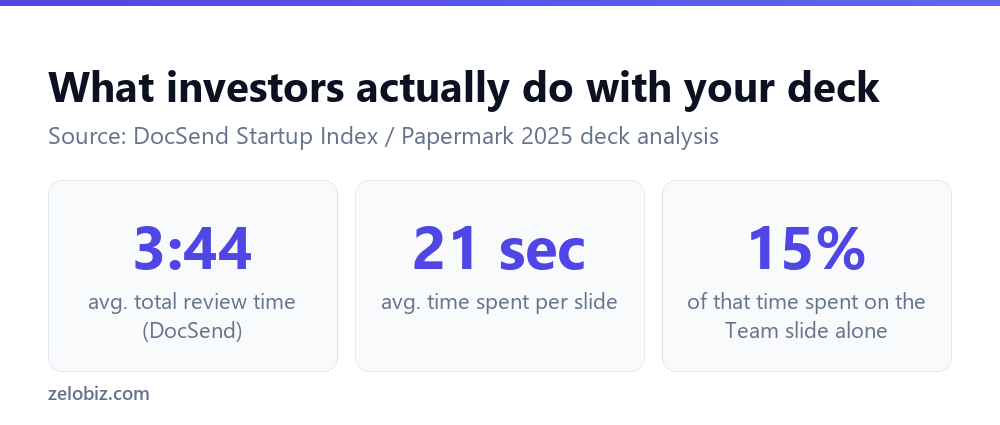
A pitch deck for investors should run 10 to 12 slides, since DocSend’s data shows investors spend just 3 minutes 44 seconds on the average deck, about 21 seconds a slide. The slide most guides skip entirely is Why Now: a specific, evidence-backed answer to “why is this the right moment for this company,” not a generic trends paragraph. Skipping it is the single most common structural gap in founder-built decks.
Search “how to create a pitch deck for investors” and you’ll get a dozen guides that all agree on the same skeleton: title, problem, solution, market, business model, traction, competition, team, financials, the ask, closing. That list is correct. It’s also incomplete in a way that costs founders meetings, because it treats every slide as equally important when investors themselves don’t read the deck that way.

This isn’t a case against the standard structure. It’s a case for one specific addition and one specific reweighting, both backed by how investors actually behave with a deck in front of them rather than how founders assume they behave. The rest of this guide walks through what to add, where to put it, and what a real example looks like next to a weak one.
What every guide already gets right
The standard slide count, roughly 10 to 15 slides, is well supported and worth keeping. DocSend’s research backs up why: the average investor spends under four minutes on a full deck, so a 25-slide deck doesn’t get read more thoroughly, it gets skimmed faster and skipped sooner. One idea per slide, large readable type, and a design that holds up on a phone screen are all sound, repeated advice for the same reason. None of that is the gap. The gap is what happens inside that four-minute window, and which specific slide most founders leave out or bury.
The slide almost every guide leaves out: Why Now
Go back through the standard slide list: problem, solution, market, business model, traction, competition, team, financials, the ask. Nowhere on that list is a slide that directly answers the question every investor is silently asking themselves: if this idea is good, why hasn’t someone already built it, and why is right now the moment it finally works? Founders and investors who write about pitch decks both flag this as the most underused, most persuasive slide in the deck, and it’s missing from most published slide lists entirely, including the version this article used to run.
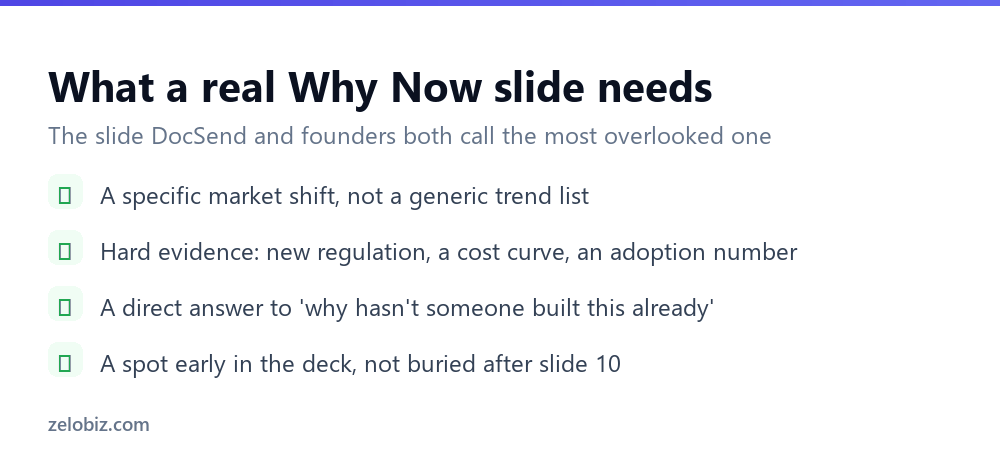
A Why Now slide isn’t a trends recap. “Remote work is growing” or “AI adoption is accelerating” is the generic version every investor has read a hundred times and skims past without registering. A real Why Now slide points to a specific, dateable shift: a regulation that just changed, a cost curve that crossed a threshold, a platform that just opened an API, an incumbent that just got acquired and left a gap. The test is whether the slide would have been false two years ago and will likely be false again in two more years. If it reads true at any point in the last decade, it isn’t a Why Now argument, it’s a market-size slide wearing a different label.
Where it goes in the deck
Placement matters as much as content. A Why Now slide buried after slide 10 has already lost most of its audience, since the bulk of investor attention concentrates on the first few slides. It works best directly after the Problem and Solution slides and before Market Opportunity, so the timing argument frames everything that follows rather than showing up as an afterthought once the investor has already formed an opinion.
A worked example
Take the parking app example this guide has used before: an app that helps drivers find open spots in a congested downtown. A weak Why Now slide says: “Urban populations are growing and parking is a universal pain point.” That’s true, was true ten years ago, and will be true in ten more, so it explains nothing about timing.
A real Why Now slide for the same company says something closer to: “Three cities in our target region passed dynamic parking-pricing ordinances in the past 18 months, which requires the real-time data feeds our app already ingests, and which didn’t exist as a public data source before those ordinances passed. Two legacy parking-app competitors shut down in the same window after failing to integrate the new feeds in time.” That version gives an investor a specific, checkable reason the opportunity exists now and not five years ago, and it implicitly answers the unspoken “why hasn’t Google done this” question by naming exactly what changed.
Why investors care about timing this much
It helps to understand what an investor is actually pricing when they evaluate a startup. They aren’t just betting on whether an idea is good, plenty of good ideas never become venture-scale businesses. They’re betting on whether this specific team, with this specific approach, has a real window to build a defensible position before a well-funded incumbent or a fast-following competitor closes it. A Why Now slide is the founder doing that risk assessment for the investor instead of leaving it as an unanswered question the investor has to work out alone, usually against the founder’s favor, since an unanswered question defaults to skepticism rather than benefit of the doubt.
This is also why a weak Why Now slide can actively hurt a deck rather than simply being neutral filler. An investor who reads “the market is growing” as the entire timing argument reasonably concludes that the founder either hasn’t thought about competitive timing at all, or has thought about it and doesn’t have a real answer. Both conclusions raise the same question a generic slide was supposed to prevent: if this is such a good idea, why hasn’t it already been built by someone with more resources?
The Team slide is also getting shortchanged, just less obviously
Investors spend roughly 15 percent of their total review time on the Team slide, a disproportionately large share given how little space most decks give it. The common mistake isn’t leaving the slide out, every guide includes it, it’s filling it with generic titles and resume bullet points instead of the one thing investors are actually trying to assess on that slide: why this specific group of people is positioned to solve this specific problem better than anyone else who could raise money to try. A former logistics engineer building the parking app example above is a stronger team slide than a founder with a marketing background and no domain connection, even if both have equally impressive resumes on paper.
A useful test for a team slide: could a stranger reading it explain, in one sentence per person, why that specific individual reduces the biggest risk in the business? For the parking app example, that might read “spent six years building traffic-data systems for a city government” rather than “MBA, five years in product management.” Both are legitimate backgrounds, but only one of them tells an investor the founder already understands the regulatory and data landscape they’re proposing to build inside of.
A gap-aware slide order
Before the deck: the paperwork investors will ask about
A polished Why Now slide doesn’t help if an investor’s first follow-up question, “what’s your entity structure,” doesn’t have a clean answer yet. Most seed and pre-seed investors expect a founder to have the basic legal groundwork in place before a first meeting, not necessarily fully built out, but at least started.
None of this replaces the fundamentals. A weak product, a market too small to matter, or a team with no credible path to execution won’t be rescued by a well-placed Why Now slide. What a real Why Now slide does is remove one specific, avoidable source of doubt from an otherwise strong pitch, the kind of doubt that costs a follow-up meeting not because the business is weak, but because the deck never addressed a question the investor was already asking themselves in the room.
Design and delivery still matter, just less than the slide list
- Keep text minimal enough that a slide is scannable in under 30 seconds
- Use one visual anchor per slide (a chart, a screenshot, a single strong image) rather than decorative filler
- Maintain consistent color and font choices across every slide
- Rehearse the verbal pitch separately from the deck; the deck should survive without narration, but the meeting is where the persuading actually happens
Common pitfalls beyond the missing Why Now slide
- Burying the ask until the final slide instead of stating it clearly once the case has been made
- Treating the competition slide as a formality instead of a real, honest comparison
- Writing team bios as resumes instead of domain-fit arguments
- Skipping the Why Now slide, or writing a generic trends paragraph in its place
Frequently asked questions
Do I really need a dedicated Why Now slide?
Not a hard requirement, but founders and investors who write about pitch decks consistently flag it as one of the most persuasive and most skipped slides, and it directly answers a question every investor is silently asking regardless of whether you address it.
How long should a pitch deck actually be?
10 to 12 slides is the range most current guides and DocSend’s own data support, since the average investor spends under four minutes reviewing a deck regardless of its length.
Where should the Why Now slide go?
Right after Problem and Solution, before Market Opportunity, so it frames the rest of the deck instead of arriving as an afterthought near the end.
What makes a Why Now slide weak?
A generic trend statement that would have been equally true five years ago and will likely still be true five years from now. A strong one points to a specific, dateable shift: a regulation, a cost curve, a new data source, a competitor’s exit.
Does the team slide really get that much investor attention?
Yes, DocSend’s data shows roughly 15 percent of total review time goes to the team slide, which is disproportionate to how little space most decks give it.
The core slide list most guides teach isn’t wrong, it’s just incomplete in one specific, fixable way. Add a real Why Now slide near the front of the deck, give the Team slide the weight investors actually give it, and the rest of the standard structure, problem, solution, market, model, traction, competition, financials, and the ask, does the rest of the work it was always meant to do.