

To register a business name, first understand which of three genuinely different registrations applies. Your legal entity name (the LLC or corporation’s official name) is automatically registered within your state when you file formation documents. If operating under a different name than that legal one, a separate DBA (“doing business as,” also called a Fictitious Business Name) filing is needed with your state and/or county. For nationwide legal protection of a name, a trademark filed with the USPTO is a completely separate process from either of these.
Three different registrations, three different jobs
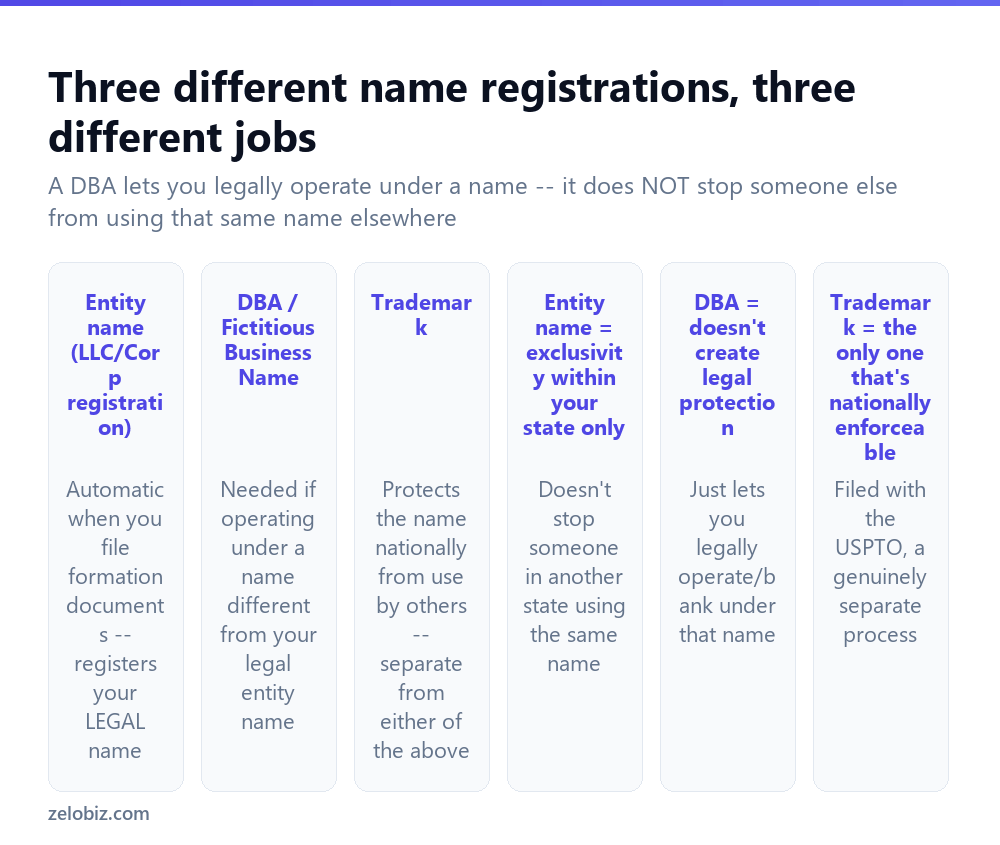
Entity name registration happens automatically as part of forming an LLC or corporation — filing Articles of Organization (or equivalent) registers that business’s official legal name within the formation state. This only provides exclusivity within that specific state; it does nothing to stop a business in a different state from using the identical name.
DBA (“doing business as”), also called a Fictitious Business Name in some states, is required when a business wants to operate under a name different from its official legal entity name — an LLC legally named “Smith Consulting LLC” that wants to operate publicly as “Bright Path Coaching,” for instance. A DBA lets you legally use that name for banking, marketing, and signage, but critically, it creates no legal exclusivity over the name at all — it’s purely a registration allowing you to operate under it, not a protection against someone else also using it.
Trademark registration, filed with the federal USPTO (United States Patent and Trademark Office), is the only one of these three that provides genuine, nationally enforceable legal protection against others using the same or a confusingly similar name in the same line of business. It’s a completely separate process from either entity formation or a DBA filing, with its own application, fees, and timeline.
A very common misunderstanding: forming an LLC does not provide nationwide protection over the business name, and a DBA provides essentially no legal protection at all. If genuine, enforceable protection of a name matters — particularly before investing heavily in branding and marketing around it — trademark registration is the only one of the three that actually accomplishes that.
Registering a DBA
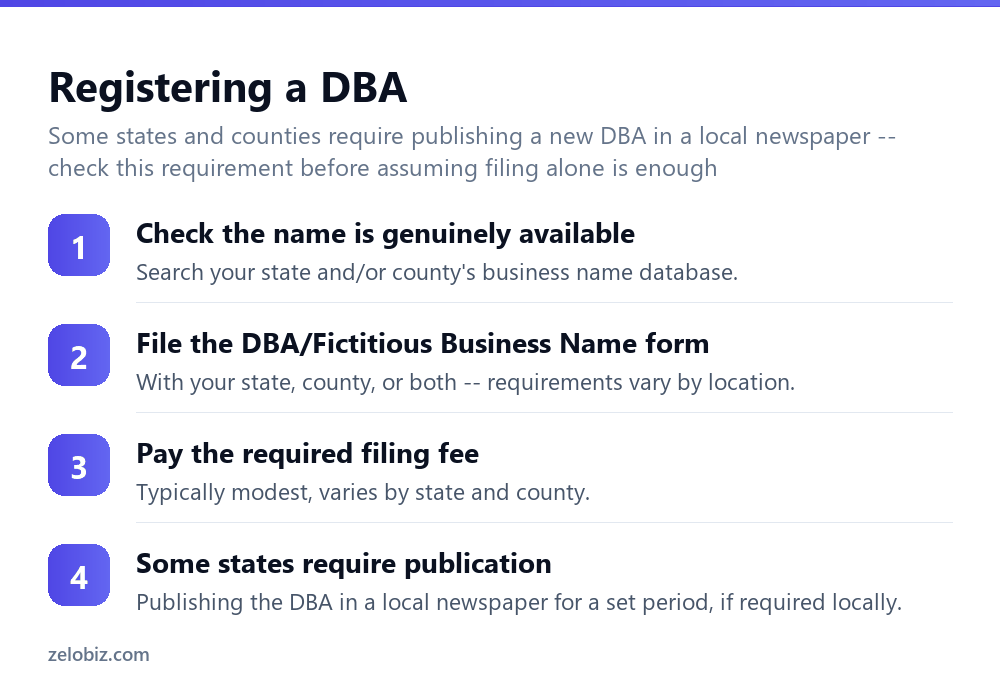
Check genuine availability first — search your state’s (and often county’s) business name database to confirm the intended DBA isn’t already registered by someone else in that same jurisdiction.
File the DBA form with the appropriate government office — this varies meaningfully by location, with some states handling it at the state level, others at the county level, and some requiring both.
Pay the filing fee, typically modest and varying by state and county.
Check for a publication requirement — some states and counties require publishing notice of the new DBA in a local newspaper for a specified period before the registration is considered complete, an easy-to-miss step if you’re not specifically told to check for it.
When trademark protection is worth pursuing
For a business making a significant, ongoing investment in a specific brand name — real marketing spend, a name central to the business’s identity and customer recognition — pursuing a federal trademark is genuinely worth the additional time and cost, since it’s the only one of the three registrations discussed here that stops someone else from using the same or a confusingly similar name in the same line of business, nationwide, with real legal enforcement behind it.
For a smaller, purely local business with no particular plans to expand or invest heavily in brand recognition beyond its immediate area, entity registration plus a DBA if needed is often genuinely sufficient, and pursuing a full trademark may not be worth the additional cost and complexity relative to the actual risk involved.
A worked example: a sole proprietor choosing between the three
Say someone is starting a freelance photography business as a sole proprietor — no LLC, no formal entity at all — and wants to operate under the name “Golden Hour Photography” rather than their own personal legal name.
Since there’s no LLC or corporation being formed, there’s no automatic entity name registration happening at all — a sole proprietor operating under their own personal legal name generally needs no registration whatsoever for that name. But since they want to operate under “Golden Hour Photography” instead of their own name, a DBA filing is specifically what’s needed here — not entity formation, and not necessarily a trademark yet.
They check their state and county’s business name database, confirm “Golden Hour Photography” isn’t already registered locally, file the DBA paperwork with the required fee, and check whether their specific county requires newspaper publication — which, in this example, it does, adding a few weeks before the registration is fully complete.
At this stage, they hold no legal exclusivity over the name “Golden Hour Photography” — another photographer in a different state, or even a different business entirely, could use the identical name with no legal conflict. If the business later grows significantly and the name becomes a genuinely valuable, recognized brand, pursuing a federal trademark at that point would be the next step for actual legal protection, rather than something needed immediately at this early stage.
Checking name availability before committing
Before settling on any name — whether for entity formation, a DBA, or eventual trademark — it’s worth checking availability across all three relevant layers, not just one: the state’s business entity database (for LLC/corporation names), the state and county’s DBA database (for fictitious business names), and a basic search of the USPTO’s trademark database, even if trademark registration itself isn’t planned immediately. Finding a name genuinely available at the state entity level but already trademarked nationally by an unrelated business in a similar industry is exactly the kind of conflict worth discovering before investing in signage, a website, and marketing built around it, rather than after.
A basic web search and social media handle check is also worth doing alongside the formal database searches — a name that’s technically available to register but already in heavy use online by a similar business, even without formal trademark protection, can create real confusion and competitive difficulty that a database search alone won’t catch.
Common points of confusion
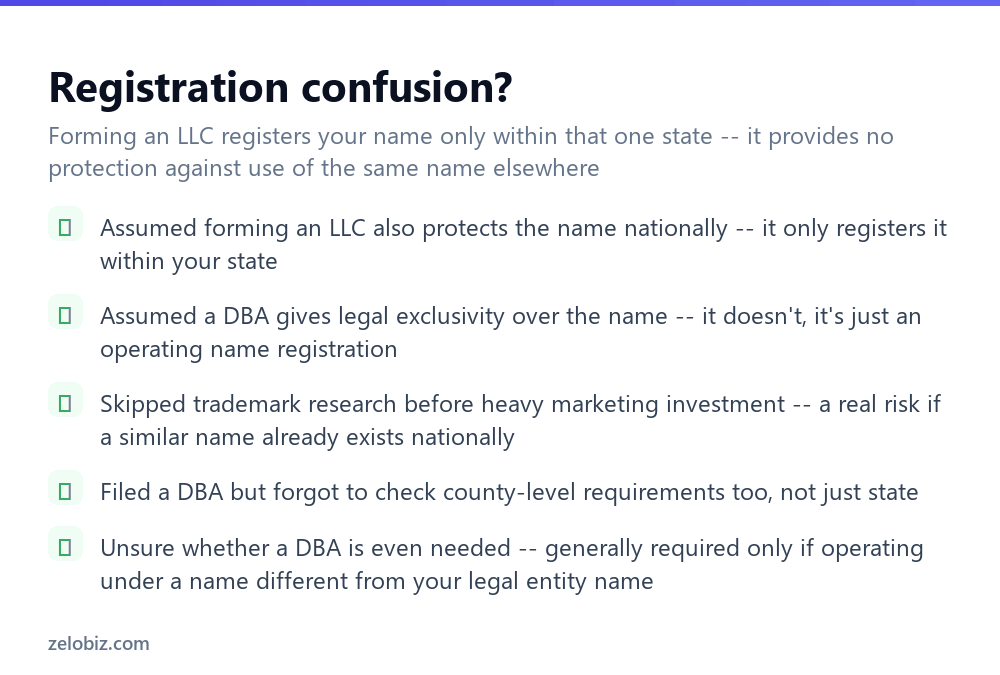
Assumed LLC formation protects the name everywhere — it only registers the name within the specific formation state, with no effect elsewhere.
Assumed a DBA provides legal exclusivity — it doesn’t; it’s purely an operating-name registration, not a protection against others using the same name.
Skipped trademark research before heavy marketing investment — a genuine risk if a similar name already exists nationally in the same industry, potentially requiring a costly rebrand later if a conflict surfaces after significant investment has already gone into the name.
Filed a DBA at only one level when both state and county filing were actually required — check both specifically for your location rather than assuming one filing covers everything.
Unsure whether a DBA is needed at all — generally required only when operating under a name different from the business’s official legal entity name; not needed if the business simply operates under its exact legal name.
Assumed one registration automatically covers the others — filing a DBA doesn’t create trademark protection, and forming an LLC doesn’t eliminate the need for a DBA if the business operates under a different public-facing name than its legal one. Each of the three genuinely stands alone, and covering one doesn’t substitute for another when the situation actually calls for it.
- ✓Understand which of the three registrations actually applies to your situation
- ✓Check both state and county DBA requirements for your specific location
- ✓Check for a newspaper publication requirement before considering DBA filing complete
- ✓Research trademark availability before heavy investment in a specific brand name
- ✓Recognize that entity registration and DBA filing provide no nationwide protection
- ✕Assuming LLC formation protects a business name nationwide
- ✕Assuming a DBA filing creates legal exclusivity over a name
- ✕Filing only at the state level when county-level DBA filing is also required
- ✕Investing heavily in a brand name before checking for trademark conflicts
- ✕Filing a DBA for a business simply operating under its own exact legal name
Frequently asked questions
How do I register a business name?
It depends on the type: entity name registration happens automatically when forming an LLC or corporation, a DBA requires a separate state/county filing, and trademark protection requires a separate USPTO application.
Does forming an LLC protect my business name everywhere?
No. It only registers the name within your specific formation state, with no effect on use of the same name in other states.
Does a DBA give me legal ownership of a business name?
No. A DBA lets you legally operate under that name but creates no legal exclusivity or protection against others using it.
When do I need a DBA?
When your business operates under a name different from its official legal entity name — not needed if operating under the exact legal name itself.
How do I get real legal protection over my business name?
Through federal trademark registration with the USPTO, the only one of the three registrations that’s nationally enforceable.
Do I need both state and county DBA filings?
It depends on your specific location — some require only state filing, others only county, and some require both. Check your specific state and county requirements.
- →Start with entity formation: how to start an LLC
- →Get an EIN for your registered business: how to get an EIN number
- →Open a bank account under the registered name: how to open a business bank account
- →Formalize agreements once branded: how to write a contract