

To start an LLC, choose and verify an available business name through your state’s Secretary of State website, decide which state to form in (usually your home state, for most small businesses), file Articles of Organization with the required state filing fee, get a free EIN directly from the IRS, write an Operating Agreement even if your state doesn’t legally require one, and open a dedicated business bank account to keep personal and business finances genuinely separate.
The core steps, in order
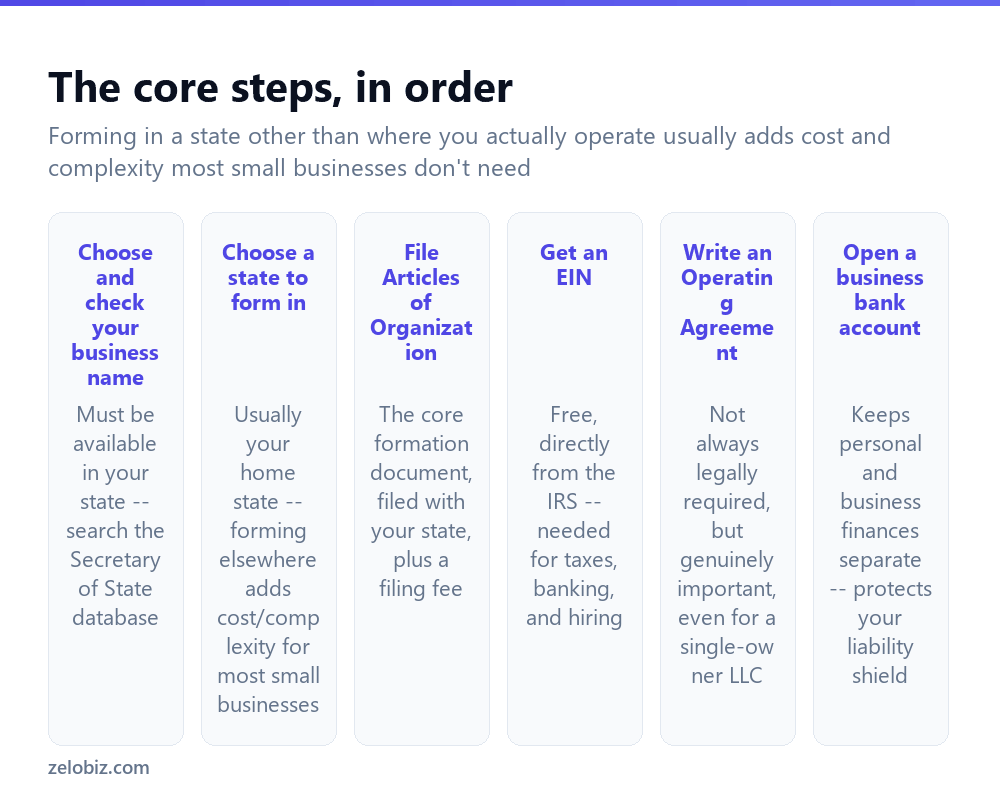
Choose and check your business name — it needs to be genuinely available in your specific state, not already registered to another business there. Nearly every state’s Secretary of State website offers a free business name search tool for exactly this check.
Choose which state to form in — for the substantial majority of small businesses, this should be the state you actually live and operate in. Forming in a different state (Delaware and Nevada are commonly discussed for this) is sometimes genuinely advantageous for larger companies with specific legal or investment considerations, but for most small, local businesses it adds real cost and complexity — typically requiring registration as a “foreign LLC” in your actual home state anyway, on top of the original state’s own fees.
File Articles of Organization — the core legal document that actually creates the LLC, submitted to your chosen state along with its filing fee, which varies meaningfully by state (from roughly $50 to a few hundred dollars).
Get an EIN (Employer Identification Number) — free, directly from the IRS website, needed for opening a business bank account, filing taxes, and hiring employees if that becomes relevant later.
Write an Operating Agreement — not legally required in every state, but genuinely important regardless, covered in more detail below.
Open a business bank account — keeping business and personal finances genuinely separate is what actually protects the liability shield an LLC is meant to provide.
Forming an LLC in a state other than where the business actually operates is one of the most common, avoidable early mistakes — it usually means paying formation and ongoing fees in two states instead of one, for a benefit that mostly applies to larger companies, not a typical small local business.
Filing Articles of Organization
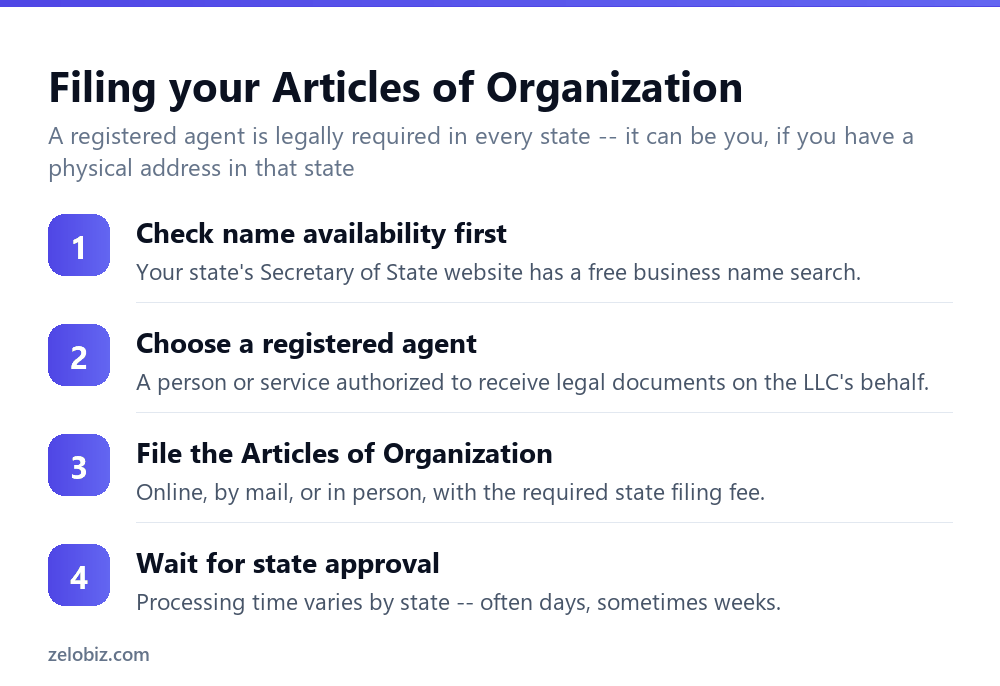
Check name availability first through your state’s Secretary of State business search, before investing time in branding, a website, or anything else tied to a specific name that might turn out to already be taken.
Choose a registered agent — a person or service with a physical address in the formation state, legally authorized to receive official and legal documents on the LLC’s behalf. This can be you personally, if you have a genuine physical address (not a P.O. box) in that state, or a paid registered agent service, commonly used by anyone who values privacy (a registered agent’s address becomes public record) or doesn’t have a qualifying address themselves.
File the Articles of Organization itself — most states offer online filing, generally the fastest option, alongside mail or in-person filing alternatives, each with the same required state filing fee.
Wait for state approval — processing time genuinely varies significantly by state, from a few days in some states to several weeks in others during busier periods.
Why the Operating Agreement matters, even for one owner
Many states don’t legally require an LLC to have a written Operating Agreement, and it’s tempting to skip it entirely for a simple, single-owner business. This is genuinely worth doing anyway. An Operating Agreement documents how the business is actually structured and run — ownership percentages, how decisions get made, what happens if the business is sold or the owner wants to exit — and having this in writing provides real legal weight to the LLC’s separateness from its owner personally, which matters directly for the liability protection an LLC is meant to provide in the first place. Without one, a court examining whether the LLC is genuinely being run as a separate entity has less documented evidence to support that separation.
Getting an EIN
The EIN application is free directly through the IRS website — worth stating plainly, since some third-party services charge a fee to “help” obtain one, providing no genuine advantage over applying directly for free. The online application typically completes in one sitting and issues the number immediately upon successful submission.
A worked example: forming a single-owner consulting LLC
Say a freelance consultant, operating solo out of their home state, decides to form an LLC mainly for liability protection and a more professional business presence with clients.
They check name availability through their state’s Secretary of State site, find their preferred name is free, and file Articles of Organization online, listing themselves as their own registered agent since they have a genuine home address in that state and value not paying for a registered agent service for a straightforward, low-risk single-owner business.
Once approved, they apply for a free EIN directly through the IRS the same afternoon, then write a short Operating Agreement — even though their state doesn’t require one for a single-member LLC — documenting that they’re the sole owner, how profits are handled, and what happens to the business if they become unable to run it. This takes an afternoon, not weeks, and provides real documented separation between them personally and the business entity.
Finally, they open a dedicated business checking account using the new EIN, and commit to running every client payment and business expense through that account specifically rather than their personal one — the habit that actually protects the liability shield day to day, long after the initial paperwork is done and largely forgotten about.
Ongoing requirements after formation
Forming the LLC is a one-time event, but most states impose ongoing requirements afterward — commonly an annual or biennial report, sometimes paired with a franchise tax or similar recurring fee, independent of whatever the business actually earns that year. Missing these isn’t merely a paperwork inconvenience; many states will administratively dissolve an LLC that falls sufficiently behind on required filings, effectively ending its legal existence without the owner necessarily realizing it happened until they discover the LLC no longer exists when they next need to prove its status. Setting a recurring calendar reminder for the specific state’s filing deadline is a simple, worthwhile habit from day one.
Common mistakes to avoid
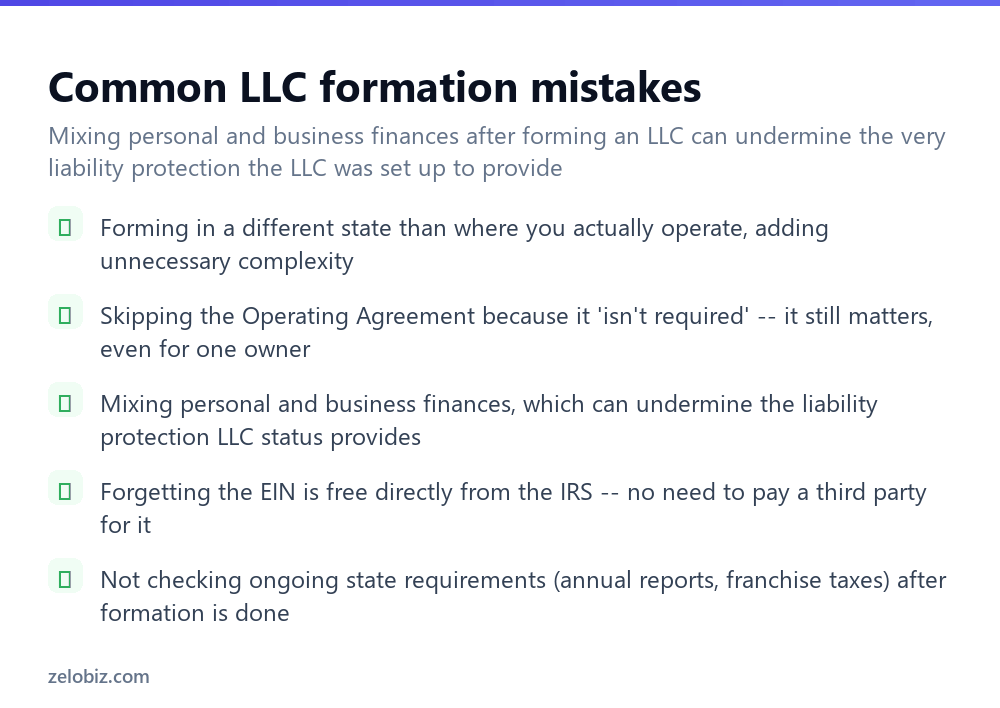
Forming in the wrong state — as covered above, this usually adds unnecessary cost and complexity for a typical small, local business.
Skipping the Operating Agreement because it isn’t legally mandatory — it still matters for genuinely establishing the LLC’s separateness, even for a single owner.
Mixing personal and business finances — paying business expenses from a personal account, or vice versa, can genuinely undermine the liability protection an LLC exists to provide, since it blurs the legal separation between the business and its owner that the protection depends on.
Paying a third party for a free EIN — unnecessary; apply directly through the IRS at no cost.
Forgetting ongoing state requirements after formation — many states require an annual report, and some impose an ongoing franchise tax or similar fee, independent of the one-time formation cost; missing these can result in the LLC being administratively dissolved by the state.
- ✓Check business name availability before investing in branding around it
- ✓Form in your actual home state for most typical small businesses
- ✓Write an Operating Agreement even if your state doesn’t legally require one
- ✓Get your EIN directly and free from the IRS, not through a paid third party
- ✓Keep a dedicated business bank account genuinely separate from personal finances
- ✕Forming in a different state without a genuine reason specific to your business
- ✕Skipping the Operating Agreement just because it isn’t legally mandatory
- ✕Paying a third-party service for something the IRS provides free directly
- ✕Mixing personal and business expenses, which can undermine liability protection
- ✕Forgetting ongoing annual report or franchise tax requirements after formation
Frequently asked questions
How do I start an LLC?
Check business name availability, choose a state (usually your home state), file Articles of Organization with the required fee, get a free EIN from the IRS, write an Operating Agreement, and open a business bank account.
How much does it cost to start an LLC?
The state filing fee for Articles of Organization varies widely, roughly $50 to a few hundred dollars depending on the state, plus any ongoing annual report or franchise tax fees.
Should I form my LLC in a different state like Delaware?
For most small, local businesses, no — it usually adds cost and complexity, since you’d typically still need to register as a foreign LLC in your actual home state.
Do I need an Operating Agreement if I’m the only owner?
It’s often not legally required, but it’s still genuinely important for documenting the LLC’s separateness, which matters for liability protection.
Is getting an EIN free?
Yes, directly through the IRS website. There’s no need to pay a third-party service for something the IRS provides at no cost.
What happens if I mix personal and business finances after forming an LLC?
It can undermine the liability protection the LLC is meant to provide, since it blurs the legal separation between the business and its owner.
- →Get your EIN in detail: how to get an EIN number
- →Plan the business itself: how to write a business plan
- →Set up finances once formed: how to open a business bank account
- →Formalize your first client agreements: how to write a contract