

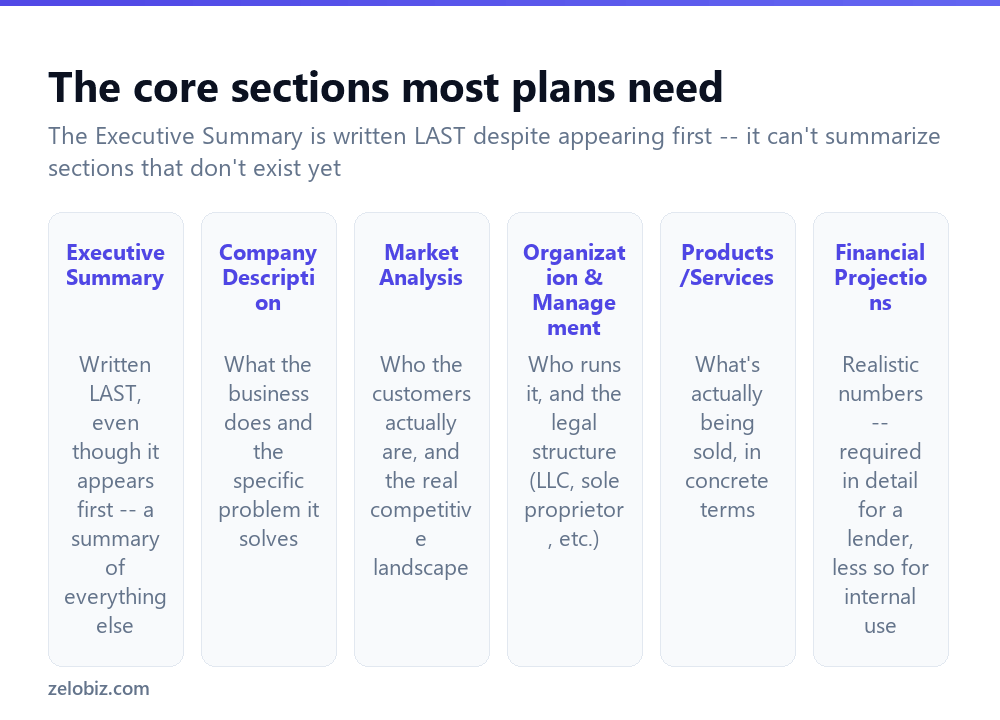
To write a business plan, first identify who it’s actually for — a formal plan for a lender or investor needs far more financial detail and polish than an internal planning document written just for yourself. Most plans cover a Company Description, Market Analysis, Organization and Management, Products or Services, and Financial Projections, with an Executive Summary written last, even though it appears first in the finished document — it summarizes everything else, which has to exist first.
Who it’s for decides how long and formal it needs to be
A business plan meant to secure a bank loan or outside investment needs to be genuinely thorough and professionally presented — detailed financial projections, real market research, and a level of polish appropriate for someone deciding whether to give you money based substantially on this document.
A business plan meant purely for your own internal clarity — working through the business’s logic before committing significant time or money to it — can be considerably shorter and less formal, since its real job is helping you think clearly, not persuading an external reader.
Deciding this upfront changes how much time and effort each section deserves. A lender-facing plan might run 15-20 pages with substantial financial detail; an internal planning document might be a few focused pages covering the same core questions more briefly.
The Executive Summary is written last despite sitting first in the finished document, for a genuinely practical reason: it summarizes the Company Description, Market Analysis, and Financial Projections, none of which exist yet if it’s written first — trying to write it first usually means writing vague generalities that need rewriting anyway once the rest of the plan is actually done.
Writing the plan in a practical order
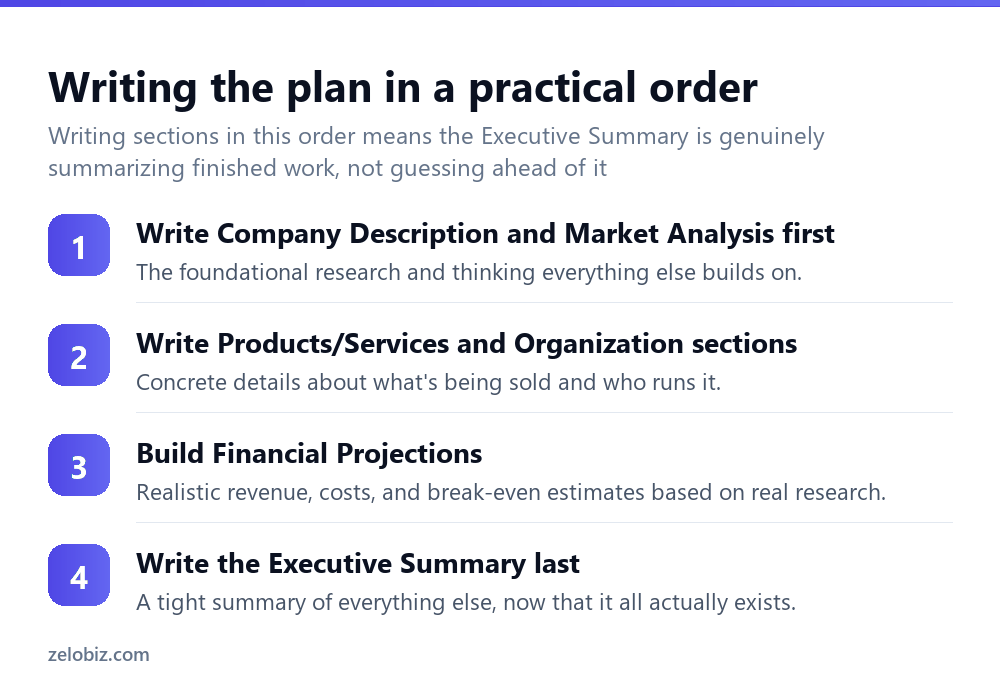
Company Description and Market Analysis first — this is the foundational thinking and research everything else builds on: what the business actually does, what specific problem it solves, who the real target customers are, and what the genuine competitive landscape looks like.
Products/Services and Organization/Management next — concrete detail about exactly what’s being sold, and who’s actually running the business, including its legal structure (sole proprietorship, LLC, and so on).
Financial Projections — realistic revenue estimates, cost structure, and a break-even estimate, built from genuine research and reasonable assumptions rather than optimistic guessing (covered in more detail below).
Executive Summary last — now that every other section genuinely exists, write a tight summary distilling the most important points from each into a concise opening that a reader (especially a busy lender skimming many plans) can absorb quickly before deciding whether to read further.
Market analysis: being specific, not vague
“Everyone” or “anyone who needs [product category]” is not a genuine target customer description — it signals that real market research hasn’t actually happened yet. A useful market analysis identifies specific customer characteristics (age range, location, income level, specific need or pain point) and, just as importantly, honestly assesses real competitors rather than claiming none exist.
“We have no competitors” is almost always a sign of insufficient research rather than a genuine market gap — even a novel business idea usually competes with some existing alternative, even an indirect one (a new meal-kit service competes with grocery stores and restaurants, not just other meal-kit companies). Identifying real competitors, even imperfect or indirect ones, demonstrates genuine market understanding far more convincingly than claiming a competitive vacuum that a reader is unlikely to actually believe.
Financial projections: realistic, not optimistic
Financial projections built on genuinely researched assumptions — actual pricing of similar products, realistic customer acquisition estimates, real cost figures rather than round guessed numbers — carry far more credibility than optimistic projections with no visible research behind them, particularly to a lender or investor who has seen many business plans and can generally recognize unsupported optimism quickly.
It’s worth including the reasoning behind key numbers directly in the plan, not just the final figures themselves — showing how a revenue estimate was actually calculated builds more confidence than a number presented with no visible support behind it.
A worked example: a plan for a small local bakery seeking a loan
Say someone is opening a neighborhood bakery and needs a business plan specifically to support a small business loan application, not just for their own planning.
They start with Company Description and Market Analysis, researching the actual neighborhood’s demographics, existing nearby bakeries and cafes (genuine competitors, not “none”), and specifically what gap those competitors leave — perhaps no one nearby offers gluten-free options, or the nearest bakery closes before evening commuters get home. This concrete, researched detail does more to convince a loan officer than a generic description of “a neighborhood bakery.”
For Financial Projections, rather than guessing at revenue, they research actual average transaction sizes at comparable bakeries, realistic foot traffic estimates for the specific location, and real lease and equipment costs already quoted for that location — building a projection a lender can trace back to real numbers rather than optimism.
Only once all of this exists do they write the Executive Summary, pulling the single strongest point from each section — the specific market gap, the realistic financial picture, the concrete plan — into a tight opening a busy loan officer can absorb in under a minute before deciding whether the rest of the document is worth reading in full.
How long a business plan should actually be
There’s no single correct page count, since it depends entirely on the plan’s purpose. A lender-facing plan commonly runs somewhere in the range of 15-25 pages once financial detail and supporting research are included. A purely internal planning document can be considerably shorter — sometimes just a few pages — since its job is clarifying your own thinking, not persuading an external reader who’s never met you and needs enough detail to evaluate real risk before committing money.
A quick reference
Writing for a lender: budget real time for financial research, and expect the document to genuinely run 15-25 pages once fully detailed. Writing purely for yourself: keep it short and focused on the questions that actually clarify your own thinking, rather than padding it to match a lender’s expected length and formality.
Updating the plan after it’s written
A business plan isn’t a document to finish once and file away permanently — if it’s actually being used to guide real decisions, it’s worth revisiting every few months against what’s genuinely happening in the business. Revenue coming in slower than the original projection, a competitor doing something unexpected, or a cost turning out higher than researched are all reasons to update the relevant section rather than quietly ignoring the gap between the plan and reality.
For a lender-facing plan already submitted as part of a loan application, this matters less after the fact, but for an internal plan genuinely guiding ongoing decisions, treating it as a living document rather than a one-time exercise is what actually makes the original effort worthwhile months later.
Common mistakes to avoid
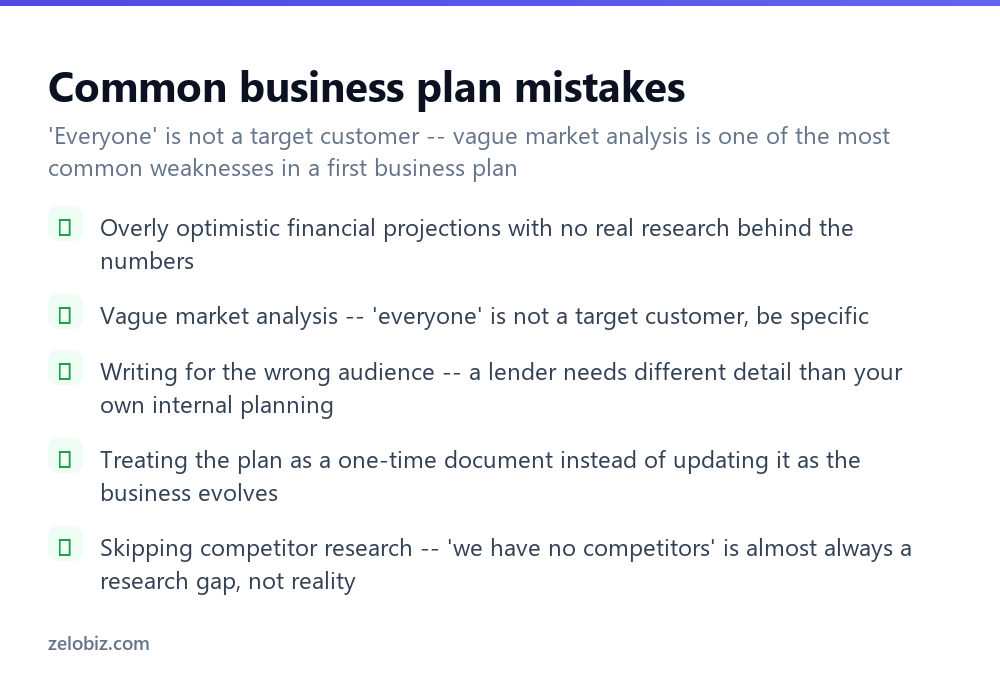
Overly optimistic financial projections with no real research behind the numbers — a credibility problem more than an honesty problem, since it signals insufficient homework to an experienced reader.
Vague market analysis — “everyone” is not a specific target customer; genuine specificity demonstrates real research.
Writing for the wrong audience — matching the plan’s length and formality to its actual intended reader, lender versus purely internal use, changes what level of detail and polish is actually appropriate.
Treating the plan as a one-time document — a business plan genuinely used for ongoing decision-making should be revisited and updated as real circumstances and results diverge from the original assumptions, not written once and never looked at again.
Skipping competitor research entirely — claiming no competitors exist is almost always a research gap rather than an accurate reflection of the actual market.
- ✓Identify who the plan is actually for before deciding its length and formality
- ✓Write the Executive Summary last, once every other section actually exists
- ✓Get specific about target customers rather than describing them as ‘everyone’
- ✓Show the reasoning behind financial figures, not just the final numbers
- ✓Research real competitors, even indirect ones, rather than claiming none exist
- ✕Writing an overly long, formal plan for purely internal use, or vice versa
- ✕Writing the Executive Summary first, before the sections it’s meant to summarize exist
- ✕Describing target customers vaguely instead of with specific, researched detail
- ✕Presenting financial projections with no visible research or reasoning behind them
- ✕Claiming a business has no competitors instead of researching the real competitive landscape
Frequently asked questions
How do I write a business plan?
Identify who it’s for, then write Company Description, Market Analysis, Organization/Management, Products/Services, and Financial Projections, finishing with an Executive Summary that ties everything together.
Why is the Executive Summary written last?
It summarizes every other section of the plan, which need to actually exist first — writing it first usually means writing vague generalities that need rewriting anyway.
Does a business plan need to be different for a lender versus personal use?
Yes. A lender-facing plan typically needs far more financial detail and polish than an internal document written purely to clarify your own thinking.
What’s wrong with saying a business has no competitors?
It’s almost always a sign of insufficient research rather than reality — even novel ideas usually compete with some existing alternative, even an indirect one.
How detailed should financial projections be in a business plan?
Detailed enough to show real research behind the numbers, with the reasoning included, not just optimistic final figures with no visible support.
Should a business plan be updated after it’s written?
Yes, especially if it’s used for ongoing decision-making — revisiting it as real results diverge from original assumptions keeps it genuinely useful.
- →Formalize the business structure first: how to start an LLC
- →Turn projections into real invoicing: how to create an invoice
- →Pitch the plan to a potential client: how to write a proposal
- →Set up business finances once the plan is set: how to open a business bank account