

To write a proposal that actually gets read and accepted, lead with the client’s specific problem, restated in your own words, rather than your own company background or credentials. Follow with a proposed solution tailored specifically to that problem, a clear scope of work (including what’s explicitly not included), a realistic timeline, clear pricing, and an obvious next step telling the client exactly what to do to move forward.
The structure that actually gets read
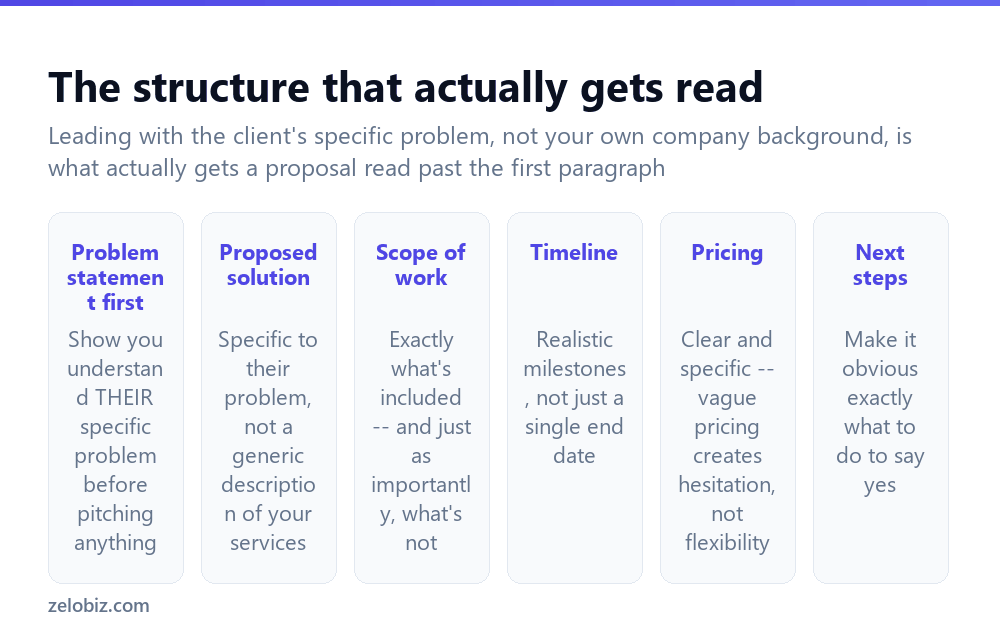
Problem statement first — restating the client’s specific situation and challenge in your own words, before proposing anything, proves you genuinely understood what they described rather than sending a generic pitch that could apply to anyone. This is the single most important structural choice in a proposal that actually gets read past the first paragraph.
Proposed solution — specific to their stated problem, not a generic overview of everything your business happens to offer. A proposal that reads like it was written specifically for this client, addressing their exact situation, is far more persuasive than one that reads like a template with their name inserted.
Scope of work — exactly what’s included, and just as importantly, what’s explicitly not included. Ambiguity here is a common source of later disputes and scope creep once work actually begins.
Timeline — realistic milestones along the way, not just a single end date, giving the client visibility into progress rather than a long silent stretch followed by a single delivery.
Pricing — clear and specific.
Next steps — an explicit, obvious action the client should take to actually say yes and move forward.
Leading with the client’s problem rather than your own company background is the single change most likely to improve how a proposal is received — it signals genuine attention to their specific situation rather than a mass-produced pitch, from the very first sentence.
Writing a proposal that gets accepted
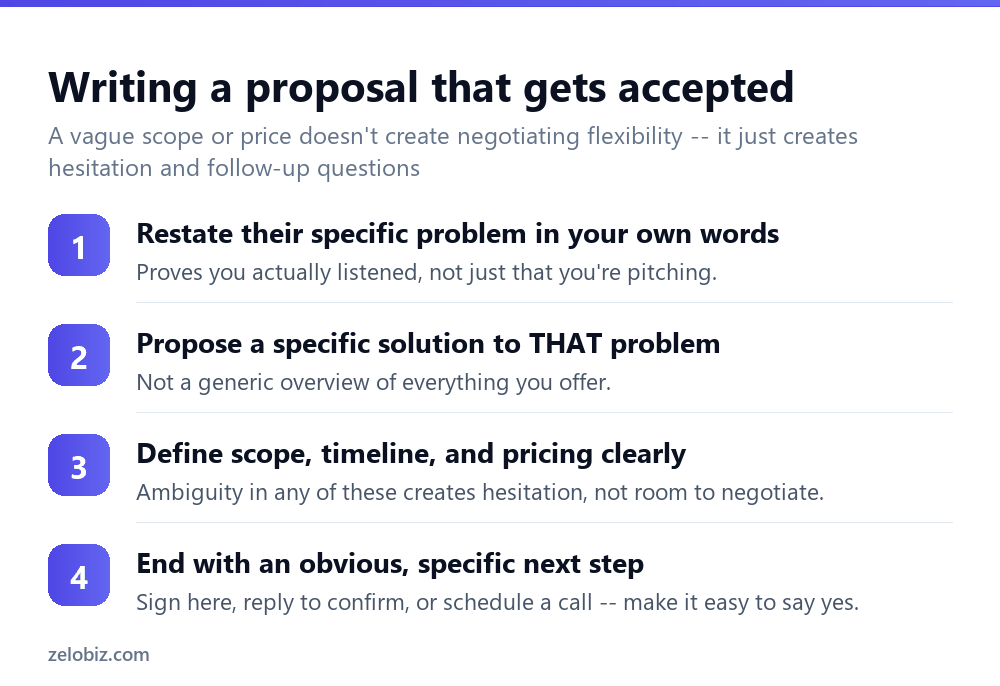
Restate their specific problem in your own words at the very start — this single paragraph does more to establish credibility and attention than any amount of company history or credential-listing could.
Propose a specific solution to that exact problem, referencing details from their actual situation rather than describing your services in the abstract.
Define scope, timeline, and pricing with genuine clarity — vagueness in any of these doesn’t create helpful flexibility for negotiation later; it creates hesitation and a round of clarifying questions before the client can even seriously consider saying yes.
End with one obvious, specific next step — “reply to this email to confirm” or “sign and return the attached agreement” or “let’s schedule a 15-minute call to finalize details,” rather than leaving the client to figure out on their own what accepting actually requires them to do.
Why vague pricing hurts more than it helps
A common instinct is to keep pricing vague or present a wide range, assuming this preserves negotiating flexibility. In practice, vague pricing more often creates genuine hesitation and an extra round of back-and-forth before a client can even meaningfully evaluate the proposal, rather than the flexibility it’s meant to provide.
If a range genuinely is necessary — because scope could reasonably vary depending on decisions the client hasn’t made yet — explain specifically what drives the range, rather than presenting an unexplained number spread that leaves the client guessing at what would put them at the lower versus higher end.
Personalizing without starting from scratch each time
A reusable proposal template, genuinely personalized for each specific client rather than sent as unedited boilerplate, is a practical middle ground — it saves real time compared to writing every proposal completely from scratch, while still requiring the problem statement, and any client-specific details throughout, to be genuinely tailored rather than generic. Reused boilerplate that skips this personalization is usually obvious to the reader, and undermines the exact impression a strong proposal is meant to create.
A worked example: proposing a website redesign
Say a potential client mentioned during a call that their current website loads slowly, looks outdated on mobile, and hasn’t generated a lead in months, and asked for a proposal.
The proposal opens by restating exactly that: “Your site currently takes over 6 seconds to load on mobile, and the layout doesn’t adapt well to smaller screens — likely why it hasn’t generated inbound leads recently despite steady traffic.” This single opening line proves the sender actually listened during the call, rather than sending a generic “we build great websites” pitch that could have gone to anyone.
The proposed solution addresses that specific problem directly — a mobile-first redesign with a stated target load time, not a vague promise of “a beautiful new website.” Scope explicitly lists what’s included (redesign of five core pages, mobile optimization, basic SEO cleanup) and what’s not (no ongoing content writing, no logo redesign), heading off a likely point of confusion before it becomes one.
Pricing is presented as one clear total for the defined scope, not a range, since the scope itself is already specific enough that a single number is genuinely achievable. The proposal ends with: “Reply to this email to confirm, and I’ll send a contract and 50% deposit invoice within 24 hours to get started” — a next step so specific the client knows precisely what happens the moment they say yes.
Following up on a proposal that hasn’t gotten a response
A proposal sitting unanswered for a week or two doesn’t necessarily mean rejection — it often just means it got buried, or the client’s own internal decision process is simply slower than expected. A brief, low-pressure follow-up (“Just checking this reached you okay — happy to answer any questions before you decide”) genuinely outperforms either aggressive repeated follow-up or silent waiting, since it stays helpful and low-friction rather than pushy, while still keeping the opportunity visibly active rather than letting it quietly disappear from the client’s attention entirely.
Proposals for internal stakeholders vs external clients
A proposal pitched to an external client and one pitched internally — to a manager, a budget committee, or another department — share the same core structure, but the framing of the “problem” section shifts. An external client already knows their own problem and is judging whether you understood it; an internal audience often needs the problem itself established and quantified first, since the person approving budget may not be the one who feels the day-to-day pain the proposal addresses.
Pricing also reads differently internally — rather than a price the reader is deciding whether to pay, it’s a budget request competing against other internal priorities, so framing it in terms of cost saved, time saved, or revenue enabled tends to land better than price alone presented without that context.
When a proposal isn’t converting
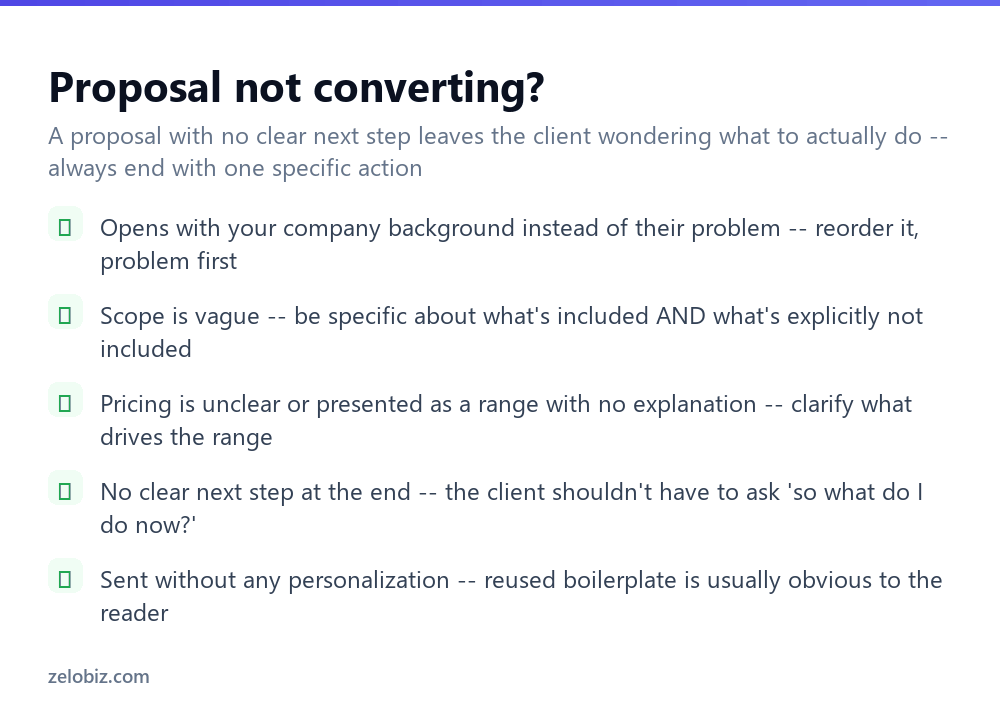
Opens with company background instead of the client’s problem — reorder it; lead with their situation, not yours.
Scope is vague — be specific about what’s included, and explicitly state what’s not, to avoid both hesitation now and disputes later.
Pricing is unclear or an unexplained range — clarify what specifically drives any range presented, rather than leaving it unexplained.
No clear next step at the end — the client shouldn’t have to ask “so what do I actually do now?”; state it explicitly.
Sent without genuine personalization — reused, unedited boilerplate is usually apparent to the reader and undermines the impression of genuine attention a strong proposal is meant to create.
- ✓Lead with the client’s specific problem, restated in your own words
- ✓Tailor the proposed solution to their actual situation, not a generic service overview
- ✓State scope, timeline, and pricing with genuine clarity, not vague flexibility
- ✓End with one obvious, specific next step for the client to take
- ✓Explain what drives a price range if one is genuinely necessary
- ✕Opening with company history or credentials before addressing the client’s problem
- ✕Sending a generic pitch that could apply to any client with minimal editing
- ✕Leaving scope vague, assuming it preserves helpful flexibility
- ✕Ending without a clear, specific action telling the client what to do next
- ✕Presenting an unexplained price range and leaving the client to guess what drives it
Frequently asked questions
How do I write a proposal that actually gets read?
Lead with the client’s specific problem, restated in your own words, before proposing anything — this is what proves genuine attention rather than a generic pitch.
What should a proposal include?
A problem statement, a tailored proposed solution, a clear scope of work, a realistic timeline, clear pricing, and an obvious next step.
Should I include a price range in a proposal?
Only if genuinely necessary, and if so, explain specifically what drives the range — an unexplained range creates hesitation rather than flexibility.
Why isn’t my proposal converting into signed clients?
Common causes: leading with company background instead of the client’s problem, vague scope or pricing, or no clear next step at the end.
Can I reuse a proposal template for different clients?
Yes, as long as it’s genuinely personalized each time — the problem statement and client-specific details need to be tailored, not left as generic boilerplate.
What’s the most important part of a proposal?
The opening problem statement — restating the client’s specific situation is what determines whether the rest of the proposal gets read at all.
- →Turn an accepted proposal into a formal agreement: how to write a contract
- →Bill for the accepted work: how to create an invoice
- →Plan the business behind your proposals: how to write a business plan
- →Set up the business itself first: how to start an LLC