

To create an invoice, include an invoice number, your business’s and the client’s contact information, both the issue date and due date, an itemized description of what’s being billed, explicit payment terms (how and when payment is expected), and a clearly displayed total amount due. Use a Word or Google Docs template, dedicated invoicing software, or accounting software to build it — the specific tool matters less than including these core elements clearly.
What every invoice needs, at minimum
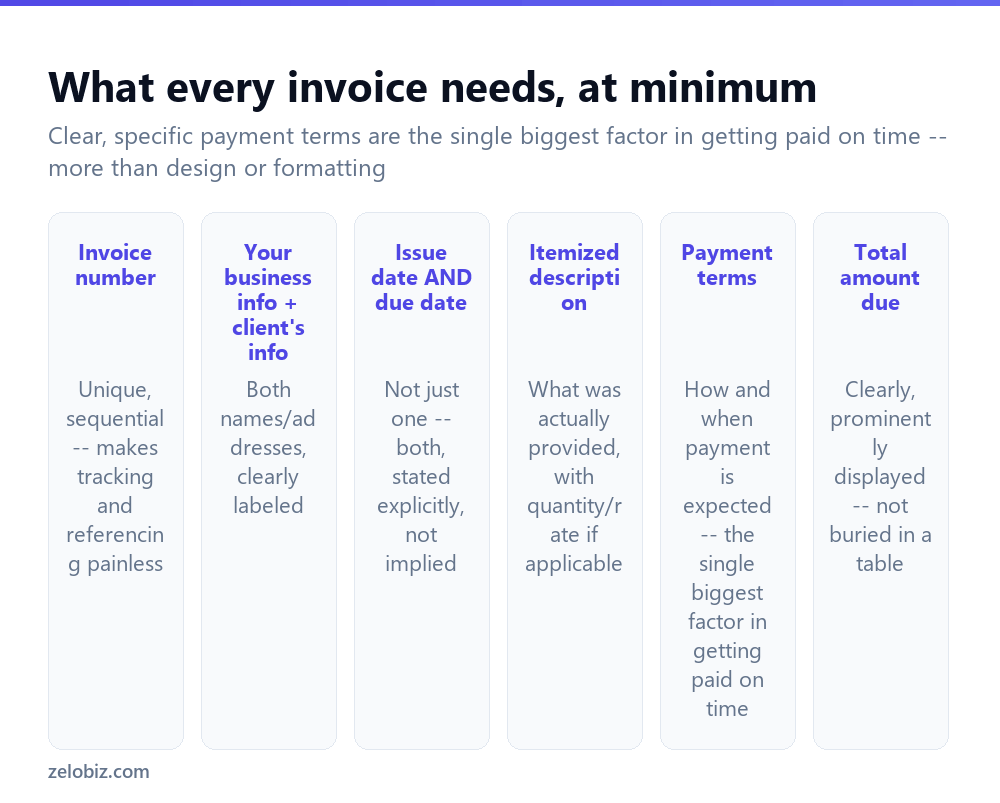
Invoice number — unique and ideally sequential (Invoice #1024, #1025, and so on), making tracking, referencing, and record-keeping straightforward for both you and the client.
Both parties’ information — your business’s name, address, and contact details, and the client’s, clearly labeled so there’s no ambiguity about who’s billing whom.
Issue date and due date, both explicit — stating only one, or using vague phrasing like “due upon receipt” without a concrete date, leaves real room for ambiguity about exactly when payment is actually expected.
An itemized description of what was actually provided — specific enough that both sides clearly understand what’s being paid for, including quantity and rate per item if the work breaks down that way.
Explicit payment terms — covered in more detail below, since this is genuinely the single biggest factor in getting paid promptly.
A clearly displayed total — prominent and unambiguous, not buried within a dense table where it’s easy to overlook.
Clear, explicit payment terms matter more for getting paid on time than any amount of visual design or professional-looking formatting. A beautifully designed invoice with vague payment terms gets paid slower than a plain one with a specific due date and clear instructions.
Building an invoice
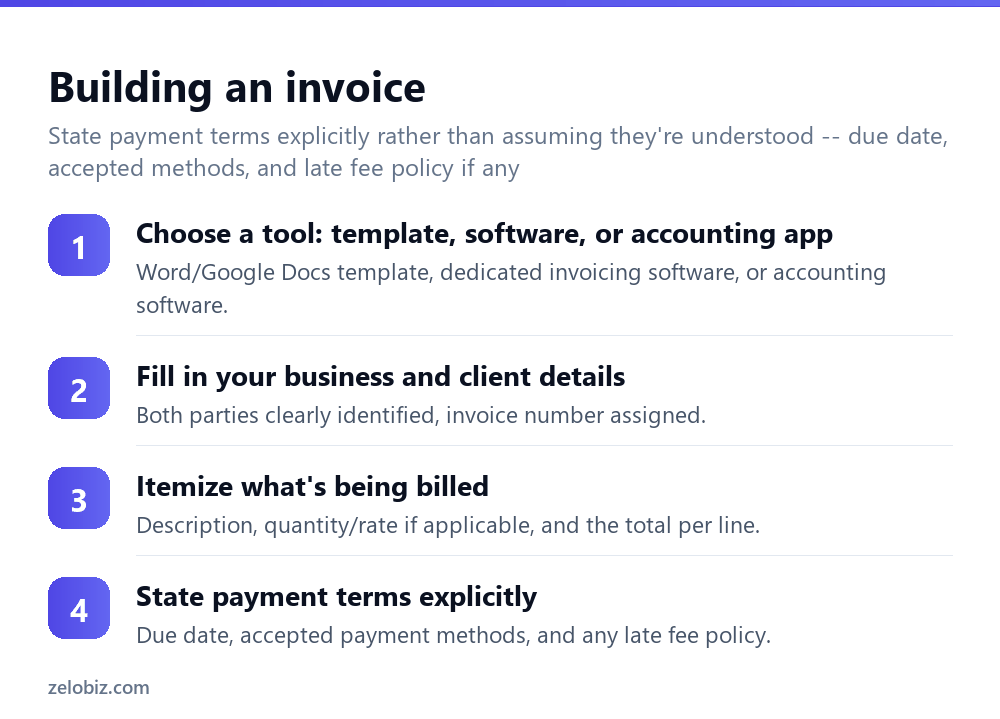
Choose a tool — a free Word or Google Docs invoice template works fine for occasional invoicing; dedicated invoicing software or accounting software (which can also track payment status, send reminders, and integrate with bookkeeping) makes more sense once invoicing becomes a regular, recurring task.
Fill in both parties’ details and assign the next invoice number in your sequence.
Itemize what’s being billed — a clear description per line item, with quantity and rate where that breakdown applies, rather than one vague lump-sum description covering everything at once.
State payment terms explicitly — an actual due date, which payment methods you accept, and any late fee policy if one applies.
Payment terms: the detail that actually matters most
A specific due date (“Due March 15, 2026”) is genuinely clearer and more actionable than “Net 30” alone, which requires the recipient to calculate the actual date themselves from the invoice’s issue date — an extra small step that occasionally introduces delay or confusion. Including both the term (Net 30) and the calculated actual date covers both preferences.
Listing accepted payment methods directly on the invoice — bank transfer details, a payment link, check mailing address, whatever specifically applies — removes a friction point where a client might otherwise have to ask how to actually pay before they can do so.
Stating a late fee policy, if one applies, sets a clear expectation upfront rather than becoming an awkward, ambiguous conversation only after a payment is already late — a policy is far easier to enforce when it was clearly communicated in advance than when it’s introduced as a surprise after the fact.
Invoicing software vs a simple template
For occasional invoicing — a handful of invoices a month, at most — a well-built template is genuinely sufficient and requires no ongoing software cost.
For regular, recurring invoicing, dedicated software becomes worth the investment — it typically handles automatic numbering, payment status tracking, automated reminder emails for overdue invoices, and often direct payment collection, removing manual tracking overhead that becomes genuinely burdensome once invoice volume grows past a few per month.
A worked example: invoicing a first-time client
Say a freelance designer just finished a first project for a new client and needs to send the very first invoice to this specific relationship.
They assign the next number in their existing sequence (say, invoice #047, continuing from prior clients rather than restarting at #1 for each new relationship), fill in both their own and the client’s full business details, and itemize the work specifically — “Logo design: 3 concepts, 2 revision rounds” rather than a vague “design services” line that doesn’t clarify what was actually delivered for the price charged.
For payment terms, since this is a new relationship with no established payment history yet, they state a specific due date 15 days out (Net 15) rather than the longer Net 30 they might extend to an established, reliable client, and list two accepted payment methods (bank transfer and a payment link) directly on the invoice so the client doesn’t need to ask.
Before sending, they double-check the client’s billing contact is actually who they’ve been corresponding with, since for a first project it’s not yet clear whether the day-to-day project contact is also the person who handles payment — a quick confirmation email avoids the invoice landing with someone who has no idea what to do with it.
Recurring invoices for ongoing work
For a client billed on a regular schedule — monthly retainer work, for instance — most invoicing software supports setting up a recurring invoice that generates and sends automatically on a set schedule, removing the need to manually rebuild and resend an essentially identical invoice every single month. This is worth setting up once a client relationship becomes genuinely ongoing and predictable, rather than continuing to create each invoice manually from scratch indefinitely.
Handling a disputed or partially incorrect invoice
If a client flags an error or disagreement on an already-sent invoice, issuing a corrected version with a clear note referencing the original invoice number (“Revised invoice for #047, correcting quantity in line 2”) keeps a clean, traceable record rather than a confusing situation where two different amounts exist for the same work with no clear indication of which one is actually current and correct.
International or currency-specific invoicing
Billing a client in a different country adds a couple of details worth stating explicitly rather than assuming they’re understood: the actual currency the amount is denominated in (writing “$500” is genuinely ambiguous between USD, CAD, and AUD, so spell out the currency code, e.g. “$500 USD”), and, if either side is a business required to charge or report tax on cross-border services, whatever tax information applies in that specific situation. Some invoicing software handles multi-currency invoicing and even shows the client an approximate conversion, which removes a layer of manual back-and-forth that would otherwise fall on both parties to sort out themselves.
When invoices aren’t getting paid promptly
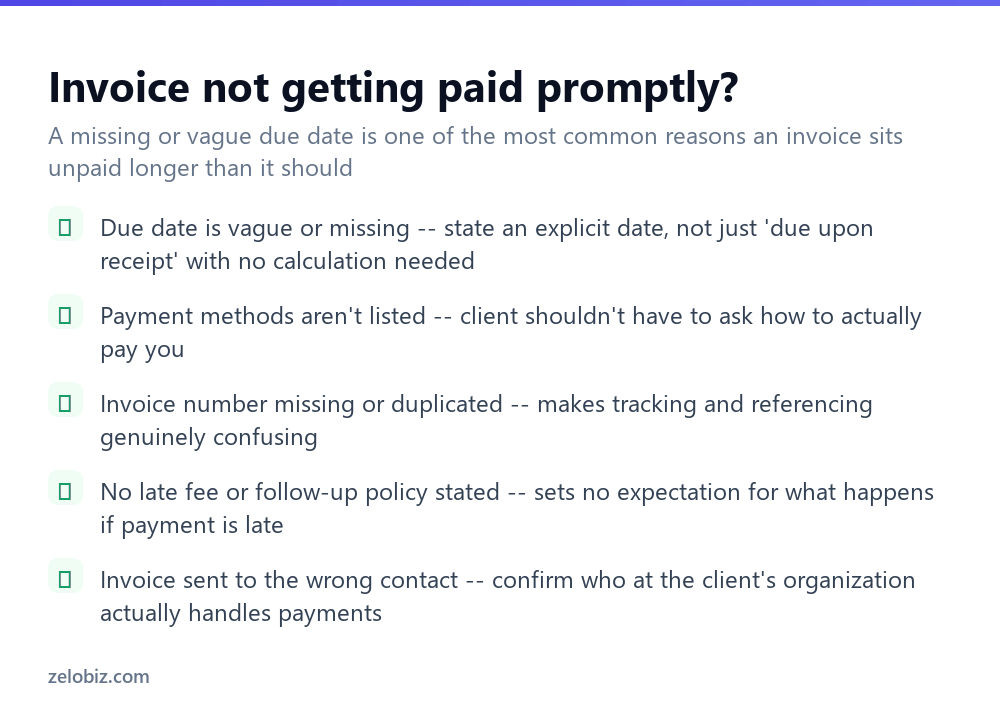
Due date is vague or missing — state an explicit calendar date, not just a payment term requiring the recipient to calculate it themselves.
Payment methods aren’t listed — a client shouldn’t need to ask how to actually pay; list every accepted method directly on the invoice.
Invoice number is missing or accidentally duplicated — makes referencing and tracking genuinely confusing for both sides; maintain a consistent, sequential numbering system.
No late fee or follow-up policy stated — sets no clear expectation for what happens if payment is late, making any actual follow-up feel more arbitrary than it needs to.
Sent to the wrong contact — confirm specifically who at the client’s organization actually handles payments, particularly for a larger client where the person you worked with day to day may not be the one processing invoices.
- ✓State an explicit due date, not just a payment term requiring calculation
- ✓List accepted payment methods directly on the invoice
- ✓Use a consistent, sequential invoice numbering system
- ✓State a late fee policy upfront if one applies, before it’s ever needed
- ✓Confirm the invoice reaches whoever actually handles payments at the client’s end
- ✕Assuming a client will calculate a due date themselves from a payment term alone
- ✕Leaving a client to ask how to actually pay instead of stating methods directly
- ✕Reusing or skipping invoice numbers, making later tracking confusing
- ✕Introducing a late fee policy only after a payment is already overdue
- ✕Sending an invoice only to a day-to-day contact without confirming who handles billing
Frequently asked questions
What information does an invoice need to include?
An invoice number, both parties’ contact information, issue and due dates, an itemized description of what’s billed, payment terms, and a clear total amount due.
How do I get clients to pay invoices on time?
State an explicit due date rather than just a payment term, list accepted payment methods directly, and consider a stated late fee policy.
Should I use invoicing software or a simple template?
A template is fine for occasional invoicing. Dedicated software becomes worthwhile once invoicing is regular, since it handles numbering, tracking, and reminders automatically.
What’s the difference between stating ‘Net 30’ and an explicit due date?
Net 30 requires the recipient to calculate the actual date themselves. Including both the term and the calculated date removes that extra step and any ambiguity.
Why isn’t my invoice getting paid promptly?
Common causes include a vague or missing due date, unlisted payment methods, or the invoice reaching the wrong contact at the client’s organization.
Do I need to number my invoices?
Yes. A unique, sequential invoice number makes tracking, referencing, and record-keeping far easier for both you and the client.
- →Formalize agreements before invoicing: how to write a contract
- →Set up a business account to receive payments: how to open a business bank account
- →Pitch new work before it becomes an invoice: how to write a proposal
- →Get the business itself set up first: how to start an LLC