

To open a business bank account, gather your EIN (or SSN, for some sole proprietors), formation documents (Articles of Organization for an LLC, or equivalent for your business structure), proof of any DBA registration if operating under a different name than the legal one, personal ID for each owner or authorized signer, and an Operating Agreement if the LLC has multiple members. Compare a few banks’ business account terms, then schedule an appointment or apply online, bringing the required initial deposit.
What most banks require
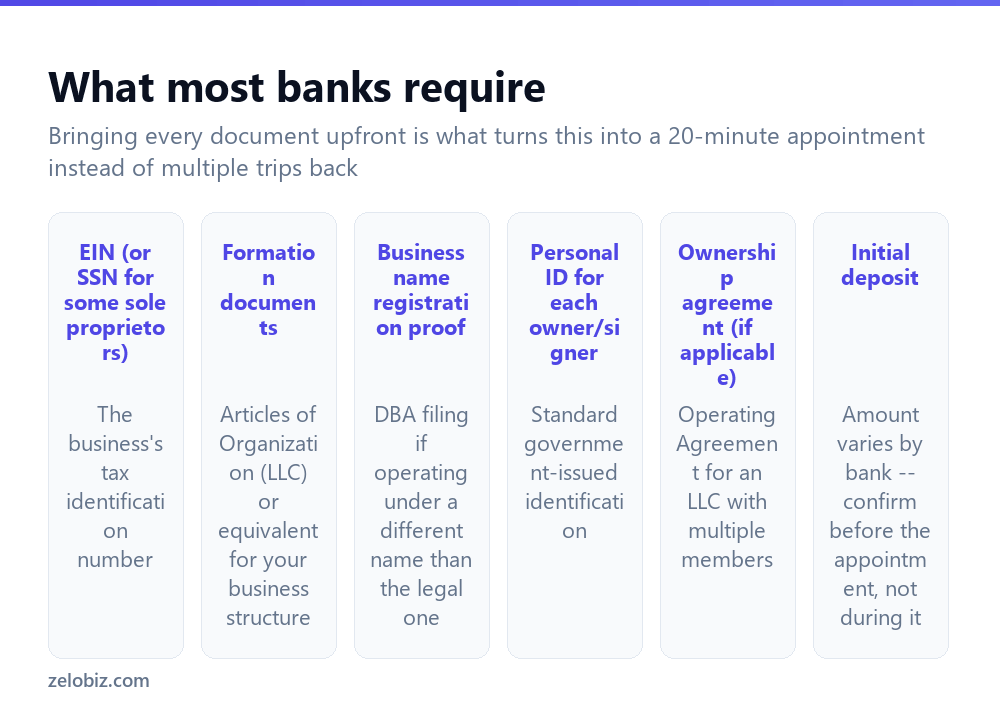
EIN — the business’s federal tax ID, or in some cases a sole proprietor’s personal SSN if they haven’t obtained a separate EIN. Covered in detail in the EIN guide linked below.
Formation documents — Articles of Organization for an LLC, or the equivalent formation paperwork for whatever structure the business actually uses, proving the business legally exists as described.
DBA registration proof — if the business operates under a name different from its official legal name (“doing business as”), most banks require proof that name is properly registered before opening an account under it.
Personal ID for every owner or anyone who’ll be an authorized signer on the account — standard government-issued identification, the same as opening any personal bank account.
Operating Agreement — for a multi-member LLC specifically, many banks want to see this document clarifying ownership percentages and authority before opening a shared business account.
Initial deposit — the required minimum amount genuinely varies by bank and account type, worth confirming directly with the specific bank before an appointment rather than discovering the requirement on arrival.
Calling ahead to confirm the exact document list for your specific business structure — since requirements can vary somewhat by bank — is the single most effective way to make this a one-visit process rather than needing to return with something missing.
Opening the account
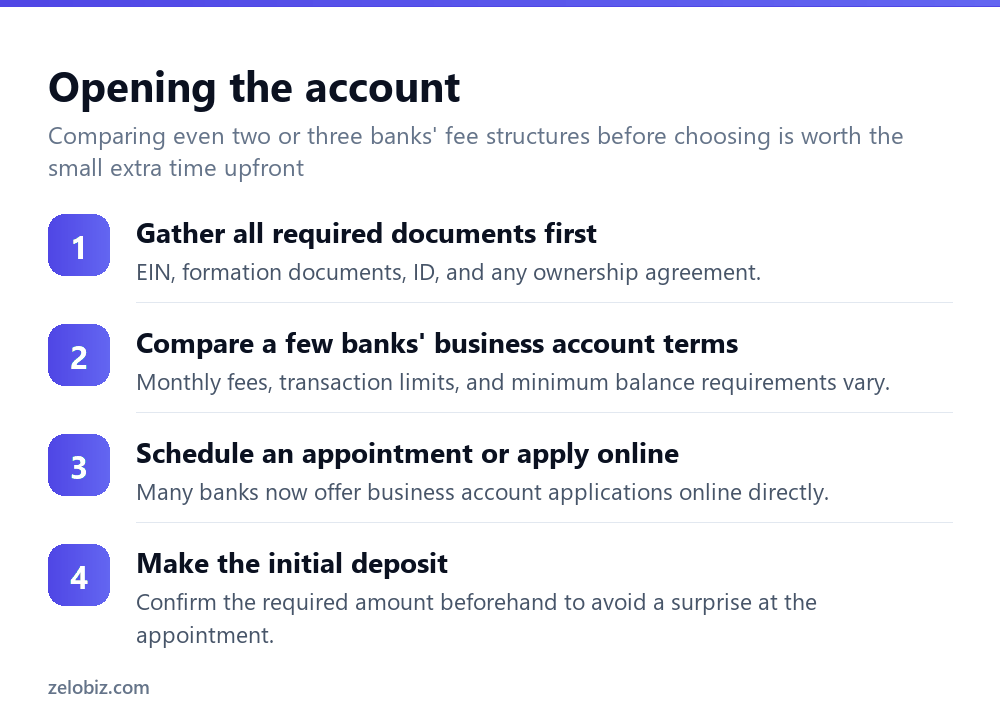
Gather every required document before attempting to open the account at all — confirming the exact list with the specific bank in advance, since requirements can differ somewhat between institutions.
Compare a few banks’ business account terms — monthly maintenance fees, free transaction limits (many business accounts charge per transaction beyond a certain monthly count), and minimum balance requirements all vary meaningfully between banks and even between different account tiers at the same bank.
Schedule an appointment, or apply online where that’s offered — many banks now support a fully online business account application for straightforward situations, though a multi-member LLC or anything with unusual ownership structure often still benefits from an in-person appointment where questions can be handled directly.
Make the initial deposit — confirmed in advance so it’s not a surprise requirement discovered at the appointment itself.
Choosing between banks
Rather than choosing based purely on a headline promotional offer, compare based on your business’s actual expected transaction volume and typical balance — a business account that waives monthly fees only above a balance threshold you won’t typically maintain, or that includes free transactions well below what you’ll actually process monthly, ends up costing more in practice than a plainer account genuinely suited to your real usage pattern.
It’s also worth checking whether the bank offers integration with whatever accounting or invoicing software the business plans to use, since direct integration can meaningfully reduce manual bookkeeping effort compared to a bank requiring manual transaction export and import.
Why a separate business account matters beyond convenience
Beyond simple organizational convenience, a genuinely separate business bank account is part of what supports the liability protection an LLC or corporation is meant to provide — mixing personal and business funds through a single shared account is exactly the kind of blurred separation that can undermine that protection if it’s ever tested, covered in more detail in the LLC formation guide linked below.
A worked example: a new single-member LLC opening its first account
Say someone just finished forming a single-member LLC for a freelance consulting business and received their EIN confirmation letter from the IRS the same week.
Before scheduling anything, they gather the EIN confirmation letter, the Articles of Organization filed with the state, and a driver’s license — since it’s a single-member LLC with no other owners, there’s no Operating Agreement required by most banks, though some ask for one anyway, so they check the specific bank’s list directly by phone first rather than assuming.
They call two local banks and one online-only bank to compare monthly fees and free transaction limits, since as a consulting business they expect low transaction volume (a handful of client payments and expense purchases monthly) and a checking-only account with no minimum balance requirement turns out to fit better than a more feature-rich account clearly built for higher-volume retail businesses.
They schedule an in-person appointment rather than applying online, since it’s their first business account and having someone confirm everything is correct on the spot feels worth the extra 20 minutes compared to an online application with no one to ask if something’s unclear. The appointment takes under 30 minutes because every document was gathered and confirmed in advance.
Checking vs. other business account types
A standard business checking account covers most day-to-day needs — receiving client payments, paying business expenses, and moving money as needed — and is the right starting point for the large majority of new businesses opening their first account.
A business savings or money market account becomes relevant once the business is holding meaningful reserves beyond what’s needed for regular operating expenses — tax savings set aside for quarterly payments, or a general reserve fund — since these typically earn some interest that a checking account doesn’t, at the cost of somewhat more limited transaction flexibility.
Opening both at once, even if the savings account starts with a small balance, is common practice — it establishes the separation between operating funds and reserved funds from day one, rather than needing to retroactively organize finances once the business has grown and the distinction matters more.
Online banks vs. traditional banks for a business account
Online-only banks frequently offer lower or waived monthly fees and sometimes better transaction terms than traditional brick-and-mortar banks, since they carry lower overhead — worth genuinely considering for a business that doesn’t need in-person banking services like cash deposits or notarization.
A business that regularly handles cash (a retail storefront, for instance) generally still needs a traditional bank with physical branches for straightforward cash deposits, since online-only banks typically have no practical way to accept cash directly. A purely service-based or online business, by contrast, may never need a physical branch at all, making an online-only bank’s typically lower fees a genuinely better fit.
When the application isn’t going smoothly
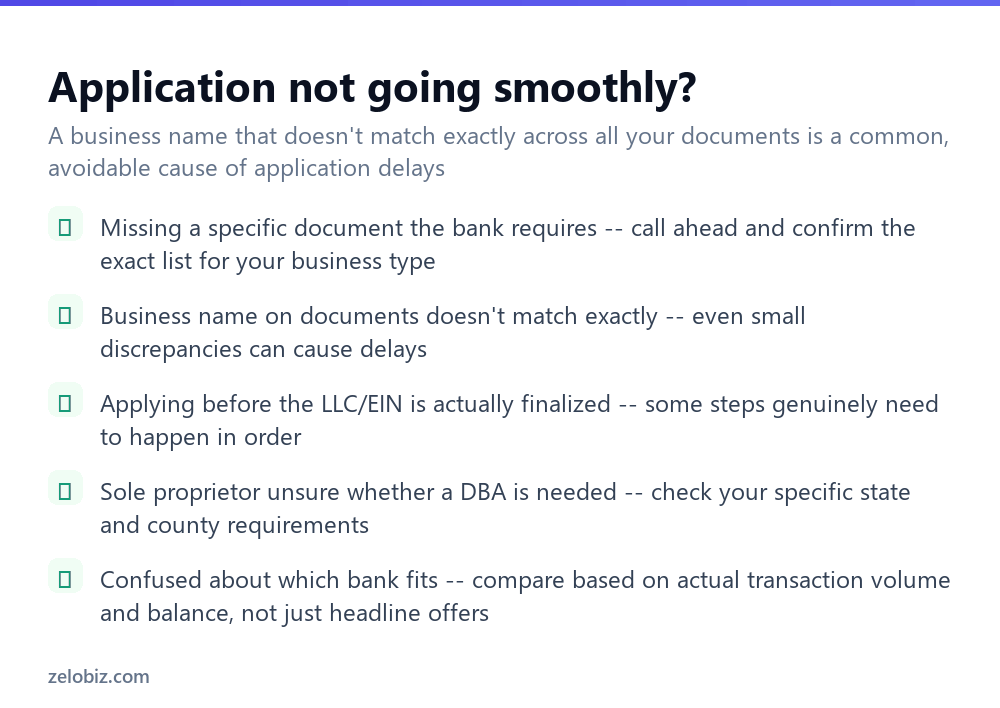
Missing a specific required document — call the bank directly ahead of time and confirm the exact list for your specific business structure, rather than assuming a generic list applies uniformly.
The business name doesn’t match exactly across documents — even small discrepancies (an abbreviation, a missing “LLC” suffix in one place but not another) can cause delays; confirm the exact legal name is consistent everywhere before the appointment.
Applying before the LLC or EIN is actually finalized — these steps genuinely need to happen in the right order; attempting to open a business account before the underlying formation and EIN are complete generally won’t work.
Unsure whether a DBA is needed as a sole proprietor — this depends on your specific state and sometimes county requirements; check locally rather than assuming a blanket answer applies everywhere.
- ✓Confirm the exact required document list with the specific bank beforehand
- ✓Compare banks based on your actual transaction volume and typical balance
- ✓Keep the business name consistent, exactly, across every document
- ✓Complete LLC formation and EIN application before attempting to open the account
- ✓Check local DBA requirements specifically if operating under a different business name
- ✕Assuming every bank requires an identical set of documents
- ✕Choosing a bank based purely on a promotional offer without checking real usage fit
- ✕Letting the business name vary even slightly between different documents
- ✕Attempting to open a business account before formation and EIN steps are actually complete
- ✕Mixing business and personal funds through the same account once it’s open
Frequently asked questions
What documents do I need to open a business bank account?
Typically an EIN, formation documents like Articles of Organization, proof of any DBA registration, personal ID for owners/signers, and an Operating Agreement for a multi-member LLC.
Do I need an EIN to open a business bank account?
Usually yes, though some sole proprietors can use their SSN instead, depending on the specific bank’s requirements.
How do I choose which bank to open a business account with?
Compare based on your actual expected transaction volume and typical balance, not just a promotional offer, since fee structures vary meaningfully between banks.
Can I open a business bank account online?
Many banks now offer this for straightforward situations, though a multi-member LLC or unusual ownership structure often still benefits from an in-person appointment.
Why does the business name need to match exactly across my documents?
Even small discrepancies, like a missing LLC suffix in one place, can cause delays — banks check for exact consistency.
Why does a separate business account matter beyond organization?
It supports the liability protection an LLC or corporation is meant to provide — mixing personal and business funds can undermine that protection if it’s ever tested.
- →Get your EIN before applying: how to get an EIN number
- →Form the business itself first: how to start an LLC
- →Start invoicing once the account is open: how to create an invoice
- →Register your business name if needed: how to register a business name