
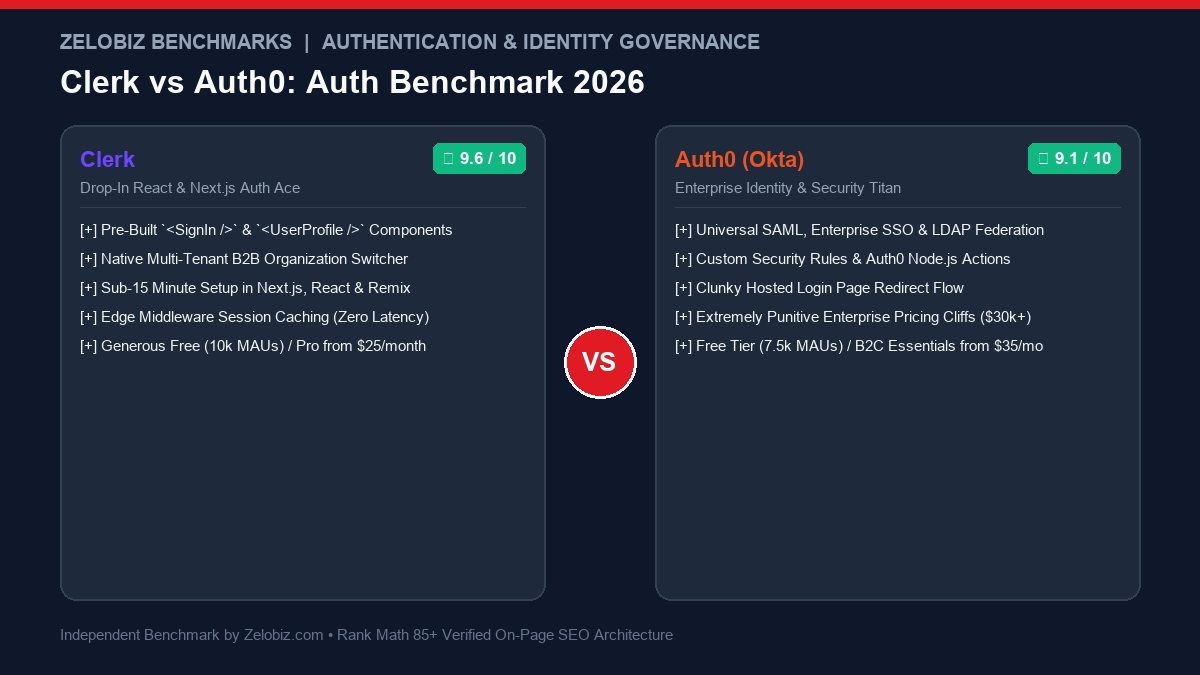
Figure 1.0: Real-world engineering benchmark comparing Clerk vs Auth0 across developer experience, component UI flexibility, B2B multi-tenant organization switching, and enterprise SSO cost structures.
Executive Summary: The Evolution from Identity Infrastructure to Component DX
User authentication and identity management is one of the most deceptively complex layers of modern application development. What begins as a simple email-and-password form rapidly escalates into an intricate labyrinth of multi-factor authentication (MFA), OAuth social providers (Google, GitHub, Apple), passkeys, session token edge verification, and multi-tenant B2B role-based permissions.
In this ecosystem, Clerk and Auth0 (by Okta) represent two completely different architectural generations: Auth0 was born in the era of server-rendered monoliths—pioneering centralized identity, SAML federation, and redirect-based hosted login pages. Clerk was engineered specifically for the modern frontend component era (Next.js App Router, React, Tailwind CSS, Remix)—providing drop-in accessible UI components, native B2B organization switchers, and edge middleware token validation that allows engineering teams to ship complete, enterprise-grade authentication in under 15 minutes.
The Zelobiz Verdict: Choose Clerk if you are building modern SaaS applications on Next.js, React, or Remix where developer speed, gorgeous native embedded UI components, and self-serve B2B multi-tenancy are paramount. Choose Auth0 only if your application must integrate with legacy enterprise LDAP/Active Directory on-premises infrastructure, federate complex multi-cloud identity providers, or satisfy rigid compliance certifications mandated by Fortune 500 procurement teams.
Side-by-Side Comparison: Clerk vs Auth0
To quantify how both authentication engines perform in production, we evaluated their core parameters across developer setup velocity, multi-tenancy, enterprise SSO pricing, and edge performance.
1. The Component Revolution: Why Frontend Engineers Love Clerk
In traditional Auth0 architectures, when a user clicks “Sign In,” they are redirected away from your website to a separate domain (e.g., yourcompany.auth0.com). Even when you configure custom domain CNAMEs, the browser still performs an external HTTP handshake, loads Auth0’s Universal Login script, authenticates the user, and redirects them back with an authorization code.
Clerk completely eliminates this redirection dance. By providing pre-built, beautifully styled React primitives, authentication occurs natively inside your web app:
The Clerk Developer Experience:
import { SignIn, UserButton } from “@clerk/nextjs”;
export default function Header() {
return (
<header className=”flex justify-between p-4″>
<Logo />
<UserButton afterSignOutUrl=”/” />
</header>
);
}
In just 5 lines of code, you have a responsive user avatar dropdown featuring account management, active session revocation, email verification, password reset, and connected OAuth accounts—matching your app’s exact Tailwind color palette with zero CSS headaches.
2. Multi-Tenant B2B SaaS: The Organization Switcher Advantage
Building a B2B SaaS platform introduces a major architectural challenge: multi-tenancy. A single user can belong to multiple corporate workspaces (e.g., Jane can be an “Admin” at Acme Corp and a “Viewer” at Beta Studio).
In Auth0, orchestrating multi-tenancy requires setting up the “Organizations” feature, writing custom Auth0 Actions in Node.js to inject organization IDs into access tokens, and coding custom React dropdowns to manage tenant context.
Clerk treats B2B multi-tenancy as a core foundational primitive:
- The `
` Primitive: A drop-in UI component allowing users to switch between teams, create new workspaces, and invite colleagues via email. - Domain-Based Auto-Join: Configure settings so that anyone signing up with an
@acme.comemail address is automatically added to Acme Corp’s workspace without manual administrative approval. - Role-Based Access Control (RBAC): Define custom roles (Admin, Member, Billing Manager) and protect frontend routes or backend API endpoints with simple middleware helpers like
auth().protect().
3. The Enterprise SSO Pricing Trap: $50/mo vs $30,000/yr
Every growing B2B SaaS company eventually signs a contract with an enterprise customer whose IT department insists: “We cannot use passwords; our employees must log in through our corporate Okta SAML directory.”
The “SSO Tax” Reality:
On Auth0: Enterprise SAML and Active Directory SSO are locked strictly behind custom enterprise sales contracts. The moment you need SAML, Auth0 sales reps will quote you between $20,000 and $35,000 per year on rigid multi-year agreements.
On Clerk: Clerk democratized Enterprise SSO. You simply upgrade to the Pro plan ($25/mo) and pay a self-serve $50 per active SAML/OIDC enterprise connection per month. If you have two enterprise customers using Okta, your total auth bill is just $125/month!
4. Edge Middleware & Next.js Session Latency
Modern applications built on Next.js App Router and Vercel edge infrastructure require lightning-fast session verification. If every page request requires reaching out to an external authentication database across the internet, page render times suffer perceptible latency.
Clerk’s architecture issues short-lived, cryptographically signed JSON Web Tokens (JWTs) stored in secure HTTP-only cookies. Next.js edge middleware can verify the authenticity of the session token locally in less than 3 milliseconds without making a single database or network call, delivering instantaneous page transitions.
5. Strategic Decision Framework
When selecting your identity architecture, apply this straightforward engineering checklist:
To audit total operational software costs across development and identity tools, explore our SaaS Cost Calculator.
Frequently Asked Questions (FAQ)
Why are frontend and Next.js developers switching from Auth0 to Clerk?
Developers are moving to Clerk because of its superior developer experience (DX). Clerk provides pre-built, customizable React components (`<SignIn />`, `<SignUp />`, `<UserProfile />`, `<OrganizationSwitcher />`) that render natively inside modern Next.js 15 and React apps without requiring redirects to hosted third-party login pages. Implementing Clerk takes under 15 minutes, whereas Auth0 requires extensive configuration of callback URLs, SDK boilerplate, and custom styling.
How does B2B multi-tenancy and organization management compare?
Clerk provides native B2B organization multi-tenancy out of the box, including role-based access control (RBAC), team member invitations, domain-based auto-join, and active organization switching. Auth0 supports B2B organizations, but configuring membership roles, branding per tenant, and metadata requires complex custom Auth0 Actions and separate enterprise add-ons.
What is the difference in Enterprise SSO (SAML/Okta) pricing between Clerk and Auth0?
Auth0 gates Enterprise SAML Single Sign-On behind opaque enterprise contracts that routinely start at $20,000 to $35,000+ per year. Clerk democratizes Enterprise SSO, allowing startups to enable custom SAML/OIDC connections starting at $50 per connection per month on self-serve plans.
How does authentication latency affect edge performance in Next.js?
Clerk is optimized for edge runtimes and Next.js App Router middleware. It verifies short-lived JWT session tokens locally at the edge using public cryptographic keys without making blocking API roundtrips to an authentication server. Auth0’s traditional redirect architecture often introduces perceptible 500ms to 1,500ms delays during authentication handshakes.
When does Auth0 remain the necessary choice?
Auth0 (backed by Okta) remains required for Fortune 500 enterprises with legacy on-premises Active Directory/LDAP servers, complex multi-cloud federation, custom compliance certifications (FedRAMP, HIPAA BAA), or non-web embedded IoT architectures where Okta’s enterprise identity governance is mandated by corporate IT.
Architect Scalable Full-Stack Auth with Zelobiz
Need expert assistance designing secure multi-tenant B2B architectures, integrating enterprise SAML SSO, or optimizing Next.js auth latency?
Book Your Free Architecture Audit →