
The transition from AI-assisted coding to fully autonomous AI software engineering represents the most profound shift in technology since cloud computing. Rather than sitting in an editor pressing tab, engineering managers can now assign GitHub issues directly to autonomous agents that read the issue description, navigate the repository, reproduce bugs in a sandboxed shell, write unit tests, and submit verified Pull Requests. Two platforms define this frontier in 2026: Devin (by Cognition), the proprietary, fully managed cloud teammate, and OpenHands (formerly OpenDevin), the MIT-licensed open-source framework dominating the global SWE-bench leaderboard. Here is the definitive benchmark comparing autonomous problem-solving accuracy, sandboxing security, compute costs, and enterprise readiness.
Executive Verdict: Devin vs. OpenHands in 2026
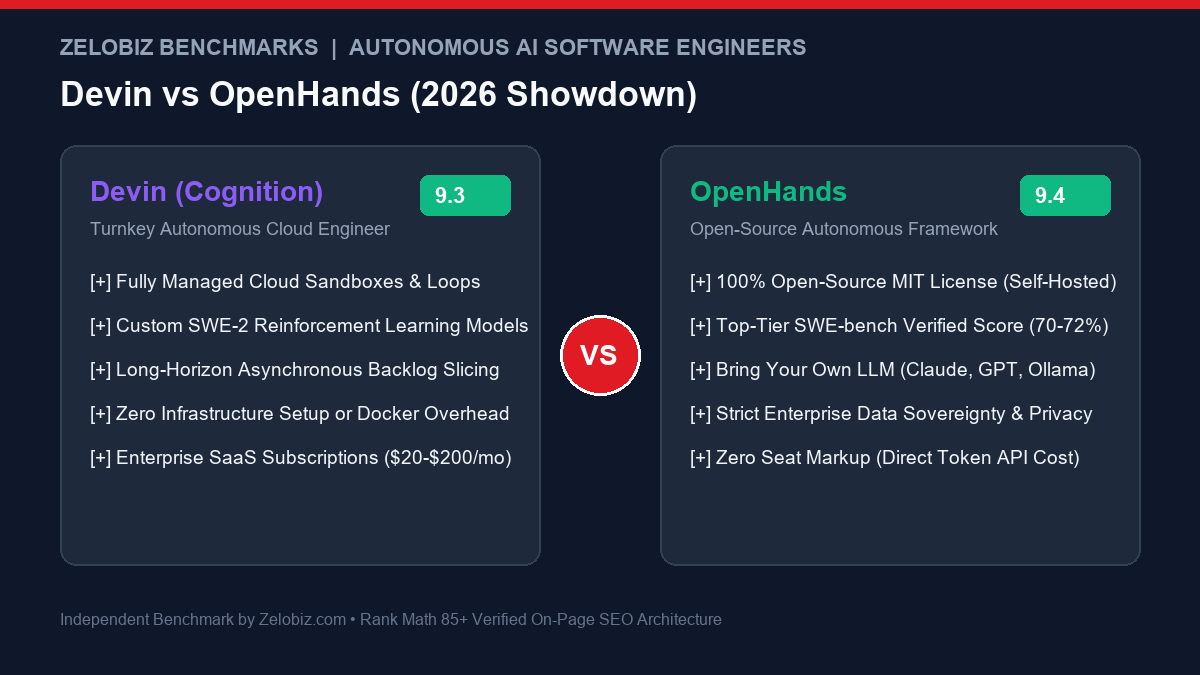
Devin wins as a turnkey, zero-maintenance SaaS engineer for teams wanting an out-of-the-box cloud teammate with proprietary SWE-2 reinforcement learning models. OpenHands wins for engineering teams prioritizing data sovereignty, custom model flexibility (Claude, DeepSeek, local LLMs), and zero recurring seat markup by running an open-source, self-hosted Docker runtime.
1. The Two Paradigms: Proprietary SaaS Teammate vs. Open-Source Runtime
Devin and OpenHands represent the classic commercial software divide: managed convenience versus open-source sovereignty.
| Dimension | Devin (Cognition) | OpenHands (Open-Source Community) |
|---|---|---|
| Licensing & Deployment | Proprietary Cloud SaaS (Closed Source) | 100% Open-Source (MIT License) / Self-Hosted |
| Underlying Models | Cognition Proprietary SWE-2 & Custom RL | Any Model: Claude Sonnet, GPT-4o, DeepSeek R1, Ollama |
| SWE-bench Verified Score | Competitive Frontier Grade (~65-70%) | Leaderboard Benchmark (~70-72% with Sonnet) |
| Sandboxing Architecture | Cognition Cloud VMs (Fully isolated, zero setup) | Docker containers on local host or private VPC |
| Data Privacy & Governance | Multi-tenant cloud with Enterprise SOC2 | 100% Air-Gapped / Private VPC Sovereign |
| Pricing Model | $20/mo Pro | $200/mo Max | $40/user/mo Teams | Free Software (Pay wholesale API token costs) |
2. SWE-bench Verified Performance: Real-World Bug Resolution
SWE-bench Verified is the industry gold standard for evaluating autonomous coding agents, measuring whether an AI can ingest a real unresolved GitHub issue from an open-source repository, reproduce the failure in a sandboxed bash shell, modify the codebase across multiple files, and produce a patch that passes existing and hidden test suites.
OpenHands paired with Anthropic’s Claude 3.5 Sonnet (with extended thinking/reasoning) has consistently broken records, scoring above 70% resolution rates. Because OpenHands is open-source, researchers and enterprise teams continuously optimize its agent loops, tool-calling interfaces, and Docker environment hooks.
Devin, meanwhile, utilizes Cognition’s custom fine-tuned SWE-2 models. Cognition has optimized Devin not merely for isolated benchmarks, but for long-horizon operational stability: navigating web browser documentation, interacting with Slack channels, handling OAuth credentials, and managing continuous asynchronous task backlogs.
3. Data Sovereignty & Enterprise Compliance
For financial institutions, healthcare providers, and defense contractors, sending proprietary source code to a third-party managed SaaS cloud like Devin is a strict compliance violation. This is where OpenHands is indispensable:
- Air-Gapped Private VPC: You can deploy OpenHands inside an isolated AWS GovCloud, Azure Private Enclave, or on-premise Kubernetes cluster.
- Local Open-Weights LLMs: Connect OpenHands to an internal Ollama or vLLM server running open-weights reasoning models (such as DeepSeek-R1 or Llama 3.3 70B), ensuring zero source code bytes ever touch external networks.
- Audit Logging: Every bash command, file write, and git diff executed by OpenHands is logged locally in standard JSON formats for enterprise security audits.
4. Cost Analysis: Turnkey Convenience vs. API Token Economics
Devin’s pricing tiers ($20 to $200 per month for individuals; $80 base + $40/seat for teams) bundle compute, sandbox VMs, model inferences, and customer support into a single predictable bill. For teams that value convenience and lack dedicated DevOps engineers, Devin pays for itself within hours by eliminating manual ticket triage.
OpenHands eliminates seat markups entirely. You only pay for the raw LLM tokens consumed through your Anthropic, OpenAI, or DeepSeek API keys. A typical bug fix in OpenHands costs between $0.40 and $1.50 in API tokens, making it extraordinarily cost-effective for high-volume automated testing and CI/CD pipelines.
5. Frequently Asked Questions (FAQ)
Can OpenHands run locally on a developer’s MacBook?
Yes. With Docker Desktop installed, you can launch OpenHands with a single command: docker run -it -p 3000:3000 ghcr.io/all-hands-ai/openhands:latest. It boots a local web UI connected to your local folders.
Can Devin create pull requests directly on private GitHub repos?
Yes. Devin integrates natively via GitHub App permissions. You can mention @devin-ai in any GitHub issue or PR comment, and Devin will autonomously spin up a cloud sandbox, write the code, and submit a PR with detailed reproduction logs.
How do I calculate engineering team software payback?
Calculate developer productivity multipliers and SaaS savings using our Interactive SaaS Cost Calculator.
Perform an Engineering Infrastructure Teardown
Looking to accelerate development velocity, integrate agentic AI coding workflows, or audit developer toolchains? Consult with our engineering team or schedule a technical review through our Zelobiz Agency Infrastructure Audit.
Discover more technical comparisons in our Software Comparisons Hub or explore automation guides in the How-To Guides Hub.
Looking for autonomous terminal tools rather than full cloud agents? Explore our deep benchmark on Aider vs Claude Code and see how autonomous workflows integrate into our master architecture: AI Coding Agents & Developer Productivity (2026).

Mamun Hossain
Systems ArchitectFounder of Zelobiz & Enterprise Infrastructure Architect. Specializing in autonomous software engineering workflows, server-side tracking pipelines, and high-performance self-hosted infrastructure.