
One of the most consequential decisions an AppSumo buyer faces at checkout is license tier selection. What began a decade ago as a chaotic system of purchasing separate redemption codes and pasting them into clunky activation fields has evolved into AppSumo’s structured multi-tier licensing model. Today, buyers are confronted with a clear financial dilemma: should you buy the entry-level Tier 1 license for $59, or should you spend $249+ for Tier 3?
For agency owners, consultants, and growth engineers, license stacking is often the difference between a high-margin client service engine and an unusable toy locked behind branding watermarks and single-user restrictions. Yet, software hoarding is an expensive trap. AppSumo forums are littered with remorseful buyers who stacked Tier 4 and Tier 5 licenses on unproven startups, only to watch the software get abandoned six months later.
In this comprehensive operational guide from the Zelobiz Growth Engineering Lab, we break down the exact mathematics of AppSumo license stacking. We examine the four non-negotiable triggers where Tier 3 delivers massive return on investment, the three psychological traps that lead to wasted capital, and the technical mechanisms of upgrading, downgrading, and auditing your stacked software portfolio.
Executive Summary: The License Stacking Rulebook
- Tier 1 ($49–$69): Ideal for personal testing, solopreneur utility, and internal experiments where vendor watermarks and single logins are acceptable.
- Tier 2 ($129–$159): Best for micro-teams requiring 3 to 5 collaborator seats and moderate credit allowances, but often lacks full white-label capabilities.
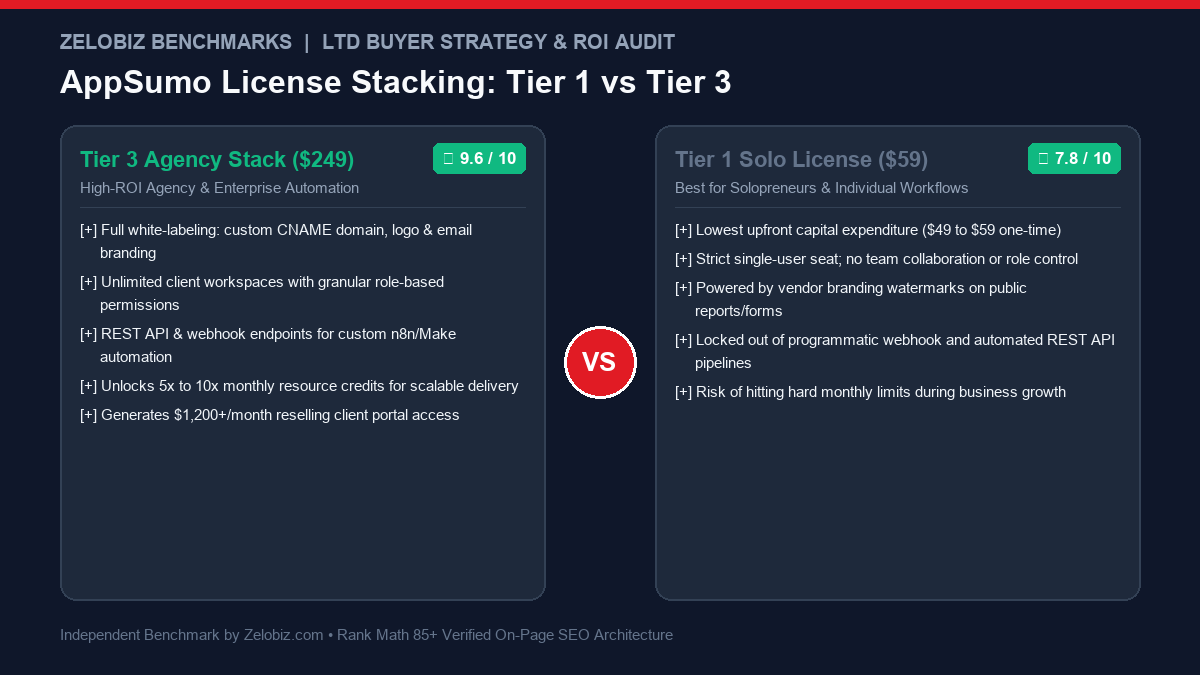
- Tier 3+ ($199–$299+): Justified only when it unlocks direct monetization features: custom CNAME domain white-labeling, client sub-accounts, and REST API/webhook automation.
- The 60-Day Downstack Window: You can only upgrade or downstack while the deal is live on AppSumo. Once the deal ends, your license tier is locked permanently.
How Modern AppSumo License Stacking Actually Works
In the early days of AppSumo, “stacking” meant literally purchasing multiple distinct redemption codes (e.g., Code 1 gave you 5,000 credits; Code 2 doubled it to 10,000; Code 3 unlocked white-label). While flexible, this system frequently led to database synchronization errors and redemption confusion between AppSumo and vendor servers.
Under the modernized AppSumo Tier Architecture, software partners structure their deals into standardized license tiers:
- Tier 1 (Single Code Equivalent): Unlocks core features for 1 user seat with foundational usage credits (e.g., 50 video exports/mo, 10,000 words/mo, or 3 tracked domains).
- Tier 2 (Double Code Equivalent): Expands limits (usually 2.5x to 3x Tier 1) and adds multi-user team collaboration (typically 3 to 5 team members).
- Tier 3 (Triple Code Equivalent): The critical inflection point for commercial operations. Unlocks white-label custom domains, client management portals, high-volume credit pools, and automated API access.
- Tier 4 & Tier 5 (Agency & Enterprise Scale): High-capacity packages offering 10+ team seats, unlimited workspaces, priority vendor SLA support, and massive data pipelines.
Pro-Tip for AppSumo Plus Members: If you are subscribed to AppSumo Plus ($99/yr), your 10% discount applies across every license tier. On a Tier 3 stack priced at $249, your discount saves $24.90 instantly. If you stack to Tier 5 ($499), you save $49.90 on a single transaction.
The 4 Golden Triggers: When Tier 3 is an Absolute No-Brainer
Upgrading from Tier 1 to Tier 3 represents roughly a 3x to 4x increase in upfront capital outlay. To justify this expenditure, Tier 3 must generate measurable operational leverage or direct client revenue. Through our analysis of hundreds of deployed agency tools, Tier 3 is mathematically justified when at least one of these four triggers is met:
Trigger 1: Client Sub-Accounts & Custom CNAME White-Labeling
If your agency provides client deliverables (such as SEO audits, social media scheduling, client review management, or reporting dashboards), displaying a vendor’s logo diminishes your perceived authority. More importantly, it invites clients to bypass your agency and purchase the tool directly.
Tier 3 frequently unlocks full white-labeling:
- Custom domain mapping via CNAME (e.g.,
portal.youragency.com). - Custom transactional SMTP email sending (so client invitations arrive from your agency domain).
- Removal of all “Powered by [Tool]” footer watermarks and badges.
- Client sub-accounts with restricted view-only or editor permissions.
The Agency White-Label ROI Calculation
Suppose you purchase a Tier 3 white-label reporting tool on AppSumo for $249:
- You onboard 5 active agency clients onto their own custom portal logins.
- You bill each client an automated “Software & Reporting Retainer” of $49/month.
- Total Monthly Client Invoicing: $245.00 / month.
- Break-even time on your Tier 3 lifetime stack: Exactly 31 Days.
- Net 3-Year Agency Profit: $8,571.00 on a single $249 investment.
Trigger 2: Webhook & Programmatic REST API Unlocks
For modern automation engineers, a software tool without webhook triggers or API endpoints is an operational dead end. If your team has to log into a browser dashboard every morning to manually copy-paste leads, download CSV exports, or trigger campaigns, human labor quickly consumes any software savings.
SaaS founders routinely gate REST API access, incoming/outgoing webhooks, and native Zapier/Make integrations behind Tier 3 or Tier 4. If you plan to connect the software to an autonomous pipeline (such as routing CRM leads into an n8n webhook or streaming data into Google BigQuery), paying for Tier 3 is non-negotiable. To explore how we structure enterprise webhook pipelines, review our AI Business Automation Guide (2026).
Trigger 3: Team Seat Headroom (Avoiding Single-Account Bottlenecks)
Tier 1 licenses almost universally restrict access to a single user login. Sharing a single login across multiple remote team members, virtual assistants, or contractors leads to continuous security headaches:
- Two-Factor Authentication (2FA) SMS or authenticator codes interrupt founder focus throughout the workday.
- Simultaneous session timeouts occur when two team members log in at the same moment.
- Zero audit logging or attribution for who created, edited, or accidentally deleted client campaigns.
If the tool will be actively operated by two or more team members, Tier 2 or Tier 3 is essential to maintain security integrity and operational efficiency.
Trigger 4: The Marginal Credit Multiplication Factor
Examine how usage credits scale between tiers. In poorly structured deals, Tier 2 merely doubles Tier 1 credits for double the price. However, in generous “founder sweetheart deals,” upgrading to Tier 3 provides an exponential jump in resource allowances:
| License Tier | Deal Price | Monthly Credits | Effective Cost / 1k Credits (Year 1) |
|---|---|---|---|
| Tier 1 | $59 | 5,000 credits/mo | $0.98 per 1,000 credits |
| Tier 2 | $139 | 15,000 credits/mo | $0.77 per 1,000 credits |
| Tier 3 | $249 | 50,000 credits/mo | $0.41 per 1,000 credits |
When Tier 3 offers a 3x+ multiplier on per-dollar credit allocation, stacking becomes a profound unit-economic advantage over any monthly subscription alternative. For proven long-term viable tools, check our curated selection of The 7 Best AppSumo Deals for Agencies.
The 3 Sunk-Cost Traps of Over-Stacking
While the upside of Tier 3 is immense, over-stacking is the primary reason buyers lose money on lifetime deals. Avoid these three psychological traps:
Trap 1: Speculative Stacking on Unproven Roadmaps
Never buy Tier 3 based on what a software startup promises to build in Q3 or Q4. If Tier 1 does not solve an immediate, painful operational bottleneck in your business today, spending $249 on Tier 3 in the hope that future updates will make it valuable is financial gambling. As we demonstrated in our guide on How to Audit a SaaS Roadmap Before Buying an LTD, early-stage roadmaps have an over 60% attrition rate.
Trap 2: The “Agency of the Future” Delusion
Solo consultants frequently talk themselves into buying Tier 4 or Tier 5 ($399–$499) because they imagine they will hire 10 full-time staff members and onboard 50 enterprise clients next quarter. Buy software for the business you operate today, plus six months of realistic expansion. If you do not currently have clients demanding that specific service, stick to Tier 1.
Trap 3: Neglecting Vendor Insolvency Risk
When you buy Tier 1, your maximum downside risk is capped at $59. When you stack to Tier 4 or 5, you are handing $400 to $600 to a pre-Series A startup. If that startup experiences proxy bankruptcy or founder burnout—as detailed in our retrospective on 5 SEO LTD Survivors vs 3 Bankrupt Tools—your entire capital investment evaporates.
Tier Decision Framework: Step-by-Step Scoring Matrix
Use our standardized rubric to determine exactly which license tier to purchase for any live software deal:
License Tier Selection Rubric
| Operational Situation | Recommended Tier | Strategic Justification |
|---|---|---|
| Solo freelancer testing a new workflow | Tier 1 ($49–$69) | Low capital exposure; test tool utility for 45 days before deciding to upgrade or refund. |
| Small agency with 2–4 staff members | Tier 2 ($129–$159) | Secures individual logins, eliminates 2FA bottlenecks, and expands team credit limits. |
| Agency reselling client portal services | Tier 3 ($199–$249) | Unlocks custom CNAME domain, white-labeling, and client sub-accounts to generate MRR. |
| Engineering team integrating webhooks | Tier 3 ($199–$249) | Required for REST API endpoints, automated webhook triggers, and high-frequency data sync. |
| High-volume programmatic operations | Tier 4 or 5 ($349–$499) | Only for battle-tested software with proven founders where maximum credit pools are needed daily. |
How to Upgrade, Downstack, or Manage Licenses on AppSumo
AppSumo provides a streamlined interface for managing your active software licenses. Follow these operational guidelines to protect your purchase:
- The “Buy Tier 1 First” Strategy: Unless a deal is in its final 2 hours of availability, always purchase Tier 1 first. Test the software inside your actual production environment for 14 to 21 days. If the tool proves indispensable, navigate to your AppSumo Products tab, click Change Tier, and pay the prorated difference to upgrade to Tier 3.
- The Deal Expiration Hard Deadline: Keep a strict calendar reminder for when the deal leaves AppSumo. Once the countdown timer hits zero, the “Upgrade Tier” button disappears forever. If you decide you need Tier 3, you must upgrade before public sales conclude.
- Understanding Modern Downstacking: Under the unified tier system, you cannot downstack from Tier 3 to Tier 1 and receive a cash difference refund after 60 days. All tier adjustments and refunds must occur strictly within the 60-day money-back guarantee window.
Frequently Asked Questions (FAQ)
What is license stacking on AppSumo?
License stacking is the process of purchasing multiple tiers or codes of a software deal on AppSumo to unlock higher monthly usage quotas, additional team member seats, custom domain white-labeling, and advanced enterprise features.
Can I upgrade or stack more licenses later after buying Tier 1?
Yes, while the deal is actively running on AppSumo, you can upgrade from Tier 1 to Tier 2 or Tier 3 directly within your account by paying the price difference. However, once the deal officially closes, you cannot purchase additional licenses or stack further.
Can I partially refund a stacked license on AppSumo?
In the modern AppSumo Tier system (Tier 1, Tier 2, Tier 3), licenses are sold as single bundled SKUs. You generally cannot keep Tier 1 and refund the difference for Tier 3; you must refund the entire tier purchase or downgrade within the 60-day refund window.
When is Tier 3 not worth the extra cost?
Tier 3 is not worth the extra cost if you are a solo practitioner who does not manage external client accounts, does not require automated REST API webhooks, and has monthly usage volume well within Tier 1 limits. Stacking high tiers on unvetted, newly launched software is a major capital risk.
Need Independent SaaS Tech Stack & Software Due Diligence?
Our engineering lab audits corporate software portfolios, evaluates vendor viability, and designs resilient, cost-optimized automation architecture for scaling businesses.
Schedule an Operations Tech Stack Audit →