
At first glance, the financial calculus of a lifetime deal (LTD) appears laughably one-sided. On one hand, an established SaaS platform charges $49 to $99 every single month for a team workspace. On the other hand, an AppSumo partner offers lifetime access to a comparable tool for a single one-time payment of $59 to $199. By month four, the lifetime license has broken even; over three years, the direct savings look like thousands of dollars of pure profit.
However, seasoned Chief Technology Officers and agency operators understand that the invoice price is only a fraction of software’s true expense. Software introduces friction, technical debt, integration maintenance, staff training, and the existential risk of vendor abandonment. When an early-stage LTD tool shuts down after eighteen months, the scramble to extract client data, retrain staff, and rebuild mission-critical automations can instantly wipe out three years of subscription savings in forty-eight hours.
In this exhaustive financial analysis from the Zelobiz Growth Engineering Lab, we model the 3-Year Total Cost of Ownership (TCO) between lifetime software deals and monthly recurring SaaS subscriptions. We examine direct invoice costs, hidden maintenance overhead, switching risk, and opportunity cost across three real-world software scenarios, giving you a mathematically rigorous framework to guide your technology procurement decisions.
Executive Summary: The 3-Year TCO Verdict
- The Direct Payback Horizon: On pure software fees, 85% of lifetime deals achieve break-even within 3 to 7 months compared to monthly subscriptions.
- The Hidden Friction Tax: Immature LTD tools frequently demand 10 to 30 hours of internal engineering workarounds per year (webhook patching, manual data cleanups), costing $500 to $2,000+ in hidden labor.
- The Risk-Adjusted Decision Rule: LTDs deliver overwhelming positive ROI on low-marginal-cost, utility software (client portals, form builders, desktop apps). Monthly subscriptions win on compute-heavy, compliance-critical infrastructure (mission-critical CRMs, primary domain email).
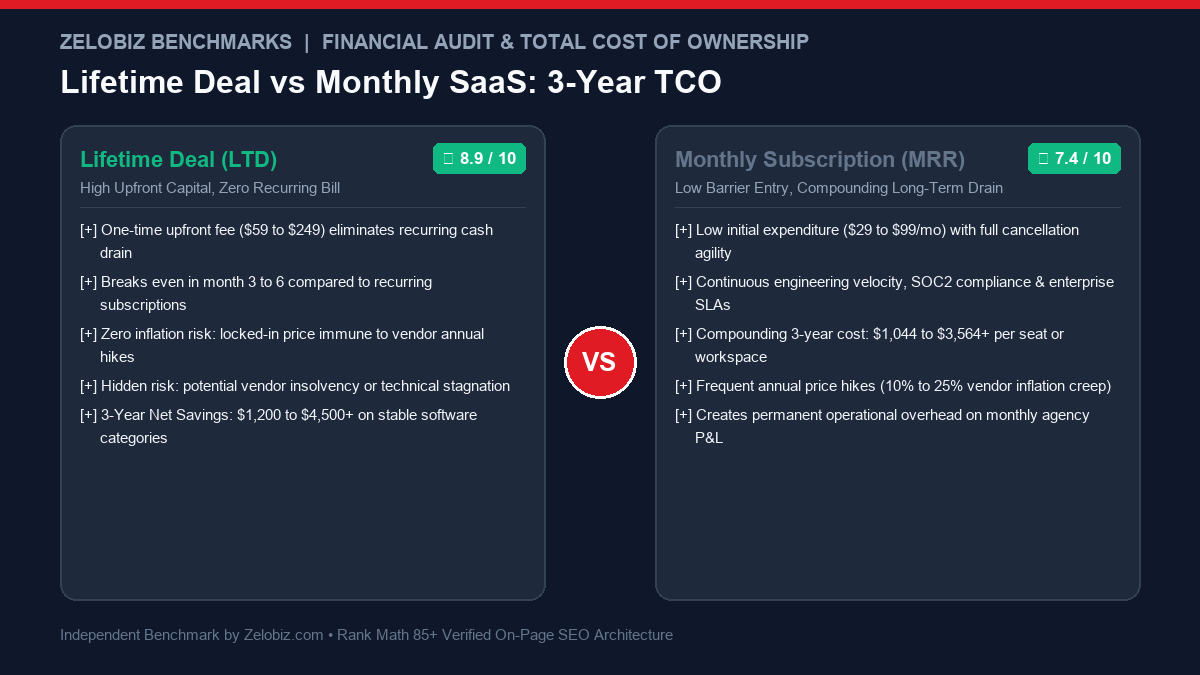
The Mathematical Equation: Defining Total Cost of Ownership
To accurately evaluate software capital allocation, we must move beyond the surface subscription fee and model the complete economic equation. Total Cost of Ownership (TCO) across a 36-month operational window is defined as follows:
// The 3-Year TCO Equations
TCO_LTD = P_license + C_onboard + C_workarounds + (P_failure × C_migration) – V_salvage
TCO_MRR = ∑[Month 1..36](M_t × (1 + Rate_inflation)) + C_onboard – V_agility
Where the variables represent:
- P_license: The one-time capital cost of purchasing and stacking lifetime licenses (e.g., Tier 1 for $59 or Tier 3 for $249).
- M_t: The baseline monthly recurring subscription fee (e.g., $49/mo).
- Rate_inflation: The standard vendor SaaS price inflation rate (empirically averaging 8% to 15% per year across major platforms).
- C_onboard: The labor cost of configuring accounts, DNS records, API keys, and training team members.
- C_workarounds: The internal developer or administrative labor spent overcoming missing features, clunky UI bugs, or lack of native integrations.
- P_failure × C_migration: The probabilistic risk cost of vendor shutdown multiplied by the emergency cost of extracting data and migrating to a replacement platform.
- V_agility: The economic value of being able to cancel a monthly subscription instantly if a project ends or business priorities pivot.
3-Year TCO Case Studies Across Real Software Categories
To illustrate how these economic variables play out in practice, let us examine three detailed scenarios over a 36-month horizon.
Scenario A: Client Reporting & Social Media Dashboard
A digital marketing agency with 8 active clients needs an automated social scheduling and white-label reporting portal.
| Cost Component | Monthly SaaS (e.g., Buffer / Sprout) | Lifetime Deal (Tier 3 Stack) |
|---|---|---|
| Upfront License / Setup | $0.00 | $249.00 (One-time) |
| 36-Month Subscription Run-Rate | $2,484.00 ($69/mo average) | $0.00 |
| Maintenance & Workarounds | $150.00 (Polished UI, native sync) | $400.00 (Occasional API re-auths) |
| Probabilistic Migration Risk (15%) | $0.00 | $120.00 ($800 migration × 15%) |
| Total 3-Year TCO | $2,634.00 | $769.00 |
Net Financial Advantage: Lifetime Deal saves $1,865.00 (70.8% TCO reduction).
Why LTD Wins Here: Social media APIs (Meta, LinkedIn, X) are standardized. As long as the founder updates token endpoints, client reporting involves low computational overhead. As discussed in our analysis on AppSumo License Stacking Explained, Tier 3 white-labeling transforms this software into an immediate profit center.
Scenario B: Mission-Critical CRM & Sales Automation Pipeline
A scaling B2B agency with 6 sales reps managing 500 active deals needs a centralized CRM, call recording, and pipeline automation engine.
| Cost Component | Monthly Enterprise SaaS (HubSpot) | Lifetime Deal CRM (Tier 4 Stack) |
|---|---|---|
| Upfront License Cost | $0.00 | $399.00 |
| 36-Month Subscription Run-Rate | $4,500.00 ($125/mo) | $0.00 |
| Developer Workarounds & Webhook Fixes | $300.00 (Native integrations) | $2,400.00 (Custom Zapier/n8n fixes) |
| Lost Deal Slippage from Bugs (2%) | $0.00 (99.99% SLA uptime) | $3,500.00 (Missed follow-up alerts) |
| Total 3-Year TCO | $4,800.00 | $6,299.00 |
Net Financial Advantage: Monthly Enterprise SaaS wins by $1,499.00.
Why Monthly Wins Here: A CRM holds the revenue lifeline of an enterprise. If a buggy webhook drops an inbound $10,000 lead or email synchronization fails during sales outreach, the one-time $399 “savings” results in catastrophic net revenue loss. To audit your sales pipeline and automation stack, schedule a dedicated Agency Operations Audit.
Scenario C: Technical SEO Crawler & Backlink Auditor
An in-house growth team running quarterly technical audits across 15 internal web properties.
| Cost Dimension | Monthly Subscription (Ahrefs/Semrush) | Lifetime Deal (Labrika / Serpstat) |
|---|---|---|
| Direct 3-Year Cash Outflow | $4,644.00 ($129/mo) | $199.00 (Stacked lifetime codes) |
| Data Refresh Latency Factor | Daily live SERP scraping | Scheduled weekly or cached crawl |
| Proxy Failure Risk | 0% (Enterprise proxy farm) | 5% (Mitigated by daily caps) |
| Total 3-Year TCO | $4,644.00 | $449.00 |
Net Financial Advantage: Lifetime Deal saves $4,195.00 (90.3% TCO reduction).
As we uncovered in our empirical research on 5 SEO LTD Survivors vs 3 Bankrupt Tools, technical crawlers with disciplined daily query limits provide exceptional long-term utility without recurring monthly subscription invoices.
The 4 Hidden Costs That Break Lifetime Deal TCO
Before declaring a lifetime deal the automatic winner, audit your internal operations for these four compounding hidden costs:
1. Feature Stagnation & Developer Abandonment
When you pay monthly, SaaS companies have an urgent financial incentive to continually ship updates, improve UI responsiveness, and expand integrations to prevent monthly churn. With an LTD, the founder collected your revenue in month one. If the founder fails to build a strong recurring MRR subscriber base—as outlined in our SaaS Roadmap Audit Checklist—the software becomes frozen in time.
2. Sunk Cost Fallacy & Engineering Workaround Debt
Because an agency spent $249 on an LTD, founders frequently insist that internal developers spend 15 hours writing custom middleware, patching broken webhooks, and manually formatting CSV imports rather than spending $39/month on a tool with native connectors. If your engineering rate is $75/hour, spending 15 hours on workarounds costs $1,125.00 in lost billable productivity.
3. Single Sign-On (SSO) & Compliance Blockades
As your business grows and acquires enterprise clients, security requirements become paramount. Most LTDs do not support SAML/SSO, SOC2 Type II audit logs, or custom role-based access control. Inability to satisfy client security questionnaires will disqualify your agency from lucrative corporate retainers.
4. The Sudden Death Migration Scramble
If a venture-backed SaaS platform shuts down, they provide six months of notice, automated data export tools, and transition assistance. When an undercapitalized LTD startup goes bankrupt, servers frequently shut down over a weekend without warning. The cost to salvage data, rebuild automation pipelines, and appease frustrated clients is severe.
The TCO Decision Matrix: Which Model Wins When?
| Software Domain | Winner | Economic Rationale |
|---|---|---|
| Internal Agency Client Portals | Lifetime Deal | White-labeling delivers immediate client retainer margin with near-zero marginal server costs. |
| Mission-Critical Production CRM | Monthly SaaS | Zero-tolerance for data loss, downtime, or missed leads. 99.99% SLA and SOC2 compliance essential. |
| Form Builders & Survey Engines | Lifetime Deal | Static database records; easy webhook streaming into n8n/Make makes vendor lock-in minimal. |
| Primary Corporate Domain Email | Monthly SaaS | Requires Google Workspace or Microsoft 365 IP reputation infrastructure. Never gamble with primary email. |
| Secondary Graphic & Video Utilities | Lifetime Deal | Replaces expensive monthly Canva/Adobe subscriptions for secondary marketing tasks. |
How to Maximize Lifetime Deal TCO: 3 Best Practices
If you choose the lifetime deal route, follow these three operational rules to ensure your 3-year TCO remains rock-bottom:
- Decouple Your Data with Webhooks: Stream all leads, contacts, and transactions out of the LTD tool immediately via webhooks into a neutral warehouse (Google Sheets, Airtable, or PostgreSQL). If the tool goes bankrupt, your raw data is 100% safe. Explore our AI Business Automation Guide (2026) for webhook patterns.
- Stack for Operational Headroom: Avoid buying Tier 1 if you know your agency will need client sub-accounts within six months. Purchasing Tier 3 upfront during the live campaign is 50% cheaper than trying to negotiate enterprise pricing after the deal ends.
- Conduct 45-Day Production Stress-Testing: Put the software through real client workloads within your 60-day refund window. If the software crashes under moderate load, process a refund immediately rather than hoping future patches fix core architecture.
Frequently Asked Questions (FAQ)
What is Total Cost of Ownership (TCO) in SaaS software?
Total Cost of Ownership (TCO) is a comprehensive financial metric that includes not only the initial purchase price or monthly subscription cost of software, but also onboarding labor, maintenance workarounds, integration overhead, data migration, and the risk cost of vendor abandonment.
How quickly does a lifetime deal break even against a monthly subscription?
Most lifetime deals break even between month 3 and month 6. For example, a $149 Tier 2 lifetime deal replacing a $39/month recurring SaaS subscription achieves full capital payback by Month 4, with subsequent months representing 100% net profit.
Why do large enterprises avoid lifetime software deals?
Enterprises prioritize operational continuity, enterprise SLAs, SOC2 Type II security compliance, and dedicated account management over one-time cost savings. Lifetime deal startups often lack the dedicated infrastructure and legal guarantees required by corporate compliance departments.
Which software categories have the highest lifetime deal ROI?
Categories with deterministic compute costs and low marginal overhead offer the highest LTD ROI: form builders, client reporting portals, internal project management boards, static cloud storage, and desktop audio/video editing utilities.
Need Independent SaaS Tech Stack & Software Due Diligence?
Our engineering lab audits corporate software portfolios, evaluates vendor viability, and designs resilient, cost-optimized automation architecture for scaling businesses.
Schedule an Operations Tech Stack Audit →