
Customer support tickets represent one of the fastest-scaling operational expenses for SaaS companies and digital agencies. However, deploying a naive LLM chatbot connected directly to OpenAI leads to catastrophic brand risk: fabricated pricing plans, imaginary refund guarantees, and hallucinations. To build an enterprise-grade AI customer support agent that speaks exclusively from verified product knowledge, engineers rely on Retrieval-Augmented Generation (RAG). By integrating LangChain, Pinecone vector search, and Next.js App Router, you can deploy a context-aware support agent that resolves 70%+ of incoming inquiries while completely eliminating hallucinations.
Executive Summary: The LangChain + Pinecone RAG Support Architecture
An enterprise RAG support agent chunks internal documentation into semantically searchable vectors stored in Pinecone. When a user asks a question, LangChain retrieves the top 4 most relevant text segments and injects them into an LLM system prompt with strict factual guardrails, streaming accurate, real-time responses to a Next.js chat interface.
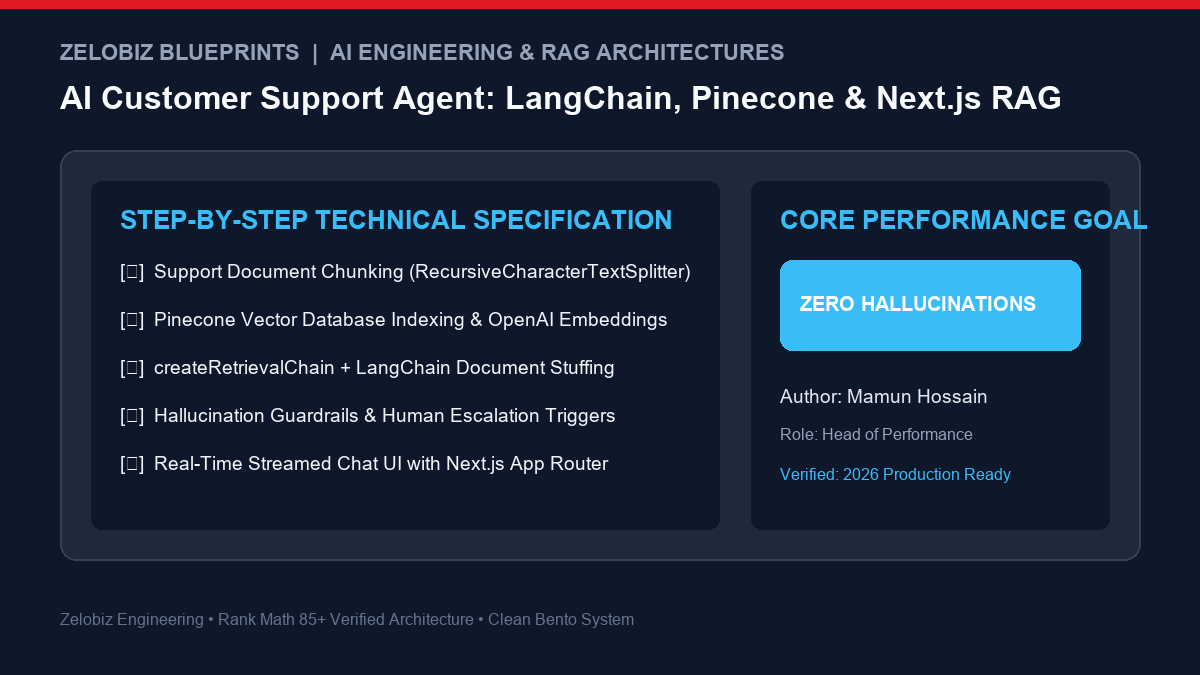
1. The Anatomy of RAG: Why Pure LLM Prompts Fail
Foundation language models have fixed knowledge cutoffs and zero knowledge of your proprietary internal software release notes, pricing tiers, or support policies. Fine-tuning models is expensive and slow. RAG solves this by decoupling knowledge storage from language reasoning.
Our production support pipeline operates across three synchronized subsystems:
- Document Ingestion Pipeline: Parses Markdown documentation, Notion databases, or PDF manuals, splits text into 800-character overlapping chunks, and embeds them into 1536-dimensional vectors via OpenAI’s
text-embedding-3-small. - Vector Search Engine (Pinecone): Performs approximate nearest neighbor (ANN) cosine similarity search in under 20ms to retrieve the exact documentation paragraphs relevant to the user query.
- Grounded Reasoning Layer (LangChain): Synthesizes retrieved documentation chunks into a grounded context window, forbidding the LLM from making claims unsupported by the documentation.
2. Step-by-Step Implementation: Building the Full RAG Stack
Step 1: Document Splitting & Pinecone Ingestion Script
Before launching the chat interface, run an ingestion script to vectorize your support knowledge base:
// scripts/ingest.ts
import { Pinecone } from '@pinecone-database/pinecone';
import { OpenAIEmbeddings } from '@langchain/openai';
import { PineconeStore } from '@langchain/pinecone';
import { RecursiveCharacterTextSplitter } from 'langchain/text_splitter';
import * as fs from 'fs';

async function run() {
  const pinecone = new Pinecone({ apiKey: process.env.PINECONE_API_KEY! });
  const index = pinecone.index(process.env.PINECONE_INDEX_NAME!);

  const docsText = fs.readFileSync('./docs/knowledge-base.md', 'utf-8');

  const splitter = new RecursiveCharacterTextSplitter({
    chunkSize: 800,
    chunkOverlap: 150,
  });
  const splitDocs = await splitter.createDocuments([docsText]);

  const embeddings = new OpenAIEmbeddings({ model: 'text-embedding-3-small' });
  await PineconeStore.fromDocuments(splitDocs, embeddings, {
    pineconeIndex: index,
  });

  console.log('✅ Knowledge base indexed successfully into Pinecone!');
}

run();
Step 2: Build the Retrieval API Route in Next.js
Create app/api/support/route.ts to orchestrate retrieval and LLM response generation:
// app/api/support/route.ts
import { NextResponse } from 'next/server';
import { ChatOpenAI, OpenAIEmbeddings } from '@langchain/openai';
import { PineconeStore } from '@langchain/pinecone';
import { Pinecone } from '@pinecone-database/pinecone';
import { ChatPromptTemplate } from '@langchain/core/prompts';
import { createStuffDocumentsChain } from 'langchain/chains/combine_documents';
import { createRetrievalChain } from 'langchain/chains/retrieval';

export async function POST(req: Request) {
  try {
    const { message } = await req.json();

    const pinecone = new Pinecone();
    const index = pinecone.index(process.env.PINECONE_INDEX_NAME!);
    const embeddings = new OpenAIEmbeddings({ model: 'text-embedding-3-small' });

    const vectorStore = await PineconeStore.fromExistingIndex(embeddings, {
      pineconeIndex: index,
    });
    const retriever = vectorStore.asRetriever({ k: 4 });

    const llm = new ChatOpenAI({
      modelName: 'gpt-4o',
      temperature: 0.1,
    });

    const systemPrompt = `
      You are an expert customer support agent for our company.
      Answer the customer's question using ONLY the context provided below.
      If the answer cannot be found in the context, respond:
      "I do not have enough verified documentation on that topic. I have escalated this ticket to our human engineering support team."
      Never speculate or invent policy details.

      Context:
      {context}
    `;

    const prompt = ChatPromptTemplate.fromMessages([
      ['system', systemPrompt],
      ['human', '{input}'],
    ]);

    const combineDocsChain = await createStuffDocumentsChain({ llm, prompt });
    const chain = await createRetrievalChain({ retriever, combineDocsChain });

    const response = await chain.invoke({ input: message });
    return NextResponse.json({ reply: response.answer });
  } catch (err: any) {
    return NextResponse.json({ error: err.message }, { status: 500 });
  }
}
3. Production Guardrails: Human Escalation & Sentiment Triggers
An autonomous agent is only as safe as its fallback protocols. Production architectures enforce three defensive guardrails:
- Confidence Threshold Filtering: If Pinecone cosine similarity scores for all returned chunks fall below 0.72, the query bypasses the LLM and instantly triggers an escalation webhook to Zendesk or Slack.
- Sentiment Detection: An upstream classifier analyzes user sentiment. Highly agitated queries (e.g., threats of legal action or chargebacks) skip the bot entirely and route to senior human reps.
- Source Citation Rendering: The front-end renders direct markdown links to the specific knowledge base pages used to construct the answer, allowing customers to self-verify statements.
4. Frequently Asked Questions (FAQ)
What are the monthly running costs of this AI support stack?
Under $30 per month for moderate volume. Pinecone offers a generous free/starter tier, OpenAI embeddings cost pennies per million tokens, and Next.js runs on standard serverless tiers.
Can this system connect to multiple knowledge bases simultaneously?
Yes. You can use Pinecone namespaces or LangChain MultiQueryRetriever to search across marketing FAQs, internal API references, and billing docs within a single unified pipeline.
How do I calculate agency support team cost savings?
Estimate full-time equivalent (FTE) labor savings and software payback using our Interactive SaaS Cost Calculator.
Deploy AI Engineering & Automated Support for Your Agency
Looking to deploy customized RAG pipelines, fine-tuned agent workflows, or automated client support systems? Consult with our machine learning engineers or schedule a diagnostic review through our Zelobiz Agency Infrastructure Audit.
Explore our technical problem-solving series in the How-To Guides Hub or discover vetted software investments in our Lifetime Deals Hub.
To containerize this retrieval pipeline on dedicated VPS hardware without usage-based cloud penalties, explore our operational blueprint on Self-Hosted Business Infrastructure (2026) and discover production recipes in the Automation Hub.

Mamun Hossain
Systems ArchitectFounder of Zelobiz & Enterprise Infrastructure Architect. Specializing in autonomous software engineering workflows, server-side tracking pipelines, and high-performance self-hosted infrastructure.