
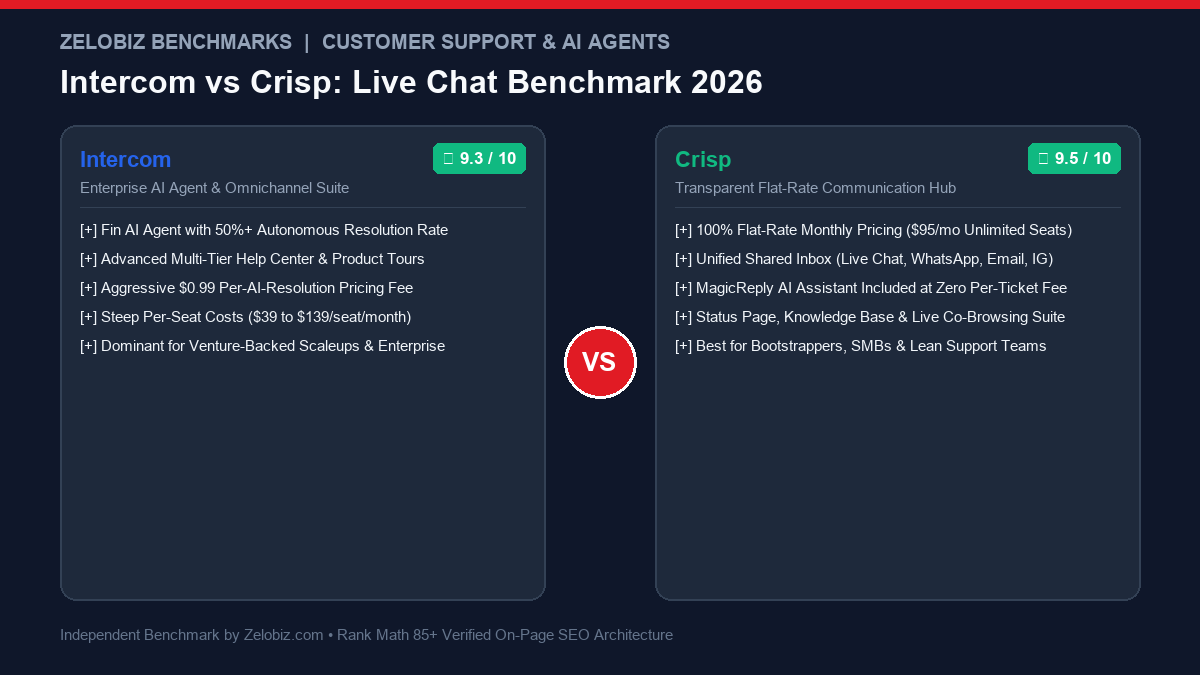
Figure 1.0: Real-world SaaS customer support benchmark comparing Intercom vs Crisp across per-seat pricing, Fin AI resolution fees ($0.99/ticket), co-browsing diagnostics, and 3-year TCO.
Executive Summary: The Battle Against Support Software Price Inflation
Customer support software has undergone a seismic revolution. The humble live chat widget of the 2010s has transformed into an autonomous, omnichannel customer communication suite powered by generative AI, automated triage routing, live video co-browsing, and integrated knowledge bases.
However, this innovation has introduced severe billing friction. Intercom, while building the industry’s most sophisticated autonomous AI agent (Fin AI), has pioneered an aggressive, multi-variable monetization model: charging high per-seat fees ($39 to $139/seat/month) combined with an eye-watering $0.99 fee for every single resolution executed by its AI. In response, Crisp has become the global sanctuary for bootstrapped SaaS companies, digital agencies, and SMBs—offering an all-in-one shared inbox (chat, email, WhatsApp, Instagram, Messenger) with unlimited support seats, co-browsing, and status pages for a predictable flat rate of $95/month.
The Zelobiz Verdict: Choose Crisp ($95/mo flat) if you are an agency, startup, or SMB support team that demands unified omnichannel messaging, native screen co-browsing, and transparent pricing where adding support agents never increases your monthly bill. Choose Intercom only if you are a venture-backed scaleup with high ticket volume where Fin AI’s 50%+ autonomous resolution rate offsets the salary of hiring 5 to 10 full-time customer service reps.
Side-by-Side Comparison: Intercom vs Crisp
To quantify how both platforms operate in production environments, we evaluated their core features across pricing models, AI automation, omnichannel communication, and diagnostics.
1. The Fin AI Fee Shock: Deconstructing the $0.99 Resolution Trap
Intercom’s Fin AI is undeniably impressive. By ingesting your public help center documentation and internal Notion/Confluence SOPs, Fin can answer complex customer questions with human-like accuracy, resolving roughly half of all inbound tickets without touching a human agent.
However, Intercom monetizes this efficiency through a controversial pricing structure: $0.99 per resolution. A resolution is counted whenever a user confirms their question was answered or closes the chat without requesting a human agent.
The Real-World Monthly Invoice Math:
Assume your SaaS platform handles 4,000 customer inquiries per month with a team of 6 support agents:
- Intercom Base Seats (6 Agents on Pro Plan): 6 × $99 = $594/month.
- Fin AI Resolutions (50% of 4,000 = 2,000 resolutions): 2,000 × $0.99 = $1,980/month.
- Product Tours & Outbound Add-ons: ~$250/month.
- Total Intercom Monthly Cost: $2,824/month ($33,888/year).
- Total Crisp Monthly Cost: $95/month ($1,140/year) for the exact same 6 agents!
That $32,748 annual difference is why so many growing startups find themselves forced to migrate off Intercom as their customer base expands.
2. Crisp’s Native Superpower: Zero-Install Co-Browsing
One of Crisp’s most remarkable built-in tools is Live Co-Browsing. When a customer reaches out via chat complaining, “I can’t find where to update my billing credit card” or “Your export button is throwing an error,” traditional support agents must ask for screenshots or schedule a Zoom call.
With Crisp, the support agent simply clicks “Start Co-Browsing” in the chat dashboard:
- The agent immediately views the customer’s active browser screen in real time with zero software downloads or browser extensions required by the customer.
- The agent can draw on the customer’s screen with a virtual highlighter, pointing directly to the exact button they need to click.
- Sensitive password fields and credit card inputs are automatically masked by Crisp for total security and compliance.
3. Omnichannel Unification: Centralizing Every Customer Touchpoint
Modern consumers do not want to wait by their desktop computer for an email response. They reach out through whatever channel is most convenient at that moment: WhatsApp on their phone, Instagram DMs, Facebook Messenger, or website live chat.
Crisp unifies all external communication channels into a single inbox:
- Whether a customer sends a message via WhatsApp, an Instagram story reply, a Telegram ping, or an email, it appears in the identical Crisp shared inbox.
- When a support agent types a reply in Crisp, it routes back to the customer’s native WhatsApp or Instagram app automatically.
- Intercom supports WhatsApp and social channels, but often requires enterprise add-on fees and complex Twilio API configurations.
4. Where Intercom Still Dominates
Despite its aggressive pricing, Intercom remains the superior enterprise platform in specific product environments:
- Interactive In-App Product Tours: Intercom allows product managers to build multi-step guided walkthroughs, interactive tooltips, and feature release banners targeted to specific user segments without writing code.
- Complex Triage & SLA Management: For large enterprise support teams with tier-1, tier-2, and tier-3 escalations, Intercom’s automated assignment rules, SLA breach timers, and custom analytics reporting are deeply mature.
- Autonomous Fin AI: If your company has the cash flow to afford $0.99/resolution, Fin AI provides a degree of autonomous resolution that few tools can rival.
5. Strategic Decision Framework
When selecting your customer support infrastructure, apply this straightforward framework:
To audit total operational software costs across your customer support and live chat subscriptions, explore our SaaS Cost Calculator.
Frequently Asked Questions (FAQ)
Why is Crisp considered dramatically more affordable than Intercom?
Crisp charges a flat rate of $95/month (Unlimited plan) covering unlimited support seats, unified shared inbox (live chat, email, WhatsApp, Instagram), knowledge base, and status page with zero per-ticket fees. Intercom charges per agent seat ($39 to $139/seat/mo) plus an aggressive $0.99 fee for every single resolution performed by its Fin AI agent, causing monthly bills to easily exceed $2,000 to $5,000+ for growing teams.
How does AI resolution compare between Intercom Fin and Crisp MagicReply?
Intercom’s Fin AI is the industry benchmark for autonomous AI customer support, capable of resolving 50%+ of routine customer inquiries without human intervention using strict anti-hallucination guardrails. Crisp provides MagicReply (AI-suggested answers to human agents) and AI bot integrations, but does not bill you $0.99 for every question resolved.
Can Crisp replace Intercom for in-app onboarding and product tours?
Crisp offers in-app triggers, targeted chat campaigns, and basic automated messaging. However, Intercom remains superior for multi-step modal product tours, feature walkthrough checklists, and in-app surveys.
What is Crisp’s Live Co-Browsing feature and does Intercom have it?
Crisp includes native, zero-install Co-Browsing. Support agents can view a customer’s active screen in real time with 1 click, annotate elements, and guide them through bugs without requiring Zoom screen shares. Intercom requires third-party app marketplace integrations to replicate this functionality.
When does Intercom justify its enterprise price tag?
Intercom justifies its cost for high-growth venture-backed companies handling tens of thousands of complex support queries where Fin AI’s autonomous resolution saves the cost of hiring 5 to 10 full-time support agents.
Scale Your Customer Operations with Zelobiz
Ready to automate customer support workflows, eliminate expensive software seat fees, and boost client retention?
Schedule Your Free Customer Ops Audit →