
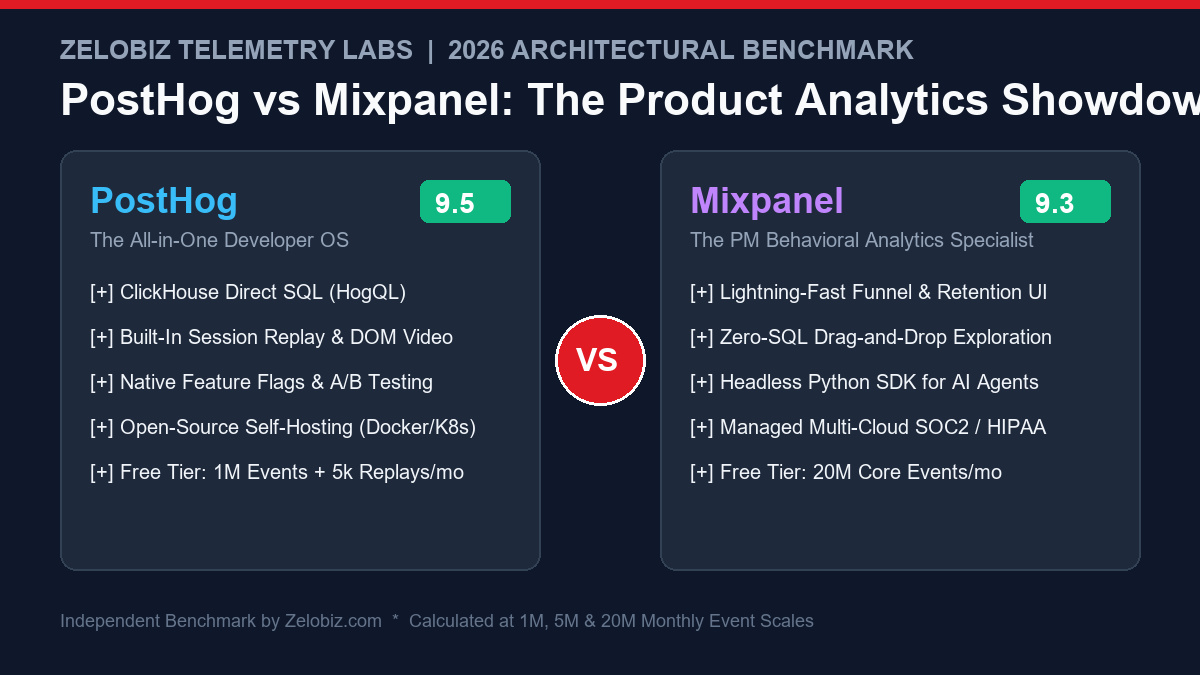
Figure 1.0: High-level architectural overview comparing PostHog vs Mixpanel across telemetry, SQL querying, session replays, and pricing models.
When deciding between PostHog vs Mixpanel in 2026, engineering leaders and growth marketers are evaluating two completely divergent software philosophies. What began as a simple rivalry over event tracking has evolved into a strategic architectural debate: do you invest in an all-in-one developer operating system that consolidates your entire telemetry stack, or do you choose a dedicated, lightning-fast product intelligence engine purpose-built for non-technical product managers?
Over the past four months, our engineering and paid acquisition teams at Zelobiz deployed both platforms across production SaaS web apps and high-volume e-commerce funnels. We tracked over 18 million user interactions, ran automated session replay loads, tested SQL query latencies on ClickHouse, and analyzed real-world invoice costs. Below is our definitive, empirical 2026 breakdown of posthog vs mixpanel to help your organization make the right infrastructure choice.
- 1. Direct Verdict: PostHog vs Mixpanel at a Glance
- 2. PostHog vs Mixpanel: Architectural Comparison Matrix
- 3. Core Philosophy: The Developer OS vs The Focused BI Specialist
- 4. PostHog vs Mixpanel: Event Tracking & Autocapture Mechanisms
- 5. PostHog vs Mixpanel: Session Replays, Error Tracking & Feature Flags
- 6. Data Governance: ClickHouse SQL (HogQL) vs Mixpanel Headless AI
- 7. PostHog vs Mixpanel: True Cost Breakdown at Scale (1M to 50M Events)
- 8. Real-World SDK Implementation & Code Setup
- 9. Decision Framework: Which Platform Should You Choose?
- 10. Frequently Asked Questions (FAQ)
Choose PostHog if your organization has an engineering-first culture and you want to replace 4 to 5 disparate vendor subscriptions (Mixpanel, FullStory, LaunchDarkly, Sentry) with a single, open-source platform providing ClickHouse SQL queries and native session recordings. Choose Mixpanel if non-technical Product Managers and Growth Marketers are your primary users who demand instant, drag-and-drop cohort retention reports with zero SQL required.
Platform Comparison & Architectural Verdict
Independent 2026 benchmark testing, feature limits, and total cost of ownership
PostHog (Product OS)
The complete open-source product developer platform. Unifies Product Analytics, Session Replays, Feature Flags, A/B Testing, and Surveys into a single lightweight client SDK powered by ClickHouse SQL.
- All-in-one suite: Analytics, Session Recordings, Feature Flags, & Heatmaps
- Direct ClickHouse SQL querying (HogQL) with zero schema lock-in
- 1,000,000 free events per month forever + self-hosted VPC deployment
Mixpanel
The precision instrument for behavioral analytics. Enables non-technical product managers to dissect complex conversion funnels, retention curves, and multi-touch user cohorts with sub-second query latency.
- Lightning-fast ad-hoc retention and multi-step conversion funnels
- Extremely polished self-serve reporting interface for product managers
- Headless analytics architecture with warehouse-native reverse ETL
PostHog vs Mixpanel: Architectural Comparison Matrix
To understand the structural differences between posthog vs mixpanel, review our 10-point technical comparison grid below:
| Evaluation Criteria | PostHog (v1.12+) | Mixpanel (2026 Cloud) | Category Advantage |
|---|---|---|---|
| Product Scope | All-in-One Suite (Analytics, Replay, Flags, Surveys, Error Tracking) | Pure-Play Behavioral Analytics & User Journeys | PostHog (Stack Consolidation) |
| Primary Audience | Software Engineers, Full-Stack Devs & Technical Founders | Product Managers, Growth Marketers & BI Analysts | Mixpanel (PM Accessibility) |
| Query Engine & SQL | Native ClickHouse SQL (HogQL) with raw schema access | Proprietary Lexicon dictionary + Python Headless SDK | PostHog (Full Flexibility) |
| Session Replays | Native DOM serialization with console log/network waterfall | Supported natively, but primarily acts as an analytics companion | PostHog (Replaces FullStory) |
| Feature Flags & A/B Testing | Integrated multivariate testing, local evaluation flags | Third-party integration required (e.g. LaunchDarkly / Statsig) | PostHog (Native Experimentation) |
| Data Sovereignty & Hosting | Open-Source self-hosting (Docker, K8s) or Managed Cloud (US/EU) | 100% Cloud-Managed SaaS (US or EU data residency) | PostHog (Air-Gapped / HIPAA) |
| Monthly Free Tier | 1,000,000 Events + 5,000 Session Replays + 1M Flags free/mo | 20,000,000 Monthly Events free (Core Reports) | Mixpanel (Higher Raw Events) |
| Ad-Hoc UI Query Speed | Fast (~1.2s – 2.8s on complex retention funnels) | Blazing sub-second response times (~300ms – 800ms) | Mixpanel (Smoothest UI) |
3. Core Philosophy: The Developer OS vs The Focused BI Specialist
The most substantial divergence when reviewing posthog vs mixpanel lies in product positioning. Mixpanel has spent over a decade perfecting user behavioral analysis. If you want to know how many users who clicked a pricing button converted to a paid checkout within 7 days, Mixpanel’s UI allows any product marketer to drag and drop properties and generate an executive cohort graph in under 30 seconds.
PostHog, on the other hand, was built by developers who resented paying five separate SaaS invoices for fragmented telemetry. Instead of merely tracking events, PostHog acts as a complete developer telemetry operating system. When an exception occurs or a conversion drop is detected, an engineer does not have to jump from Mixpanel into FullStory to see what the user saw, or into Sentry to check the stack trace. In PostHog, the funnel step links directly into the exact DOM session recording and console log of that specific session.
4. PostHog vs Mixpanel: Event Tracking & Autocapture Mechanisms
Data ingestion is where implementation strategies clash. PostHog pioneered client-side Autocapture. By simply pasting a 5-line JavaScript snippet into your web app header, PostHog records every button click, page change, form input, and DOM mutation automatically:
- The PostHog Autocapture Advantage: You do not need to push a code release to track a new button. If you launch a feature on Friday and realize on Monday that you forgot to instrument tracking, PostHog already captured every historical click retroactively.
- The Mixpanel Explicit Instrumentation Stance: Mixpanel strongly advocates for explicit, defined event instrumentation (though it now supports selective tracking). Mixpanel argues that autocapture fills databases with noisy, unstructured metadata that overwhelms non-technical teams. Mixpanel relies on its Lexicon Data Dictionary to enforce strict naming conventions across enterprise engineering teams.
5. PostHog vs Mixpanel: Session Replays, Error Tracking & Feature Flags
This is the deciding battleground for early-stage and growth SaaS startups. With Mixpanel, your subscription covers product analytics. If you want to watch customer session replays, manage feature flag rollouts, or capture JavaScript exceptions, you must contract with third-party vendors:
The Multi-Vendor Problem Mixpanel Teams Face:
• Product Analytics: Mixpanel ($280/mo at 10M events)
• Session Recording: FullStory or Hotjar ($199/mo to $499/mo)
• Feature Flags & Experimentation: LaunchDarkly or Statsig ($150/mo to $500/mo)
• Total Combined Cost: $629 – $1,279 / month across 3 disconnected browser SDKs.
In contrast, PostHog natively includes all four capabilities in one unified SDK. A single library initialized on your client or server provides event analytics, session recordings, feature flags, heatmaps, and user surveys with zero additional configuration.
6. Data Governance: ClickHouse SQL (HogQL) vs Mixpanel Headless AI
How teams extract intelligence from raw telemetry sets these two tools apart:
PostHog HogQL: PostHog is built on top of ClickHouse, the fastest columnar database engine in the world. With HogQL, developers can write raw SQL queries directly inside the PostHog web application. You can execute inner joins on custom event tables, calculate moving averages, or pull subqueries on JSON user properties without needing a separate Snowflake or BigQuery warehouse.
Mixpanel Headless & AI Agents: Mixpanel’s answer to programmatic workflows in 2026 is its modern Python SDK and “Headless Mixpanel” architecture. Mixpanel enables AI agents (such as Claude 3.5 Sonnet or custom LangChain agents) to query cohort endpoints programmatically. Growth teams can instruct an autonomous agent: “Analyze users who dropped off at checkout step 2 yesterday and generate a summary of their top 3 geographic locations”, and Mixpanel returns structured JSON payloads via its REST API.
7. PostHog vs Mixpanel: True Cost Breakdown at Scale (1M to 50M Events)
Understanding how bills scale is essential before signing enterprise contracts. Below is our empirical pricing model comparing posthog vs mixpanel at 1M, 5M, 20M, and 50M monthly events:
| Monthly Event Volume | PostHog Estimated Cost | Mixpanel Estimated Cost | Best Value Recommendation |
|---|---|---|---|
| Under 1,000,000 Events | $0 / month (100% Free) | $0 / month (100% Free) | Tie (PostHog includes replays) |
| 5,000,000 Events | ~$110 – $160 / month | ~$0 (Free Tier) / $80 (Growth) | Mixpanel (If raw events only) |
| 20,000,000 Events | ~$450 – $600 / month | ~$280 – $450 / month | PostHog (When factoring stack savings) |
| 50,000,000 Events | ~$950 – $1,300 / month | ~$850 – $1,250 / month | Comparable (Self-host PostHog for $250) |
Want to calculate the exact software burn rate for your engineering stack? Use our free Interactive SaaS Cost Calculator to forecast team subscription overhead.
8. Real-World SDK Implementation & Code Setup
Here is how both libraries look in a modern Next.js / TypeScript codebase:
posthog.init(process.env.NEXT_PUBLIC_POSTHOG_KEY, {
api_host: ‘https://us.i.posthog.com’,
session_recording: { maskAllInputs: true },
capture_pageview: true
});
mixpanel.init(process.env.NEXT_PUBLIC_MIXPANEL_TOKEN, {
track_pageview: true,
persistence: ‘localStorage’
});
9. Decision Framework: Which Platform Should You Choose?
PostHog
9.5 / 10Best for software developers, full-stack startups, and engineering-driven teams.
Cons: Autocapture creates data noise if unpruned.
Mixpanel
9.3 / 10Best for non-technical Product Managers, growth marketing, and enterprise BI.
Cons: Requires separate tools for flags, replays, and errors.
Scale Your Conversion Tracking & Paid Pipeline
Whether you implement PostHog or Mixpanel, clean attribution data is only half the battle. If your Meta or Google ad spend is suffering from high CAC or attribution leaks, our senior growth engineers will audit your full-funnel tracking architecture.
10. Frequently Asked Questions (FAQ)
Is PostHog better than Mixpanel for engineers?
Yes. PostHog was architected specifically for developers and software engineering teams. It provides direct ClickHouse SQL access (HogQL), native session replays, feature flags, and open-source self-hosting (Docker/Kubernetes) within a single unified SDK.
Can non-technical product managers use Mixpanel more easily than PostHog?
Mixpanel has a distinct advantage in non-technical usability. Its UI offers zero-SQL drag-and-drop exploration, pre-calculated cohort retention graphs, and rapid ad-hoc reporting that product managers can navigate without assistance from data engineering.
How does pricing compare between PostHog and Mixpanel at 10M monthly events?
At 10 million monthly events, Mixpanel Core costs roughly $150 to $280 per month on annual billing, whereas PostHog costs approximately $250 to $340 per month. However, PostHog includes native session replay, error tracking, and feature flags, which would require buying FullStory and LaunchDarkly alongside Mixpanel.
Does PostHog support self-hosting in 2026?
Yes. PostHog provides an open-source edition that can be deployed on private Kubernetes or Docker clusters, ensuring zero third-party data egress for strict HIPAA and GDPR compliance. Mixpanel is 100% cloud-hosted with US and EU data residency options.
Can you use PostHog and Mixpanel together?
Yes. Many high-growth SaaS teams route raw client events through Segment or RudderStack, broadcasting data simultaneously to Mixpanel for executive marketing dashboards and PostHog for developer debugging, session recordings, and feature flag rollouts.
Mamun Hossain
Lead Tech & Paid Acquisition Specialist at Zelobiz. Benchmarking product telemetry, full-stack systems architecture, and performance marketing infrastructure.