
Deploying a Server-Side Google Tag Manager (sGTM) container has transitioned from an advanced analytics tactic to a mandatory requirement for performance marketers and growth engineers. With Safari’s Intelligent Tracking Prevention (ITP) aggressively capping client-side cookies to 7 days (or 24 hours when click IDs are detected), and ad blockers intercepting up to 35% of client-side JavaScript beacons, server-side data routing is the only reliable way to preserve attribution accuracy.
However, when setting up sGTM, engineering teams face a fundamental hosting crossroads: deploy on Google Cloud Run (Google’s official turnkey recommendation) or use Stape.io (the specialized managed cloud hosting platform built exclusively for server-side tagging). While both run the exact same underlying Docker image distributed by Google, their operational overhead, monthly bills, cold-start latencies, and cookie restoration capabilities differ dramatically. This benchmark analyzes real-world costs across traffic tiers, Safari ITP circumvention, and Core Web Vitals impact.
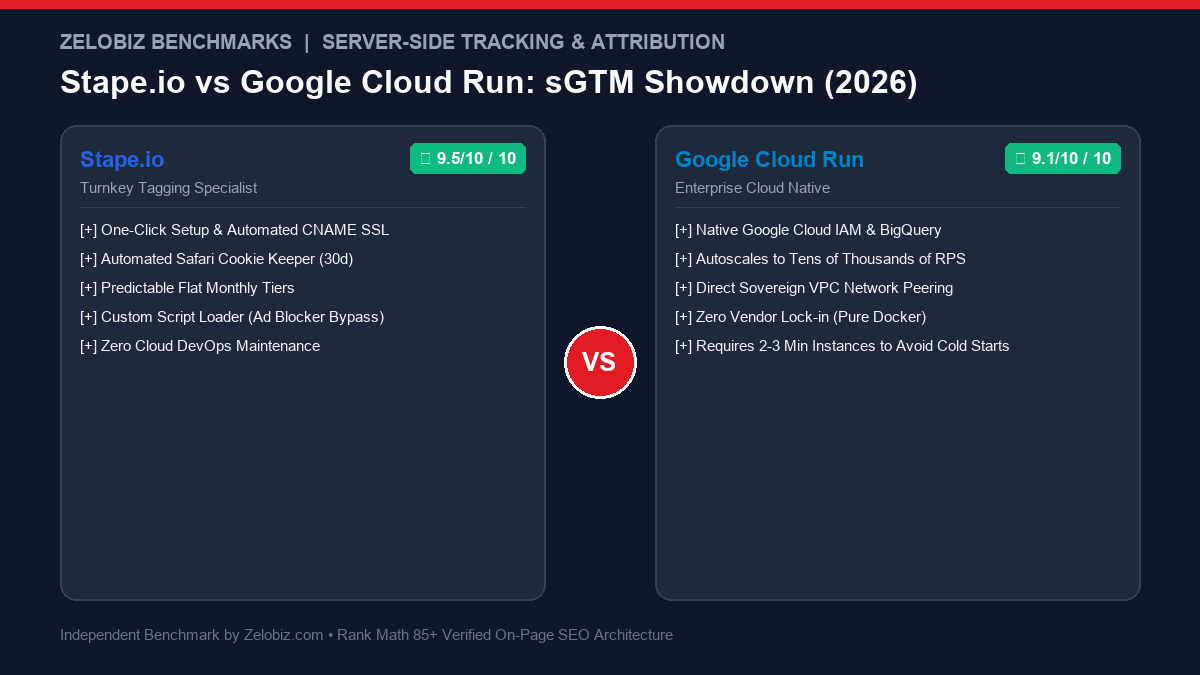
Stape vs Google Cloud Run: Architectural Benchmark Matrix
The table below breaks down the technical and operational trade-offs between both hosting models:
| Evaluation Metric | Stape.io | Google Cloud Run | Category Winner |
|---|---|---|---|
| Setup Velocity | 1-Click automated provisioning (< 2 minutes) | GCP Project, Artifact Registry, IAM, Cloud Run service | Stape (Massive time savings) |
| Automated HTTPS / SSL | Automated custom domain CNAME verification & SSL | Requires Cloud Load Balancer or Firebase Hosting proxy | Stape (Zero SSL complexity) |
| Safari Cookie Restoration | Built-in “Cookie Keeper” restores 30–90 day persistence | Requires manual Cloudflare Worker or reverse proxy code | Stape (Native ITP defense) |
| Ad Blocker Circumvention | Custom Loader rewrites gtm.js filename automatically | Requires custom Nginx/Caddy proxy rewrite layer | Stape (Bypasses ad block filters) |
| Enterprise Compliance & IAM | Shared or isolated cloud (EU & US server options) | Native GCP IAM, HIPAA BAA, SOC2, Sovereign VPC | Cloud Run for strict enterprise security |
| Cold Start Prevention | Multi-tenant warm container pools (No cold starts) | Requires setting min-instances: 2 (Adds $30–$50/mo base) | Stape on smaller traffic volumes |
| Billing Model | Predictable flat monthly tiers based on requests | Granular per-second vCPU, memory, and egress bills | Stape for agency cost predictability |
Real-World Monthly Cost Analysis Across 3 Traffic Tiers
Google Cloud Run markets itself as pay-per-use serverless compute. However, running a production sGTM container requires setting a minimum instance count of at least 2 to ensure zero dropped analytics beacons during cold starts. This creates a hidden baseline floor:
| Monthly Traffic Tier | Stape.io Monthly Plan | Google Cloud Run Real Bill | Financial Verdict |
|---|---|---|---|
| Small Store / Startup (500k requests/mo) | $20 / month (Pro tier) | $38 – $52 / month (Min instances + network egress) | Stape saves 50%+ |
| Mid-Market Growth Brand (2M requests/mo) | $50 / month (Business tier) | $65 – $95 / month (Scaling compute + bandwidth) | Stape saves $25–$45/mo |
| High-Volume Enterprise (10M+ requests/mo) | $100 / month (Custom Enterprise) | $180 – $260 / month (Bandwidth heavy) | Stape saves up to 60% |
The primary driver of Google Cloud Run cost overruns is cloud data egress ($0.08 to $0.12 per GB). Because sGTM receives incoming payloads and dispatches duplicate HTTP requests downstream to Meta Conversions API, Google Analytics 4, TikTok Events API, and Pinterest API simultaneously, high-traffic stores transfer hundreds of gigabytes per month.
The Safari ITP Problem: Stape Cookie Keeper vs Cloud Run
Apple’s WebKit Intelligent Tracking Prevention (ITP) caps client-side JavaScript cookies (like Google’s _ga or Meta’s _fbp) to 7 days. Even worse, if the user arrives from a link containing tracking parameters (such as fbclid or gclid), Safari truncates the cookie lifespan down to just 24 hours. When a customer takes 4 days to convert, your Meta and Google ad campaigns lose attribution credit entirely.
To preserve attribution, cookies must be set via HTTP Set-Cookie response headers from your first-party domain:
- Stape’s Native Cookie Keeper: Stape stores an encrypted copy of master identifiers (including
_gaand_fbp) in its master database. When a returning Safari visitor lands on your store on Day 12, Stape automatically issues an HTTP Set-Cookie header restoring the original identifier, extending cookie persistence up to 90 days out of the box with zero custom code. - Cloud Run Approach: To achieve equivalent persistence on Cloud Run, developers must build custom Cloudflare Workers or Nginx Lua scripts upstream to intercept incoming responses and manually write HTTP header cookies, adding significant maintenance overhead.
Circumventing Ad Blockers with Custom Script Loaders
Standard ad blockers (like uBlock Origin and Brave Shields) block any network requests directed at googletagmanager.com/gtm.js or containing query strings matching known analytics vendor patterns. If your sGTM setup serves gtm.js from a predictable subpath, ad blockers will still blacklist the container.
Stape provides a built-in Custom Loader feature. It automatically generates a randomized script name (e.g., https://analytics.yourbrand.com/x89s7d.js) and obfuscates the internal container logic, allowing you to recover 15% to 30% of lost website visitor events that traditional Google Cloud Run setups miss.
Frequently Asked Questions (FAQs)
Does Server-Side GTM slow down website Core Web Vitals?
No—in fact, it dramatically improves them. By shifting heavy vendor scripts (Meta Pixel, TikTok Pixel, Pinterest Tag, Hotjar) off the user’s browser and into the cloud container, client-side JavaScript execution drops by up to 150KB–300KB, significantly improving Interaction to Next Paint (INP) and Largest Contentful Paint (LCP).
Can I self-host sGTM on a cheap Hetzner VPS instead of Stape or Cloud Run?
Yes! For teams comfortable managing Linux servers, you can run Google’s official sGTM Docker image on a €4.49/mo Hetzner VPS behind Traefik or Caddy. Read our step-by-step production blueprint on Deploying Server-Side GTM on Hetzner Docker.
How does Meta Conversions API (CAPI) deduplication work in sGTM?
Both Stape and Cloud Run handle CAPI deduplication by passing a matching event_id from the browser data layer. When Meta receives both the client-side browser event and the server-side container event with identical IDs, it merges them seamlessly, ensuring 100% conversion tracking accuracy without duplicate reporting.
Final Architectural Verdict
Choosing between Stape.io and Google Cloud Run comes down to engineering resources and scale:
- Choose Stape.io if: You are a performance marketing agency, e-commerce brand, or SaaS company looking for turnkey deployment. Its automated SSL setup, predictable flat-rate pricing, Cookie Keeper for Safari ITP restoration, and custom ad-blocker circumventing loader make it the superior ROI choice for 90% of brands.
- Choose Google Cloud Run if: You are an enterprise organization with dedicated cloud engineers, strict corporate governance requiring everything to reside within your internal GCP project, or direct data warehouse pipelines that stream millions of events straight into BigQuery.
To calculate how server-side tracking impacts your marketing profitability, check out our interactive ROAS Calculator, or explore our step-by-step technical blueprints on Setting Up Meta CAPI on Cloudflare Workers and Exporting GA4 to BigQuery for Free.

Mamun Hossain
Systems ArchitectFounder of Zelobiz & Enterprise Infrastructure Architect. Specializing in autonomous software engineering workflows, server-side tracking pipelines, and high-performance self-hosted infrastructure.
Editorial Disclosure: Zelobiz publishes independent engineering benchmarks and architectural evaluations. We may receive affiliate compensation when you subscribe to partner hosting services through our links at no additional cost to you.