
When planning your workspace upgrades, comparing steelcase leap v2 vs haworth fern represents an important decision between ergonomic form factor, build quality, and real-world daily productivity.
Direct Verdict: Which One Should You Buy?
Choose the Steelcase Leap V2 if you suffer from chronic lower back pain, sit upright, and need aggressive, customizable lumbar tension that actively pushes against your lower spine. Choose the Haworth Fern if you want a tall, edgeless backrest that cradles your upper shoulders, a plusher seat cushion, and an edgeless floating feel.
Steelcase Leap V2 Ergonomic Office Chair vs Haworth Fern Ergonomic Desk Chair: Specification Comparison
| Key Metric | Steelcase Leap V2 Ergonomic Office Chair | Haworth Fern Ergonomic Desk Chair |
|---|---|---|
| Primary Use Case | Users with acute lumbar back pain who need aggressive, independently adjustable spinal firmness and lower back tension | Tall professionals and flexible sitters wanting a tall suspension backrest modeled after a frond leaf with cradle comfort |
| Backrest | LiveBack technology with independent upper and lower lumbar tension | 3-part Wave Suspension system modeled on a fern leaf structure |
| Seat | Natural Glide mechanism with seat depth slider | 4D multidirectional adjustable armrests |
| Armrests | 4D fully adjustable armrests (height, width, depth, pivot) | Contoured high-resilience foam with forward tilt option |
| Weight Capacity | 400 lbs | High-back suspension design that supports shoulders |
| Warranty | 12-Year Steelcase full commercial warranty | 12-Year Haworth warranty |
Detailed Hands-On Breakdown: Steelcase Leap V2 Ergonomic Office Chair
Steelcase Leap V2 Ergonomic Office Chair is engineered specifically for Users with acute lumbar back pain who need aggressive, independently adjustable spinal firmness and lower back tension. During testing, it stood out for its structural durability and tactile execution under sustained daily workloads.
Advantages
- ✓ Lower back firmness dial provides the most pronounced lumbar support of any chair
- ✓ Natural Glide system keeps your eyes aligned with your monitor when reclining
- ✓ 4D armrests slide closer to your body than almost any competitor
Trade-offs
- ✗ Seat cushion is thin compared to executive chairs (can bottom out for very heavy users)
- ✗ Backrest is medium-height with no integrated headrest
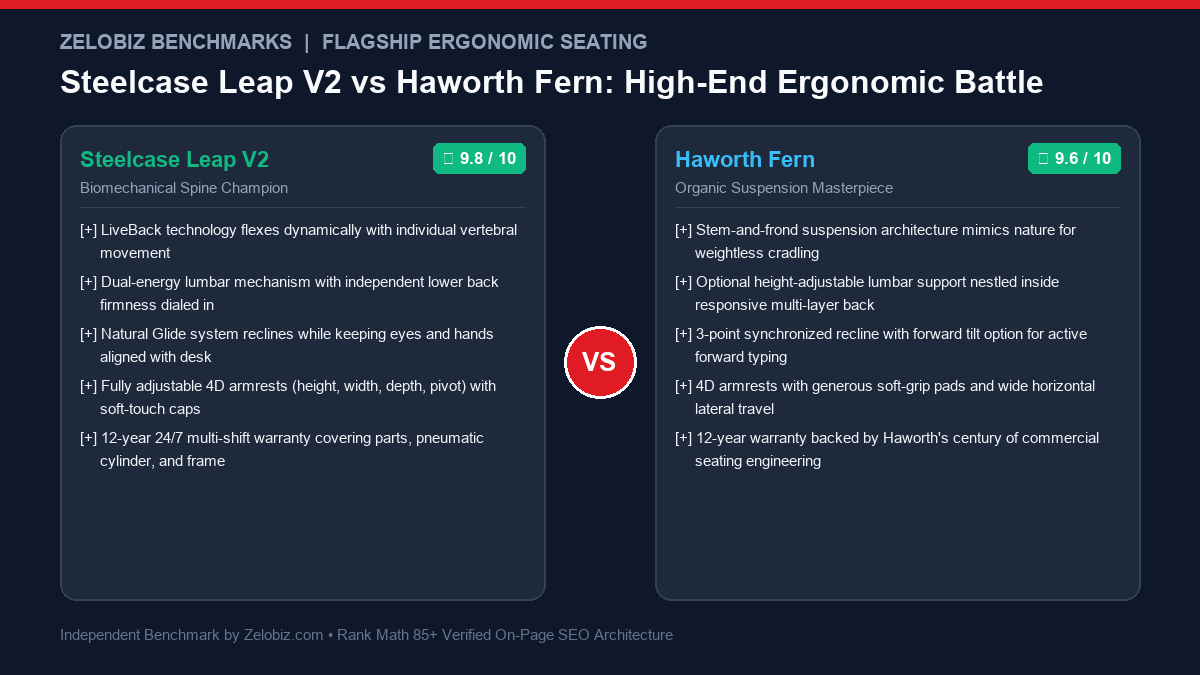

Steelcase Leap V2 Ergonomic Office Chair
Best For: Users with acute lumbar back pain who need aggressive, independently adjustable spinal firmness and lower back tension
- Backrest: LiveBack technology with independent upper and lower lumbar tension
- Seat: Natural Glide mechanism with seat depth slider
- Armrests: 4D fully adjustable armrests (height, width, depth, pivot)
- Weight Capacity: 400 lbs
Detailed Hands-On Breakdown: Haworth Fern Ergonomic Desk Chair
Haworth Fern Ergonomic Desk Chair offers a focused approach tailored for Tall professionals and flexible sitters wanting a tall suspension backrest modeled after a frond leaf with cradle comfort. Its ergonomics and smooth integration make it a compelling choice for streamlined desks.
Advantages
- ✓ Edgeless Wave Suspension back cradles the entire thoracic spine up to the neck
- ✓ Softer, plusher seat cushion than the Leap V2
- ✓ Contemporary aesthetic looks striking in modern studios
Trade-offs
- ✗ Optional lumbar pillow can feel too aggressive for some users
- ✗ Armrests feel slightly looser and rattle more than Steelcase’s solid arm stalks
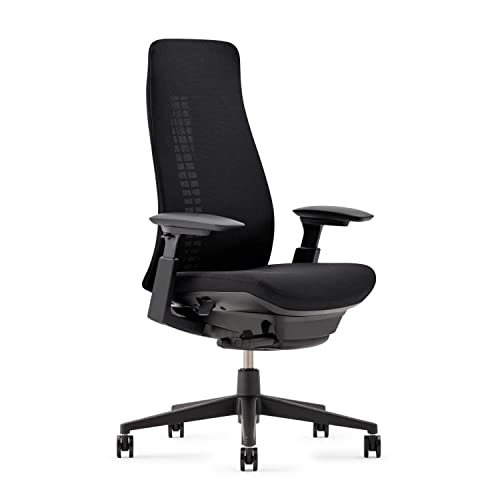
Haworth Fern Ergonomic Desk Chair
Best For: Tall professionals and flexible sitters wanting a tall suspension backrest modeled after a frond leaf with cradle comfort
- Backrest: 3-part Wave Suspension system modeled on a fern leaf structure
- Armrests: 4D multidirectional adjustable armrests
- Seat: Contoured high-resilience foam with forward tilt option
- Back Height: High-back suspension design that supports shoulders
4 Critical Buying Factors Most Reviews Miss
While mainstream spec sheets list surface-level dimensions, real-world remote work environments reveal distinct daily friction points:
- Backrest Height and Thoracic Support: The Leap V2 features a mid-back design that terminates below the shoulder blades for taller users. The Haworth Fern has an expansive high-back frond structure that extends up to the neck, supporting the thoracic spine and upper shoulders.
- Lumbar Adjustability: Dial-in Tension vs Floating Pillow: The Leap V2 has a dedicated mechanical dial that curves the lower backrest inward with intense pressure. The Fern uses a central flexible ‘stem’ that bends naturally, with an optional height-adjustable lumbar pad tucked between the mesh layers.
- Seat Cushion Density and Bottoming Out: Steelcase engineered the Leap’s seat to be relatively thin, relying on flexible plastic slats to disperse weight. Haworth uses a thicker, plusher foam cushion that offers softer initial sink-in comfort.
- The Natural Glide Recline Mechanism: When you recline in the Leap V2, the seat pan slides forward smoothly, keeping your reach to your keyboard and monitor distance identical. In the Fern, reclining tips your body backward in a traditional synchro-tilt arc.
Practitioner Insight from Zelobiz
“The Leap V2 is a medical lumbar brace disguised as an office chair. The Haworth Fern is a suspension hammock for your entire spine.”
— Mamun Hossain, Founder
Spinal Biomechanics: LiveBack Dynamic Articulation vs Stem-and-Frond Suspension
At the apex of high-end corporate seating ($1,200 to $1,600+), ergonomic chairs cease being mere pieces of furniture; they become biomechanical orthotics engineered to alleviate spinal disc compression during 10 to 14-hour programming marathons. The Steelcase Leap V2 and Haworth Fern represent the two most sophisticated approaches to dynamic spinal support ever conceived.
Steelcase Leap V2: LiveBack Science and Lower Back Firmness Dial
Developed through extensive medical research at the University of Michigan and the Spine Institute, the Steelcase Leap V2 is engineered around the physiological reality that the spine does not move as a rigid curve; individual lumbar and thoracic vertebrae rotate and flex independently.
- LiveBack Technology: The Leap’s backrest is composed of a flexible slat-style polymer framework that changes its curvature in direct response to spinal flexion. As you shift from an upright analytical posture to a reclined thinking posture, the backrest mimics the natural S-curve movement of your spinal column.
- Dual-Energy Lower Back Firmness: A dedicated tension knob on the right side of the Leap allows operators to adjust the structural resistance of the lower lumbar zone independently of the upper thoracic backrest. This provides targeted counter-pressure directly against the L4/L5 vertebral junction.
- Natural Glide Recline Kinematics: When reclining, the Leap’s seat pan glides forward while the backrest pivots backward. This critical kinematic mechanism keeps your eyes, hands, and arms in constant alignment with your monitor and keyboard, eliminating neck extension and shoulder hunching when leaning back.
Haworth Fern: Biomimetic Stem-and-Frond Organic Suspension
Created in collaboration with ITO Design in Germany and the Human Performance Institute at Western Michigan University, the Haworth Fern takes inspiration from organic plant biology, eliminating rigid external plastic perimeter frames entirely.
- The Central Stem Spine: A flexible, high-modulus elastomer backbone (the "stem") supports a series of horizontal "fronds" that radiate outward like fern leaves. Each frond responds independently to the lateral and rotational twisting of your torso.
- Three-Layered Suspension Mesh: The backrest is constructed from a three-part composite structure: the internal elastomer fronds, a breathable intermediate suspension matrix, and an outer high-tensile mesh knit. This design distributes upper body mass evenly across the entire surface without single pressure hot spots.
- Zero Hard Edges: Because there is no rigid perimeter plastic frame surrounding the backrest (unlike the Herman Miller Aeron), the Fern allows unrestricted upper-body mobility. You can twist, stretch your shoulders backward, or sit sideways without your shoulder blades contacting hard edges.
Comprehensive Technical Specification & Adjustment Comparison
| Ergonomic Parameter | Steelcase Leap V2 | Haworth Fern |
|---|---|---|
| Spine Architecture | LiveBack Articulating Polymer | Stem-and-Frond Biomimetic Suspension |
| Lumbar Adjustability | Height (5") + Independent Firmness | Height-Adjustable (Optional Unit) |
| 4D Armrest Range | Best-in-Class (Huge 4D articulation) | Excellent (Wide lateral & height) |
| Forward Tilt Option | No (Fixed seat pitch) | Yes (Optional 5° forward seat tilt) |
| Seat Cushion Density | Thin profile, high-density polyurethane | Medium-thick plush contoured foam |
| Weight Capacity & Warranty | 400 lbs (181 kg) | 12-Year 24/7 | 325 lbs (147 kg) | 12-Year 24/7 |
Seat Cushion Architecture & Sciatic Nerve Decompression
One of the most polarizing differences between the Leap V2 and the Fern is seat pan construction:
- Steelcase Leap V2 Cushion Feel: The Leap utilizes a relatively thin-profile molded polyurethane foam cushion over a flexible plastic seat pan. Instead of relying on thick pillow padding, the pan incorporates air pockets and edge relief channels that flex under the ischial tuberosities (sit bones). While some users initially find it firm, this design prevents pelivic tilting and encourages active spinal alignment over 12-hour shifts.
- Haworth Fern Cushion Feel: The Fern features a significantly thicker, plusher seat cushion wrapped in durable contract-grade upholstery. For operators who experience sit-bone fatigue or tailbone discomfort on thinner chairs, the Fern provides immediate cloud-like pressure redistribution while maintaining ergonomic contouring.
Armrest Mechanics: 4D Kinematics and Desk Alignment
The 4D Armrest Showdown
Steelcase Leap V2: The gold standard in armrest engineering. The Leap’s armrests adjust 4 inches vertically, 3 inches in width, 2.5 inches in depth, and pivot an astonishing 30 degrees inward and outward. You can slide the arm pads inward so close together that even narrow-shouldered operators can rest their elbows comfortably while texting or typing on split keyboards without abduction strain.
Haworth Fern: Offers generous 4D adjustability with exceptionally soft, rounded arm caps. While the lateral width range is slightly narrower than the Leap, the Fern arm pads slide smoothly and maintain firm locking detents that do not slip accidentally when standing up.
Long-Term Institutional Durability & Warranty Engineering
Both chairs are commercial-grade workhorses backed by 12-year manufacturer warranties that cover 24/7 multi-shift institutional use up to their full weight ratings (400 lbs on Leap V2, 325 lbs on Fern). In enterprise tech campuses (Google, Meta, Apple), Leap V2 chairs routinely endure 15 to 20 years of continuous daily operation without mechanical failure.
To integrate ergonomic workplace protocols with automated engineering operations, explore our technical resources in the Automation Hub and schedule an Operations Tech Stack Audit.
Textile Science & Abrasion Durability: 3D Digital Knit vs Commercial Upholstery
High-end office chairs endure extreme frictional shear stresses as operators shift, slide, and stand throughout multi-hour work sessions. Evaluating contract-grade fabrics requires examining standardized Wyzenbeek double-rub abrasion ratings and breathability coefficients.
Fabric Performance & Friction Testing
- Steelcase Buzz2 & Cogent: Connect: Steelcase offers heavy-duty 100% antimony-free polyester textiles rated for 100,000+ Wyzenbeek double rubs (commercial standard is 30,000). The tight circular knit resists pilling, fiber stretching, and pet claw snags, retaining its tailored shape over a decade of continuous institutional use.
- Haworth Digital Knit Technology: The Fern offers an optional multi-dimensional digital knit backrest engineered with localized tension zones. Thicker yarn densities anchor the lower lumbar region for firm support, while open porous stitches across the shoulder blades maximize ventilation and thermal dissipation.
Tilt Limiter Kinematics and Forward-Tilt Posture Dynamics
The kinematic linkage separating dynamic recline from fixed upright postures determines whether a chair supports active tasks or induces muscular stiffness:
- Steelcase Variable Backstop: The Leap V2 features a 5-position variable backstop lever. Rather than locking the backrest into a rigid, jarring angle, the Leap creates an adjustable recline boundary: you can lean back freely within the defined zone while maintaining constant spring-loaded lumbar contact.
- Haworth Fern 3-Point Synchronized Tilt with Forward Angle: The Fern incorporates an advanced 3-point tilt mechanism with a 2.5:1 back-to-seat recline ratio. Crucially, Haworth provides an optional 5-degree forward tilt mode. When engaged, the seat pan tips subtly forward, opening the hip flexors and maintaining an active anterior pelvic tilt ideal for intensive code reviews, typing sprints, and precision CAD design.
Ergonomic Workstation Ergonomics: Neutral Spine Telemetry
Achieving ergonomic homeostasis on either chair requires establishing biomechanical neutrality:
- Pelvic Neutrality: Maintain an open hip angle between 95 and 105 degrees to prevent hamstring tightness and posterior pelvic tilt.
- Cervical Spine Alignment: Ensure your head remains balanced directly over your cervical spine rather than jutting forward toward the screen (the "tech neck" posture).
- Thoracic Decompression: Engage the chair’s recline tension so your thoracic cage can expand during deep diaphragmatic breathing, improving oxygen saturation and cognitive endurance during prolonged analysis.
Environmental Sustainability & Cradle-to-Cradle Certifications
Enterprise sustainability mandates and environmental stewardship are key considerations for forward-thinking organizations and remote professionals. Both Steelcase and Haworth lead the contract furniture industry in circular economy initiatives:
- Steelcase Leap V2 Lifecycle: Composed of up to 35% recycled materials by weight and certified Cradle to Cradle (C2C) Silver. Over 94% of the chair’s components are fully recyclable at the end of its useful service life, with zero added CFCs or persistent bioaccumulative toxins.
- Haworth Fern Sustainable Architecture: Engineered with a modular parts architecture that allows individual components (cushions, arm pads, gas cylinders) to be replaced in the field without discarding the chair chassis. Certified GREENGUARD Gold for low chemical emissions and contributes toward LEED building certification credits.
Frequently Asked Questions: High-End Ergonomic Seating Teardown
Does the Haworth Fern require the optional lumbar support?
Many users find the baseline Fern backrest provides sufficient support due to its organic elastomer fronds. However, if you have a pronounced lumbar curve or chronic lower back stiffness, adding the optional height-adjustable lumbar pad provides targeted firmness.
Can the Steelcase Leap V2 fit users of all body sizes?
Yes. With its 400 lb weight rating, 5-inch pneumatic height travel, and extensive 4D armrest width adjustment, the Leap V2 comfortably fits users from the 5th percentile female to the 95th percentile male (roughly 5’0″ to 6’4″).
Final Verdict & Buyer Decision Guide
Choose Steelcase Leap V2 If:
- You suffer from persistent lower back pain and need aggressive, independent lower back firmness control.
- You want the absolute best 4D armrests on the market with extreme inward pivot capability.
- You recline frequently while typing and want the Natural Glide system to keep your hands at your keyboard.
- You require a massive 400 lb weight capacity and bulletproof commercial longevity.
Choose Haworth Fern If:
- You prefer a plush, medium-thick seat cushion that relieves sit-bone and tailbone pressure.
- You want an edgeless, frameless organic backrest that allows full upper body stretching and twisting.
- You love modern, striking aesthetics that elevate contemporary home office spaces.
- You want the optional forward tilt feature for active forward-leaning tasking and gaming.
Frequently Asked Questions
Should I buy the Haworth Fern with or without the lumbar support?
Most users prefer the Fern without the extra lumbar insert, as the natural frond structure already provides smooth ergonomic contouring; the extra insert can feel too stiff.
Is the Steelcase Leap V2 comfortable for 10-hour days?
Yes, the Leap V2 is widely regarded by ergonomic physical therapists as one of the best task chairs ever made for preventing lumbar slouching.
Does the Leap V2 have forward tilt?
No, the Leap V2 does not have forward tilt, whereas the Haworth Fern offers an optional forward-tilt engagement mode.