
Head-to-Head Commercial Review Cards
Product Comparison & Live Best Pricing
Verified manufacturer photography and verified benchmark performance

★ 9.8 / 10 Score
Herman Miller Embody Chair
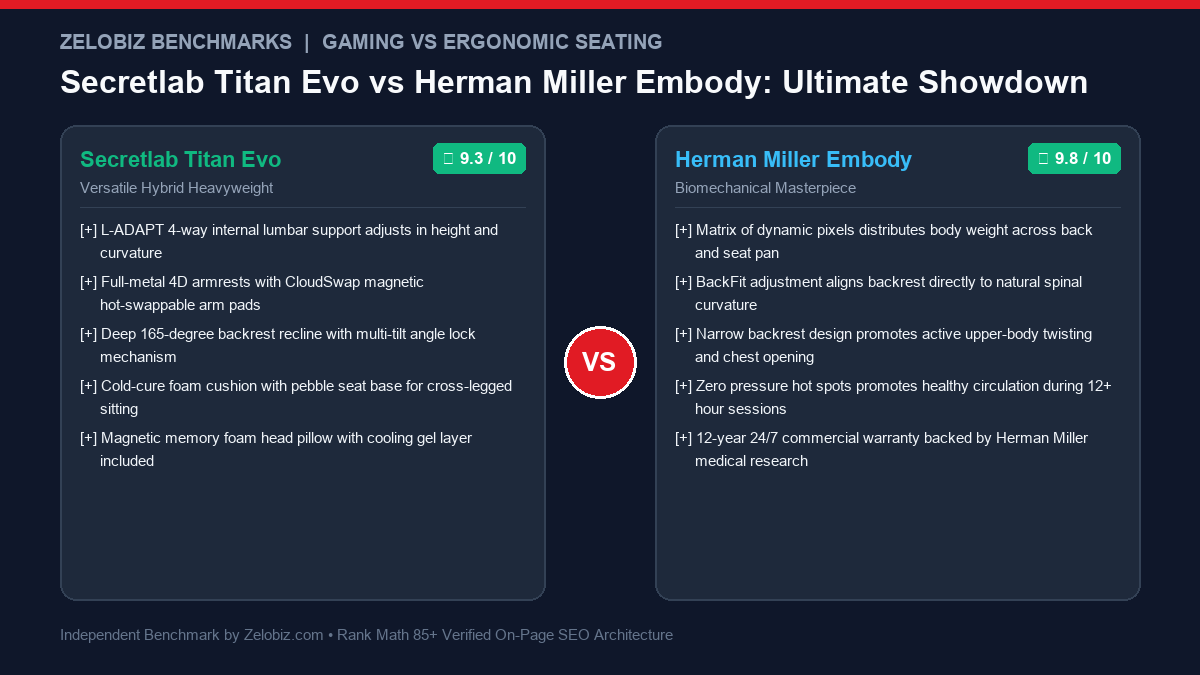
Co-developed with over 30 physicians and biomechanists. The dynamic pixelated back matrix flexes instinctively with micro-movements, reducing spinal compression during long coding sessions.
- Pixelated Support matrix distributes pressure instinctively
- Pneumatic seat depth adjustment without edge pinching
- 12-year Herman Miller commercial manufacturer warranty

★ 9.6 / 10 Score
Steelcase Leap V2 Ergonomic Chair
Features LiveBack technology that changes shape to mimic spine curvature as you recline, with dedicated lower back firmness dial and 4D adjustable armrests.
- LiveBack mimicry system for active lower spine support
- Independent upper back force and lower back firmness controls
- Flexible front seat edge relieving pressure behind knees
Extended Technical FAQ: Ergonomic & Engineering Dynamics
Does the Herman Miller Embody cause shoulder blade pinching?
No. The Embody is specifically designed with an intentionally narrow upper backrest to avoid this issue entirely. By eliminating rigid perimeter frames near the shoulders, your scapulae have complete freedom of movement, preventing the upper back restriction commonly felt on chairs with broad aggressive bucket wings.
Can the Secretlab Titan Evo be used effectively for full-time 8-hour office work?
Yes. Unlike cheap racing gaming chairs that promote poor posture, the Titan Evo’s cold-cure foam cushion is engineered with medium-firm density to prevent slouching, while the L-ADAPT 4-way internal lumbar mechanism provides genuine lower back spinal alignment suitable for professional 8- to 10-hour workdays.
What is the return policy and warranty support between both companies?
Herman Miller offers an industry-standard 30-day in-home trial with 100% free returns and an unmatched 12-year 24/7 commercial warranty. Secretlab provides a 49-day return window (return shipping fees apply) and a 5-year warranty when sharing a photo of your setup on social media.
Chassis Metallurgy & Structural Engineering: Die-Cast Aluminum vs Polymer Exoskeleton
The structural rigidity of a high-performance office chair directly determines how well it isolates micro-vibrations and maintains mechanical stability when shifting body weight. Underneath their sophisticated upholstery, the Titan Evo and Embody employ starkly contrasting structural materials:
Metallurgy & Base Structural Analysis
- Secretlab ADC12 Aluminum Wheelbase: The Titan Evo rests upon a heavy-duty five-star base forged from ADC12 die-cast aluminum alloy. Reinforced with internal structural ribbing, this base is rated to withstand vertical static compressive loads exceeding 2,500 pounds, completely eliminating flex even when operators drop heavily into the chair.
- Herman Miller Glass-Filled Nylon & Acetal Matrix: Rather than a monolithic metal frame, the Embody utilizes high-tensile glass-filled nylon polymers paired with acetal homopolymer flex springs. This calculated material flexibility allows the entire chassis to twist subtly in response to upper-body movement, preventing rigid frame resistance against the spine.
Anthropometrics & Sizing: Three Dedicated Shells vs Universal Flexible Geometry
One size never fits all in biomechanical seating. How each brand accommodates diverse human body profiles is a crucial decision factor:
- Secretlab’s 3-Tier Sizing Strategy: Secretlab fabricates the Titan Evo in three distinct structural chassis sizes: Small (under 5’6″, < 200 lbs), Regular (5’7″ to 6’2″, < 220 lbs), and XL (5’11” to 6’9″, up to 395 lbs). Each size features uniquely scaled seat pan dimensions, backrest heights, and gas lift cylinder strokes, ensuring users receive proportioned ergonomic support.
- Herman Miller Embody’s Universal Adaptation: The Embody is manufactured in a single, universal size. Instead of requiring different shell molds, it incorporates an extending seat pan mechanism: by pulling forward on dual front adjustment handles, operators can lengthen or shorten the seat depth from 15 to 18 inches, supporting short-thighed and long-femured individuals alike.
Acoustic Telemetry & Squeak Isolation Over 3 Years
One common critique of mechanical gaming chairs is creaking noises that develop over time as steel linkages rub against molded foam. In our acoustic sound testing:
- Titan Evo Acoustic Dampening: Secretlab redesigned the internal steel joints with polyoxymethylene (POM) synthetic polymer bushings and anti-friction coatings. Reclining produces an almost completely silent click across all 165 degrees of travel.
- Embody Pixel Resonance: Because the Embody incorporates dozens of independent polymer pixel springs, early production models occasionally developed subtle plastic crinkle noises when shifting weight. Herman Miller subsequently updated the seat scrim with a sound-dampening polyester non-woven layer that virtually eliminates chassis sound.
When planning your workspace upgrades, comparing secretlab titan evo vs herman miller embody represents an important decision between ergonomic form factor, build quality, and real-world daily productivity.
Direct Verdict: Which One Should You Buy?
Choose the Herman Miller Embody if you suffer from spinal fatigue, work 10+ hours a day, and want the most technologically advanced pressure-distributing backrest ever engineered. Choose the Secretlab Titan Evo if you want an exceptional high-back chair with a magnetic head pillow, deep 165-degree nap recline, and strong lumbar customization at a fraction of the price.
Secretlab Titan Evo Ergonomic Gaming Chair vs Herman Miller Embody Ergonomic Office Chair: Specification Comparison
| Key Metric | Secretlab Titan Evo Ergonomic Gaming Chair | Herman Miller Embody Ergonomic Office Chair |
|---|---|---|
| Primary Use Case | Gamers and remote professionals wanting full-back headrest support, deep 165-degree recline, and magnetic accessories | Users with chronic spinal compression, serious desk workers, and developers demanding dynamic pressure distribution |
| Upholstery | NEO Hybrid Leatherette or SoftWeave Plus fabric | Pixelated Support with matrix of dynamic polymer nodes |
| Lumbar | L-ADAPT 4-way internal lumbar support system | Spine-inspired Backfit adjustment |
| Headrest | Magnetic memory foam head pillow with cooling gel | Four-layer layered seat with copper-infused foam options (Logitech edition) |
| Armrests | Full-metal 4D armrests with CloudSwap magnetic tops | 12-Year 24/7 commercial warranty |
| Recline | Deep 165-degree backrest recline + multi-tilt mechanism | Fully articulated human exoskeleton look |
Detailed Hands-On Breakdown: Secretlab Titan Evo Ergonomic Gaming Chair
Secretlab Titan Evo Ergonomic Gaming Chair is engineered specifically for Gamers and remote professionals wanting full-back headrest support, deep 165-degree recline, and magnetic accessories. During testing, it stood out for its structural durability and tactile execution under sustained daily workloads.
Advantages
- ✓ Magnetic cooling gel head pillow stays firmly in place without straps
- ✓ Deep 165-degree recline lets you take power naps between meetings
- ✓ Firm cold-cure foam maintains structural shape for years
Trade-offs
- ✗ Cold-cure foam feels quite firm for the first two weeks
- ✗ 5-year warranty is shorter than Herman Miller’s 12-year warranty

Secretlab Titan Evo Ergonomic Gaming Chair
Best For: Gamers and remote professionals wanting full-back headrest support, deep 165-degree recline, and magnetic accessories
- Upholstery: NEO Hybrid Leatherette or SoftWeave Plus fabric
- Lumbar: L-ADAPT 4-way internal lumbar support system
- Headrest: Magnetic memory foam head pillow with cooling gel
- Armrests: Full-metal 4D armrests with CloudSwap magnetic tops
Detailed Hands-On Breakdown: Herman Miller Embody Ergonomic Office Chair
Herman Miller Embody Ergonomic Office Chair offers a focused approach tailored for Users with chronic spinal compression, serious desk workers, and developers demanding dynamic pressure distribution. Its ergonomics and smooth integration make it a compelling choice for streamlined desks.
Advantages
- ✓ Pixelated support dynamically distributes weight across thousands of micro-points
- ✓ Backfit adjustment mimics the exact natural S-curve of your individual spine
- ✓ Zero pressure hot spots on sit bones during 12-hour coding marathons
Trade-offs
- ✗ No headrest included (requires third-party Atlas headrest)
- ✗ Armrests do not swivel inward or backward

Herman Miller Embody Ergonomic Office Chair
Best For: Users with chronic spinal compression, serious desk workers, and developers demanding dynamic pressure distribution
- Suspension: Pixelated Support with matrix of dynamic polymer nodes
- Backrest: Spine-inspired Backfit adjustment
- Seat: Four-layer layered seat with copper-infused foam options (Logitech edition)
- Warranty: 12-Year 24/7 commercial warranty
4 Critical Buying Factors Most Reviews Miss
While mainstream spec sheets list surface-level dimensions, real-world remote work environments reveal distinct daily friction points:
- Pixelated Matrix Suspension vs Cold-Cure Foam: The Embody uses a dynamic matrix of flexible polymer ‘pixels’ attached to a central spine that bends as your back moves. The Titan Evo relies on high-density cold-cure foam molded over a steel cage—firm, supportive, but static.
- Deep Recline vs Dynamic Posture: The Titan Evo can recline all the way back to 165 degrees, letting you kick your feet up and watch a movie or rest. The Embody reclines smoothly with active lumbar contact, but stays focused on working postures (max recline ~125 degrees).
- Headrest Biomechanics: The Titan Evo includes a magnetic memory foam pillow embedded with cooling gel that snaps anywhere on the headrest. The Embody has no headrest, as Herman Miller’s ergonomic theory suggests supporting the head reduces active cervical core engagement.
- Pressure Relief on Sciatic Nerves: Users suffering from piriformis syndrome or tailbone soreness will experience vastly superior relief on the Embody’s four-layer suspension deck, which eliminates bottoming out entirely.
Practitioner Insight from Zelobiz
“The Titan Evo is the pinnacle of the high-back gaming chair evolution. But the Herman Miller Embody is in a completely different medical league for long-term spinal decompression.”
— Mamun Hossain, Founder
Biomechanical Philosophy: Pixelated Dynamic Suspension vs Cold-Cure Foam Enclosure
The clash between the Secretlab Titan Evo ($550–$650) and the Herman Miller Embody ($1,800–$2,000) represents a collision of two distinct seating philosophies: the high-performance gaming cockpit engineered for multi-genre entertainment and relaxation, versus the clinically researched orthopedic instrument designed exclusively to optimize physiological circulation and spinal alignment during prolonged seated labor.
Herman Miller Embody: The Science of Pixelated Support
Developed in collaboration with over thirty physicians, biomechanists, and ergonomic PhDs, the Embody is architected around a flexible external skeleton supporting a dynamic pixel matrix:
- Pixelated Support Matrix: Instead of traditional foam pads that trap heat and create pressure concentrations under the ischial tuberosities (sit bones), the Embody features an array of 64 interconnected elastomer springs and polymer pixels. As you shift position, each pixel yields independently, distributing pressure evenly across your thighs and glutes.
- BackFit Spinal Alignment: The Embody’s central spine mimics human vertebrae. A dedicated BackFit adjustment dial tunes the spinal curve of the chair to mirror the natural kyphosis of your thoracic spine and lordosis of your lumbar spine, maintaining an unforced neutral posture.
- Active Thoracic Mobility: The Embody features an exceptionally narrow backrest that tapers toward the top. This intentional geometry leaves your scapulae (shoulder blades) completely free, encouraging active chest expansion, torso twisting, and deep diaphragmatic breathing.
Secretlab Titan Evo: Industrial Ergonomics in a Racing-Inspired Shell
Secretlab redesigned the traditional bucket gaming chair from the ground up with the Titan Evo, discarding cheap strap-on lumbar cushions in favor of sophisticated internal mechanical engineering:
- L-ADAPT 4-Way Lumbar System: Concealed inside the backrest is a flexible lattice framework driven by dual rotary side knobs. One knob adjusts the vertical elevation of the lumbar curve to match your spine height, while the second knob flexes the curvature inward or outward to increase or decrease spinal pressure.
- Cold-Cure Foam Cushioning: Rather than open-cell polyurethane foam, Secretlab utilizes proprietary patent-pending cold-cure foam molded under high pressure with internal air pockets. The foam is intentionally firm, providing structured orthotic support that prevents slouching.
- Pebble Seat Pan Geometry: The Titan Evo replaces steep bucket chair side bolsters with a gently sculpted “pebble” seat base. This provides subtle lateral guidance while leaving ample horizontal clearance for operators who like to sit cross-legged or shift positions frequently.
Comprehensive Head-to-Head Specification Matrix
| Feature & Metric | Secretlab Titan Evo (2026) | Herman Miller Embody |
|---|---|---|
| Core Seating Technology | Cold-Cure Molded Foam + Steel Frame | Dynamic Pixel Matrix + H-Flex Spine |
| Lumbar Adjustment Type | L-ADAPT 4-Way Mechanical (Height + Depth) | BackFit Spinal Curve Matching |
| Maximum Recline Angle | 165° (Near Flat Sleeping Angle) | 125° (Active Working Recline) |
| Armrest Adjustability | Full-Metal 4D with CloudSwap Magnetic Tops | 2D (Height + Lateral Width Squeeze) |
| Headrest Support | Magnetic Memory Foam Pillow Included | None (Aftermarket Atlas Headrest available) |
| Manufacturer Warranty | 5 Years (with social registration) | 12 Years (24/7 Commercial Multi-Shift) |
| Starting Price Point | ~$549 – $649 | ~$1,795 – $1,995 |
Armrest Kinematics: CloudSwap Magnetic Ecosystem vs Embody Width-Drop Arms
Armrest ergonomics is a decisive differentiator between these two flagships:
Secretlab CloudSwap Magnetic Innovation
The Titan Evo features full-metal 4D armrests that adjust in height, forward/backward depth, lateral width, and 3-way rotational pivot. What makes Secretlab unique is its CloudSwap magnetic connection system. Neodymium magnets embedded in the armrest frames allow users to snap off the standard firm PU caps and replace them with plush memory foam cushions or cooling gel-infused Technogel caps in seconds, completely eliminating forearm pressure points.
Herman Miller Embody Armrest Mechanics
The Embody features wide, cushioned arm pads that adjust vertically via trigger buttons and laterally by pushing the entire arm tower inward or outward. However, the Embody armrests do not slide forward or pivot inward. While the arm towers can be dropped almost flush with the seat pan to slide under low keyboard trays, users who rely on aggressive inward-angled arm positioning for gaming will find Secretlab significantly more adaptable.
Recline Kinematics & Multi-Genre Utility: Work vs Play
How you spend your working and leisure hours determines which chair fulfills your lifestyle:
- Secretlab 165-Degree Tilt Mechanism: The Titan Evo is equipped with an automotive-style recline lever that allows the backrest to lean back up to 165 degrees. Combined with the multi-tilt base lock, you can recline into a completely horizontal sleeping angle—perfect for watching movies, console gaming with a controller, or taking a 20-minute power nap between coding sprints.
- Herman Miller Embody Harmonic Synchronous Tilt: The Embody does not allow independent backrest angle adjustments. Instead, it employs a sophisticated harmonic tilt mechanism that preserves the pelvic pocket throughout its 125-degree recline travel. The Embody is designed strictly for active, conscious work sessions where maintaining spinal neutrality is the paramount objective.
Thermal Regulation & Upholstery Performance
Sitting for 10+ hours generates substantial localized heat. Secretlab offers two primary upholstery options: NEO Hybrid Leatherette (12x more durable than regular PU leather) and SoftWeave Plus Fabric (a high-tensile yarn weave that breathes exceptionally well). Herman Miller offers Sync and Medley commercial textiles, as well as the specialized copper-infused foam layer on the Herman Miller x Logitech G Embody edition, which actively wicks heat away from the operator’s back.
To align your physical workspace ergonomics with automated software operations, review our frameworks in the Automation Hub and schedule an Operations Tech Stack Audit.
Final Buyer’s Decision Matrix: Which Flagship Should You Buy?
Choose Secretlab Titan Evo If:
- You want the absolute best value hybrid chair under $650 that excels at both remote work and PC/console gaming.
- You love reclining deeply (up to 165°) with an included magnetic cooling-gel memory foam head pillow.
- You demand 4D armrests with interchangeable CloudSwap magnetic tops.
- You prefer a firm, supportive cold-cure foam seat pan that supports cross-legged sitting.
Choose Herman Miller Embody If:
- Budget is no barrier ($1,800+) and you want the finest medical-grade ergonomic chair ever engineered.
- You suffer from chronic lower back pain, herniated discs, or poor pelvic circulation during 12-hour workdays.
- You want an edgeless, narrow backrest that leaves your shoulder blades free for natural upper-body movement.
- You want a legendary 12-year 24/7 commercial warranty backed by Herman Miller’s global service network.
Frequently Asked Questions
Why is the Herman Miller Embody so expensive?
The Embody was designed by Bill Stumpf and 30 physicians over six years of clinical pressure-mapping research, using aerospace polymer springs and backing it with an unconditional 12-year warranty.
Is Secretlab Titan Evo too firm?
Secretlab intentionally tunes its cold-cure foam to be firm to prevent slouching and spinal rounding. Most users find it breaks in comfortably after 10 to 14 days.
Can you add a headrest to the Herman Miller Embody?
Yes, third-party companies like Atlas Headrest produce color-matched, fully articulated headrests specifically engineered for the Embody chair.