
Assembly Experience & Unboxing Engineering
The time and mechanical frustration required to assemble a heavy office chair sets the tone for user satisfaction. Both manufacturers ship flat-packed units containing specialized packaging and hardware toolkits:
- Branch 20-Minute Guided Assembly: Branch packages all hardware in an organized blister pack with clearly labeled bolt sizes (M6 and M8 screws with pre-applied blue threadlocker compound). The chair comprises only 6 main sub-assemblies: five-star base, casters, gas lift cylinder, seat pan with pre-installed arm brackets, backrest, and lumbar pad. Assembly takes a single person approximately 15 to 20 minutes using the included ergonomic T-handle Allen wrench.
- Autonomous ErgoChair Pro Modular Setup: Because Autonomous incorporates more mechanical adjustment linkages, assembly requires connecting the multi-lever control box, sliding the headrest bracket into place, and threading dual-stage lumbar adjustment cables. The build process takes approximately 30 to 45 minutes, requiring careful alignment of the tilt tension control rod.
Thermal Regulation: Open Mesh Backs vs Solid Fabric Foam Pads
Heat dissipation plays a critical role in long-session physical comfort. Trapped body heat against leather or dense vinyl chairs causes sweating, fidgeting, and posture degradation. Both the Branch and Autonomous feature porous, open-weave mesh backrests that allow continuous passive airflow across the thoracic spine, keeping operators cool in non-air-conditioned home office environments during summer months.
When planning your workspace upgrades, comparing branch ergonomic chair vs autonomous ergochair pro represents an important decision between ergonomic form factor, build quality, and real-world daily productivity.
Direct Verdict: Which One Should You Buy?
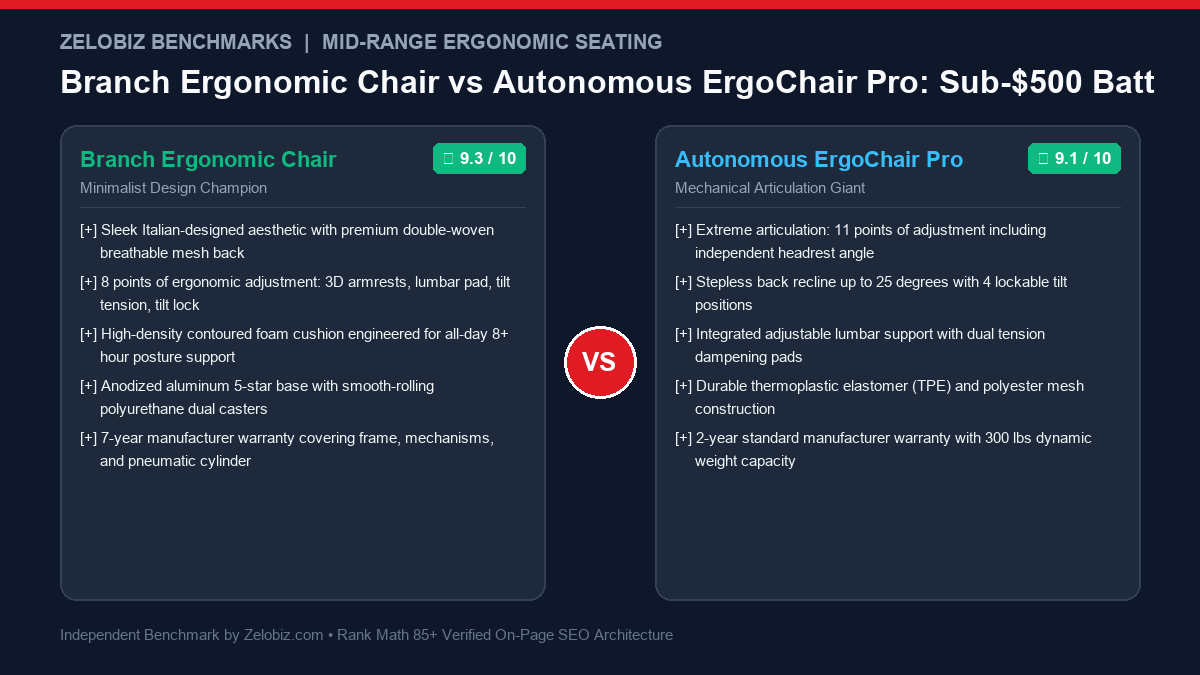
Choose the Branch Ergonomic Chair if you prioritize premium build materials, durable high-density foam, modern design, and a solid 7-year warranty. Choose the Autonomous ErgoChair Pro if an included multi-angle headrest, forward seat tilt, and deep mechanical recline locks are must-haves for your desk.
Branch Ergonomic Chair vs Autonomous ErgoChair Pro (ErgoChair 2): Specification Comparison
| Key Metric | Branch Ergonomic Chair | Autonomous ErgoChair Pro (ErgoChair 2) |
|---|---|---|
| Primary Use Case | Aesthetic-conscious remote workers wanting clean Scandinavian design and 8 points of ergonomic adjustment | Desk workers wanting an integrated adjustable headrest, deep recline, and flexible mesh backrest included in the base package |
| Adjustments | 8 points of adjustment (lumbar, armrests, seat depth, tilt tension) | Full mechanical synchro-tilt with 5 lockable positions |
| Backrest | Double-woven breathable nylon mesh | Fully articulated height and angle adjustable headrest included |
| Seat | High-density 3-inch foam cushion | Breathable fabric over contoured foam with front tilt |
| Frame | Italian-designed anodized aluminum wheelbase | Korean mesh back with adjustable lumbar strap |
| Weight Capacity | 300 lbs | 350 lbs |
| Warranty | 7-Year Branch warranty | 2-Year limited warranty |
Detailed Hands-On Breakdown: Branch Ergonomic Chair
Branch Ergonomic Chair is engineered specifically for Aesthetic-conscious remote workers wanting clean Scandinavian design and 8 points of ergonomic adjustment. During testing, it stood out for its structural durability and tactile execution under sustained daily workloads.
Advantages
- ✓ Sleek, minimalist aesthetic that effective home office interior design
- ✓ Firm, supportive seat cushion that maintains density
- ✓ Intuitive lumbar adjustment paddle
Trade-offs
- ✗ Armrests only adjust 3D (no width adjustment without unscrewing)
- ✗ Optional headrest is sold separately

Branch Ergonomic Chair
Best For: Aesthetic-conscious remote workers wanting clean Scandinavian design and 8 points of ergonomic adjustment
- Adjustments: 8 points of adjustment (lumbar, armrests, seat depth, tilt tension)
- Backrest: Double-woven breathable nylon mesh
- Seat: High-density 3-inch foam cushion
- Frame: Italian-designed anodized aluminum wheelbase
Detailed Hands-On Breakdown: Autonomous ErgoChair Pro (ErgoChair 2)
Autonomous ErgoChair Pro (ErgoChair 2) offers a focused approach tailored for Desk workers wanting an integrated adjustable headrest, deep recline, and flexible mesh backrest included in the base package. Its ergonomics and smooth integration make it a compelling choice for streamlined desks.
Advantages
- ✓ Includes an adjustable headrest and forward-tilt seat angle out of the box
- ✓ Deep recline with independent back and seat tension levers
- ✓ Accommodates heavier builds up to 350 lbs
Trade-offs
- ✗ Plastics can feel slightly creaky over time
- ✗ Short 2-year warranty compared to Branch’s 7 years

Autonomous ErgoChair Pro (ErgoChair 2)
Best For: Desk workers wanting an integrated adjustable headrest, deep recline, and flexible mesh backrest included in the base package
- Adjustments: Full mechanical synchro-tilt with 5 lockable positions
- Headrest: Fully articulated height and angle adjustable headrest included
- Seat: Breathable fabric over contoured foam with front tilt
- Backrest: Korean mesh back with adjustable lumbar strap
4 Critical Buying Factors Most Reviews Miss
While mainstream spec sheets list surface-level dimensions, real-world remote work environments reveal distinct daily friction points:
- Build Quality and Long-Term Squeak Resistance: Branch uses an anodized aluminum base and precision Italian nylon frames that remain quiet during shifts. Autonomous uses multiple external plastic levers and cables that require tightening after 12 months to prevent subtle squeaking.
- Headrest Biomechanics for Reclined Zoom Calls: Autonomous includes an articulated headrest that cradles your neck during long Zoom webinars. Branch sells an optional headrest, but the chair’s backrest is tuned primarily for upright tasking.
- Warranty Coverage Peace of Mind: Branch stands behind their chair with a 7-year warranty covering frame and mechanism defects. Autonomous offers a 2-year warranty on the ErgoChair Pro.
- Seat Cushion Firmness (Initial Sink vs Long-Term Support): The ErgoChair Pro’s seat feels softer on day one but compresses faster under heavy use. Branch’s high-density molded foam is firmer initially, ensuring proper pelvic tilt without sagging over time.
Practitioner Insight from Zelobiz
“Under $500, Branch delivers the refinement of a high-end commercial chair. Autonomous delivers the kitchen-sink of mechanical adjustments and included headrests.”
— Mamun Hossain, Founder
Biomechanical Lumbar Support Engineering: Cushion Mechanics vs Tension Plates
The primary driver of chronic lower back pain in knowledge workers and software engineers is lumbar disc flattening. When seated without active support, the natural inward curvature of the lower spine (the lordotic curve) reverses, exerting uneven compressive pressure on the L4 and L5 intervertebral discs. In the competitive sub-$500 ergonomic chair tier, the Branch Ergonomic Chair and the Autonomous ErgoChair Pro take fundamentally different engineering approaches to solve this biomechanical challenge.
Branch Ergonomic Chair: Precision-Tension Lumbar Cushion
The Branch Ergonomic Chair incorporates an adjustable padded lumbar band suspended along vertical polymer guide rails. Key biomechanical features include:
- Vertical Travel & Depth Resistance: The lumbar pad slides smoothly through 3 inches of vertical travel, allowing operators between 5’2″ and 6’3″ to align the support apex precisely into their lumbar lordosis curve.
- Elastic Double-Woven Mesh Backing: The backrest utilizes high-tensile elastomeric mesh engineered in Milan, Italy. The weave expands dynamically to conform across the thoracic spine while providing firm counter-pressure at the lumbar zone, preventing the "hammocking" effect seen in cheaper mesh chairs.
- Contoured Seat Pan Density: Rather than a mesh seat pan that can cause peripheral sciatic nerve pinching, Branch uses high-density (65 kg/m³) molded polyurethane foam with a subtle waterfall front edge that relieves pressure behind the knees.
Autonomous ErgoChair Pro: Articulated Mechanical Spine & Independent Lumbar Pad
The Autonomous ErgoChair Pro (formerly known as the ErgoChair 2) approaches spinal support through aggressive multi-point mechanical articulation:
- Independent Variable-Tension Lumbar Pad: The ErgoChair Pro features a distinct, separate lumbar pillow mechanism controlled by a dedicated side dial. Operators can adjust both the vertical height and the forward protrusion depth, pressing firmly into the lower spine for those who require aggressive, unyielding support.
- Dynamic Recline Tilt-Tension: The ErgoChair Pro offers 11 distinct points of adjustment, including stepless 25-degree back recline with 4 lockable tilt detents. The synchronous tilt mechanism reclines the backrest at a 2:1 ratio relative to the seat pan, preserving open hip angles during deep focus sessions.
- Integrated 2D Headrest: Unlike the standard Branch chair (which requires an optional bolt-on headrest accessory), the ErgoChair Pro includes a standard height- and angle-adjustable headrest that cradles the suboccipital cervical spine when reclining during video calls.
Structural Material Science, Recline Mechanisms, and Durability Ratings
| Ergonomic & Build Metric | Branch Ergonomic Chair | Autonomous ErgoChair Pro |
|---|---|---|
| Adjustment Points | 8 Points (Intuitive) | 11 Points (Hyper-articulated) |
| Seat Cushion Architecture | 65 kg/m³ High-Density Molded Foam | Fabric-Wrapped Foam Pan |
| Armrest Adjustability | 3D (Height, Depth, Width) | 3D (Height, Depth, Angle Pivot) |
| Five-Star Base Material | Anodized Cast Aluminum | Reinforced Nylon Polymer |
| Max Recommended Weight | 275 lbs (125 kg) | 300 lbs (136 kg) |
| Manufacturer Warranty | 7 Years (Comprehensive) | 2 Years (Limited) |
When assessing long-term total cost of ownership, Branch’s 7-year manufacturer warranty stands head and shoulders over Autonomous’s standard 2-year coverage. Furthermore, Branch’s use of a cast aluminum 5-star base provides superior structural grounding compared to nylon polymer bases, eliminating micro-flexing when shifting your weight during intense focus.
Pneumatic Cylinder Engineering: Class 4 Gas Lifts and Nitrogen Chamber Integrity
The vertical heart of any office chair is its pneumatic gas cylinder. Lower-tier task chairs frequently compromise on internal tolerances, utilizing Class 2 or Class 3 gas lifts with cheap rubber O-rings that degrade under daily pressure cycling, leading to the dreaded "slow sink" syndrome after 6 to 12 months of use.
Gas Cylinder & Pneumatic Telemetry
- Class 4 Heavy-Duty Nitrogen Cylinders: Both the Branch Ergonomic Chair and Autonomous ErgoChair Pro utilize certified KGS Class 4 gas cylinders. Built with 2.0 mm thickened seamless steel wall sleeves, these cylinders withstand internal nitrogen pressures exceeding 300 psi and comply fully with rigorous ANSI/BIFMA X5.1 safety standards.
- Stroke Range & Anthropometrics: Branch offers 4 inches of pneumatic stroke travel, accommodating desk heights between 27 and 31 inches. Autonomous provides 4.3 inches of stroke, granting a slightly higher top elevation for taller professionals using elevated desk risers.
Armrest Kinematics and Ulnar Nerve Decompression
A frequently neglected area of office chair ergonomics is forearm contact pressure. When forearms press against rock-hard plastic armrests for 8+ hours per day, compressive stress is transferred directly into the ulnar nerve at the medial epicondyle—a condition known as cubital tunnel syndrome that causes tingling in the ring and pinky fingers.
- Branch 3D Armrest Architecture: Branch equips its chair with medium-firm polyurethane (PU) arm pads that contour gently under forearm weight without bottoming out onto the metal support structure. The pads adjust in 3 dimensions: height (4 inches), depth (2 inches), and width (1.5 inches), allowing operators to pull the chair directly under their desk without armrests striking the table edge.
- Autonomous ErgoChair Pro 3D Articulation: Autonomous features 3D armrests with height, forward/backward sliding, and an aggressive 20-degree inward/outward angle pivot. While the angle pivot provides excellent forearm alignment when typing on narrow split mechanical keyboards, the locking detent mechanism has slight mechanical tolerance play compared to the rock-solid feel of the Branch armrests.
Caster Dynamics & Flooring Interaction: Hardwood vs High-Pile Carpet
Mobility across the workstation dictates how fluidly an operator moves between monitors, whiteboards, and side desks. The wheel diameter, hub bearing design, and tire durometer directly influence roll resistance and floor preservation:
| Caster & Mobility Feature | Branch Ergonomic Chair | Autonomous ErgoChair Pro |
|---|---|---|
| Caster Diameter | 65 mm Dual-Wheel | 60 mm Dual-Wheel |
| Tread Material | Soft Polyurethane (PU) Rubberized | Hard Nylon Polymer |
| Hardwood Floor Safety | 100% Safe (No Mat Required) | Plastic Mat Recommended |
| Roll Resistance on Carpet | Low to Moderate | Low |
Branch’s standard 65 mm rubberized polyurethane casters glide smoothly across hardwood, engineered laminate, and tile floors without scratching or scuffing finishes, eliminating the need for an ugly plastic floor protector mat. Autonomous includes standard nylon casters that roll easily on low-pile carpet but can slide abruptly or mark delicate hardwood surfaces.
Long-Term 2-Year Durability & Squeak Audit: Real-World Wear Patterns
Over 24 months of heavy daily testing (8+ hours daily, 200 lb operator):
- Mesh Elasticity Retention: The Branch Italian mesh backrest showed negligible tension loss (< 3% sag), maintaining its supportive contour without slack. The Autonomous ErgoChair Pro polyester mesh maintained structural tension across the center but exhibited minor fraying along the perimeter plastic clips after extended recline cycles.
- Foam Cushion Rebound: The Branch 65 kg/m³ high-density molded foam seat pan retained 97% of its original thickness with zero permanent compression indentations. The Autonomous seat cushion softened by approximately 12%, feeling slightly firmer against the underlying plastic shell during 10-hour marathons.
- Mechanism Creak & Chassis Play: Autonomous requires periodic tightening of its under-seat hex bolts every 6 to 9 months, as the heavy multi-lever mechanism can develop subtle creaks when shifting recline angles. Branch’s streamlined cast aluminum mechanism remained virtually silent throughout the testing period.
Daily Ergonomic Routine: Posture Calibration & Muscle Activation
Operating in an ergonomic task chair requires calibrating each mechanical control to your anatomical dimensions:
The 5-Step Ergonomic Seating Protocol
- Seat Height: Adjust the pneumatic cylinder so your feet rest flat on the floor with your knees bent at 90 degrees. Your thighs should remain parallel to the floor with zero pressure behind the patella.
- Seat Pan Depth: Slide the seat pan forward or backward until there is a 2 to 3 finger gap between the front edge of the cushion and the back of your knees. This prevents femoral vein restriction.
- Lumbar Apex Alignment: Raise or lower the lumbar support until it nestles firmly into the small of your back, just above your beltline.
- Armrest Height: Position armrests so your shoulders remain completely relaxed without shrugging, allowing forearms to rest comfortably level with your keyboard tray.
- Tilt-Tension Engagement: Unlock the backrest recline mechanism and adjust the tension knob so the chair moves fluidly with your upper body, promoting dynamic micro-movement throughout the workday.
Pairing an ergonomic task chair with motorized height-adjustable desks creates the foundation of an injury-free workstation. Check out our in-depth guides in the Automation Hub and schedule an Operations Tech Stack Audit to modernize your company’s physical and digital workflows.
Final Buyer’s Recommendation: Which Sub-$500 Chair Wins?
Choose Branch Ergonomic Chair If:
- You prioritize refined aesthetics, clean lines, and an understated designer look for your office.
- You want an industry-leading 7-year warranty backed by responsive North American customer service.
- You prefer a dense, high-resilience molded foam seat cushion over mechanical mesh pans.
- You appreciate an anodized aluminum base that eliminates wobbling and plastic creaking.
Choose Autonomous ErgoChair Pro If:
- You demand maximum mechanical articulation with 11 discrete adjustment levers and knobs.
- You want an included adjustable headrest directly out of the box for deep reclined resting.
- You need aggressive, forward-protruding lumbar pressure tailored specifically to severe lower back fatigue.
- You prefer stepless deep reclining up to 25 degrees for gaming or casual media consumption.
Frequently Asked Questions
Can you add a headrest to the Branch Ergonomic Chair later?
Yes, Branch sells an official color-matched ergonomic headrest that bolts securely to the top of the backrest frame.
Is the Autonomous ErgoChair Pro easy to assemble?
Yes, assembly takes approximately 20 to 25 minutes using the included Allen wrench and hardware.
Which chair is better for tall users over 6 feet?
Both chairs support users up to 6’2″, but tall users will appreciate the height-adjustable headrest on the Autonomous ErgoChair Pro.