
Creative strategy is the single most powerful lever for profitable performance marketing in 2026. With Meta, TikTok, and Google leveraging automated algorithmic bidding (Advantage+ and Performance Max), manual audience targeting has become commoditized. What separates an agency scaling to $100k/day from one stuck at a 1.2 ROAS is the ability to deconstruct winning competitor ad creatives, diagnose psychological hooks, and rapidly deploy higher-converting iterations.
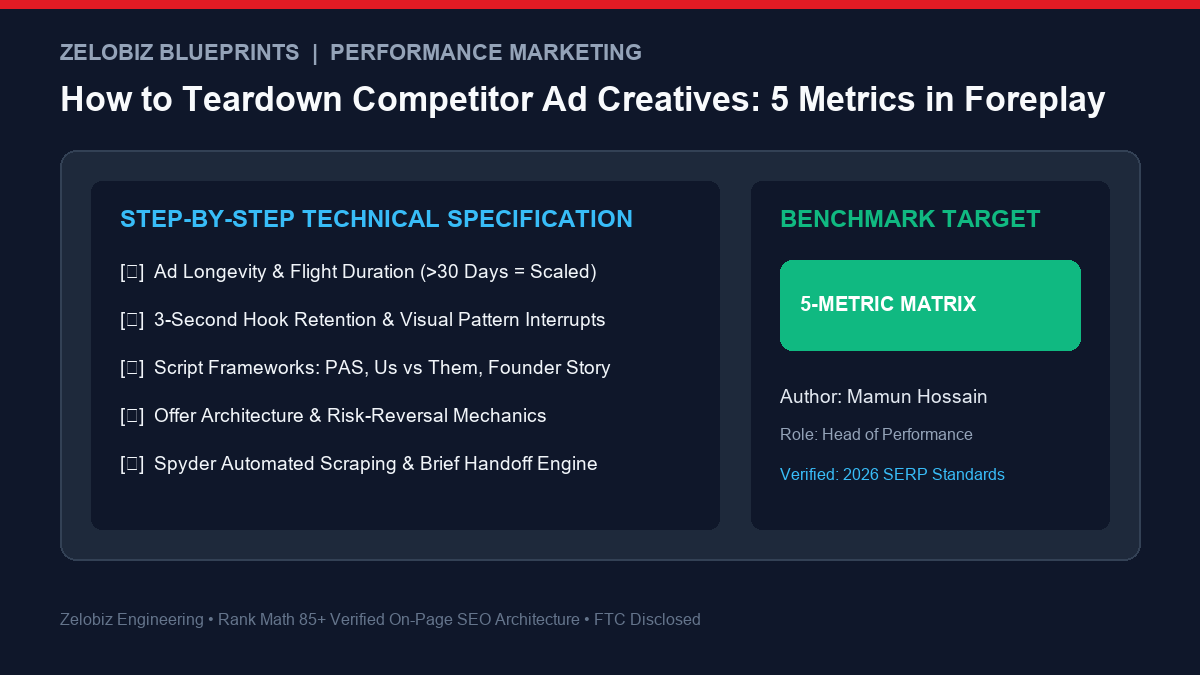
Figure 1: The 5-metric quantitative ad creative teardown framework utilized by top direct-response media buyers in Foreplay.co.
Direct Answer: What Is the Optimal Framework for Ad Creative Teardowns?
Bottom Line: A professional ad creative teardown evaluates 5 quantifiable pillars: Ad Longevity (identifying ads active for >30–60 days as proven winners), 3-Second Hook Retention (visual pattern interrupts and opening audio hooks), Messaging Architecture (problem-agitate-solution vs. Us-vs-Them contrast), Offer Risk-Reversal (free trial, guarantee, or bundle pricing), and Asset Pacing (shot length and text density). Platforms like Foreplay.co streamline this by scraping competitor assets 24/7, transcribing copy, and exporting structured briefs to video editors.
Instead of relying on random hunches or messy Google Drive folders with expiring Meta Ad Library links, scaling direct-to-consumer (DTC) brands and B2B agencies treat creative research as an engineered pipeline.
Why the Native Meta Ad Library Is Insufficient for Serious Teams
While the Meta Ad Library is free, it possesses severe structural flaws that cripple creative workflow:
- Temporary Cloud Links: Video assets in the Meta Ad Library expire once the competitor pauses the campaign. If a competitor runs a seasonal flash-sale winner, you lose access to the video asset before your editors can review it.
- No Longevity Telemetry: The native library does not track historic run-time data, making it difficult to differentiate an experimental $5/day test ad from an asset that has spent $250,000 over 4 months.
- Zero Audio Transcription: Reviewing 50 competitor TikTok and Reels ads requires watching hundreds of minutes of footage. Modern research tools use AI speech-to-text to index ad copy transcripts in seconds.
- No Team Briefing Handoff: You cannot easily transform an Ad Library link into an actionable storyboard with camera angles, text overlays, and B-roll callouts for your content creators.
The 5 Quantitative Metrics of an Ad Creative Teardown
1. Ad Longevity & Flight Duration (The “Proof of Spend” Metric)
The cardinal rule of media buying: Nobody keeps losing ads running.
When conducting a teardown, filter competitor creatives by active flight time:
- Under 7 Days: Experimental testing asset. Ignore for now.
- 14 to 30 Days: Promising variation gaining algorithmic spend.
- 60+ Days: Flagship Hero Asset. The advertiser is pumping substantial daily budget into this creative. This asset holds the winning hook, angle, or offer you must study.
2. The 3-Second Hook & Visual Pattern Interrupt
In mobile feeds, 85% of users scroll past ads within 2.5 seconds. The hook’s sole job is to stop the thumb. Break down the opening 3 seconds into:
- Visual Disruption: Does the ad open with an unexpected motion, a jarring split-screen, or an unconventional camera perspective (e.g., dropping the product on a concrete floor)?
- Text Overlay Hook: Does the first caption challenge conventional wisdom (e.g., “Stop using Zapier for this” or “Why dermatologists are throwing away retinol”)?
- Auditory Hook: Is the audio an ASMR tactile sound, a trending TikTok sound bite, or a direct provocative question?
3. Messaging Architecture & Script Angle
Categorize the underlying psychological trigger behind the creative:
| Script Framework | Core Narrative Arc | Best Funnel Placement |
|---|---|---|
| PAS (Problem-Agitate-Solve) | Exposes a daily friction, highlights consequences of inaction, presents product as relief. | Cold Top-of-Funnel (Broad) |
| Us vs. Them (Side-by-Side) | Split screen contrasting legacy competitor flaws against your streamlined feature set. | Middle-of-Funnel Consideration |
| Founder Teardown / Unboxing | Raw, high-authenticity breakdown explaining why the founder built the product. | Retargeting / Trust Building |
| Social Proof Montage | Rapid 3-second cuts of real customer video reviews and press quotes. | Bottom-of-Funnel Conversion |
4. Offer Structure & Risk-Reversal Mechanics
An extraordinary creative cannot fix an uninspired offer. During your teardown, document the exact call-to-action:
- What is the headline value proposition (e.g., “Buy 1 Get 1 50% Off”, “14-Day Free Trial Without Credit Card”, or “Lifetime Deal Access”)?
- How is risk neutralized (e.g., 60-day money-back guarantee, free returns, instant setup)?
- Is the checkout landing page a custom advertorial, a listicle, or a direct product page?
5. Production Pacing & Asset Density
Analyze the technical construction of the video or static card:
- Shot Transition Speed: Top-performing UGC ads switch camera angles or B-roll shots every 1.5 to 2.2 seconds to maintain high dopamine engagement.
- Caption Styling: High-contrast, dynamic word-by-word subtitles (CapCut/Submagic style) increase muted mobile view engagement by over 30%.
Step-by-Step Workflow: Conducting Teardowns with Foreplay.co
Step 1: Set Up Automated Competitor Tracking via “Spyder”
- Log into your Foreplay.co dashboard.
- Open the Spyder tool from the left menu.
- Add your top 10 direct competitors and 5 aspirational brands outside your niche (e.g., Athletic Greens, Ridge Wallet, or Monday.com).
- Spyder will crawl the Meta Ad Library, TikTok Creative Center, and LinkedIn Ads automatically, saving every newly launched asset directly into your team workspace.
Step 2: Save to Categorized Swipe File Boards
Never dump creatives into a single chaotic folder. Organize your swipe file boards by strategic function:
Board 1: High-Performing Hooks (0-3s Inspiration)Board 2: Us vs. Them ComparisonsBoard 3: B2B SaaS Workflow DemosBoard 4: Black Friday / Promotional Offers
Step 3: Extract AI Transcripts & Generate Creative Briefs
- Click on any saved competitor video in Foreplay.
- Review the automated AI speech transcript to instantly copy the script narrative without manual typing.
- Click Create Brief. Foreplay allows you to select specific scenes from the competitor asset, attach notes for your videographer (e.g., “Replicate this hook angle with our brand colors”), and export a shareable link or PDF storyboard.
Frequently Asked Questions (FAQ)
Does analyzing competitor ads violate platform policies or copyright?
No. Publicly broadcast advertisements in the Meta Ad Library and TikTok Creative Center are public records. Analyzing competitor angles, hooks, and structures to inspire your own original creative content is standard marketing practice. Never steal or re-upload a competitor’s proprietary video or image assets directly.
How many ad creative iterations should an agency test per week?
For brands spending between $10,000 and $50,000 per month, the golden standard is deploying 5 to 10 new creative variations per week (including 2–3 new script concepts and 3–5 hook variations of existing winning bodies).
Can Foreplay track TikTok Spark Ads and Dark Posts?
Yes. Foreplay’s Chrome extension clips both active dark posts and standard organic creator Spark ads directly from mobile web links or desktop feeds.
Struggling with Creative Ad Fatigue on Meta or TikTok?
Zelobiz conducts comprehensive ad account audits, creative teardowns, and high-CTR video brief production for ambitious brands looking to scale profitably.
Claim Your Free Creative & Ad Audit →Explore more actionable playbooks in our Performance Marketing Resource Center or calculate your break-even ad metrics with our free ROAS Calculator.