
Modern B2B Go-To-Market (GTM) teams spend thousands of dollars each month on enterprise data enrichment subscriptions like Clay, ZoomInfo, and Clearbit. While Clay provides a slick spreadsheet interface, agencies and scaling startups quickly run into prohibitive credit costs when enriching tens of thousands of outbound prospects. By architecting an automated lead enrichment pipeline using n8n (self-hosted or cloud) combined with Apollo.io, Hunter.io, and OpenAI, you can build a customized, production-grade enrichment waterfall that cuts data acquisition costs by over 80% while retaining full ownership of your pipeline logic.
Executive Architecture Summary: Building an n8n Enrichment Engine
An automated n8n lead enrichment engine ingests raw company domains via webhooks, checks local database caches to prevent duplicate credit burn, queries Apollo and Hunter APIs in a fallback waterfall, and applies OpenAI structured JSON parsing to score ICP fit (0-100) before routing qualified leads directly to your CRM.
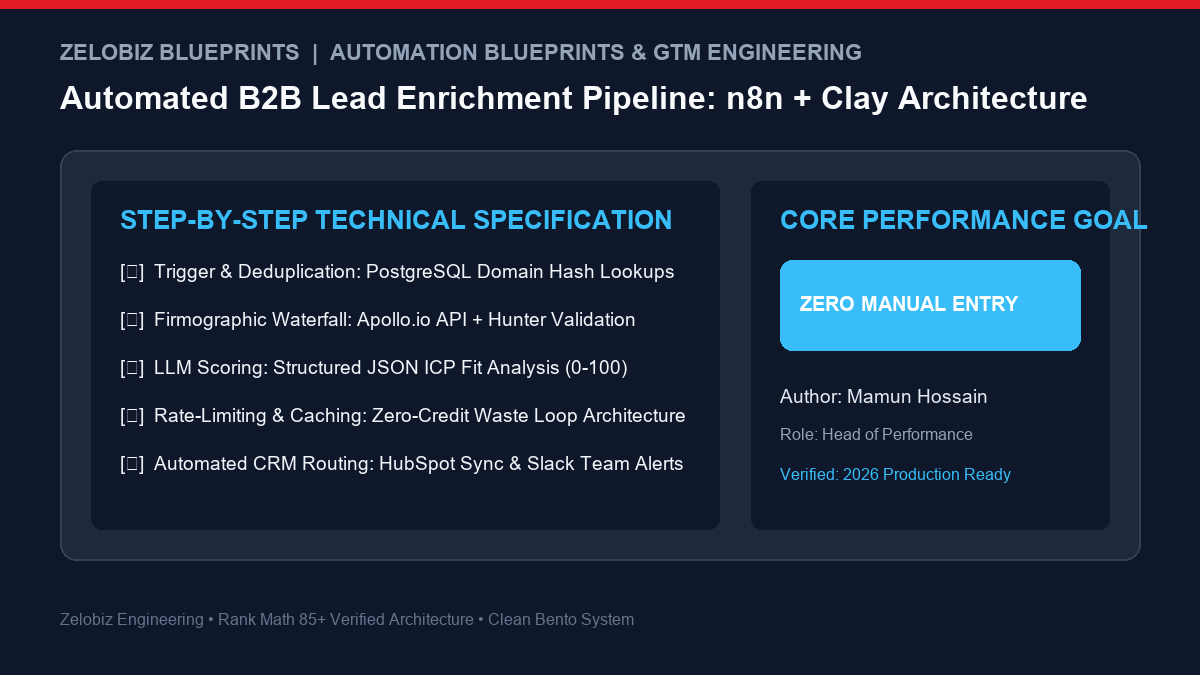
1. The Core Architecture: The “Waterfall” Enrichment Pattern
The waterfall enrichment design pattern sequentially queries multiple data providers in order of cost and data fidelity. If Provider A returns an unverified email or missing phone number, the workflow automatically cascades to Provider B, ensuring maximum data match rates without overpaying for enterprise bundles.
Our production pipeline operates across six discrete execution stages:
- Ingestion & Normalization: Webhook catches incoming form submissions (Tally, Typeform) or CSV uploads from Google Sheets/Airtable. URL clean-up extracts root domains (e.g., stripping
https://www.and query parameters). - Cache & Deduplication: Workflow queries an internal PostgreSQL or Airtable table. If the domain was enriched within the last 30 days, cached data is returned instantly, preventing wasted API credits.
- Firmographic & Contact Lookup (Apollo.io API): Queries Apollo for company size, revenue estimates, technology stack, and decision-maker profiles (e.g., “VP of Marketing”, “Head of Sales”).
- Email Verification Waterfall (Hunter.io): If Apollo returns an unverified or catch-all email, n8n invokes Hunter.io’s Email Finder to determine confidence scores and MX server deliverability.
- AI ICP Scoring (OpenAI / Claude): An LLM node ingests the aggregated profile and scores the lead against your Ideal Customer Profile criteria using strict JSON schema output.
- CRM Routing & Team Alerting: High-scoring leads (Score > 75) sync immediately to HubSpot or Salesforce and trigger a Slack notification; secondary leads enter a nurture sequence.
2. Step-by-Step n8n Pipeline Implementation
Step 1: Ingest & Deduplicate with Domain Hashing
To eliminate duplicate credit usage, place a Code Node immediately following your webhook or Google Sheets trigger. This normalizes the domain string and queries your local cache:
// Normalize domain string in n8n Code Node
const rawUrl = $json.website || $json.domain || "";
let domain = rawUrl.toLowerCase().trim();
domain = domain.replace(/^(?:https?:\/\/)?(?:www\.)?/i, "").split('/')[0];

return {
  json: {
    clean_domain: domain,
    company_name: $json.company_name || "",
    ingested_at: new Date().toISOString()
  }
};
Step 2: Query the Apollo.io API via HTTP Request Node
Instead of relying on rigid community nodes, use n8n’s native HTTP Request node to interact directly with Apollo’s mixed people search endpoint. This provides total control over pagination and job title filters:
// HTTP Request Node Configuration:
// Method: POST
// URL: https://api.apollo.io/v1/mixed_people/search
// Headers:
//   Content-Type: application/json
//   Cache-Control: no-cache
//   Api-Key: {{ $env.APOLLO_API_KEY }}

{
  "q_organization_domains": "{{ $json.clean_domain }}",
  "person_titles": ["Founder", "Co-Founder", "CEO", "Head of Growth", "VP Marketing"],
  "page": 1,
  "per_page": 1
}
Step 3: Hunter.io Verification Fallback
Connect an If Node evaluating {{ $json.people[0].email_status }}. If the status is not verified, branch to a Hunter.io HTTP request node passing first_name, last_name, and clean_domain. Hunter returns an email deliverability score and MX server verification.
Step 4: AI Qualification with Structured JSON Schema
Feed the enriched contact and company profile into an OpenAI Chat Model node paired with an n8n Structured Output Parser. This guarantees reliable downstream routing without syntax crashes:
System: You are an elite B2B SDR. Analyze the target company and contact profile. Score the opportunity strictly from 0 to 100 based on fit for our enterprise agency service.
Required JSON Output:
{
“icp_score”: 85,
“qualification_tier”: “Tier-1 Enterprise”,
“personalized_hook”: “Noticed your team is scaling paid acquisition on Meta while hiring 3 Growth Engineers.”,
“routing_decision”: “direct_sales_rep”
}
Step 5: Automated CRM Sync & Slack Webhook Routing
Use a Switch Node on {{ $json.icp_score }}:
- Score >= 75 (Hot Prospects): Push to HubSpot as an active Sales Lead, assign account executive, and post a rich formatted card into
#sales-hot-leadsvia Slack Bot. - Score 40–74 (Nurture Pool): Sync to Airtable and add to an automated 30-day educational newsletter drip via SendFox or Mailchimp.
- Score < 40 (Disqualified): Log to database for negative targeting in paid advertising campaigns.
3. Comparing Enrichment Approaches: n8n vs. Clay vs. Traditional SaaS
| Architecture Dimension | Custom n8n Pipeline | Clay.com | ZoomInfo / Clearbit |
|---|---|---|---|
| Monthly Cost (10k Leads) | $49 – $99 (Direct API costs) | $349 – $800/mo (Credit tiers) | $15,000+/year (Annual lock-in) |
| Provider Flexibility | Infinite (Any REST API can be chained) | High (Pre-built Clay marketplace) | Zero (Locked to proprietary database) |
| Data Privacy & Governance | 100% Self-Hosted on your VPS/Docker | Multi-tenant Cloud SaaS | Enterprise Cloud SLA |
| Setup Complexity | Intermediate (Low-code node setup) | Beginner-Friendly (Spreadsheet UI) | Enterprise Onboarding Needed |
4. Frequently Asked Questions (FAQ)
Can I self-host n8n to avoid execution fees?
Yes. n8n can be deployed via Docker on any cheap VPS (such as a $6/mo Hetzner or DigitalOcean droplet). In self-hosted community editions, you receive unlimited workflow executions with zero per-run fees.
What if Apollo API hits rate limits during heavy batch processing?
Implement n8n’s Wait Node with exponential backoff. Configure your batch loop to process in chunks of 10 items, followed by a 2-second sleep. In the HTTP Request node settings, enable “Retry on Fail” with 3 retry attempts to handle transient 429 status codes automatically.
How do I calculate software savings from building this pipeline?
Calculate your agency’s cumulative SaaS spend across subscriptions and credit burn using our Interactive SaaS Cost Calculator to determine your exact payback period.
Automate Your Agency’s Outbound & Inbound Funnels
Looking to build custom data pipelines, high-converting server-side tracking, or automated lead workflows? Consult with our engineering team or run a diagnostic teardown through our Zelobiz Agency Infrastructure Audit.
Explore our technical problem-solving series in the How-To Guides Hub or discover vetted software investments in our Lifetime Deals Hub.
To learn how to host your own high-volume n8n workflow engine on dedicated cloud instances, check out our operational guide on Self-Hosted n8n on Hetzner vs n8n Cloud and read the overarching architecture in our Self-Hosted Business Infrastructure Guide (2026).

Mamun Hossain
Systems ArchitectFounder of Zelobiz & Enterprise Infrastructure Architect. Specializing in first-party server-side tracking (sGTM, Meta CAPI), multi-touch ad attribution pipelines, and automated business workflows.