
Cloud storage subscription fees have quietly become one of the most persistent recurring drains on creative agencies, remote developers, and digital entrepreneurs. Paying $120 to $240 every year to Dropbox, Google One, or Microsoft OneDrive for storage that you never truly own feels increasingly unsustainable. In 2026, the two premier providers offering genuine lifetime cloud storage are Switzerland-based pCloud and UK-based Icedrive.
Executive Summary: Swiss Veteran vs Next-Gen Privacy
When weighing pCloud vs Icedrive, you are choosing between two of the most technically capable non-Big-Tech cloud ecosystems on the planet:
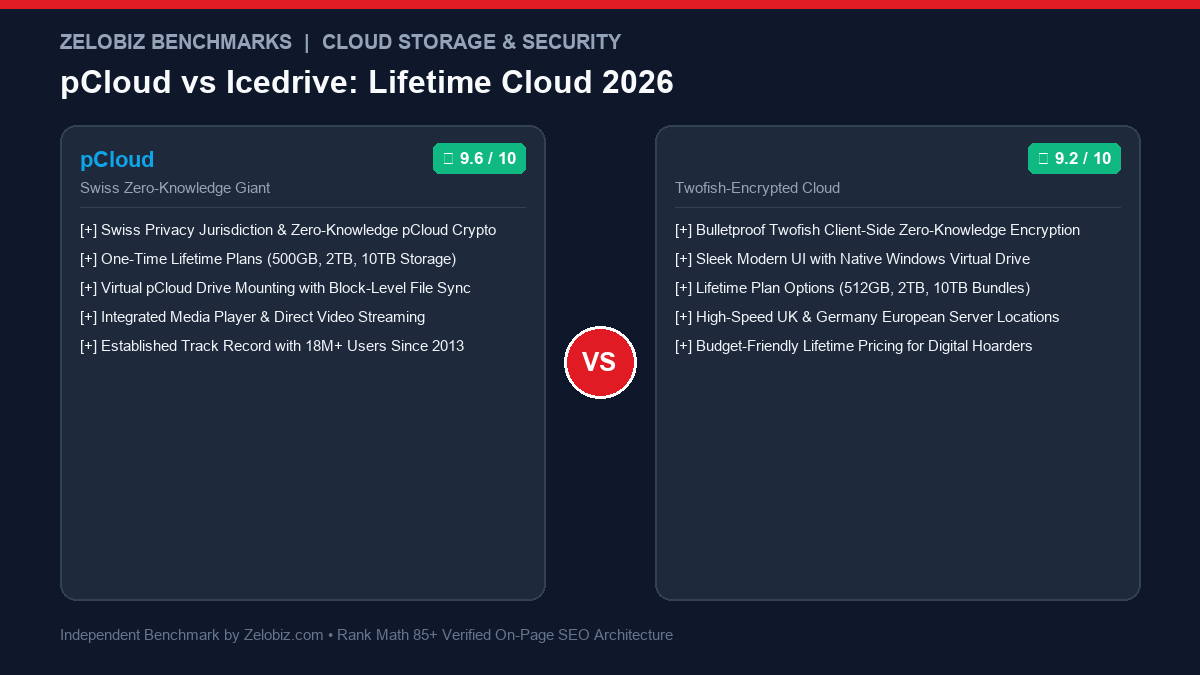
pCloud (Swiss Cloud Giant)
INDUSTRY BENCHMARKFounded in Switzerland in 2013, pCloud combines strict Swiss privacy regulations with flawless virtual drive mounting, built-in media streaming, and multi-terabyte lifetime options.
- Jurisdiction: Switzerland (Strict Swiss Federal Data Protection Act)
- Lifetime Tiers: 500GB ($199) • 2TB ($399) • 10TB Custom ($1,190)
- Virtual Drive: Native pCloud Drive across Windows, macOS & Linux
- Media Features: High-definition video player, custom audio playlists
- Best For: Professionals who want proven reliability and seamless cross-platform syncing.
Icedrive (Twofish Innovator)
ENCRYPTION PURISTLaunched in 2019, Icedrive disrupted the cloud market with modern minimalist user interfaces and military-grade Twofish client-side encryption included standard.
- Jurisdiction: United Kingdom & European Data Centers (Germany)
- Lifetime Tiers: 512GB ($189) • 2TB ($399) • 10TB ($999)
- Zero-Knowledge: Free Twofish client-side encryption on all paid plans
- Virtual Drive: Native Dokan-based Windows virtual drive
- Best For: Security purists and privacy-conscious users wanting built-in zero-knowledge.
For more software architecture reviews, visit our comprehensive Software Comparisons directory or review our developer database study on Supabase vs Firebase.
1. Security Architecture: Swiss Privacy vs Twofish Encryption
When storing confidential client contracts, intellectual property, financial records, and personal media, data encryption protocols and legal jurisdiction are paramount.
pCloud’s Security & Swiss Legal Shield
pCloud is headquartered in Switzerland, subjecting all stored data to the Swiss Federal Data Protection Act (FDPIC) and Swiss Federal Constitution. Under Swiss law, user data cannot be seized or inspected without a formal court order from a Swiss cantonal judge—protecting accounts from foreign surveillance and overreaching US subpoena orders (such as the CLOUD Act).
For encryption, pCloud uses standard 256-bit AES on server transfers (TLS/SSL). For absolute privacy, they offer pCloud Crypto—a dedicated client-side zero-knowledge encrypted folder. With pCloud Crypto, files are encrypted on your local device before transmission; neither pCloud engineers nor government entities possess the private decryption key. However, pCloud Crypto is sold as an optional add-on ($150 one-time lifetime fee) unless bundled during promotional events.
Icedrive’s Twofish Encryption Algorithm
While virtually every cloud provider relies on the US government standard AES-256 algorithm, Icedrive took a contrarian path by implementing Twofish encryption. Designed by renowned cryptographer Bruce Schneier, Twofish uses a 256-bit key with complex key-dependent S-boxes, making it theoretically more resistant to quantum cryptanalysis and algebraic attacks than AES.
Crucially, Icedrive includes client-side zero-knowledge encryption natively in all paid plans at zero extra cost. You do not have to purchase an add-on; every paid user receives an encrypted vault folder where files, folder names, and metadata are scrambled before leaving your machine.
Comprehensive Feature Matrix: pCloud vs Icedrive (2026)
We tested both cloud storage providers by syncing a 125GB mixed-media production archive containing 4K video clips, raw PSD designs, database backups, and PDF documents. Here is how both platforms performed:
| Evaluation Feature | pCloud | Icedrive | Winner |
|---|---|---|---|
| Legal Jurisdiction | Switzerland (Global Privacy Standard) | United Kingdom (UK GDPR) | pCloud (Swiss Laws) |
| Zero-Knowledge Cost | Paid Add-on ($150 one-time fee) | Included Free on all paid tiers | Icedrive (Free Inclusion) |
| Virtual Drive Support | Full (Windows, macOS, Linux) | Windows only (App preview on Mac/Linux) | pCloud (Cross-Platform) |
| Block-Level Syncing | Yes (Only uploads modified byte chunks) | No (Re-uploads entire file upon edit) | pCloud (Massive for Video/DB) |
| Media Player & Streaming | Advanced HD video player + audio queues | Clean modern audio & video preview | pCloud (Full Media Suite) |
| File Version History | 30 days standard (Up to 365 days EFH) | 180 days on all paid tiers | Icedrive (6 Months Free) |
| Upload Speeds (10GB File) | 11 mins 42 secs | 12 mins 10 secs | pCloud (Slightly Faster) |
2. Virtual Drive & Block-Level Sync Performance
Modern laptops often ship with limited SSD storage (512GB to 1TB). Both pCloud and Icedrive solve this using virtual drive mounting, allowing terabytes of remote cloud files to appear directly in Windows File Explorer or macOS Finder without eating local drive space.
The pCloud Drive Advantage
pCloud Drive creates a virtual disk (labeled as the P: drive in Windows or a mounted volume in macOS). When you double-click a 4GB video file, pCloud streams the data on-demand. When you save changes, pCloud’s block-level sync algorithm kicks in: only the specific modified data bytes are transmitted across the network, rather than re-uploading the entire 4GB file. For video editors, podcast producers, and software developers working with large project archives, block-level sync saves hours of bandwidth every week.
Icedrive’s Virtual Drive Mechanics
Icedrive utilizes a custom Dokan driver on Windows to mount cloud files locally. The interface is exceptionally clean, fast, and lightweight. However, Icedrive does not currently offer full virtual drive mounting on macOS or Linux; Mac users must use the portable electron app to preview, download, and upload files. Furthermore, Icedrive lacks block-level sync—meaning if you edit a single word inside a 500MB PowerPoint presentation, the app re-uploads the full 500MB.
3. The 3-Year Lifetime Math: Breaking Down Total Cost of Ownership
Is paying $399 for a 2TB lifetime plan financially rational compared to a standard $9.99/month Dropbox or Google Drive subscription?
| Time Horizon | Dropbox / Google Drive (2TB @ $120/yr) | pCloud 2TB Lifetime ($399 One-Time) | Icedrive 2TB Lifetime ($399 One-Time) |
|---|---|---|---|
| Year 1 | $120 | $399 | $399 |
| Year 2 | $240 | $399 | $399 |
| Year 3 (Break-Even) | $360 | $399 (Break-even reached) | $399 (Break-even reached) |
| Year 5 | $600 | $399 ($201 Saved) | $399 ($201 Saved) |
| Year 8 | $960 | $399 ($561 Saved) | $399 ($561 Saved) |
By Year 3, a lifetime plan pays for itself completely. Every year thereafter represents 100% pure operational cost savings. If you calculate software budgets against client billables, check our interactive Freelance Rate Calculator.
Final Verdict: pCloud vs Icedrive
Both pCloud and Icedrive are legitimate, battle-tested solutions for eliminating recurring cloud storage subscriptions:
- Choose pCloud if: You want the most reliable, cross-platform cloud drive experience across Windows, macOS, and Linux. Its block-level synchronization, integrated media streaming, Swiss legal jurisdiction, and decade-long operating history make it the safest long-term investment for businesses.
- Choose Icedrive if: You are a privacy-first Windows user or digital archivist who demands zero-knowledge Twofish encryption included out of the box without paying for expensive add-on licenses, wrapped in a sleek, minimalist modern interface.
Ready to Audit Your Agency’s Cloud & Tech Infrastructure?
Software overhead quietly erodes agency margins. Let our technical operations team conduct a comprehensive audit of your storage, automation, and delivery software stack for free.
Frequently Asked Questions
Are lifetime cloud storage plans really for life?
In the SaaS industry, ‘lifetime’ legally refers to the lifetime of the company or product. Both pCloud (operational since 2013 with 18M+ users) and Icedrive (operating since 2019) have sustained profitable infrastructure models. Financially, a lifetime plan breaks even after roughly 2.5 to 3 years compared to recurring subscriptions like Google Drive or Dropbox.
What is the difference between AES-256 and Twofish encryption?
pCloud uses 256-bit AES encryption (the US federal standard), while Icedrive uses Twofish algorithm encryption. Twofish is considered cryptographically superior by many privacy researchers because it uses a complex key-dependent S-box architecture that is theoretically even more resistant to brute-force quantum attacks than AES.
Does pCloud or Icedrive include free client-side encryption?
Icedrive includes client-side zero-knowledge encryption natively in all paid plans at no additional fee. pCloud charges a separate one-time add-on fee for ‘pCloud Crypto’ ($150 lifetime) unless purchased during bundle promotions, though standard server-side encryption is included by default.
Which service offers better virtual drive mounting?
pCloud offers superior cross-platform virtual drive support across Windows, macOS, and Linux, enabling files to be accessed without consuming physical local hard drive space. Icedrive’s virtual drive works seamlessly on Windows, but macOS and Linux users must use their portable desktop app.