
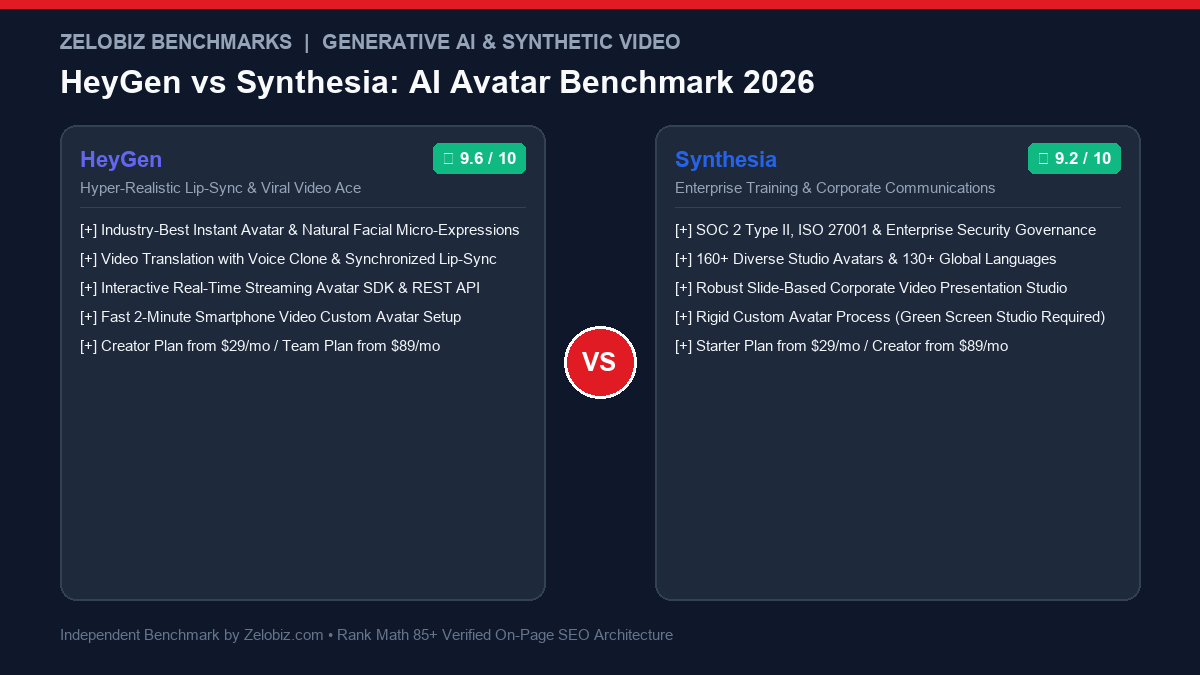
Figure 1.0: Real-world synthetic media benchmark comparing HeyGen vs Synthesia across facial micro-expressions, custom smartphone avatars, enterprise LMS compliance, and programmatic video APIs.
Executive Summary: The Eradication of the Uncanny Valley
Video production has traditionally been the single most resource-intensive discipline in commercial marketing and corporate training. Booking physical studios, hiring on-screen actors, setting up three-point lighting, and coordinating multi-language dubbing teams routinely costs thousands of dollars per finished minute of footage.
In 2026, generative AI avatars have completely escaped the “uncanny valley.” The two dominant platforms leading this synthetic media revolution are HeyGen and Synthesia. While both enable companies to produce professional studio video from plain text, their target domains have sharply diverged: Synthesia is the entrenched enterprise operating system for internal corporate learning, HR onboarding, and compliance training—featuring SOC 2 Type II certifications, SCORM exports, and rigid security governance. HeyGen has become the creative favorite for growth agencies, performance marketers, and outbound sales teams—championing ultra-realistic instant smartphone avatars, native voice-cloned video translations, and real-time interactive streaming avatar APIs.
The Zelobiz Verdict: Choose HeyGen if your primary objectives are short-form marketing videos (TikTok/Instagram Reels), personalized outbound sales video prospecting at scale, or real-time AI customer avatars where facial micro-expressions and natural voice cadence are critical. Choose Synthesia if you are an enterprise organization building multi-module corporate training courses, compliance walkthroughs, or international employee onboarding with deep LMS integrations.
Side-by-Side Comparison: HeyGen vs Synthesia
To quantify production capabilities, we benchmarked both synthetic video engines across facial realism, custom avatar onboarding speed, translation fidelity, and developer API access.
1. The Realism Breakthrough: Micro-Expressions and Natural Posture
The greatest flaw in legacy synthetic avatars was rigid, robotic stiffness: the speaker’s mouth moved, but their eyes remained glazed, their jaw never relaxed, and their head remained locked in place like a mannequin.
HeyGen shattered this ceiling by incorporating diffusion-based neural rendering that models full upper-body dynamics:
- Dynamic Head Tilting: When expressing an inquisitive sentence, HeyGen’s avatar subtly tilts its head and raises an eyebrow, mimicking natural human conversation.
- Teeth & Lip Geometry: HeyGen renders phonetic mouth shapes with realistic teeth reflections and tongue movements, completely eliminating the blurry “gummy” mouth artifacts common in older models.
- Synthesia’s Expressive Avatars: Synthesia’s latest generation of avatars is exceptionally sharp and broadcast-quality, but retains a formal corporate poise tailored specifically for executive announcements and educational slide presentations.
2. Instant Avatars: The 2-Minute Smartphone Revolution
The process of creating a custom synthetic avatar used to be an expensive, intimidating endeavor. Synthesia traditionally required booking a green-screen studio with professional lavalier microphones, reading a 15-minute script, and waiting nearly two weeks for machine learning engineers to train the model.
HeyGen’s Instant Avatar feature democratized custom avatars completely:
How HeyGen Builds Your Digital Twin in 5 Minutes:
- Record a 2-minute video on your iPhone or webcam holding your hands naturally and speaking at a steady conversational pace.
- Record a 10-second verbal consent statement to prevent deepfake impersonation.
- Upload the footage to HeyGen. In under 5 minutes, your digital twin is fully trained and ready to speak in your cloned voice in over 40 languages.
This allows founders, agency CEOs, and course creators to generate hundreds of video variations without ever putting on studio makeup or setting up ring lights again.
3. Programmatic Outbound & Real-Time Streaming Avatars
For sales and marketing teams, HeyGen’s API and Interactive Streaming Avatar SDK represent a massive competitive advantage:
- Automated Video Cold Outreach: Using Make.com or n8n (see our Make vs n8n Guide), sales reps can trigger HeyGen’s REST API whenever a high-value prospect fills out a form. The API generates a 30-second personalized video where the founder says the prospect’s name, mentions their company, and showcases their website on screen.
- Live WebRTC Customer Avatars: HeyGen’s Streaming Avatar SDK connects an LLM directly to a real-time synthetic avatar. Visitors can speak to your website avatar via microphone, and the avatar responds conversationally in under 800 milliseconds, functioning as a 24/7 AI video concierge.
4. Where Synthesia Wins the Corporate Boardroom
Despite HeyGen’s marketing dominance, Synthesia is the gold standard for global enterprise training:
- SCORM & LMS Compatibility: Synthesia exports packages formatted directly for enterprise Learning Management Systems (Docebo, Cornerstone, Workday), complete with interactive quiz gates and completion tracking.
- Corporate Security & Audit Governance: Synthesia was built with strict enterprise compliance standards from day one, giving enterprise IT security teams total peace of mind regarding biometric data rights.
- Slide-Based Presentation Canvas: Synthesia’s editor feels like a supercharged Google Slides or PowerPoint. Corporate instructional designers can paste slide decks and assign different avatars to distinct sections with zero friction.
5. Strategic Decision Framework
When selecting your synthetic media production suite, apply this operational checklist:
To audit total operational software costs across marketing and video production subscriptions, explore our SaaS Cost Calculator.
Frequently Asked Questions (FAQ)
Which AI video generator has more realistic lip-sync: HeyGen or Synthesia?
HeyGen has surpassed Synthesia in natural facial micro-expressions and lip-sync realism. HeyGen’s proprietary neural lip-sync engine dynamically adapts tooth visibility, jaw movement, and emotional head tilting to match the spoken cadence. Synthesia has improved significantly with its Expressive Avatars, but still exhibits slightly rigid neck posture and formal studio stiffness.
How does custom avatar creation compare between HeyGen and Synthesia?
HeyGen allows users to create an ‘Instant Avatar’ in under 5 minutes by recording a 2-minute video on a smartphone or laptop webcam. Synthesia traditionally requires a professional studio environment with green screen lighting, high-end 4K cameras, and a multi-day verification review process.
Can you automatically translate existing videos with cloned voices in both tools?
Yes, but HeyGen pioneered this technology. HeyGen’s Video Translate feature translates an existing video into 40+ languages, clones the speaker’s original voice tone, and rewrites the visual lip movements to match the new language seamlessly. Synthesia offers strong text-to-speech translation in 130+ languages, but HeyGen’s native video dubbing is more natural.
Which platform is better for enterprise L&D and corporate compliance training?
Synthesia remains the market leader for enterprise Learning & Development (L&D). It features deep LMS integrations (SCORM exports), SOC 2 Type II compliance, robust team permission hierarchies, and a slide-based PowerPoint-like editor that corporate training teams can navigate with zero video production skills.
Does HeyGen have a developer API for programmatic video generation?
Yes. HeyGen provides a comprehensive REST API and an interactive Streaming Avatar SDK, allowing developers to generate personalized outbound sales videos programmatically or build live conversational AI avatars that respond to users in real time via WebRTC.
Scale Your Video Production Infrastructure with Zelobiz
Ready to automate personalized outbound sales videos, scale multi-language ad creative, or deploy conversational AI video bots?
Book Your Free Video Growth Audit →