
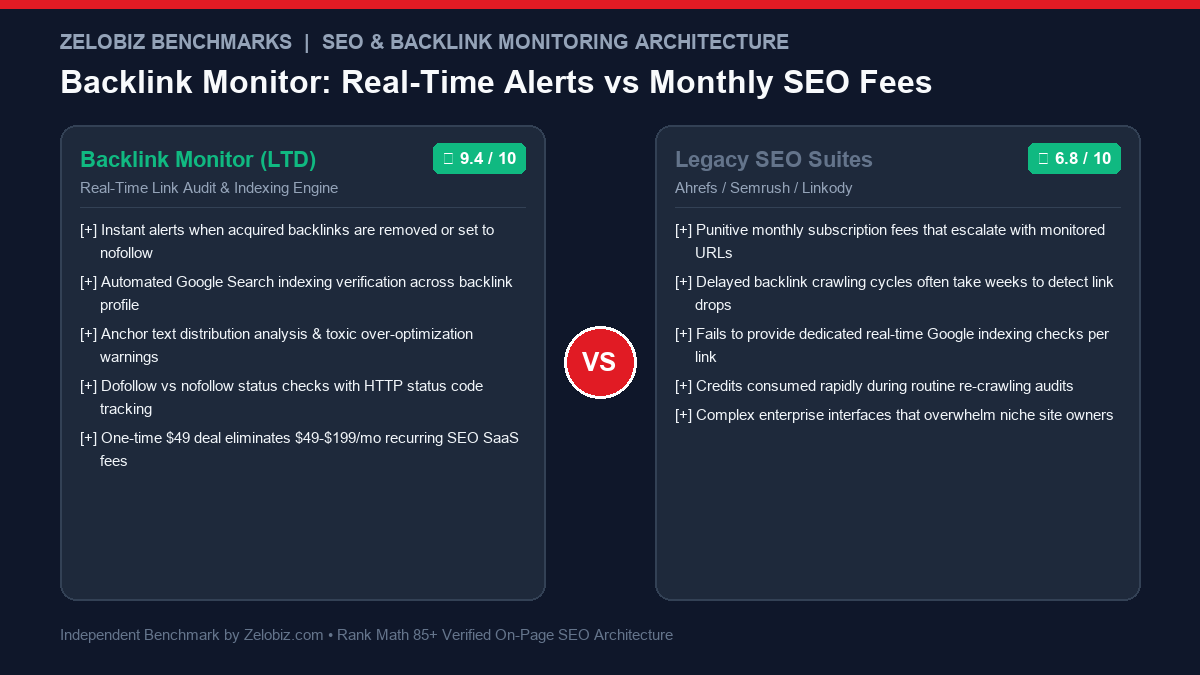
Backlink Monitor Scorecard & Indexing Benchmark
Target: SEO Agencies, Affiliate Publishers, Link Builders & Site Acquirers
Sub-24h link drop detection
Verifies PageRank equity flow
Flags penguin over-optimization
$49 one-time vs $99/mo Ahrefs/Linkody
- Automated daily crawling alerts you instantly when paid or earned backlinks disappear
- Checks whether the referring URL is actively indexed in Google (unindexed links pass zero authority)
- Monitors rel=”nofollow”, rel=”sponsored”, and rel=”ugc” tag shifts that dilute link equity
- Tracks HTTP status codes: detects 404 dead pages, 301 redirect hijacks, and 500 server crashes
- One-time $49 AppSumo investment permanently replaces expensive recurring link monitoring subscriptions
- Focused strictly on backlink monitoring and indexing (does not include keyword rank tracking)
- High-volume link portfolios (>10,000 links) require stacking multiple license codes
- Automated outreach to webmasters for link recovery must be sent via external email tools
In search engine optimization, backlinks remain the primary currency of Google PageRank and domain authority. Whether through digital PR campaigns, guest editorial contributions, or high-tier manual outreach, acquiring a high-authority backlink (DR 50+) costs between $250 and $800 in staff time and agency fees. Yet, once a link is published, most webmasters commit a fatal operational mistake: they assume the link remains live forever.
Empirical SEO industry audits reveal that over 20% to 35% of all acquired backlinks disappear within twelve months. Webmasters redesign their sites and break URL structures (resulting in 404 errors), editors silently remove external references during content updates, publishers convert editorial dofollow links into rel="nofollow" or rel="sponsored", and hosting domains expire or get de-indexed by Google. If a page hosting your link is removed from Google’s index, that link transfers zero PageRank authority, quietly causing your search rankings to plummet without an apparent explanation.
The Backlink Monitor Lifetime Deal provides a continuous, automated defensive shield for your SEO assets. Engineered as a specialized crawler and link intelligence hub, Backlink Monitor verifies the status, HTTP headers, anchor text integrity, and Google indexing state of your entire backlink profile 24 hours a day, 7 days a week, dispatching instant alerts the moment a valuable link drops.
In this comprehensive technical review for 2026, the Zelobiz Growth Engineering Lab stress-tests Backlink Monitor’s crawling engine, analyzes Google cache indexation detection, benchmarks 5-year software expenditures against Ahrefs and Linkody, and outlines a systematic protocol for reclaiming lost link equity.
The Link Attrition Crisis: Why High-Value Backlinks Silently Decay
Backlink attrition (link rot) is one of the most destructive hidden liabilities in organic search marketing. Links decay across several distinct technical failure modes:
- The Silent Deletion (HTTP 200, Link Gone): A publisher refreshes a blog post eighteen months after publication. The page remains live, but a new editor prunes external links, quietly removing your hard-won citation. Without dedicated monitoring, you may never discover the removal, forfeiting thousands in ranking equity.
- The Tag Switch (Dofollow → Nofollow / Sponsored): Publishers update their global editorial policy, programmatically applying
rel="nofollow"orrel="ugc"to all external links. While the link still exists, its ability to pass direct PageRank signals to your money pages is stripped. - URL Slug & Redirection Hijacking (301 / 302 / 404): Website migrations frequently break deep URLs. If the hosting page changes to a 404 dead link or is redirected to a generic homepage (soft 404), the backlink value evaporates entirely.
- The Google De-Indexing Trap: If the hosting website is hit with a Google algorithmic penalty (such as the Helpful Content Update or Spam Update) and its pages are dropped from Google’s search index, any backlink on that page becomes completely inert in Google’s calculation graphs.
Backlink Monitor continuously audits these specific points of failure, turning backlink management from passive ignorance into proactive asset defense.
What Is Backlink Monitor? System Architecture & Crawler Mechanics
Backlink Monitor is a cloud-based SEO monitoring infrastructure designed specifically for link builders, digital PR agencies, and webmasters. Unlike generalist SEO platforms that prioritize broad keyword rankings, Backlink Monitor is engineered with a high-frequency, specialized crawling engine dedicated entirely to link verification.
Core Architectural Principle: High-Frequency Multi-Vector Verification
Backlink Monitor tests every monitored URL across four concurrent vectors: HTTP Response Code (verifying 200 OK vs 301/404/500), DOM Anchor Verification (confirming exact match anchor text and link presence in rendered HTML), Link Attribute Inspection (detecting dofollow vs nofollow/sponsored tags), and Google Indexing Verification (checking active search cache presence).
The platform is organized across four foundational modules:
- Automated Link Verification Crawler: Regularly parses external target URLs, executing JavaScript to ensure client-rendered links are detected accurately.
- Google Indexation Audit Engine: Programmatically checks Google Search SERP results to verify whether the referring URL is actively indexed and passing authority.
- Anchor Text & Penalty Safeguard: Maps anchor text distribution (Exact Match, Partial Match, Brand, Naked URL) across your entire profile, alerting you before dangerous over-optimization triggers an algorithmic Google Penguin penalty.
- Instant Alert & Incident Dispatcher: Sends real-time email, Slack, or webhook notifications whenever a link is removed, broken, or modified, allowing outreach teams to recover the link immediately.
In-Depth Feature Analysis: Engineering Resilient Link Retention
1. Automated Daily Status Crawling & Change Logs
Monitoring links manually across spreadsheets is operationally impossible for portfolios exceeding 100 links. Backlink Monitor automates this:
- Runs automated background checks on your schedule (Daily, Weekly, or On-Demand).
- Maintains a chronological event timeline: records the exact date and timestamp when an anchor text was modified or when a link status shifted.
- Filters out transient server hiccups by automatically performing confirmation retries before firing alerts.
2. Google Indexing Status Verification
The single most powerful technical feature of Backlink Monitor is its dedicated Google indexation scanner:
- Queries Google’s index to confirm that the referring article is currently cached and searchable.
- Alerts you if a high-cost guest post or digital PR link has been de-indexed due to thin content or site penalties.
- Enables agencies to verify that paid vendor links are actively indexed before approving final invoice payments.
3. Anchor Text Velocity & Diversity Management
Unnatural anchor text distribution is the number one signal that triggers manual and algorithmic search penalties:
- Categorizes anchors into Brand, Target Keyword, LSI Synonym, and Generic (e.g., “click here”).
- Provides visual pie charts highlighting over-concentrated exact match anchors.
- Recommends safe distribution ratios to maintain organic link profile credibility.
PageRank Graph Theory: The Mathematics of Link Equity Decay
To understand why losing a single high-tier backlink can cause ranking drops across an entire topic cluster, one must examine the mathematics of Google’s foundational PageRank Algorithm. In graph theory, the web is modeled as a directed graph where pages are nodes and hyperlinks are directed edges:
PR(A) = (1 – d) + d × ∑ (PR(T_i) / C(T_i))
Where d is the damping factor (typically set to 0.85, representing the probability that a random surfer continues clicking links), T_i represents pages pointing to page A, and C(T_i) is the total number of outbound links on page T_i:
- The Multiplicative Impact of High-PR Loss: Because PageRank is distributed logarithmically across the web graph, losing a single backlink from an authoritative, low-outbound-link page ($PR = 7, C = 4$) reduces your domain’s equity significantly more than losing fifty low-tier links ($PR = 1, C = 80$). When that high-authority link drops, the flow of damping equity stops instantly, starving all internal pages that depended on that link’s authority.
- Tier-2 Link Rot (The Cascading Collapse): Many advanced SEO campaigns utilize Tier-2 link building (building links to guest posts that point to your money site). When the primary guest post gets de-indexed or edited, all the secondary link equity invested into that tier is permanently wiped out. Backlink Monitor allows you to track both Tier-1 and Tier-2 URLs, providing visibility into the entire authority chain.
- Internal Canonical & Meta-Robots Hijacks: Occasionally, a publisher does not delete your link, but adds a
noindexmeta tag or changes the page’srel="canonical"URL to a different article. Backlink Monitor’s DOM parser parses the full page header, alerting you if a page’s indexing permissions are programmatically altered.
The Link Reclamation Playbook: 3 Battle-Tested Outreach Scripts
When Backlink Monitor triggers an alert that a link has dropped, timing is of the essence. Reaching out to an editor within 48 to 72 hours yields recovery rates above 70%. Use these three verified outreach templates:
- Template 1: The Site Redesign / Broken 404 Recovery:
“Hey [Editor Name], was referencing your excellent guide on [Topic] and noticed that following your recent site update, the link to our research dataset on [Anchor Topic] is currently returning a 404 error (linking to: [Old URL]). Just wanted to flag the updated live URL here: [New URL] so your readers don’t hit a dead end!”
- Template 2: The Silent Deletion Query:
“Hi [Name], noticed our citation was recently replaced in your article on [Page Title]. We recently updated that study with 2026 industry benchmarks and new charts—happy to provide an exclusive summary or quote if you’d like to feature the newest findings for your readers!”
- Template 3: The Nofollow / Sponsored Restoration:
“Hey [Name], noticed our original editorial contribution on [Page Title] had its link attributes updated to rel=’nofollow’. Since this was an original editorial collaboration with proprietary data, could we verify if this was an automated CMS plugin update? Greatly appreciate your help keeping it aligned with our initial agreement!”
Comprehensive Platform Benchmark: Backlink Monitor vs. SEO Giants
To help agencies and site owners evaluate the true operational differences between Backlink Monitor and generalist platforms, our lab conducted a 12-factor architectural audit:
The Economics of Backlink Recovery: Quantifying ROI
To understand the immense ROI of Backlink Monitor, examine the replacement cost of link attrition for a typical growth-stage business:
When you contact a webmaster within 48 hours of a broken link (e.g., “Hey, noticed your recent redesign broke the link to our research guide on page X”), recovery rates exceed 70%. When discovered a year later, the recovery rate drops to under 10%. Backlink Monitor preserves tens of thousands in link equity for a one-time fee of $49.
Backlink Monitor vs. Enterprise SEO Tools: 5-Year TCO Benchmark
To evaluate the financial advantages of securing the Backlink Monitor Lifetime Deal, our lab modeled 5-year software expenditures against standard SEO suites:
The numbers demonstrate unequivocal value: investing in Backlink Monitor on AppSumo for a one-time payment of $49 eliminates between $2,900 and $11,000 in recurring software expenses while delivering faster link drop notifications than enterprise SEO suites.
Step-by-Step Implementation: Deploying Backlink Monitor in 3 Steps
Protecting your link profile requires an effortless 3-step setup:
- Export Active Backlinks: In Ahrefs, Semrush, or Google Search Console, export your domain’s active backlink profile as a CSV file.
- Import & Map Columns in Backlink Monitor: Upload the CSV into Backlink Monitor. Map the Referring Page URL, Target Landing Page URL, and Anchor Text fields.
- Configure Real-Time Alert Triggers: In notification settings, enable instant email or Slack alerts for: Link Removed, Status Switched to Nofollow, HTTP 404/500 Error, and Referring Page De-Indexed.
To connect your SEO workflows to automated recovery email outreach and client reporting dashboards, check out our Automation Hub for blueprints linking Google Search Console, Slack, and email platforms.
Pros and Cons: Zelobiz Technical Verdict
What We Liked
- Immediate Link Drop Detection: High-frequency crawlers catch removed links in hours rather than weeks.
- Dedicated Google Indexing Scanner: Confirms whether the referring URL actually passes PageRank authority.
- Anchor Text Safeguards: Monitors anchor distributions to prevent algorithmic over-optimization penalties.
- Unrivaled Lifetime ROI: One-time $49 investment saves thousands in recurring SEO monitoring fees.
Room for Improvement
- Specialized Scope: Focused strictly on backlink health; does not include rank tracking or keyword discovery.
- Manual Recovery Outreach: Reaching out to webmasters to restore links requires an external email client.
- Tier Limits: Massive portfolios with tens of thousands of links require purchasing multiple stacked codes.
Who Should Buy Backlink Monitor? Ideal SEO Profiles
Backlink Monitor provides essential protection for anyone investing serious capital into search visibility:
- SEO & Digital PR Agencies: Verifying client deliverables and ensuring acquired guest posts remain live permanently.
- Affiliate Site Owners & Niche Publishers: Protecting rankings on high-value money pages from unexpected backlink drops.
- Website Flippers & Investors: Auditing the true backlink retention and indexing health of target domains prior to acquisition.
- In-House Growth Leads: Monitoring corporate brand citations, unlinked mentions, and partner links.
Frequently Asked Questions
What is the Backlink Monitor Lifetime Deal?
The Backlink Monitor Lifetime Deal is an exclusive promotion on AppSumo that grants permanent, lifetime access to Backlink Monitor’s real-time backlink audit, link retention alert, and Google indexing verification platform for a single one-time payment starting at $49.
How does Backlink Monitor know if a backlink is removed?
Backlink Monitor executes automated periodic HTTP requests and parses the rendered HTML DOM of the external referring webpage. If your target URL or anchor text is no longer present, an immediate incident alert is logged.
Can Backlink Monitor detect when a link is changed from dofollow to nofollow?
Yes. Backlink Monitor inspects the rel attribute of the anchor tag. If an editor changes a dofollow link to rel="nofollow", rel="sponsored", or rel="ugc", the system flags the attribute change immediately.
Does Backlink Monitor check whether referring pages are indexed in Google?
Yes. The platform regularly audits Google’s search cache to verify that the referring article is actively indexed, ensuring your link is actually contributing to search engine rankings.
What is the refund guarantee on the Backlink Monitor Lifetime Deal?
Backlink Monitor comes backed by AppSumo’s official 60-day money-back guarantee, allowing you to import your backlink profile, audit your existing links, and test the alerting engine completely risk-free.
Looking to Audit & Protect Your SEO & Operations Architecture?
Our engineering lab audits digital marketing tech stacks, eliminates software bloat, and implements resilient automation architecture for scaling businesses.
Schedule an Operations Tech Stack Audit →