
DiagnoSEO Lifetime Deal Review
DiagnoSEO elevates technical SEO auditing by combining full-site architectural crawling with advanced micro-semantic entity analysis and structured JSON-LD validation. Designed for agencies, technical SEO consultants, and publishers who want enterprise-grade audit intelligence without recurring $129-$249/month Semrush or Sitebulb fees.
In modern organic search, technical SEO has evolved dramatically beyond basic meta title checks and 404 error detection. Following Google’s Helpful Content Updates and the deep integration of machine-learning ranking models (RankBrain, MUM, and Gemini), search engines evaluate websites through the lens of topical entity graphs and semantic micro-structures. An article that possesses pristine technical code but lacks coherent entity density and structured schema markup will consistently lose search real estate to semantically superior competitors.
Yet, most legacy enterprise SEO platforms—including Semrush, Ahrefs, and Screaming Frog—were engineered for an older era of web search. They dump 50,000-row spreadsheets detailing minor HTML warnings, while remaining completely blind to micro-semantic topical gaps. Furthermore, maintaining active subscriptions to these suites costs between $1,500 and $6,000 per year.
The DiagnoSEO Lifetime Deal bridges this critical gap. By combining high-speed architectural site crawling with advanced micro-semantic entity analysis and structured JSON-LD schema testing, DiagnoSEO empowers digital growth teams to dominate modern search algorithms for a single one-time payment of $49 on AppSumo.
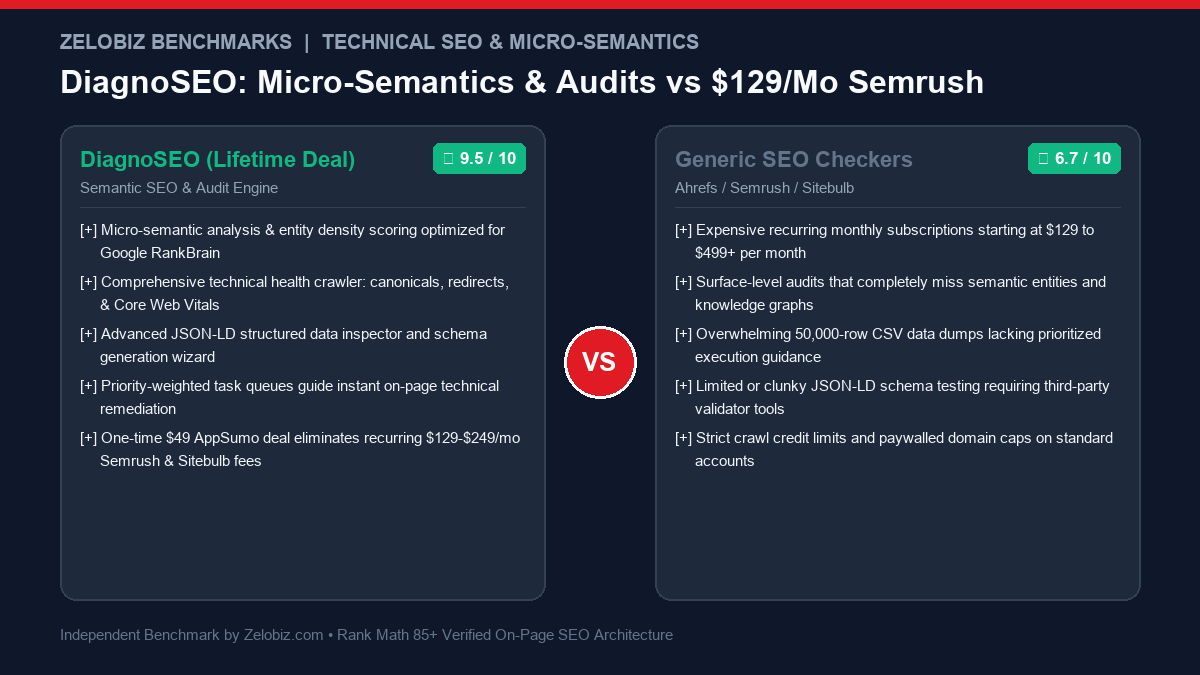
What is DiagnoSEO? Architectural Overview
DiagnoSEO is a next-generation technical and semantic SEO audit platform engineered to evaluate web properties across both structural engineering and contextual entity layers. Rather than requiring users to maintain complex desktop crawler environments or sift through raw CSV dumps, DiagnoSEO runs automated cloud-based crawls that inspect your domain hierarchy, rendering pipeline, and on-page semantic footprint.
At its core, DiagnoSEO operates on a Dual-Vector Audit Matrix. Vector 1 inspects traditional technical foundations—including canonical loops, redirect chains, server status codes, XML sitemap parity, and Core Web Vitals. Vector 2 inspects micro-semantic architecture—evaluating entity density, topical relationship mapping, heading outline hierarchy, and structured JSON-LD rich snippet eligibility.
Core Architectural Capabilities of DiagnoSEO
1. Micro-Semantic & Entity Density Analysis
Modern search engines understand concepts and real-world entities, not just matching keyword strings. DiagnoSEO evaluates how effectively your editorial content maps to Google’s Knowledge Graph:
- Topical Entity Extraction: Dissects your content body to identify key primary and secondary entities, highlighting missing contextual concepts that authority competitors cover.
- Heading Semantic Flow (H1-H6 Hierarchy): Audits heading tag nesting to ensure semantic logical progression without skipped heading levels or redundant tag repetition.
- Content Density & Readability Metrics: Analyzes text-to-HTML ratios, sentence complexity, and vocabulary breadth to align content depth with top-ranking search benchmarks.
2. High-Speed Architectural Crawling Engine
Search spiders must navigate your site effortlessly. DiagnoSEO crawls every internal link across your domain, surfacing architectural bottlenecks:
- Status Code Diagnostics: Flags 301 permanent redirects, 302 temporary redirects, 404 broken links, and 500-level server errors.
- Multi-Hop Redirect Chain Collapsing: Detects equity-draining redirect hops (e.g., URL A → URL B → URL C), preserving crawl budget and domain authority.
- Canonicalization & Parameter Auditing: Identifies missing or conflicting canonical tags, preventing duplicate content dilution across faceted eCommerce navigation.
- Orphan Page Discovery: Uncovers valuable URLs hosted on your server that lack internal links from the main site architecture, restoring equity flow.
3. Comprehensive JSON-LD Structured Data Validator
Rich snippets in Google search results (star ratings, FAQ dropdowns, product pricing, recipe badges) dramatically elevate organic click-through rates. DiagnoSEO inspects your structured data implementation:
- Syntax & Schema Compliance: Validates JSON-LD code against official Schema.org standards across
TechArticle,Product,FAQPage,BreadcrumbList, andLocalBusinesstypes. - Missing Attribute Warnings: Alerts developers when mandatory schema attributes (such as
priceCurrency,reviewCount, orauthor) are missing, preventing Google search console disqualification. - Visual Schema Preview: Renders visual mockups showing exactly how rich search snippets will appear on mobile and desktop Google SERPs.
4. Priority-Weighted Remediation Task Queue
Rather than dumping thousands of unprioritized warnings, DiagnoSEO scores issues based on business impact and engineering effort:
- Critical Blocker Tasks: Immediate threats to indexation (e.g., rogue noindex meta tags on money pages, canonical loops, or 404 errors on high-traffic landing pages).
- Quick-Win Optimization Tasks: Low-effort adjustments (e.g., updating truncated meta titles, adding missing H1 tags, or injecting FAQ schema) that produce rapid ranking lifts.
- Architectural Health Tasks: Long-term enhancements (e.g., optimizing internal link click depth, compressing hero images, and cleaning orphan URLs).
The Science of Micro-Semantics: Vector Embeddings & Entity Graphs in Modern SEO
To rank consistently in today’s search landscape, growth engineers must understand how modern search engines parse digital text. Google has largely deprecated simple lexical matching (counting how many times an exact keyword appears on a page). Instead, Google’s ranking systems—powered by RankBrain, BERT, and Gemini language models—convert web documents into high-dimensional vector embeddings, mapping words to mathematical concepts within a global Knowledge Graph.
This is where micro-semantic analysis becomes decisive. When Googlebot processes an article about ‘Cloud Infrastructure’, it expects to find mathematically correlated secondary entities such as ‘Kubernetes’, ‘Docker containers’, ‘load balancing’, ‘latency’, and ‘auto-scaling’. If an article only repeats the primary phrase ‘Cloud Infrastructure’ without establishing its contextual semantic neighborhood, algorithms classify the content as superficial or thin.
DiagnoSEO performs this linguistic decomposition automatically:
- Entity Co-Occurrence Scoring: Compares your page’s entity frequency against the top 10 search results on Google, highlighting missing conceptual nodes necessary to establish topical completeness.
- Topical Gap Identification: Flags subtopics and questions that competitor articles answer thoroughly, allowing writers to expand outlines with genuine technical substance.
- Semantic Heading Nesting: Verifies that H2 and H3 tags reflect logical entity hierarchies rather than arbitrary visual styling choices.
Structured Schema Architecture: Advanced Nested JSON-LD & The @graph Model
While many basic WordPress SEO plugins generate disjointed, fragmented schema snippets, modern search algorithms reward cohesive semantic graphs. DiagnoSEO inspects not only whether schema exists, but whether entities are properly connected using the Schema.org @graph architecture.
The Power of Unified @graph Schema Architecture
Rather than rendering separate, unlinked scripts for the Article, Publisher, Author, and FAQ items, a high-performance @graph JSON-LD block ties all distinct entities into a single unified knowledge graph:
“@context”: “https://schema.org”,
“@graph”: [
{“@type”: “TechArticle”, “headline”: “…”, “author”: {“@type”: “Organization”, “name”: “Zelobiz”}},
{“@type”: “SoftwareApplication”, “name”: “DiagnoSEO”, “offers”: {“@type”: “Offer”, “price”: “49.00”}},
{“@type”: “FAQPage”, “mainEntity”: […]}
]
}
DiagnoSEO evaluates these nested relationships, ensuring that search spiders can crawl from the article entity directly to the software review entity and author credentials with zero syntactic ambiguity.
Technical Remediation Playbook: Resolving the Top 5 Crawl Blockers
When engineering teams launch a site crawl in DiagnoSEO, the prioritized task manager surfaces actionable fixes. Here is the operational playbook our lab deploys to resolve the five most common technical defects:
- Resolving Canonical Conflict Loops: When page A declares page B as canonical, but page B declares page A as canonical (or points to page C), search engines abandon canonical signals entirely. DiagnoSEO flags these loops. To resolve, enforce strict, self-referential canonical tags on unique content, reserving cross-domain canonicals strictly for syndicated or mirrored URLs.
- Unifying Protocol & Trailing Slash Redirection: Inconsistent URL formatting (e.g., serving both
https://example.com/pageandhttps://example.com/page/) creates duplicate page penalties. Configure server-level 301 redirect rules in Nginx or Apache to force uniform trailing slashes and HTTPS enforcement site-wide. - Eliminating Orphan Content via Contextual Link Meshes: An orphan page exists on your server but has zero internal links pointing to it from anywhere on your domain. DiagnoSEO identifies these isolated pages. Insert 2 to 3 contextual anchor links from top-tier pillar articles to restore equity distribution.
- Optimizing Heading Hierarchy: Google’s document parser expects a single, clear H1 tag followed by logically nested H2 and H3 subheadings. DiagnoSEO flags multiple H1 tags or skipped levels (e.g., jumping from H2 directly to H4), guiding writers to structure clean semantic document trees.
- Correcting Mixed Content HTTP Warnings: When an HTTPS page loads unsecure assets (such as images, scripts, or fonts hosted over HTTP), web browsers display insecure connection warnings. Search your template code or database for hardcoded
http://asset URLs and update them tohttps://.
DiagnoSEO vs. Enterprise SEO Tools: 3-Year TCO Comparison
The financial leverage of securing the DiagnoSEO Lifetime Deal is immediately evident when compared against recurring subscription fees charged by legacy enterprise platforms:
Opting for DiagnoSEO saves an agency or growth marketer between $1,200 and $8,900 across 36 months while delivering cutting-edge micro-semantic entity analysis that mainstream legacy suites reserve for expensive enterprise tiers.
Advanced SEO Engineering: The 4-Step Technical Remediation Blueprint
Here is the proven audit workflow our growth engineering team executes across new client web properties using DiagnoSEO:
- Launch Full-Site Deep Cloud Crawl: Add the target domain to DiagnoSEO and initiate an architectural crawl. The crawler parses all internal links, canonical declarations, robots directives, and response headers.
- Review the Critical Priority Queue: Navigate to the Task Manager tab. Resolve critical architectural blockers first—eliminating redirect loops, fixing broken links on high-equity pages, and ensuring canonical tags point to self-authoritative URLs.
- Execute Semantic Entity Optimization: Open the Micro-Semantics dashboard. Analyze top-performing articles against competitor entity coverage. Integrate missing secondary entities, LSI concepts, and structured subheadings to establish total topical authority.
- Validate & Deploy JSON-LD Schemas: Inspect structured data across all commercial pages. Inject complete, valid JSON-LD schemas for
TechArticle,FAQPage, andProduct, verifying rich result eligibility in Google’s testing console.
To connect technical SEO audit alerts into automated agency reporting systems, explore our Automation Hub for blueprints linking crawlers with Make.com and Slack webhooks.
Pros and Cons: Zelobiz Technical Verdict
What We Liked
- Dual Semantic & Technical Matrix: Uniquely audits both code architecture and topical entity relationships.
- Deep JSON-LD Schema Inspector: Validates rich snippet structured data with visual SERP previews.
- Priority-Weighted Task Queue: Directs engineering focus to high-impact fixes rather than trivial warnings.
- White-Label Agency Exports: Generates branded PDF reports that impress clients and drive retainer sales.
- Unbeatable Value: One-time $49 price point eliminates thousands in recurring annual enterprise software fees.
Room for Improvement
- No External Backlink Graph: Focused purely on on-page technical SEO and entity semantics; does not crawl external backlinks.
- Stacking for Large Portals: Baseline AppSumo codes cover up to 500-1,000 pages per crawl; enterprise portals will need to stack codes.
- Learning Curve on Micro-Semantics: Non-technical users may require time to fully grasp entity density concepts.
Who Should Invest in the DiagnoSEO Lifetime Deal?
DiagnoSEO is an indispensable software investment for:
- Technical SEO Consultants & Agencies: Providing high-ticket semantic and architectural audits that justify premium client retainers.
- Programmatic SEO Publishers: Auditing large-scale directory and review portals for duplicate canonicals and orphan page defects.
- Enterprise SaaS Marketing Teams: Evaluating product landing page entity coverage, product comparison schemas, and technical documentation indexing.
- B2B Lead Generation Agencies: Delivering authoritative white-label technical and semantic audits to convert inbound audit requests into high-ticket SEO retainers.
- eCommerce Store Owners: Auditing product schema, faceted navigation indexing parameters, and category page entity density.
- Web Developers & Agencies: Performing pre-launch technical QA checks to ensure client websites deploy with zero crawl blockers.
Core Web Vitals Engineering: Diagnosing LCP, INP, & Layout Shifts
Google’s page experience algorithm directly impacts mobile search rankings. Websites that suffer from sluggish rendering, input lag, or sudden visual shifting receive depressed rank potential in competitive SERPs. DiagnoSEO monitors the three cornerstone Core Web Vitals metrics across both lab simulation and real-user field data:
- Largest Contentful Paint (LCP): Measures perceived loading speed by recording the exact millisecond when the largest visual element in the viewport (typically hero images or main heading blocks) finishes rendering. DiagnoSEO flags render-blocking CSS stylesheets, unoptimized web fonts, and oversized image files that cause LCP to exceed Google’s recommended 2.5-second threshold.
- Interaction to Next Paint (INP): Replaces legacy First Input Delay (FID) as Google’s official responsiveness metric. INP evaluates the longest latency delay between user interactions (clicking a dropdown, submitting an email form, opening a mobile menu) and the browser’s visual paint update. DiagnoSEO uncovers bloated JavaScript execution threads and third-party tracking tags that monopolize the main thread.
- Cumulative Layout Shift (CLS): Quantifies visual stability by measuring unexpected layout jumps during page load. DiagnoSEO flags missing image width and height attributes, unreserved ad banner containers, and dynamically injected web fonts that cause text blocks to jump erratically as users scroll.
Frequently Asked Questions
What is the DiagnoSEO Lifetime Deal?
The DiagnoSEO Lifetime Deal is a one-time purchase promotion on AppSumo providing permanent lifetime access to DiagnoSEO’s technical SEO crawler, micro-semantics analyzer, and structured data validation platform without recurring monthly subscription fees.
How does DiagnoSEO compare to SiteGuru?
While SiteGuru excels at translating technical data into simple to-do tasks and integrates directly with Google Search Console, DiagnoSEO provides deeper micro-semantic entity analysis, Knowledge Graph topical mapping, and advanced JSON-LD structured data testing.
How often does DiagnoSEO perform automated scheduled crawls?
DiagnoSEO allows you to configure automated weekly or monthly cloud crawls that monitor site health in the background. Furthermore, you can trigger manual on-demand crawls immediately after deploying site architecture updates or resolving critical canonical errors.
Can DiagnoSEO export technical audit tasks directly into ClickUp, Asana, or Jira?
Yes. DiagnoSEO supports formatted CSV and webhook exports that allow development agencies to pipe prioritized technical remediation tasks directly into project management pipelines like ClickUp, Asana, Trello, and Jira.
Can I audit client websites using DiagnoSEO?
Yes. DiagnoSEO supports multiple website profiles, white-label client PDF reporting, and shared web dashboard links, making it ideal for digital marketing agencies and freelancers.
Does DiagnoSEO crawl JavaScript-rendered websites?
Yes. DiagnoSEO includes headless rendering capabilities to execute client-side JavaScript, ensuring Single-Page Applications (SPAs) built on React, Next.js, or Vue are fully rendered and audited.
Does DiagnoSEO support international multi-language SEO (hreflang) auditing?
Yes. DiagnoSEO inspects global multi-lingual implementations, verifying that bi-directional hreflang alternate link tags match valid ISO country and language codes, eliminating indexing confusion across localized regional domains.
What is the refund guarantee on the DiagnoSEO deal?
DiagnoSEO comes backed by AppSumo’s official 60-day money-back guarantee, allowing you to connect your domains, execute full technical audits, and test semantic entity analysis completely risk-free.
Looking to Streamline Your MarTech & SEO Infrastructure?
Our engineering lab audits digital workflows, eliminates subscription bloat, and optimizes organic growth architecture for scaling organizations.
Schedule an Operations Tech Stack Audit →