
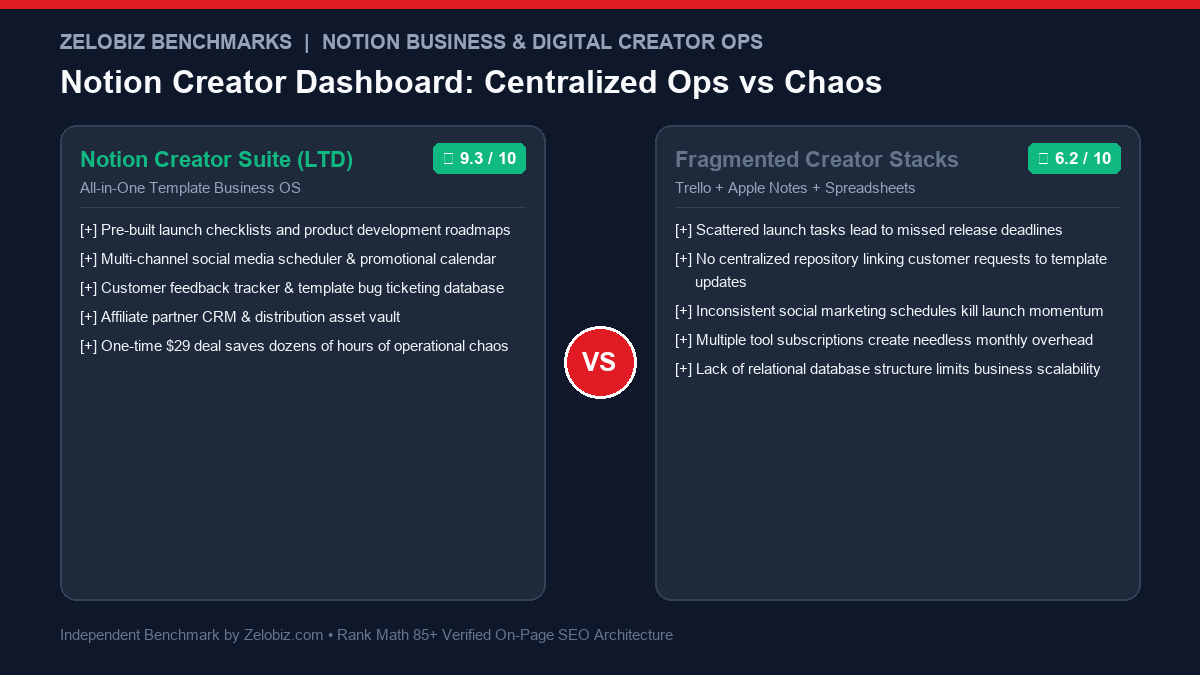
Notion Creator Dashboard Scorecard & Architecture Benchmark
Target: Notion Creators, Solopreneurs, Digital Product Designers & No-Code Builders
Interlinked rollups & views
Product Hunt & social cadences
Multi-channel editorial calendars
$29 one-time vs $30/mo project tools
- Centralizes template ideation, feature development, QA testing, and launch checklists
- Pre-built relational databases connecting templates to feedback, assets, and affiliate links
- Comprehensive multi-platform launch playbooks for Gumroad, Product Hunt, Twitter/X, and Etsy
- Eliminates operational brain fog and reduces template production cycles by up to 60%
- One-time $29 AppSumo investment eliminates ongoing project management software subscriptions
- Requires an existing active Notion workspace and basic familiarity with database views
- Does not process credit card transactions directly (connects to Gumroad, Lemon Squeezy, or Stripe)
- Advanced automated data sync with external CRMs requires third-party webhooks (Make or Zapier)
The Notion template ecosystem has matured from a casual hobbyist community into a lucrative digital product industry where top creators generate $10,000 to over $100,000 per month selling second-brain systems, agency project managers, and personal finance trackers. However, as a creator’s catalog expands from one simple template to a portfolio of interconnected products, operational complexity multiplies exponentially. Creators quickly find themselves drowning in operational chaos: scattered notes in Apple Notes, half-finished launch checklists in Trello, customer feature requests buried in Twitter DMs, and disorganized marketing schedules across Google Docs.
This operational friction stalls growth. Instead of focusing on designing elegant user experiences and building distribution channels, creators spend valuable hours looking for lost assets, forgetting critical Product Hunt launch milestones, and failing to follow up with affiliate partners. When systems break down, template releases are delayed, product launches fall flat, and high-intent customer feedback is lost.
The Notion Template Creator Dashboard Lifetime Deal provides the ultimate operational antidote. Built natively inside Notion, this dedicated business operating system centralizes the entire lifecycle of a digital product venture: from initial niche ideation and database architecture design, through pre-launch marketing, community feedback aggregation, and multi-channel affiliate distribution.
In this technical review for 2026, the Zelobiz Growth Engineering Lab evaluates the dashboard’s relational database architecture, stress-tests its product launch frameworks, analyzes 5-year cost savings against conventional project management stacks, and outlines a repeatable blueprint for scaling digital template businesses to consistent revenue.
The Creator Bottleneck: Why Digital Product Ventures Stall Without an Operations Spine
Most digital product builders are exceptional creators but struggle with operational discipline. Building a scalable digital product business requires juggling four distinct business engines simultaneously:
- The Engineering & Architecture Engine: Designing intuitive page hierarchies, building relational databases with accurate rollups, writing robust formula properties, and stress-testing mobile responsiveness. Without a standardized QA checklist, bugs and broken database relations slip into production releases, generating negative customer reviews.
- The Marketing & Pre-Launch Engine: Building pre-launch hype requires a coordinated marketing campaign: teaser videos, Twitter/X threads, LinkedIn carousels, Product Hunt asset prep, and early-bird email sequences. Without a unified content calendar, launch day arrives without an audience, resulting in lackluster sales.
- The Customer Feedback & Support Loop: Customers constantly submit feature requests, report usability confusions, and ask for edge-case integrations. When these inputs are scattered across Gumroad messages, emails, and social mentions, creators cannot identify high-demand features or systematically improve their templates.
- The Distribution & Affiliate Engine: Scaling past an initial audience requires empowering affiliate partners and influencers with promo codes, graphic banners, swipe copy, and commission tracking. Managing affiliates through manual spreadsheets quickly becomes an administrative nightmare.
The Notion Template Creator Dashboard unifies these disparate operational workflows into a single relational workspace, providing creators with the structure needed to scale.
What Is the Notion Template Creator Dashboard? System Architecture & Database Schemas
The Notion Template Creator Dashboard is an end-to-end business operating system engineered specifically for digital product creators who build and monetize within the Notion ecosystem. Rather than offering basic static checklists, the dashboard is constructed on an enterprise-grade relational database architecture.
Core Architectural Principle: Interlinked Relational Databases & Rollups
The dashboard connects four master databases: Products (Templates), Tasks & Milestones, Marketing Content, and Customer Feedback. When you open a specific template page (e.g., Agency OS), it dynamically surfaces all linked tasks, upcoming launch dates, scheduled social posts, and unresolved customer feature requests through filtered inline database views and rollup calculations.
The system is organized into four foundational operating modules:
- Template Roadmap & Product Modeler: A master Kanban and gallery view tracking templates across their complete developmental lifecycle: Ideation → Wireframing → Database Build → Quality Assurance → Launch Ready → Live → Archived.
- Launch Command Center: A battle-tested launch framework featuring day-by-day countdown checklists for Gumroad, Product Hunt, Reddit, and Twitter/X launches.
- Multi-Channel Content & Distribution Planner: An editorial calendar designed to plan, draft, and schedule promotional content across multiple social media platforms, complete with pre-written copywriting templates.
- Customer Intelligence & Affiliate Hub: Centralizes user feedback, feature upvotes, bug reports, affiliate partner contracts, and promotional asset links in a single organized directory.
In-Depth Feature Analysis: Engineering the High-Velocity Launch Pipeline
1. Standardized Quality Assurance (QA) Checklist
Releasing a template with broken relations or missing permissions damages creator credibility instantly. The dashboard includes a comprehensive pre-launch audit checklist:
- Verification of locked database views and formula property syntax.
- Mobile responsive stress-testing across iOS and Android Notion apps.
- Removal of placeholder personal data and sensitive private workspace relations.
- Creation of clear “Duplicate to Workspace” instructions and Loom onboarding walkthrough embeds.
2. The Product Hunt & Multi-Channel Launch Playbook
Launching successfully on Product Hunt requires precision timing and asset coordination. The dashboard provides a time-sequenced launch checklist:
- T-Minus 14 Days: Finalize gallery screenshots, record 60-second teaser demo GIFs, and draft maker comments.
- T-Minus 7 Days: Reach out to community hunters, schedule teaser social threads, and configure early-bird promo codes on Gumroad/Lemon Squeezy.
- Launch Day (12:01 AM PST): Live checklist tracking upvote notifications, maker comment posting, and social engagement cadences across Twitter, LinkedIn, and relevant Reddit subreddits.
3. Centralized Feedback & Template Changelog Management
Customer retention and referral growth depend on continuous product iteration. The dashboard links feedback directly to product cards:
- Log user requests with priority tags (Critical Bug, High-Value Feature, Minor Tweak).
- Automatically generate public-facing changelog entries when new versions are released.
- Maintain a repository of customer testimonials and social proof screenshots for marketing landing pages.
4. Affiliate Partner & Asset Vault
Managing an army of affiliate promoters is simple when assets are organized:
- Track affiliate names, social followings, unique referral links, and commission tiers.
- Provide partners with a curated swipe file of high-converting promotional copy, product badges, and banner imagery.
Relational Database Blueprint: The 4 Core Connected Databases
To appreciate the structural sophistication of the dashboard, examine how the underlying relational schemas interact:
This relational architecture eliminates cognitive fragmentation. A creator never has to duplicate data; updating a milestone in the Task database automatically updates the completion percentage on the master Product card.
Notion Formula 2.0 Engineering: Rollups, Progress Bars & Dynamic KPIs
A primary technical strength of the Notion Template Creator Dashboard is its modern utilization of Notion’s Formula 2.0 engine. In legacy Notion setups, calculating project completion percentages or aggregating task data across relations required clunky multi-step rollups and nested if() statements that frequently caused page latency. The Creator Dashboard harnesses modern functional syntax:
- Automated Sprint Completion Formulas: The master Template database utilizes dynamic array filtering to calculate exact launch readiness in real time. Rather than manually ticking a status dropdown, the dashboard calculates:
/* Formula 2.0 Dynamic Launch Readiness Calculation */ let( totalTasks, prop("Tasks").length(), completedTasks, prop("Tasks").filter(current.prop("Status") == "Complete").length(), if(totalTasks == 0, "No Tasks Logged", round((completedTasks / totalTasks) * 100) + "% Ready" ) ) - Visual Progress Bar Rendering: The completion percentage is dynamically rendered as an inline visual progress bar with color-coded milestone thresholds (Red: <40% in build phase; Amber: 40-80% in QA phase; Emerald Green: >80% launch ready).
- Automated Revenue per Template Analytics: By connecting product sales records via Gumroad or Stripe webhooks to the database, the dashboard computes average order value (AOV) and customer lifetime value (LTV) per template category automatically.
The Omnichannel Distribution Playbook: 4 High-Conversion Acquisition Engines
Creating a beautiful Notion template represents only 20% of commercial success; 80% of revenue generation is dictated by distribution velocity. The Creator Dashboard provides structured workflows tailored to the four primary customer acquisition channels:
- Product Hunt Launch Orchestration: Product Hunt remains the single highest-volume launchpad for productivity tools. The dashboard’s launch engine breaks preparation into strict chronological batches: securing a hunter with a verified streak, uploading 1270×760 high-contrast gallery slides, drafting the maker’s first comment explaining the backstory, and scheduling morning reminder emails to core community supporters.
- Programmatic SEO & Directory Distribution: Beyond primary marketplaces, top creators list their tools across curated directories (Notion Everything, Notionery, Toolify, Product Hunt). The dashboard maintains an outreach checklist with live submission URLs and status tracking to ensure maximum backlink authority.
- The Twitter/X “Build in Public” Funnel: The content engine includes pre-structured thread frameworks: The Problem Breakdown (identifying workflow chaos), The Architectural Solution (showing dynamic GIF screen recordings of relations in action), and The Limited Early-Bird Incentive (offering 40% discount codes for the first 100 buyers).
- Gumroad SEO & Tag Optimization: The dashboard includes an algorithmic keyword optimizer that suggests high-volume search tags (e.g., second brain, freelance client portal, finance tracker) to capture organic search traffic within Gumroad’s native marketplace discover tab.
Fulfillment & Post-Purchase Automation Architecture with Webhooks
While the dashboard organizes your internal operations, connecting it to automated post-purchase workflows transforms your creative venture into a hands-free digital business:
- Stripe & Gumroad to Notion Sync via Make.com: When an order completes, an automated Make (Integromat) webhook ingests the customer’s email, transaction amount, and purchased template SKU, immediately appending a new record into your Notion Sales Database and updating revenue rollups.
- Automated Onboarding Email Triggers: The webhook automatically adds the customer into your email marketing platform (Kit/ConvertKit or MailerLite), triggering a 3-part onboarding sequence: Day 1 (How to duplicate and configure your workspace), Day 3 (Advanced tips and keyboard shortcuts), and Day 7 (Invitation to submit a review and join the affiliate program).
- Direct Support Ticket Routing: When buyers submit feature requests or report bugs via an embedded Notion Form, the entry routes directly into your Customer Feedback database with priority flags.
The 5 Cardinal Rules of Commercial Notion Template Architecture
Designing templates for internal personal use is vastly different from engineering commercial templates intended to be duplicated by thousands of paying customers. The Creator Dashboard enforces five core design principles:
- The Zero Orphan Page Rule: Every single sub-page, documentation doc, and resource list must be housed within a structured parent database or linked navigation sidebar. Orphaned, unlinked pages create navigation dead-ends that frustrate customers.
- Standardized Database Prefixing (DB / Linked): Master backend databases should always be labeled clearly (e.g.,
[DB] Master Projects) and stored in a dedicated, locked System Architecture toggle at the bottom of the workspace. Public-facing views should be labeled as[View] Active Projects, preventing users from accidentally deleting the underlying database. - Mobile-First Property Auditing: Over 50% of Notion users browse their workspaces on mobile devices. If a database contains 25 visible properties, the mobile card view becomes an unreadable, endless scrolling list. The dashboard guides creators to display a maximum of 3 to 4 high-priority properties on primary gallery cards.
- Lightweight WebP Imagery & SVG Icons: Heavy 5MB uncompressed PNG cover images degrade workspace loading times. The dashboard emphasizes using optimized WebP banner graphics under 150KB and clean SVG icons to maintain instant page renders.
- The Duplication Safety Protocol: Before generating public sharing links, creators must run the automated QA checklist to verify that all private workspace mentions (
@personor private page links) have been scrubbed, ensuring customer privacy and clean duplication.
Notion Creator Dashboard vs. Generic Project Management Stacks: 5-Year TCO
To evaluate the long-term cost benefits of securing this system via the Lifetime Deal, our lab modeled 5-year operating expenditures against conventional project management SaaS subscriptions:
Investing $29 in the Notion Template Creator Dashboard delivers a tailored, native operating spine while saving hundreds of dollars in external software subscriptions and dozens of hours of manual template administration.
Step-by-Step Implementation: Deploying the Dashboard in 3 Steps
Setting up your template business operating system takes less than five minutes:
- Duplicate the Template: Access the official download link provided via AppSumo. Click “Duplicate” in the top-right menu to copy the entire framework into your Notion workspace.
- Input Existing Portfolio Items: Navigate to the Templates Database and add your existing products, active Gumroad links, current pricing, and revenue benchmarks.
- Schedule Your Next Product Launch: Create a new template card using the pre-configured “Product Launch Template”. This instantly populates the standardized QA checklist, Product Hunt launch cadence, and social promotion schedule.
To connect your Notion workspace to external marketing automations and payment gateways, check out our Automation Hub for blueprints linking Gumroad webhooks, Notion databases, and email marketing workflows.
Pros and Cons: Zelobiz Technical Verdict
What We Liked
- Architecturally Sound: Built on robust relational databases, formula rollups, and clean view structures.
- Actionable Launch Checklists: Eliminates launch anxiety with day-by-day countdowns for Product Hunt and social platforms.
- Seamless Notion Integration: Operates directly in the same workspace where you build your products; zero context switching.
- Incredible Price-to-Value: $29 one-time payment provides permanent access with lifetime update rights.
Room for Improvement
- Requires Notion Familiarity: Beginners unfamiliar with database relations and rollups may experience a minor learning curve.
- No Native Payment Gateway: Relies on external platforms (Gumroad, Lemon Squeezy, Stripe) for payment handling.
- Manual Data Entry Without Automations: Syncing sales numbers automatically requires setting up Make or Zapier webhooks.
Who Should Invest in the Notion Creator Dashboard?
This operating system delivers immediate high leverage for:
- Full-Time & Aspiring Notion Creators: Anyone looking to transition from building one-off templates to operating a repeatable, profitable digital product venture.
- Digital Agency Operators: Agencies building client workspaces and internal operating hubs who want to productize their frameworks into commercial templates.
- No-Code & Productivity Consultants: Advisors seeking a structured method to organize product development, user feedback, and client resources.
- Solopreneurs Scaling Multiple Digital Products: Creators managing ebooks, templates, and courses who need a centralized operational command center.
Frequently Asked Questions
What is the Notion Template Creator Dashboard Lifetime Deal?
The Notion Template Creator Dashboard Lifetime Deal is a one-time purchase promotion on AppSumo that gives creators lifetime access to a complete business operating system for designing, launching, and managing Notion digital products for a single payment starting at $29.
Do I need a paid Notion plan to use this dashboard?
No. The dashboard functions perfectly on Notion’s free plan, making it an accessible, zero-recurring-cost solution for early-stage digital creators.
Can I customize the databases, tags, and formulas?
Yes. Because the system is built natively in Notion, you have complete architectural freedom to add custom properties, build new database views, modify styling, and adapt frameworks to your unique niche.
How does this tool help increase template sales?
By enforcing systematic pre-launch checklists, structured social media editorial calendars, and continuous customer feedback tracking, the dashboard ensures consistent marketing execution and higher-converting product launches.
What is the refund guarantee on the lifetime deal?
The deal includes AppSumo’s standard 60-day money-back guarantee, allowing you to duplicate the dashboard, organize your templates, and test the launch frameworks completely risk-free.
Looking to Streamline Your Agency Operations & Digital Tech Stack?
Our engineering lab audits digital workflows, eliminates software clutter, and builds resilient automation systems for scaling businesses.
Schedule an Operations Tech Stack Audit →