
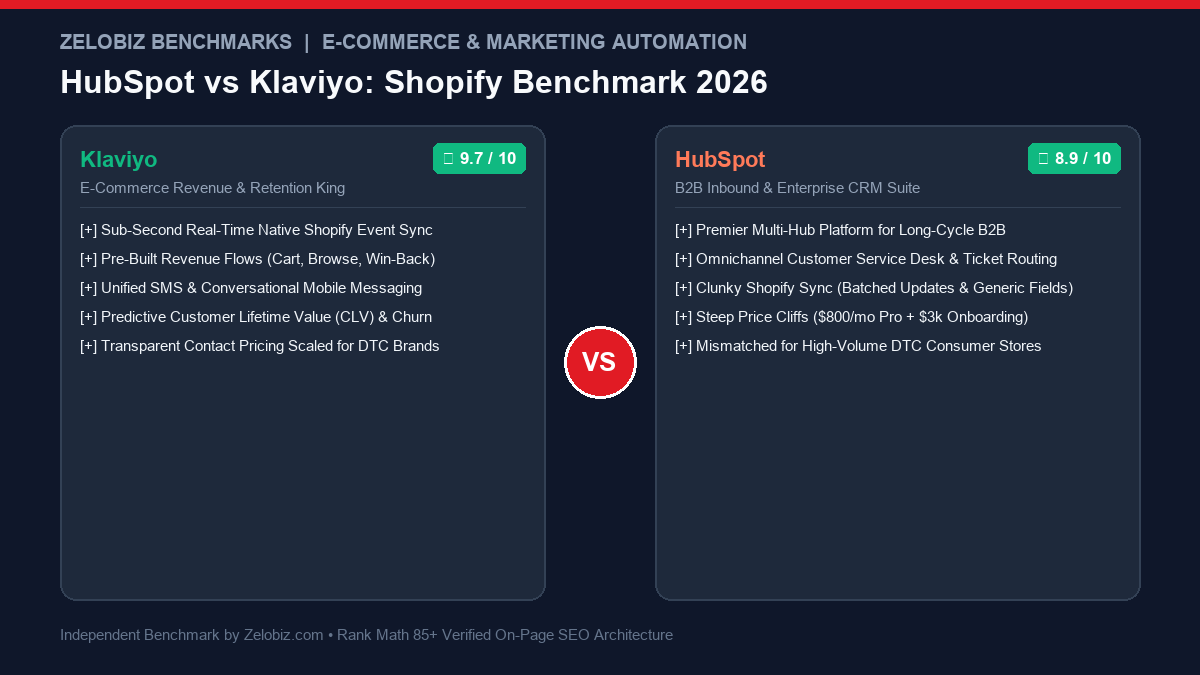
Figure 1.0: Real-world Shopify revenue benchmark comparing HubSpot vs Klaviyo across event synchronization speed, flow attribution, predictive CLV modeling, and scaling costs.
Executive Summary: The Fundamental E-Commerce Architectural Divide
In modern e-commerce, retention marketing is the engine of profitability. With paid acquisition customer acquisition costs (CAC) climbing higher across Meta and Google, a direct-to-consumer (DTC) Shopify store survives and thrives based on its ability to generate 30% to 45% of its gross revenue through automated email and SMS flows.
When merchants evaluate HubSpot vs Klaviyo, they are frequently comparing two industry giants built for entirely different universes: HubSpot is the undisputed titan of B2B inbound lead nurturing, sales deal pipelines, and customer support desks. Klaviyo is the undisputed operating system for e-commerce revenue generation—engineered from the database layer up to ingest real-time Shopify event webhooks, predict customer churn, and trigger hyper-personalized product recommendations at sub-second speeds.
The Zelobiz Verdict: Choose Klaviyo for any consumer-facing Shopify, Shopify Plus, or WooCommerce store. Its real-time cart synchronization, automated revenue flows, dynamic product blocks, and native SMS will generate 2x to 4x higher attributed revenue at a fraction of HubSpot’s cost. Choose HubSpot only if your business is a high-ticket B2B wholesale or industrial manufacturer on Shopify where human account reps negotiate custom contracts and manage multi-month pipeline stages.
Head-to-Head Comparison: Klaviyo vs HubSpot for Shopify
To quantify performance in active retail environments, we analyzed both platforms across event latency, automated flow revenue, SMS marketing, and operational cost.
1. Event-Level Architecture: Why Milliseconds Matter in E-Commerce
The core difference between Klaviyo and HubSpot is not cosmetic; it is fundamentally architectural.
In high-volume e-commerce, consumer shopping behavior is fluid and ephemeral. A shopper adds an item to cart on mobile, opens Instagram, gets distracted, and closes the browser. To recover that sale, an abandoned cart automation must fire within 30 to 60 minutes while purchase intent remains peak.
Klaviyo connects directly into Shopify’s native webhook infrastructure. Every single micro-interaction—Viewed Product, Added to Cart, Started Checkout, Placed Order, Refunded—is recorded into the customer profile in under 500 milliseconds, carrying rich metadata including product SKU, variant size, price, stock status, and product image URLs.
HubSpot was engineered around contact records and company domains. When connected to Shopify via its app, updates are processed in batched sync intervals. A customer who abandons a cart might not be flagged in HubSpot for 20 to 45 minutes, and pulling the exact dynamic cart items into an email template requires navigating complex HubL code loops.
2. The Essential Flow Benchmark: Comparing Revenue Generation
In our agency audits of Shopify merchants generating $1M to $10M in annual GMV, retention email flows consistently generate 30%+ of total store revenue:
Head-to-Head Flow Capabilities:
- Browse Abandonment: Klaviyo tracks which exact collection or product an identified visitor inspected without adding to cart, triggering a tailored email featuring that exact product alongside dynamic “You Might Also Like” recommendations. HubSpot cannot easily trigger browse abandonment based on Shopify page views without custom JavaScript engineering.
- Price Drop & Back-in-Stock Alerts: When a popular item restocks on Shopify, Klaviyo automatically triggers personalized restock notifications to shoppers who requested alerts, generating massive revenue spikes with zero ad spend.
- Predictive Replenishment: Klaviyo’s machine learning analyzes a shopper’s consumption rate (e.g., a 30-day supply of protein powder) and sends a replenishment prompt on day 24—timed precisely before they run out.
3. The Financial Equation: 25,000 Contacts Cost Comparison
In DTC e-commerce, list size scales rapidly. A store running Meta Advantage+ ads (see our Meta Advantage+ Benchmark) can easily capture 3,000 to 5,000 new email subscribers per month via spin-to-win popups and discount offers.
Cost of Scaling to 25,000 Contacts:
Klaviyo (Email Plan):
- Monthly cost: $450/month ($5,400/year).
- Onboarding fees: $0.
- Full access to all predictive segmentation, unlimited flows, and A/B testing.
HubSpot Marketing Hub (Professional):
- Base Pro tier (includes 2,000 contacts): $800/month.
- Additional 23,000 marketing contacts ($225 per 5k batch): +$1,035/month.
- Monthly cost: $1,835/month ($22,020/year).
- Mandatory onboarding fee: $3,000.
- Total Year 1 Cost: $25,020 (vs $5,400 for Klaviyo).
Spending an extra $19,620 per year on HubSpot for inferior e-commerce functionality represents an enormous drag on store margins. To model your exact software expenditures, utilize our SaaS Cost Calculator.
4. When Should an E-Commerce Merchant Choose HubSpot?
There is exactly one operational use case where HubSpot is the appropriate choice for an e-commerce business:
- B2B Wholesale / Contract Manufacturing: If your Shopify store sells $10,000 commercial espresso machines, custom industrial packaging, or wholesale apparel to retail buyers, your sales cycle is relationship-driven. You need sales reps logging calls, sending custom contract quotes, and tracking deal stages in a CRM pipeline.
- The Hybrid Solution: Even in this scenario, top B2B e-commerce brands often use both: Klaviyo handles consumer email flows and marketing newsletters, while HubSpot functions purely as the sales team’s CRM pipeline.
Frequently Asked Questions (FAQ)
Why is Klaviyo considered far superior to HubSpot for Shopify stores?
Klaviyo was engineered specifically for e-commerce, offering real-time native event synchronization with Shopify. It tracks granular SKU-level data, cart totals, and catalog browsing behavior in real time, triggering automated abandoned cart and back-in-stock flows instantly. HubSpot was designed for B2B lead nurturing and its Shopify connector syncs in batched intervals with limited product-level personalization.
Can HubSpot handle abandoned cart and browse abandonment flows on Shopify?
Yes, but it requires HubSpot Marketing Hub Professional ($800+/month) and custom integration mapping. Even then, dynamically rendering exact product images, sizes, and localized discount codes inside HubSpot emails is cumbersome compared to Klaviyo’s 1-click native Shopify product blocks.
How does native SMS marketing compare between Klaviyo and HubSpot?
Klaviyo offers fully unified SMS and MMS marketing with compliance management (TCPA/CTIA), two-way conversational text messaging, and multi-channel branching (e.g., if recipient doesn’t open email in 2 hours, send SMS). HubSpot’s SMS capabilities are primarily add-ons geared toward B2B sales alerts rather than high-volume promotional DTC text campaigns.
How does pricing compare for an e-commerce store with 25,000 subscribers?
For 25,000 contacts, Klaviyo costs approximately $450/month with unlimited automated flows and predictive analytics. HubSpot Marketing Hub Professional for 25,000 marketing contacts costs approximately $1,600/month plus a mandatory $3,000 onboarding fee, making HubSpot more than 3.5x more expensive.
When should an e-commerce brand choose HubSpot instead of Klaviyo?
An e-commerce brand should only choose HubSpot if they operate a high-ticket B2B wholesale operation (such as industrial equipment or wholesale apparel on Shopify Plus) where human sales reps manage custom quotes, contract negotiations, and multi-stage deal pipelines.
Scale Your E-Commerce Revenue with Zelobiz
Want to unlock 35%+ of your store’s GMV from automated Klaviyo flows, reduce churn, and scale high-ROAS paid media?
Book Your Free E-Commerce Audit →