
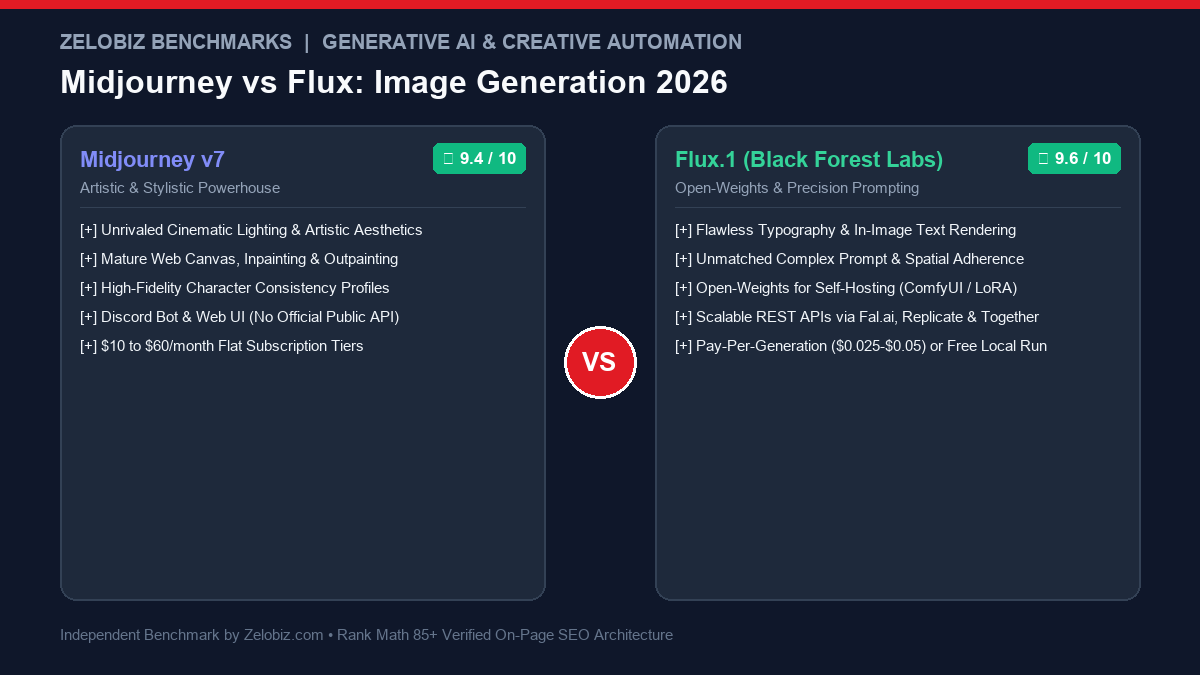
Figure 1.0: Real-world marketing benchmark comparing Midjourney v7 vs Flux.1 across typography rendering, prompt adherence, API automation, and infrastructure costs.
Executive Summary: The Battle for Commercial Creative Superiority
For several years, Midjourney reigned as the undisputed gold standard of generative AI imagery. Its default aesthetic produced rich cinematic lighting, hyper-realistic skin textures, and painterly concept compositions that made competitor models look cartoonish. However, for digital marketers, media buyers, and growth agencies, Midjourney possessed critical structural handicaps: zero official API for bulk generation, persistent hallucinations when rendering legible text, and erratic prompt following when multiple subjects were introduced.
Enter Flux.1, engineered by Black Forest Labs (founded by the original research minds behind Stable Diffusion). By leveraging a hybrid 12-billion parameter Diffusion Transformer (DiT) architecture, Flux solved the two greatest historical hurdles of AI image generation: flawless typography rendering and strict spatial prompt adherence. Furthermore, with open weights and developer-friendly REST APIs, Flux transformed AI image creation from a manual graphic design hobby into an automated performance marketing pipeline.
The Zelobiz Verdict: Choose Flux.1 if you run e-commerce product mockups, programmatic Facebook/TikTok ad creative generation, SaaS interface renderings, or need custom typography baked into images via API. Choose Midjourney v7 if you are an art director or brand designer seeking editorial fashion shoots, high-fantasy illustrations, atmospheric mood boards, or cinematic key visuals where organic artistic flair outweighs literal precision.
Technical Comparison Matrix: Midjourney v7 vs Flux.1
To evaluate performance in production environments, we tested both engines across commercial advertising use cases, graphic rendering accuracy, workflow integration, and compute costs.
1. The Typography Breakthrough: Why Marketers Switched to Flux
In paid digital marketing, static image ads require high-converting visual hooks: discount badges (“50% OFF TODAY”), product labels, t-shirt slogans, street signs, and UI callouts. For years, marketing teams had to generate an AI visual in Midjourney, import it into Canva or Photoshop, clone-stamp out the scrambled alien letters, and manually overlay vector typography.
Flux.1 eradicated this friction completely. Because Flux couples a 12-billion parameter multimodal Diffusion Transformer with a T5-XXL text encoder, the model exhibits a semantic understanding of written characters.
Head-to-Head Typography Prompt Test:
“A vintage matte black coffee bag on an oak counter, with elegant embossed white typography centered on the pouch reading: ‘DARK ROAST VELVET 2026’ and a small red ribbon label reading ‘ORGANIC ORIGIN’.”
- Flux.1 [dev]: 10 out of 10 generations spelled every single word correctly with accurate kerning, embossed depth, and realistic fabric folds across the letters.
- Midjourney v7: Rendered a stunning cinematic coffee bag with gorgeous morning light, but text appeared as “DARK ROAST VELVT 2020” with the ribbon displaying illegible pseudo-script.
2. Prompt Adherence and Spatial Composition
Midjourney has an inherent “stylistic bias.” Even when you provide an elaborate prompt specifying that a character should wear a blue hoodie on the left side of the room while a dog sits beside a red chair on the right, Midjourney frequently reorganizes the composition to look more aesthetically balanced according to its aesthetic score functions.
Flux, by contrast, behaves with literal robotic discipline. If you specify four distinct objects in specific quadrant coordinates with defined hex colors, Flux honors the spatial geometry without cross-contaminating colors (color bleeding). This makes Flux invaluable for:
- App & SaaS Interface Mockups: Generating accurate device frames with designated button placements and realistic dashboard widgets.
- Multi-Character Scenarios: Positioning specific individuals with unique clothing colors without mixing their facial features or apparel.
- Architectural Layouts: Adhering to precise interior design blueprints and product staging angles.
3. Aesthetic Polish: When Midjourney Still Reigns Supreme
While Flux wins on precision, Midjourney retains the creative crown for artistic flair and evocative atmosphere.
Flux’s raw photographic output can occasionally appear clinical, neutral, or resembling an unedited smartphone photo taken under daylight. Midjourney v7’s default latent space possesses an innate understanding of cinematic color grading, Kodak Portra 400 film grain, anamorphic lens flares, and volumetric rim lighting.
If your creative objective is an evocative lifestyle campaign, an editorial magazine cover, an abstract 3D landing page illustration, or high-concept sci-fi storytelling, Midjourney produces breath-taking results on the very first prompt without requiring 50 words of descriptive photography modifiers.
4. Automation & Scale: The API Paradigm Shift
For growth marketing agencies running hundreds of ad variants on Meta Advantage+ (see our Meta Advantage+ Benchmark), manual generation is a fatal operational bottleneck.
Midjourney requires a human operator sitting inside Discord or on the Midjourney web app, manually typing prompts, clicking upscales, downloading PNGs, and organizing folders. Midjourney has explicitly resisted offering a developer API to preserve their community-centric platform.
Programmatic Flux Ad Generation Pipeline:
Using modern workflow automation engines like Make.com or n8n (see our Make vs n8n Benchmark), media buyers can execute the following automated loop:
1. Read winning ad headlines from Google Sheets.
2. Call Fal.ai or Together AI with Flux.1 [schnell] API ($0.03 per image).
3. Automatically upload generated creatives to Meta Ads Manager via Graph API.
4. Launch 50 personalized UGC-style ad variations while the media buyer sleeps.
5. LoRA Training & Enterprise Brand Consistency
Brand consistency is paramount in commercial design. If your company sells a proprietary ergonomic chair or a specific beverage bottle, general AI models cannot recreate your exact product geometry from text prompts alone.
- Midjourney Approach: Relies on
--cref(Character Reference) and--sref(Style Reference). While impressive for replicating clothing textures or artistic color palettes, it cannot achieve 100% CAD-accurate product reproduction. - Flux Approach: Because Flux is open-weights, developers and agencies can train lightweight Low-Rank Adaptation (LoRA) models using 15 to 30 studio photos of a specific product, founder, or corporate visual style. Once trained, the LoRA ensures 100% photorealistic consistency across all future marketing assets.
6. Cost Comparison & Infrastructure ROI
The financial model between the two tools hinges on scale and deployment preferences:
To audit total operational software costs across marketing and design subscriptions, explore our SaaS Cost Calculator.
Frequently Asked Questions (FAQ)
Which AI image generator is better for marketing teams in 2026?
Flux.1 is superior for performance marketing teams because of its ability to render legible, perfectly spelled typography inside images (billboards, mockups, labels) and its open REST API, which allows programmatic ad generation inside automated workflows. Midjourney remains the preferred choice for art directors seeking stylized concept art, cinematic key visuals, and painterly aesthetics.
Can Flux.1 render legible text and typography inside images?
Yes. Flux.1 utilizes a 12-billion parameter Diffusion Transformer (DiT) architecture that integrates T5 text encoders, enabling it to render complex sentences, logos, branded labels, and quotes accurately without character scrambling or gibberish.
Does Midjourney have an official API for automated workflows?
No. As of 2026, Midjourney does not offer a public developer API. Creating automated image generation pipelines requires either reverse-engineered Discord bots (which violate Midjourney TOS) or manual web generation. In contrast, Flux offers official cloud APIs through providers like Fal.ai, Together AI, and Replicate.
Can you run Flux locally on your own computer?
Yes. Flux.1 [schnell] and Flux.1 [dev] are open-weights models that can be run locally using ComfyUI, Forge, or Diffusers on an NVIDIA GPU with at least 12GB to 16GB of VRAM (using GGUF/bitsandbytes 4-bit and 8-bit quantizations).
How does commercial licensing compare between Midjourney and Flux?
Midjourney grants full commercial usage rights on paid plans ($10/mo and above), though companies with over $1M in gross annual revenue must purchase the Pro ($60/mo) or Mega ($120/mo) plan. Flux.1 [schnell] (Apache 2.0) and Flux.1 [pro] (via API) provide full commercial rights. Flux.1 [dev] is non-commercial by default but available for commercial deployment via hosted API partners.
Scale Your Creative Acquisition Stack with Zelobiz
Want to build automated AI creative generation pipelines that slash customer acquisition costs and outpace your competitors?
Book Your Free Performance Audit →