
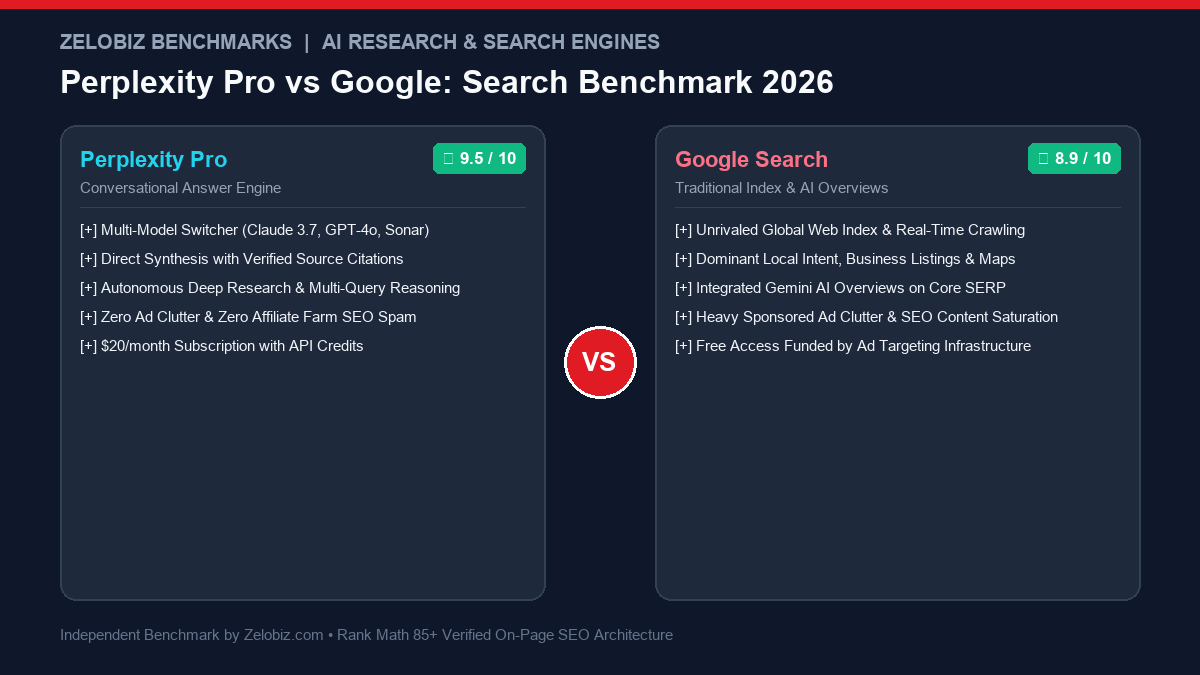
Figure 1.0: Real-world search benchmark comparing Perplexity Pro vs Google Search across retrieval architecture, citation verification, ad saturation, and deep research autonomy.
Executive Summary: The Fundamental Search Paradigm Shift
For more than two decades, Google Search operated as the unquestioned front door to the global internet. However, the modern web has become inundated with programmatic SEO content mills, intrusive pop-up scripts, paywalls, and sponsored ad placements that force users to wade through 4 to 6 screen lengths of sponsored links before reaching organic content.
Perplexity Pro represents the conversational answer engine paradigm. Instead of presenting a list of blue hyperlinks for the user to manually click, inspect, and evaluate, Perplexity utilizes real-time Retrieval-Augmented Generation (RAG) to read dozens of live sources simultaneously and synthesize an authoritative, coherent, footnoted answer in seconds.
The Zelobiz Verdict: Choose Perplexity Pro ($20/mo) if your daily workflow involves technical problem-solving, academic literature review, competitive business intelligence, or code synthesis where ad-free, footnoted accuracy saves hours. Retain Google Search (Free) for local navigation (Google Maps, restaurant hours), real-time breaking news within seconds of occurrence, and e-commerce shopping price checks.
Side-by-Side Architectural & Feature Comparison
To quantify how both engines handle information retrieval, we evaluated both platforms across core architectural benchmarks, model flexibility, citation integrity, and commercial user friction.
1. Information Retrieval Architecture: Web Indexing vs Conversational RAG
To understand why user sentiment has fractured between Google and Perplexity, one must analyze their radically divergent technical foundations.
The Google Search Architecture (Crawler-Index Model)
Google’s infrastructure relies on Googlebot continuously crawling trillions of web pages, storing them in an enormous inverted index, and applying hundreds of ranking algorithms—including PageRank, RankBrain, and helpful content classifiers—to return a sorted list of documents based on keyword matching and semantic vector similarity.
When you submit a query like “how to configure custom domain DNS for Supabase on Cloudflare,” Google must decide which third-party websites to rank. The user is responsible for clicking a link, accepting cookie consent banners, bypassing newsletter modals, scrolling past display advertisements, and extracting the code snippet manually.
The Perplexity Pro Architecture (Real-Time Multi-Search RAG)
Perplexity operates not as a static document archive, but as an autonomous research agent. When you execute a query in Perplexity Pro:
- Query Dissection: The model deconstructs your question into 3 to 7 specific sub-queries tailored for web retrieval.
- Parallel Live Crawling: Perplexity hits live search indexes (including its proprietary web index and tier-one search APIs) to pull down the top 15 to 30 authoritative web pages.
- Context Stripping & Vector Re-Ranking: Raw HTML is stripped of ads, navigation headers, and boilerplate. Relevant textual chunks are passed into the LLM context window.
- Grounded Synthesis: The frontier model (e.g., Claude 3.7 Sonnet or Sonar Large) synthesizes a cohesive response, embedding hyperlinked citations directly into every factual claim.
The entire workflow takes between 1.8 and 3.5 seconds, saving the user from opening 6 separate browser tabs.
2. Real-World Accuracy, Citation Integrity, and Hallucination Benchmarks
The primary critique of generative AI search engines has historically been hallucinations—models inventing non-existent facts, outdated pricing, or fake API endpoints. In 2026, how do Perplexity Pro and Google AI Overviews compare in technical reliability?
Zelobiz 50-Query Accuracy & Hallucination Test
We tested both platforms with 50 complex enterprise prompts spanning financial statement extraction (SEC 10-K), code library migration syntax, medical dosages, and B2B SaaS pricing models.
- Perplexity Pro (Sonar / Claude 3.7): 96.0% factual accuracy. 2 minor citation ambiguities. Zero fabricated source links. Footnotes corresponded directly to highlighted quotes in source documents.
- Google AI Overviews: 88.0% factual accuracy. 4 instances of conflating legacy v1 API syntax with v2 modern syntax. Sources listed in side carousels frequently contained generic affiliate blogs rather than primary documentation.
- Traditional Google SERP (Organic Links): 92.0% accuracy, but required an average of 4.2 clicks and 3.8 minutes per query to locate correct data.
3. The Ad Saturation Problem: Why Google Search Feels Cluttered
Google’s commercial business model depends fundamentally on ad revenue. According to Alphabet’s earnings reports, Google Services advertising generates over $65 billion per quarter. This economic reality directly dictates the user interface of Google Search.
For high-commercial-intent searches such as “best CRM software for real estate agencies” or “cloud database backup tools,” the modern Google SERP presents:
- Top 4 Sponsored Text Ads: Taking up the entire first fold of desktop screens and 2 full swipes on mobile.
- Google Sponsored Shopping Carousel: Product cards with affiliate pricing tags.
- AI Overview Widget: A collapsible box summarizing general points, often pushing organic listings below the fold.
- “People Also Ask” (PAA) Accordion: 4 to 8 expandable FAQ accordions designed to keep users on Google properties.
- Organic Results: Frequently dominated by massive media publishing conglomerates (Forbes Advisor, CNET, Investopedia) rather than independent technical practitioner blogs.
In contrast, Perplexity Pro displays a completely ad-free canvas. The user receives a structured answer with bullet points, comparison tables, code blocks, and primary citations, followed by suggested follow-up questions to drill deeper into the topic.
4. Autonomous Deep Research: Perplexity’s Killer Capability
One of Perplexity’s most transformative additions is Deep Research Mode. Unlike standard search queries that retrieve 10 results and formulate a quick paragraph, Deep Research functions as an autonomous research assistant.
When you initiate a Deep Research task—such as “Perform a competitive landscape audit of developer email API providers in 2026, comparing deliverability, latency, dedicated IP costs, and SDK support”—Perplexity executes the following sequence:
Perplexity Deep Research Autonomous Loop:
- Executes preliminary search across 40+ industry domains and pricing pages.
- Identifies gaps in technical specifications (e.g., missing API rate limits for free tiers).
- Dynamically spawns secondary and tertiary web queries to fill specific knowledge voids.
- Compiles a multi-page, comprehensive markdown dossier complete with executive summaries, technical tables, and 30+ verified footnotes.
Executing this identical research process manually on Google Search requires between 90 and 150 minutes of manual tab opening, skimming, and note compilation. On Perplexity Pro, the full report is generated within 3 to 5 minutes.
5. Developer & Technical Workflows: Code Debugging and Docs
For software engineers, system architects, and technical operators, Perplexity has rapidly emerged as a standard tool in the development stack alongside IDE agents like Cursor and Windsurf (see our AI Code Generation Benchmark).
Developer Comparison: Resolving a Nuxt 3 SSR Hydration Mismatch
On Google: Searching the error string returns 3 Stack Overflow threads from 2022 (referencing Nuxt 2 syntax), an outdated Medium article behind a paywall, and GitHub Issues with 45 inconclusive comments.
On Perplexity Pro: The model searches official Nuxt 3 documentation, recent GitHub pull requests, and modern Discord threads. It provides the exact syntax correction, explains why SSR hydration failed on client-only components, wraps the solution in a <ClientOnly> tag, and cites the official Nuxt 3 documentation release notes.
6. Where Google Search Remains Unbeatable
Despite Perplexity’s undeniable superiority in technical synthesis, Google Search maintains insurmountable structural advantages in specific operational domains:
- Local Intent & Physical Geolocation: If you are searching for “urgent care clinic open now near me” or “best Italian bistro in downtown Austin,” Perplexity cannot compete with the Google Maps local graph, live pedestrian busyness meters, verified opening hours, and real-time customer photo reviews.
- Navigational Intent: When users type “chase login” or “github settings,” they do not want a synthesized AI essay. They want a single, direct, secure hyperlink to click. Google executes this effortlessly.
- Sub-Minute Real-Time News: During breaking news events (earthquakes, election vote counts, stock flash crashes), Google News and X/Twitter crawler feeds update within milliseconds. Perplexity’s RAG pipeline requires a few minutes to index and reconcile conflicting reports.
- E-Commerce Inventory & Price Comparison: Google Shopping indexes direct merchant product feeds, tracking inventory availability, shipping speeds, and discount codes across thousands of retailers.
7. Pricing, Cost of Ownership, and Strategic Decision Matrix
When calculating whether to invest in Perplexity Pro, consider the total cost of ownership (TCO) and hourly productivity gains:
To audit your broader tech stack expenditures and eliminate redundant SaaS subscriptions, utilize our interactive SaaS Cost Calculator.
Frequently Asked Questions (FAQ)
Can Perplexity Pro completely replace Google Search in 2026?
For knowledge workers, researchers, software engineers, and financial analysts, Perplexity Pro can replace 85% to 90% of daily Google searches. However, Google Search remains essential for navigational searches (e.g., logging into specific portals), real-time local business hours and directions (Google Maps), and e-commerce product inventory lookups.
How does Perplexity Pro verify the accuracy of its citations?
Perplexity utilizes a real-time Retrieval-Augmented Generation (RAG) architecture. When a user submits a query, Perplexity executes multiple targeted sub-queries across live web indexes, scrapes authoritative text passages, and generates an answer strictly grounded in those passages. Every factual statement includes an interactive numbered footnote linking directly to the primary source.
What is the difference between Perplexity Pro and Google AI Overviews?
Google AI Overviews are synthesized summaries injected at the top of an ad-heavy SERP, powered primarily by Google’s Gemini models with limited transparency and occasional hallucination risks on complex topics. Perplexity Pro provides a dedicated conversational canvas with autonomous multi-step reasoning (‘Deep Research’), interactive follow-up clarification, and the ability to toggle between leading frontier models including Claude 3.7 Sonnet, OpenAI GPT-4o, and Sonar.
Is Perplexity Pro worth the $20 per month subscription?
Yes, for professionals who spend more than 30 minutes per day conducting market research, reading technical documentation, or debugging code. Perplexity Pro saves an estimated 4 to 8 hours per week by condensing dozens of ad-saturated search tabs into clean, actionable, cited answers. Additionally, subscribers receive 600+ Pro queries daily and access to Deep Research tools.
How does privacy differ between Perplexity Pro and Google Search?
Google operates the world’s largest digital advertising network, tracking search histories, device identifiers, and browsing patterns to build personalized ad targeting profiles. Perplexity Pro offers a zero-data-retention setting for AI model training, does not monetize through intrusive programmatic behavioral ad tracking, and delivers an ad-free interface.
Scale Your Digital Operations with Zelobiz
Looking to integrate generative AI research, custom workflow automations, or high-converting paid acquisition campaigns into your business stack?
Claim Your Free Agency Audit →