
If your e-commerce brand or growth agency is spending more than $5,000 per month on Meta Ads (Facebook and Instagram) in 2026, relying solely on the traditional client-side browser pixel is burning ad budget. Between Safari’s Intelligent Tracking Prevention (ITP), Chrome’s third-party cookie restrictions, mobile ad-blockers, and iOS network filters, client-side scripts routinely miss 25% to 40% of all purchase transactions. To feed Meta’s Advantage+ algorithms the training data they require, performance marketers must master the architectural debate: Meta Conversions API vs Pixel.
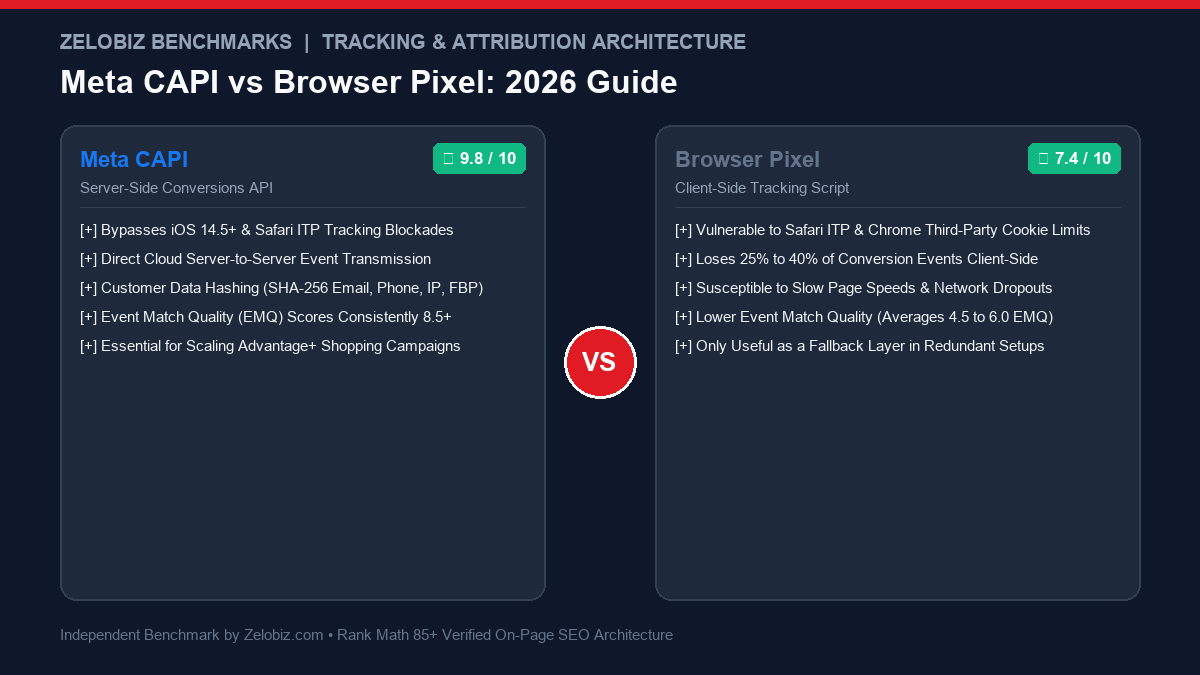
Executive Summary: Client-Side Breakdown vs Server Reliability
Understanding Meta Conversions API vs Pixel requires examining where tracking execution actually occurs:
Meta Conversions API (CAPI)
SERVER ARCHITECTUREDirect cloud server-to-server data transmission that bypasses browser ad blockers, network drops, and device privacy filters with 100% data integrity.
- Execution Layer: Backend Web Server / Cloud Run / AWS ECS
- Data Privacy: SHA-256 client hashing for emails, phone numbers & names
- Event Match Quality: Consistently 8.5 – 9.5 out of 10
- Durability: Immune to Safari ITP cookie expiration & ad blockers
- Best For: Any brand spending $3,000+/mo demanding precision ROAS.
Browser Pixel (Client-Side)
LEGACY SCRIPTA JavaScript snippet embedded in the website header (fbq('track')) that fires HTTP beacon requests from the user’s local browser window.
- Execution Layer: User’s local browser (Chrome, Safari, Firefox, Edge)
- Data Loss: Loses 25% to 40% of signals to Brave, uBlock, and Safari ITP
- Event Match Quality: Averages 4.5 – 6.2 out of 10
- Cookie Life: Capped at 24 hours on Safari iOS without first-party CNAME
- Best For: Free entry-level tracking; redundant fallback layer only.
To evaluate how accurate tracking transforms creative workflows, see our analysis of AdCreative.ai vs Foreplay, read our multi-touch attribution audit in Triple Whale vs Northbeam, or compare cross-channel ad networks in our TikTok Ads vs Facebook Ads guide.
1. Why the Browser Pixel Fails in 2026
For over a decade, digital marketers pasted a 10-line JavaScript snippet into their website header and trusted that Facebook would record every purchase. Today, four distinct technical barriers break that pipeline:
- Aggressive Ad-Blockers & Privacy Extensions: Over 38% of desktop internet users and 22% of mobile shoppers utilize browser extensions like uBlock Origin, AdGuard, Privacy Badger, or native privacy browsers like Brave. These tools block network requests to
connect.facebook.netby default. The pixel script never loads, and the checkout event vanishes. - Apple WebKit Intelligent Tracking Prevention (ITP): Safari restricts client-side JavaScript cookies to a lifespan of 1 to 7 days. If a user clicks your Facebook ad on Monday, browses your store, and returns on Sunday to buy, the browser treats them as an organic visitor. Your ad campaign receives zero attribution credit.
- Page Load Latency & Fast Checkout Bounces: When mobile shoppers complete a purchase through Apple Pay or Shopify Shop Pay, they often close their mobile browser window before the confirmation page’s client-side JavaScript finishes executing. The payment processes on Stripe, but the tracking pixel never fires.
- Loss of High-Fidelity Match Keys: Browser pixels rely primarily on IP address and browser user-agent strings. With Apple’s iCloud Private Relay masking IP addresses for millions of iOS subscribers, Meta cannot accurately link an anonymous browser session to a real user account.
Technical Architecture: Meta CAPI vs Browser Pixel
Here is an architectural comparison of how data travels under both tracking paradigms:
| Architecture Parameter | Meta Conversions API (CAPI) | Browser Pixel (JavaScript) | Advantage |
|---|---|---|---|
| Data Transmission Route | Server-to-Server direct HTTPS POST request | Client-side JavaScript HTTP beacon | CAPI (100% Delivery) |
| Ad Blocker Bypass | 100% Immune (Server logs directly to Meta) | Blocked by ~30% of web traffic | CAPI (Zero Loss) |
| Customer Data Parameters | SHA-256 hashed Email, Phone, First/Last Name, City, ZIP, Country, IP, User Agent, _fbp, _fbc | IP Address, User Agent, basic cookies | CAPI (10+ Match Keys) |
| Event Match Quality (EMQ) | 8.5 – 9.5 / 10 Score | 4.5 – 6.2 / 10 Score | CAPI (+40% match rate) |
| Website Page Speed Impact | Zero impact on client Core Web Vitals | Adds 120-180ms to Total Blocking Time (TBT) | CAPI (Faster Site) |
| Setup Complexity | Requires Server GTM / Cloud Run or native app | 1-click header code copy/paste | Pixel (Easier setup) |
2. How to Score 8.5+ Event Match Quality (The Step-by-Step Protocol)
Inside Meta Events Manager, every event received via CAPI is assigned an Event Match Quality (EMQ) score from 1 to 10. If your EMQ score sits below 7.0, Meta’s auction algorithms treat your conversion data with low confidence. Follow this engineering protocol to consistently score 8.5 or higher:
Step 1: Strict Normalization Before SHA-256 Hashing
Meta requires that all Personal Identifiable Information (PII) parameters be cryptographically hashed using SHA-256. However, if your customer enters John.Doe@Gmail.com with leading or trailing whitespace, an un-normalized SHA-256 hash will produce a completely different string than john.doe@gmail.com:
- Email: Strip all whitespace, convert to strictly lowercase letters, and remove periods if using Gmail aliases before hashing.
- Phone Numbers: Strip all parentheses, dashes, and spaces. Prepend the international dialing country code according to the E.164 standard (e.g.,
+14155552671) before hashing. - First & Last Name: Convert to lowercase, remove punctuation, and trim whitespace.
Step 2: Capture and Pass _fbp and _fbc Cookies
The two most powerful parameters for achieving a 9.0+ EMQ score are Meta’s first-party browser cookies:
_fbp(Browser Identifier): Generated by the Meta script when a user visits your domain. This cookie is unique to that specific browser instance._fbc(Click Identifier): Generated when a user arrives at your store after clicking an active Facebook or Instagram ad containing thefbclidquery parameter.
When an order completes on your backend server (e.g., via a Shopify webhook or WooCommerce order hook), your server code must extract the active _fbp and _fbc cookies from the user session and pass them inside the CAPI payload. This enables Meta to instantly associate the conversion with the exact ad impression.
Step 3: Implement Cryptographic Event ID Deduplication
Running both the Browser Pixel and CAPI simultaneously is essential for maximum signal speed. To prevent Meta from counting a single purchase twice, you must implement Event Deduplication:
- Generate a unique string identifier (e.g.,
order_id_10842_timestamp) at checkout. - Pass this exact string as the
event_idin the client-side call:fbq('track', 'Purchase', {...}, {eventID: 'order_id_10842'}); - Pass the exact same string as the
event_idin the server-side CAPI payload.
When Meta’s ingestion pipeline receives both events, it compares the event_name and event_id. It merges the rich server-side match keys with the instant browser signal and discards the duplicate record automatically within 48 hours.
3. Deploying Server-Side Google Tag Manager on Cloud Run
For custom web applications (Next.js, Remix, Laravel) and high-volume e-commerce stores, the most robust architecture for running CAPI is Server-Side Google Tag Manager (sGTM) deployed on Google Cloud Run:
- First-Party Custom Domain: Point a custom subdomain (e.g.,
metrics.yourbrand.com) to your Cloud Run container. Because tracking requests are sent to your own domain, browser ad blockers treat the traffic as first-party application data, bypassing client-side blocking completely. - Data Governance: You inspect, sanitize, and filter sensitive customer data before it ever leaves your cloud environment.
- Cost Efficiency: A Google Cloud Run auto-scaling container handling 250,000 monthly events typically costs less than $15 per month in Google Cloud compute fees.
If you bill client retainers for tracking architecture and media management, calculate your agency project fees using our free Freelance Rate Calculator.
Final Verdict: The Redundant Dual-Tracking Standard
The question in 2026 is not whether you should choose Meta Conversions API vs Pixel. The answer is that you must run both in a redundant, deduplicated architecture:
- The Browser Pixel provides instantaneous sub-second signal dispatch for top-of-funnel events (PageViews, ViewContent) to assist real-time ad delivery.
- The Conversions API (CAPI) guarantees 100% data durability for critical bottom-of-funnel events (AddPaymentInfo, Purchase) with 8.5+ Event Match Quality, ensuring your ad spend feeds Meta’s AI algorithms without losing a single dollar to browser privacy barriers.
Losing Ad Budget to Broken Conversion Tracking?
A low Event Match Quality score forces Meta to overcharge for ad impressions. Let our technical tracking engineers audit your Meta Pixel, CAPI implementation, and server-side GTM setup for free.
Frequently Asked Questions
What is the primary difference between Meta CAPI and the Browser Pixel?
The Meta Browser Pixel is a client-side JavaScript snippet that runs inside the user’s web browser, making it vulnerable to ad blockers, network drops, and browser privacy restrictions like Apple’s Intelligent Tracking Prevention (ITP). The Meta Conversions API (CAPI) sends event data directly from your web server or cloud container to Meta’s servers, ensuring 100% data delivery without client-side interception.
What is Event Match Quality (EMQ) and why does it matter?
Event Match Quality (EMQ) is a score from 1 to 10 that Meta assigns to your conversion tracking events based on how effectively customer information parameters (email, phone, IP address, user agent, _fbp, _fbc) match active Facebook and Instagram user profiles. Scoring 8.5+ EMQ unlocks cheaper CPMs, superior Lookalike audience targeting, and higher attribution accuracy for Advantage+ campaigns.
Should you turn off the Browser Pixel once Meta CAPI is installed?
No. The industry best practice is redundant dual-tracking. Run both the Browser Pixel and Conversions API simultaneously while attaching an identical event_id to both payloads. Meta’s deduplication algorithm will discard the duplicate event within 48 hours while maintaining the fastest possible real-time signal.
How does server-side tracking lower paid advertising CPMs?
When Meta’s machine learning optimization algorithms receive comprehensive conversion signals with 8.5+ EMQ, the ad auction can accurately identify which high-value users actually completed purchases. This reduces algorithmic guessing, minimizes wasted ad impressions on non-converting users, and lowers cost per acquisition (CPA) by 15% to 30%.