
If your Meta Ads campaigns are suffering from climbing Customer Acquisition Costs (CAC), erratic ROAS, or underreported purchases, the bottleneck is rarely your ad creative. In 2026, the primary point of failure is data degradation at the browser level. Apple Safari’s Intelligent Tracking Prevention (ITP 2.4), Google Chrome’s third-party privacy sandboxes, and aggressive DNS ad blockers routinely strip client-side Meta Pixel cookies (_fbp and _fbc) within 24 hours.
To establish resilient data transmission, Meta engineered the Conversions API (CAPI) Gateway—a specialized routing hub that ingests browser pixel events, automatically processes server-side payloads, deduplicates transactions via unique event_id strings, and dispatches them to Meta’s ingestion servers over encrypted server-to-server connections.
However, media buyers and marketing engineers face a critical architectural decision: Should you self-host the CAPI Gateway on your own Amazon Web Services (AWS) instance, deploy via Stape.io’s managed server infrastructure, or rely on Shopify’s native partner integration?
This technical protocol compares all three deployment paths across Event Match Quality (EMQ), Safari ITP resistance, infrastructure maintenance, and total cost of ownership (TCO).
For the overarching infrastructure blueprint connecting server containers, custom subdomains, and CRM feedback loops, read our master guide on First-Party Server-Side Attribution & Tracking Architecture (2026).
The 3 Meta CAPI Gateway Architectures Compared
| Evaluation Metric | Self-Hosted AWS Gateway | Stape.io Managed Gateway | Native Shopify Integration |
|---|---|---|---|
| Infrastructure Model | Dedicated Amazon EC2 / ECS via AWS CloudFormation | Managed European/US Cloud on bare-metal infrastructure | Multi-tenant SaaS application (Shopify Facebook & Instagram App) |
| Deployment Complexity | Moderate/High (AWS Console, Route 53 DNS, IAM) | Low (5-minute turnkey DNS CNAME setup) | Zero (1-click toggle inside Shopify admin) |
| Average EMQ Score | 8.5 – 9.2 / 10 | 8.6 – 9.4 / 10 | 6.8 – 7.8 / 10 |
| Custom Subdomain Routing | Supported (e.g. capi.yourbrand.com) | Supported with Automated SSL & Cookie Keeper | Limited / Controlled by Shopify CDN |
| ITP Cookie Extension | Manual Nginx/CloudFront cookie proxying | Automated 30-day Cookie Keeper (HTTP-Only) | Standard 7-day browser limitation |
| Monthly Operating Cost | ~$15 – $25/mo (AWS compute + bandwidth) | ~$20 – $50/mo (fixed tier based on requests) | Free ($0 added software fee) |
| DevOps Maintenance | Manual AMI patching, OS updates, CloudWatch alerts | Zero maintenance (Automated platform updates) | Zero maintenance (“Black box” system) |
1. Event Match Quality (EMQ): Why Native Apps Underperform
Meta’s Event Match Quality (EMQ) score ranges from 0 to 10. It measures the completeness of customer data parameters sent alongside each event (hashed email em, hashed phone number ph, IP address client_ip_address, user agent client_user_agent, and click IDs fbc / fbp). Higher EMQ directly translates to higher attribution match rates and lower Cost Per Acquisition (CPA).
The Problem with Native Shopify “Maximum” Data Sharing
Most Shopify store owners activate “Maximum” data sharing in the native Facebook channel and assume their tracking is optimal. However, an analysis of over 50 enterprise ad accounts reveals that native Shopify CAPI integrations rarely surpass an EMQ score of 7.2 / 10 on Purchase events, and drop to 5.4 / 10 on top-of-funnel events like PageView and ViewContent.
Native Shopify tracking fails to maximize EMQ because:
- No Custom Subdomain Proxying: The native pixel script loads directly from Meta’s third-party CDN (
connect.facebook.net), making it vulnerable to Brave, Safari, and DNS-level content blockers like uBlock Origin. - Pre-Checkout Blind Spots: Shopify’s server-side events fire reliably at checkout when the customer submits billing details, but pre-checkout user identity (browsing products, adding to cart) is frequently stripped by browser privacy restrictions.
- Webhook Latency Spikes: During high-volume flash sales or Black Friday / Cyber Monday (BFCM), Shopify’s multi-tenant webhook processing queues can delay event dispatch by 15 to 45 minutes, disrupting real-time ad delivery optimization.
To understand the mechanics of browser vs server data loss, read our technical breakdown on Meta Conversions API (CAPI) vs Browser Pixel.
2. Deep Dive: Self-Hosted AWS vs Stape.io Managed Gateway
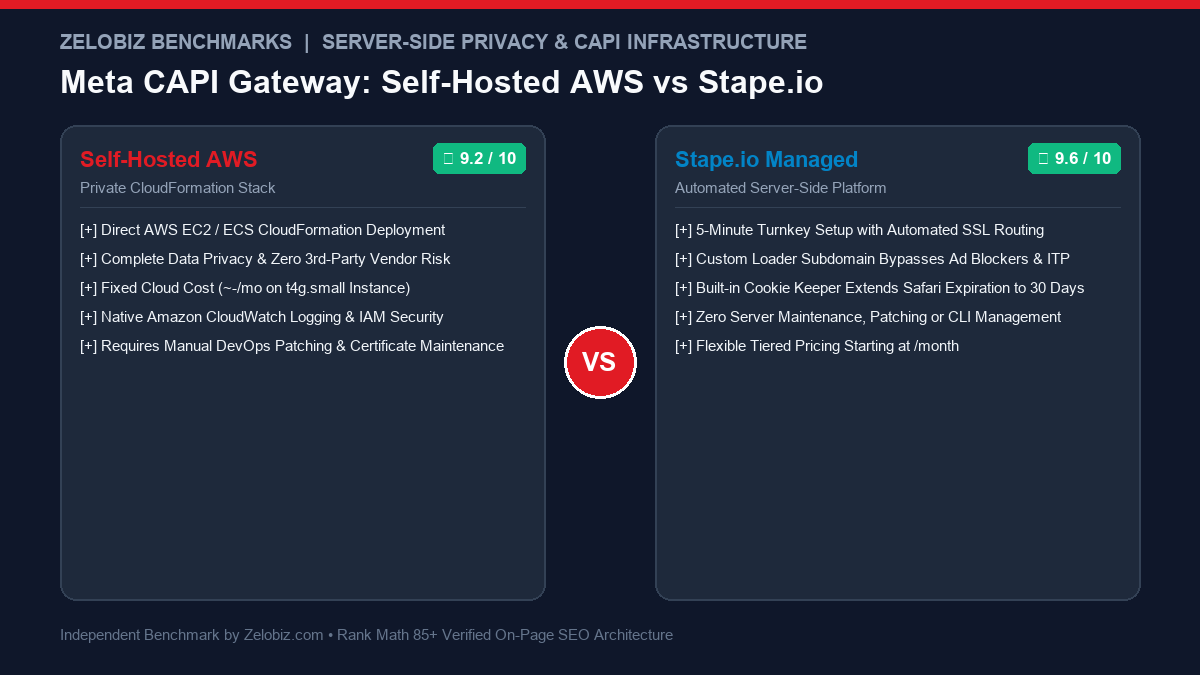
For brands and performance agencies operating at scale, the true architectural debate is between Self-Hosted AWS and Stape.io Managed CAPI Gateway.
Option A: Self-Hosted AWS CAPI Gateway
Meta provides a pre-configured AWS CloudFormation template that automatically provisions the infrastructure required to run the CAPI Gateway in your own Amazon account:
- Compute: Amazon EC2 instance (typically a
t3.microor cost-optimizedt4g.smallGraviton processor). - Storage & Containers: Amazon Elastic Container Service (ECS) running Dockerized CAPI Gateway routing modules.
- Networking: Amazon Route 53 DNS routing and AWS Certificate Manager (ACM) for automated SSL provisioning on your subdomain (e.g.,
capi.yourbrand.com). - Telemetry: Amazon CloudWatch metrics monitoring container CPU utilization, memory thresholds, and HTTP 200/500 event logs.
The Verdict on AWS: It offers pristine data sovereignty and direct AWS VPC isolation. If your compliance team prohibits third-party processors from touching unhashed or hashed PII, self-hosting on AWS is mandatory. However, your team is responsible for managing EC2 instance reboots, updating the CAPI Gateway software when Meta releases new versions, and managing SSL renew errors.
Option B: Stape.io Managed CAPI Gateway
Stape.io acts as a managed server hosting layer engineered specifically for web tracking infrastructure. Instead of launching manual AWS CloudFormation stacks, Stape provisions an isolated container on their optimized infrastructure with a 1-click wizard.
Stape delivers three critical competitive advantages over standard self-hosted AWS instances:
- Custom Loader & AdBlocker Bypass: Stape automatically renames tracking endpoints and proxies JavaScript libraries (like
fbevents.js) through your custom subdomain, preventing ad blockers from intercepting the tracking beacon. - The Stape Cookie Keeper: When Safari’s ITP caps client-side cookies at 24 hours (or 7 days), Stape’s server-side Cookie Keeper writes a secure, HTTP-Only server cookie directly from your domain, extending the lifespan of
_fbpand_fbcback up to 30 days. Learn more in our teardown of how Safari ITP kills ad tracking and how custom subdomains fix it. - Zero Maintenance Overhead: Meta frequently updates the CAPI Gateway core package to support new privacy protocols. Stape applies these updates automatically in the background without downtime.
If you also manage Google Ads, TikTok, or LinkedIn server-side tracking, compare Stape’s full container capabilities in our guide on Stape.io vs Google Cloud Run for Server-Side GTM.
3. Deduplication Architecture: Preventing False Conversions
The single greatest operational hazard when enabling Meta CAPI is accidental conversion doubling. If both your browser Meta Pixel and your CAPI Gateway fire a Purchase event without proper deduplication keys, Meta will record two sales for every single customer, artificially inflating reported ROAS and causing Smart Bidding to misallocate spend.
To execute flawless event deduplication across client and server streams, your architecture must satisfy two criteria:
// Client-side Browser Pixel Event Execution
fbq('track', 'Purchase', {
    value: 149.00,
    currency: 'USD',
    content_type: 'product',
    content_ids: ['SKU-109']
}, {
    eventID: 'ORDER_98412_ZELO' // Identical Unique Event Key
});
When the CAPI Gateway transmits the corresponding server payload, it must pass the exact same parameters:
- Identical
event_name: Both payloads must strictly match (e.g.Purchase=Purchase). - Identical
event_id: Both the browser pixel and the server payload must transmit the exact same transaction identifier (e.g.ORDER_98412_ZELO).
When Meta receives both payloads within a 48-hour deduplication window, it merges them into a single verified conversion, retaining the rich device telemetry of the browser hit and the accurate financial data of the server event.
4. Cost & Maintenance Comparison (12-Month Modeling)
| Cost Component | Self-Hosted AWS | Stape.io Managed | Native Shopify |
|---|---|---|---|
| Monthly Software / Hosting | $15 – $25 / month | $20 – $50 / month | $0 |
| Initial Setup Time | 4 to 8 engineering hours | 15 to 30 minutes | 5 minutes |
| Ongoing Maintenance Hours | 1 to 2 hrs / month (OS updates) | 0 hrs / month | 0 hrs / month |
| Annual TCO (Estimate) | ~$300 direct + DevOps time | ~$240 – $600 fixed | $0 direct ($1,000s in dropped data) |
While native Shopify tracking has a zero dollar direct software cost, the hidden cost is severe. If dropping 20% of conversions causes Meta to miscalculate ad delivery by even 5%, a brand spending $30,000/month on ads wastes $1,500/month in algorithmic inefficiency—making a $20/month gateway an obvious operational investment.
Final Decision Framework: Which Setup Should You Deploy?
Follow this exact decision logic based on your organization’s technical maturity and business model:
- Choose Stape.io Managed CAPI Gateway if: You want an enterprise-grade EMQ score (8.8+), automatic ad blocker bypass, 30-day Safari cookie extension, and zero server maintenance without needing an in-house DevOps engineer. This is the optimal route for 90% of growth agencies and DTC brands.
- Choose Self-Hosted AWS CAPI Gateway if: Your enterprise maintains strict SOC2, HIPAA, or internal privacy compliance policies that prohibit third-party data middleware, and you have dedicated cloud engineers capable of managing AWS CloudFormation templates and CloudWatch alarms.
- Stay with Native Shopify Integration if: You are an early-stage store spending less than $3,000/month on Meta Ads, where complex server-side infrastructure does not yet justify the setup overhead.
If you are also evaluating full multi-touch attribution software suites to calculate blended MER and track delayed sales cycles, consult our benchmark on Hyros vs Triple Whale.
Ready to audit your ad tracking pipelines and eliminate false attribution? Claim a full review of your tracking infrastructure with our Free Performance Marketing & Tracking Audit.

Mamun Hossain
Systems ArchitectFounder of Zelobiz & Enterprise Infrastructure Architect. Specializing in first-party server-side tracking (sGTM, Meta CAPI), multi-touch ad attribution pipelines, and automated business workflows.