
Between Apple Safari’s Intelligent Tracking Prevention (ITP 2.4), Google Chrome’s third-party cookie restrictions, and ubiquitous DNS ad blockers, traditional client-side JavaScript pixels are obsolete. Engineering-led marketing audits demonstrate that browser-only tracking routinely loses 25% to 40% of conversion telemetry. When conversion data is dropped, algorithmic bidding engines—including Meta Advantage+ and Google Smart Bidding—fly blind, drastically inflating Customer Acquisition Costs (CAC).
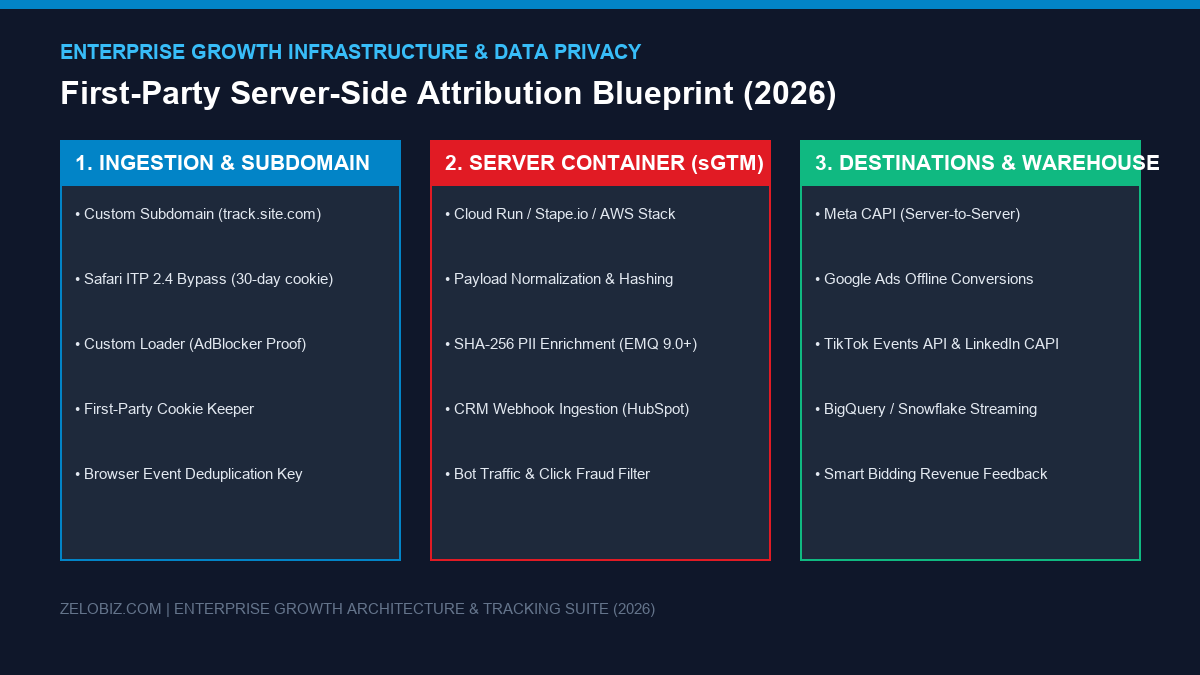
To establish resilient data transmission, modern growth teams must replace fragile client-side tags with a First-Party Server-Side Attribution Pipeline. When properly deployed, this architecture restores 98%+ conversion visibility, achieves an Event Match Quality (EMQ) score above 8.5/10, and feeds clean revenue data back into ad network algorithms.
This master guide outlines the complete architectural blueprint for designing, hosting, and optimizing an enterprise server-side tracking stack in 2026.
The 3-Tier Enterprise Server-Side Tracking Pipeline
Enterprise server-side attribution consists of three decoupled architectural layers:
- First-Party Ingestion Layer: Directing traffic through custom DNS subdomains (e.g.,
track.yourdomain.com) to disguise tracking requests as first-party website assets, bypassing client-side ad blockers and resetting Safari cookie expiration to 30 days. - Server Container & Transformation Layer: A cloud-hosted execution environment—such as Server-Side Google Tag Manager (sGTM) on Google Cloud Run or a managed Meta CAPI Gateway on Stape.io—that normalizes incoming event payloads, hashes personally identifiable information (PII) using SHA-256, and executes deduplication logic.
- Destination & Attribution Layer: Server-to-server API endpoints that dispatch verified payloads directly to Meta Conversions API (CAPI), Google Ads Offline Conversion Tracking (OCT), TikTok Events API, and your internal data warehouse (BigQuery or Snowflake).
Server-Side Infrastructure & Attribution Tool Comparison
Depending on your business model (high-ticket B2B vs direct-to-consumer e-commerce), different architectural hubs provide optimal ROI:
| Solution Architecture | Primary Use Case | Monthly Infrastructure Cost | Key Advantage | Reference Implementation |
|---|---|---|---|---|
| sGTM on Google Cloud Run | Custom enterprise pipelines & multi-platform tracking | $15 – $40 / month | Maximum customization; direct BigQuery streaming | Cloud Run Setup Guide |
| Managed Stape.io sGTM | Growth agencies & rapid multi-client deployment | $20 – $50 / month | Automated Cookie Keeper; 5-minute DNS routing | Stape vs Cloud Run |
| Meta CAPI Gateway (AWS) | Private VPC compliance & zero 3rd-party vendor risk | $15 – $25 / month | Direct CloudFormation stack; complete data isolation | AWS vs Stape CAPI |
| Triple Whale (Shopify OS) | Shopify DTC brands with physical product catalogs | From $129 / month | 1-click native Shopify app; real-time blended MER | Triple Whale Benchmark |
| Hyros (Print Tracking) | High-ticket B2B, consulting, and phone call funnels | From $349 / month | 90-day cross-device call attribution & CRM sync | Hyros vs Triple Whale |
Step-by-Step Implementation Blueprint
Step 1: First-Party DNS Delegation
Never load tracking containers directly from third-party domains like googletagmanager.com or connect.facebook.net. Add a DNS CNAME record in your domain registrar (Cloudflare, Route 53, or Namecheap):
# DNS CNAME Configuration
Type:  CNAME
Name:  track (or capi)
Value: gtm.yourdomain.com.stape.io  (or AWS CloudFront endpoint)
TTL:   Auto / 300 seconds
Proxy: DNS Only (Grey Cloud in Cloudflare to prevent TLS certificate conflicts)
By serving your GTM web container through https://track.yourdomain.com/gtm.js, browser ad blockers cannot distinguish analytics scripts from core application logic. Furthermore, cookies set via this HTTP response header gain first-party status under Safari ITP. For deep configuration nuances, explore our teardown on bypassing Safari ITP with custom loader subdomains.
Step 2: Universal Event Deduplication
When running a redundant hybrid setup (browser pixel + server-side CAPI), ad platforms require deterministic deduplication keys. Without a matching event_id, ad networks record two conversions for a single customer transaction.
Generate a unique transaction identifier on the client side and inject it synchronously into both browser and server payloads:
// Client-Side Payload Execution
const uniqueEventId = 'ORDER_' + Date.now() + '_' + Math.floor(Math.random() * 10000);

// Browser Pixel Hit
fbq('track', 'Purchase', {
    value: 299.00,
    currency: 'USD'
}, { eventID: uniqueEventId });

// Forward same payload to Server-Side GTM endpoint
dataLayer.push({
    event: 'server_purchase',
    event_id: uniqueEventId,
    value: 299.00,
    currency: 'USD',
    user_data: {
        email: customerEmail,
        phone: customerPhone
    }
});
To master high EMQ scores on server payloads, review our detailed guide on Meta Conversions API (CAPI) vs Browser Pixel.
3. Closing the Feedback Loop: CRM Offline Conversion Sync
The ultimate objective of server-side tracking is feeding actual verified revenue back into ad algorithms. In lead generation and B2B pipelines, optimizing Meta and Google Ads on front-end “Lead” events creates algorithmic degradation because bidding systems prioritize low-cost, unqualified form fills.
By connecting your CRM (HubSpot, Salesforce, GoHighLevel) directly to Google Ads Offline Conversion Tracking (OCT) and Meta CAPI:
- When an account executive marks a deal as “Closed Won ($15,000)”, a webhook transmits the deal value alongside the original
gclidorfbclidto your server container. - The server container injects an offline
Purchaseevent back into the ad networks. - Google’s Target ROAS Smart Bidding automatically recalibrates bids around high-value executive decision-makers rather than junior job seekers.
If you track phone call conversions from Google Search ads, see our benchmark on CallRail vs WhatConverts for Call Attribution.
4. Evaluating True ROI: Blended MER vs Platform ROAS
Once your server-side attribution pipeline is operational, you will notice a divergence: in-platform ad manager ROAS numbers will adjust, while third-party platforms reconcile multi-touch interactions. To prevent misallocating ad spend, transition your growth modeling to Marketing Efficiency Ratio (MER):
Blended MER = Total Verified Cash Collections / Total Blended Ad Spend Across All Channels
For an in-depth mathematical walkthrough on avoiding double-counted revenue, consult our guide on Blended ROAS vs MER calculations, or model your target unit economics directly inside our interactive Breakeven ROAS Calculator.
Audit Your Tracking Infrastructure
Transitioning from browser pixels to an enterprise server-side attribution pipeline requires meticulous configuration of DNS routing, SSL handshakes, and event deduplication keys. Even a minor parameter mismatch can cause ad networks to reject conversion feeds.
If your team spends over $20,000/month across Meta, Google, or TikTok and needs an architectural audit of your server containers, custom subdomains, and EMQ scores, request a confidential evaluation with our Free Performance Marketing & Tracking Audit.

Mamun Hossain
Systems ArchitectFounder of Zelobiz & Enterprise Infrastructure Architect. Specializing in first-party server-side tracking (sGTM, Meta CAPI), multi-touch ad attribution pipelines, and automated business workflows.