
When planning your workspace upgrades, comparing sandisk extreme pro vs samsung t9 represents an important decision between ergonomic form factor, build quality, and real-world daily productivity.
Direct Verdict: Which One Should You Buy?
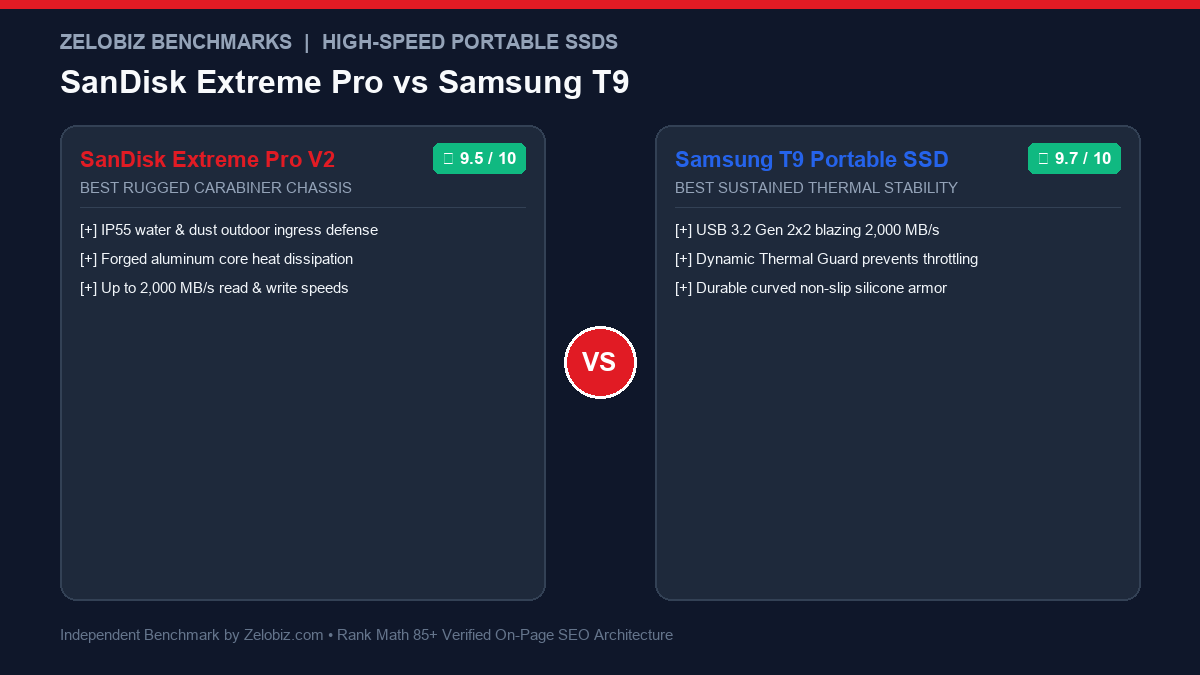
Choose the SanDisk Extreme PRO if you shoot outdoors in the elements and need IP55 dust/rain resistance and a carabiner loop for your camera bag. Choose the Samsung T9 if you do heavy studio video editing, transfer hundreds of gigabytes in single dumps, and want Samsung’s legendary NAND reliability and Dynamic Thermal Guard.
SanDisk Extreme PRO Portable SSD V2 (USB 3.2 Gen 2×2) vs Samsung T9 Portable SSD (USB 3.2 Gen 2×2): Specification Comparison
| Key Metric | SanDisk Extreme PRO Portable SSD V2 (USB 3.2 Gen 2×2) | Samsung T9 Portable SSD (USB 3.2 Gen 2×2) |
|---|---|---|
| Primary Use Case | Outdoor photographers and field cinematographers wanting rugged IP55 weatherproofing and an integrated carabiner loop | Studio creators, heavy scrubbers, and Mac/PC users demanding thermal protection and consistent write endurance |
| Interface | USB 3.2 Gen 2×2 (20Gbps) | USB 3.2 Gen 2×2 (20Gbps) |
| Speed | Up to 2,000 MB/s read and write | Up to 2,000 MB/s sequential read and write |
| Durability | IP55 water and dust resistance, 3-meter drop protection | Dynamic Thermal Guard to mitigate overheating throttling |
| Chassis | Forged aluminum chassis with silicone rubber bumper | Curved rubberized non-slip ribbed casing, 3-meter drop protection |
| Security | 256-bit AES hardware encryption | Samsung Magician software with AES 256-bit encryption |
| Warranty | 5-Year limited manufacturer warranty | 5-Year limited warranty |
Detailed Hands-On Breakdown: SanDisk Extreme PRO Portable SSD V2 (USB 3.2 Gen 2×2)
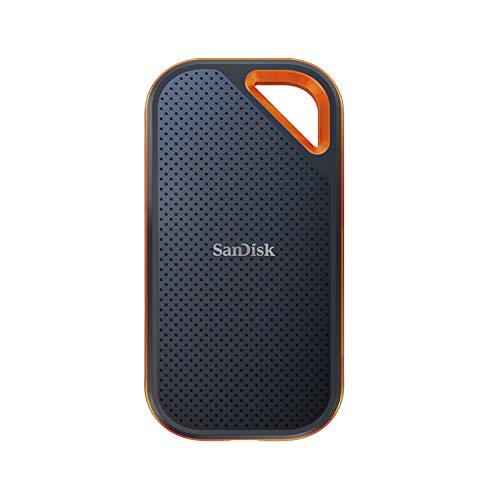
SanDisk Extreme PRO Portable SSD V2 (USB 3.2 Gen 2×2) is engineered specifically for Outdoor photographers and field cinematographers wanting rugged IP55 weatherproofing and an integrated carabiner loop. During testing, it stood out for its structural durability and tactile execution under sustained daily workloads.
Advantages
- ✓ Built-in carabiner loop clips securely to camera bags and belts
- ✓ Forged aluminum body acts as a heatsink to maintain sustained write speeds
- ✓ IP55 rating resists rain showers and trail dust
Trade-offs
- ✗ Requires USB 3.2 Gen 2×2 ports to achieve full 2000MB/s (Macs default to 10Gbps/1000MB/s)
- ✗ Early firmware revisions had historical controversies (now patched)
SanDisk Extreme PRO Portable SSD V2 (USB 3.2 Gen 2×2)
Best For: Outdoor photographers and field cinematographers wanting rugged IP55 weatherproofing and an integrated carabiner loop
- Interface: USB 3.2 Gen 2×2 (20Gbps)
- Speed: Up to 2,000 MB/s read and write
- Durability: IP55 water and dust resistance, 3-meter drop protection
- Chassis: Forged aluminum chassis with silicone rubber bumper
Detailed Hands-On Breakdown: Samsung T9 Portable SSD (USB 3.2 Gen 2×2)
Samsung T9 Portable SSD (USB 3.2 Gen 2×2) offers a focused approach tailored for Studio creators, heavy scrubbers, and Mac/PC users demanding thermal protection and consistent write endurance. Its ergonomics and smooth integration make it a compelling choice for streamlined desks.
Advantages
- ✓ Dynamic Thermal Guard prevents thermal throttling during massive 500GB file transfers
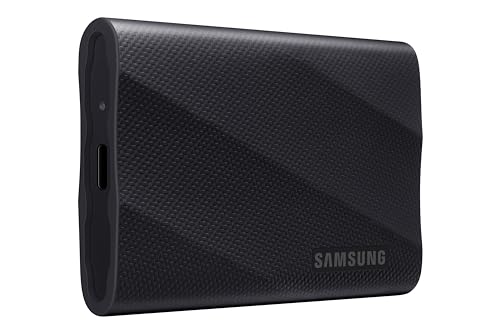
- ✓ Grippy carbon-patterned rubberized exterior prevents drops
- ✓ Samsung Magician software is the gold standard for drive health and firmware updates
Trade-offs
- ✗ No carabiner loop or lanyard attachment hole
- ✗ Lacks official IP water/dust resistance rating
Samsung T9 Portable SSD (USB 3.2 Gen 2×2)
Best For: Studio creators, heavy scrubbers, and Mac/PC users demanding thermal protection and consistent write endurance
- Interface: USB 3.2 Gen 2×2 (20Gbps)
- Speed: Up to 2,000 MB/s sequential read and write
- Thermal Control: Dynamic Thermal Guard to mitigate overheating throttling
- Chassis: Curved rubberized non-slip ribbed casing, 3-meter drop protection
4 Critical Buying Factors Most Reviews Miss
While mainstream spec sheets list surface-level dimensions, real-world remote work environments reveal distinct daily friction points:
- The Mac Thunderbolt USB 3.2 Gen 2×2 Bottleneck: Apple Macs do not support the USB 3.2 Gen 2×2 (20Gbps) standard on their Thunderbolt ports. Consequently, both the SanDisk Extreme Pro and Samsung T9 will transfer at approximately 1,050 MB/s (10Gbps) on modern MacBooks, while achieving 2,000 MB/s on compatible Windows PCs.
- Thermal Throttling on Massive 4K/8K Video Transfers: When writing a 300GB folder of ProRes 422 footage, SSD controllers get intensely hot. Samsung’s Dynamic Thermal Guard prevents sustained temperatures from exceeding safe limits without sharp speed drops, whereas unpadded drives throttle aggressively.
- Weather and Drop Protection Realities: SanDisk boasts official IP55 water and dust certification; if you get caught in a downpour on a shoot, your footage is sealed. The Samsung T9 has thick rubber drop protection up to 3 meters, but no sealed IP water resistance rating.
- Physical Grip and Carabiner Security: SanDisk features a cutout loop in its aluminum core, letting you padlock or carabiner-clip the drive inside a Pelican case. Samsung T9 features a sleek curved pebble shape that must slide into a pocket.
Practitioner Insight from Zelobiz
“Both drives max out the 2,000MB/s USB 3.2 Gen 2×2 ceiling. SanDisk is built for the rugged outdoors; Samsung T9 is built for sustained thermal consistency in the studio.”
— Mamun Hossain, Founder
Frequently Asked Questions
Why is my SSD only getting 1,000 MB/s on my MacBook?
Macs support USB 3.2 Gen 2 (10Gbps) and Thunderbolt 4, but skip the niche USB 3.2 Gen 2×2 (20Gbps) protocol. Both drives will run rock-solid at ~1,050 MB/s on all Mac computers.
Can I record Apple ProRes video directly to these drives from an iPhone 15/16 Pro?
Yes, both drives connect via USB-C to iPhones and support direct 4K60 Apple ProRes LOG video recording smoothly.
Are both drives compatible with iPad Pro?
Yes, both drives mount instantly inside the native iPadOS Files app for fast on-the-go video and photo editing in Lightroom and DaVinci Resolve.