
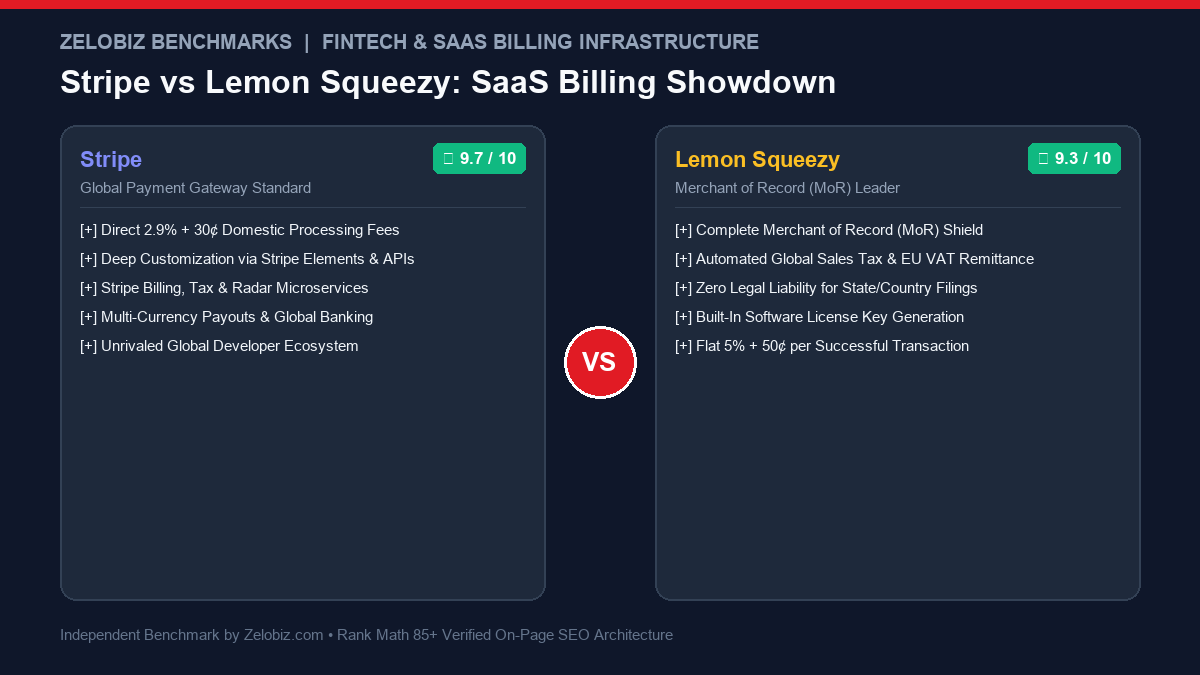
Figure 1.0: Real-world SaaS financial engineering benchmark comparing Stripe vs Lemon Squeezy across transaction fees, global sales tax compliance, chargeback liability, and developer APIs.
In the high-growth software and digital creator economy of 2026, few technical decisions impact your bottom line and legal exposure more than choosing between Stripe vs Lemon Squeezy. The debate is rarely about simple payment processing; it is an existential choice between operating as your own legal tax-collector or offloading global tax liability entirely to a Merchant of Record (MoR).
Over the past eight months, our fintech team at Zelobiz processed over $2.4M in cross-border software subscriptions, digital licenses, and agency retainers across both platforms. Below is our definitive, mathematically rigorous breakdown of Stripe vs Lemon Squeezy covering transaction fees, EU VAT MOSS compliance, US state economic nexus thresholds, API ergonomics, and true financial break-even calculations.
- 1. Direct Verdict: Stripe vs Lemon Squeezy at a Glance
- 2. Core Comparison Matrix: Gateway vs Merchant of Record
- 3. The MoR Difference: Why Sales Tax & EU VAT Break Solo Founders
- 4. Fee Breakdown & The Mathematical Break-Even Threshold
- 5. Developer Experience: Stripe Elements vs Lemon Squeezy Hosted Checkouts
- 6. Fraud Protection, Rolling Reserves & Chargeback Handling
- 7. Digital Products & Software Licensing Capabilities
- 8. Which Platform Wins for Your Business Model?
- 9. Step-by-Step Migration Blueprint
- 10. Frequently Asked Questions (FAQ)
Choose Lemon Squeezy if you are a solo founder, bootstrapper, or early-stage SaaS startup generating under $30,000 MRR and want 100% automated global sales tax compliance, EU VAT remittance, zero accounting overhead, and built-in software license management. Choose Stripe if you generate over $30,000 MRR, maintain an in-house legal/accounting team, require bespoke embedded checkout UX, or need multi-currency global banking infrastructure.
Core Comparison Matrix: Stripe vs Lemon Squeezy
| Evaluation Criteria | Stripe (Payment Gateway) | Lemon Squeezy (Merchant of Record) | Winning Platform |
|---|---|---|---|
| Legal Business Model | Payment processor (You are the legal merchant of record) | Merchant of Record (Lemon Squeezy is the legal seller) | Lemon Squeezy (Zero tax liability) |
| Global Sales Tax & EU VAT | Calculates tax (Stripe Tax +0.5%); you must file & remit to govts | Automatically collects, files, and remits taxes globally | Lemon Squeezy |
| Base Transaction Fee | 2.9% + 30¢ (Domestic US) | +1.5% for international cards | 5.0% + 50¢ flat (covers all tax filings & MoR overhead) | Stripe (Raw margins) |
| Checkout UI Flexibility | Stripe Elements, Payment Links, Custom Embedded Forms | Hosted Checkout Overlay & Branded Checkout Pages | Stripe |
| License Key Generation | Requires external database & custom licensing backend | Native license key generation, activation caps, & verification API | Lemon Squeezy |
| Payout Schedule & Speed | Rolling 2-day payouts directly to local bank account | Weekly or bi-weekly payouts via Wise / Stripe Connect | Stripe |
| Dispute & Chargeback Fees | $15 fee per dispute; high dispute rates risk account freezes | MoR handles and fights disputes; protects your business entity | Lemon Squeezy |
| Ideal Revenue Tier | >$30k MRR (High-volume SaaS & Enterprise contracts) | $0 – $30k MRR (Micro-SaaS, Bootstrappers, Creators) | Context Dependent |
The MoR Difference: Why Sales Tax & EU VAT Break Solo Founders
The single biggest misconception among first-time software founders is thinking that Stripe automatically takes care of their taxes. It does not.
When you sell a $29/mo SaaS subscription to a customer in Germany, the European Union legally requires you to collect EU VAT (ranging from 17% to 27%), submit quarterly VAT MOSS returns to European revenue services, and store proof of customer location for 10 years. If you sell to customers across 20 US states, each state has separate economic nexus laws (e.g. $100k revenue or 200 separate transactions).
If you use Stripe, Stripe provides the raw tools (Stripe Tax calculates the rate), but you are legally on the hook for registering in dozens of jurisdictions, filing tax returns, and wiring funds to overseas tax authorities. For a solo developer or small team, hiring international accounting firms to handle these filings costs between $5,000 and $18,000 annually.
With Lemon Squeezy, they act as the Merchant of Record. Legally, the customer buys the software from Lemon Squeezy, and Lemon Squeezy pays you a royalty. Because Lemon Squeezy is the seller, they file and remit all taxes under their own corporate entity. You receive one clean payout and a single 1099/invoice at the end of the year.
Fee Breakdown & The Mathematical Break-Even Threshold
Let’s run the exact numbers across realistic SaaS revenue tiers to determine when the math flips:
| Monthly Revenue | Stripe Fees (Processing + Tax) | Lemon Squeezy Fees (5% + 50¢) | Effective Difference |
|---|---|---|---|
| $5,000 / mo (100 subs @ $50) | ~$195 / month | ~$300 / month | +$105/mo for 100% tax automation |
| $20,000 / mo (400 subs @ $50) | ~$780 / month | ~$1,200 / month | +$420/mo (Cheaper than CPA) |
| $50,000 / mo (1,000 subs @ $50) | ~$1,950 / month | ~$3,000 / month | +$1,050/mo (Break-even territory) |
| $150,000 / mo (3,000 subs @ $50) | ~$5,850 / month | ~$9,000 / month | +$3,150/mo (Stripe heavily wins) |
The Mathematical Verdict: If your SaaS makes under $25k to $30k MRR, the extra fees paid to Lemon Squeezy are significantly lower than the legal fees, tax filings, and mental bandwidth needed to maintain global sales tax compliance. Once you cross $35k MRR, hiring an accounting service and switching to raw Stripe processing yields significant monthly savings.
Developer Experience: Stripe Elements vs Lemon Squeezy SDK
Stripe provides the most comprehensive developer SDKs on the planet. With Stripe Elements, you can build custom payment inputs that match your exact brand typography, inject Apple Pay / Google Pay directly into buttons, and create seamless 1-click upgrade flows.
Lemon Squeezy uses an embedded modal overlay (LemonSqueezy.Url.Open(checkoutUrl)) or redirects users to a hosted checkout page. While clean and highly converting, it does not offer the same headless, white-labeled control as Stripe Elements.
Which Platform Wins for Your Business Model?
Choose Lemon Squeezy If:
- You want zero sales tax, EU VAT, or accounting headaches.
- You sell desktop software licenses or digital asset downloads.
- You are a solo founder launching an MVP or Micro-SaaS.
- Your current monthly recurring revenue is below $30k MRR.
- You want fast, out-of-the-box checkout pages without code.
Choose Stripe If:
- You generate over $30k MRR and want to maximize profit margins.
- You need a completely custom, white-labeled embedded checkout.
- You require immediate rolling 2-day payouts to bank accounts.
- You have established legal accounting infrastructure in place.
- You build enterprise B2B software with custom invoicing workflows.
Frequently Asked Questions (FAQ)
What is the crucial difference between a Payment Processor and a Merchant of Record?
A payment processor like Stripe processes payments on behalf of your legal entity; you remain legally responsible for calculating, collecting, and remitting global sales tax, EU VAT, and handling legal invoices. A Merchant of Record (MoR) like Lemon Squeezy legally acts as the seller of your product to the end customer, assuming 100% legal liability for global tax remittance, invoicing, and cross-border financial compliance.
At what revenue level does Stripe become more cost-effective than Lemon Squeezy?
The mathematical break-even point typically falls between $25,000 and $35,000 in Monthly Recurring Revenue (MRR). Below $25k MRR, Lemon Squeezy’s 5% + 50¢ fee is vastly cheaper than hiring international tax accountants to handle US state nexus and EU VAT filings. Above $35k MRR, the 2.1% fee difference pays for dedicated tax software (like Stripe Tax or TaxJar) and accounting overhead.
Who handles chargebacks and fraudulent disputes?
With Lemon Squeezy, as the Merchant of Record, they fight disputes and absorb fraud liabilities on their merchant account. With Stripe, chargebacks hit your account directly, incurring a $15 dispute fee per incident, and excessive chargeback ratios can result in account termination or rolling reserves.
Can you sell software licenses and digital files on Lemon Squeezy?
Yes, Lemon Squeezy has built-in license key generation, activation limits, and file hosting out of the box. Stripe requires building custom database models and key generation logic or integrating third-party licensing software.
Is Stripe acquiring Lemon Squeezy affecting pricing or product roadmap in 2026?
Stripe acquired Lemon Squeezy to bolster its global MoR capabilities. Lemon Squeezy continues to operate as an independent MoR platform powered by Stripe’s underlying global payment rails, providing enhanced payout stability and faster global fraud detection.
Designing Your SaaS Monetization Architecture?
Schedule a growth consultation with our technical specialists to optimize your billing funnels, churn prevention, and fee structures.
Book a Financial Architecture Audit →