
Disclosure: Zelobiz may earn a commission if you buy through an AppSumo link on this page, at no extra cost to you. This review is based on TextLink’s AppSumo listing, its product pages, and a reading of public buyer reviews, not on a paid subscription or a live SMS campaign we ran ourselves.

TextLink is a bulk SMS tool, not an SEO or backlink product, and clearing that up is the first order of business here since an earlier version of this page described it incorrectly. What TextLink actually does is let a business send bulk SMS campaigns using its own Android phone and a regular SIM card, instead of going through a carrier’s business messaging registration process or paying a per-message fee to a provider like Twilio. This review covers how that works, what the AppSumo lifetime tiers included, what real buyers say about it, and where the approach carries real tradeoffs worth understanding before switching a business’s SMS outreach onto it.
What TextLink actually is
Most business SMS platforms, Twilio, EZ Texting, SimpleTexting, route messages through the carrier network using a registered business number, which in the US usually means going through A2P 10DLC registration, a formal process carriers require for application-to-person bulk messaging. That registration takes time, sometimes money, and adds friction for a small business that just wants to text a customer list.
TextLink takes a different approach entirely. The app runs on a spare Android device connected to a normal SIM card, and it sends messages as if a person were texting from their own phone, rather than through a carrier’s bulk messaging infrastructure. According to its own product description and independent reviews, setup involves installing the TextLink app on an Android device, logging in, and configuring which countries that SIM can send to. From there, campaigns can be built through a no-code interface, uploaded from a CSV or Excel file, or triggered through TextLink’s API for more automated workflows. It also includes a browser-based chat interface for one-to-one conversations, not just bulk blasts.
Current AppSumo deal status
As of this review, TextLink’s AppSumo listing shows Sold out!, with a notify-me option for when it returns. When the deal was live, five license tiers were available:
| Tier | Price | Devices |
|---|---|---|
| Tier 1 | $39 (reg. $275) | 2 |
| Tier 2 | $69 (reg. $448) | 5 |
| Tier 3 | $139 (reg. $950) | 10 |
| Tier 4 | $249 (reg. $1,942) | 25 |
| Tier 5 | $399 (reg. $3,884) | Unlimited |
Every tier included the same core feature set: unlimited messages, users, and API access, with the tiers differing only by how many Android devices can be connected simultaneously. All tiers carried the standard 60-day refund window, plus AppSumo’s “We Got Your Back” guarantee, which is worth noting since several other deals covered in this review series were explicitly excluded from that particular guarantee. TextLink’s listing being covered by it suggests a slightly higher level of AppSumo vetting than some of the partner-managed deals elsewhere in this cluster.
Key features
- Bulk SMS sending through a regular Android device and SIM card, bypassing carrier A2P registration
- No-code campaign builder with CSV and Excel contact uploads
- API access for automated, developer-driven messaging workflows
- Browser-based chat interface for one-to-one conversations, not just bulk sends
- Multi-device support scaling from 2 devices up to unlimited, depending on tier
- Country-level configuration for which destinations a connected SIM can message
What actual buyers say
TextLink holds a strong 4.5 out of 5 rating across 33 public AppSumo reviews, a notably better score than some of the other tools in this review series. Buyers consistently mention ease of setup, low cost relative to traditional SMS platforms, and reliable delivery once a device is configured. The recurring complaint is around customer support responsiveness and documentation, several reviewers wanted clearer setup guidance, particularly around configuring multiple devices and troubleshooting connection drops, rather than reporting the core sending function failing outright.
What running this actually looks like day to day
The device requirement is easy to gloss over in a feature list, but it changes how you operate the tool compared to a cloud SMS platform. A dedicated Android phone has to stay powered on, connected to WiFi or mobile data, and signed into the TextLink app continuously for messages to send and receive. That means finding a spot for the phone, keeping it charged, and building some kind of check on whether it has gone offline, since a dead battery or a dropped connection silently stops your SMS channel until someone notices. For a single device on Tier 1 or Tier 2, that is a manageable bit of light infrastructure. Scaling to 10 or 25 devices on the higher tiers turns it into a small device-management operation, racks of phones or tablets, in whatever form that takes, that someone has to physically maintain, charge, and troubleshoot when a specific device stops sending.
That operational overhead is the real cost of TextLink’s pricing advantage. A cloud SMS platform charges more per message partly because it is running that infrastructure reliability for you. TextLink shifts that reliability work onto the buyer in exchange for a lower price, which is a reasonable trade for some businesses and a bad one for others depending on how much internal capacity exists to babysit a bank of Android devices.
Doing the math against Twilio and EZ Texting
Twilio’s per-message and per-number fees mean a business sending a meaningful volume of SMS, several thousand messages a month, can accumulate a real recurring bill fast, on top of the up-front work of setting up A2P 10DLC registration correctly. EZ Texting and SimpleTexting bundle more done-for-you campaign tools and support into their subscription pricing, which is worth paying for if you value not having to build campaign logic yourself, but that convenience is also a recurring cost that never goes away as long as you use the platform. TextLink’s one-time tiers, by contrast, top out at $399 for unlimited devices and messages, a cost that a business sending real volume through Twilio or EZ Texting could plausibly exceed within a single year of subscription fees. The question is not whether TextLink is cheaper on paper, it clearly is, but whether the device management overhead and the compliance considerations below make that cheaper price worth the operational tradeoff for your specific business.
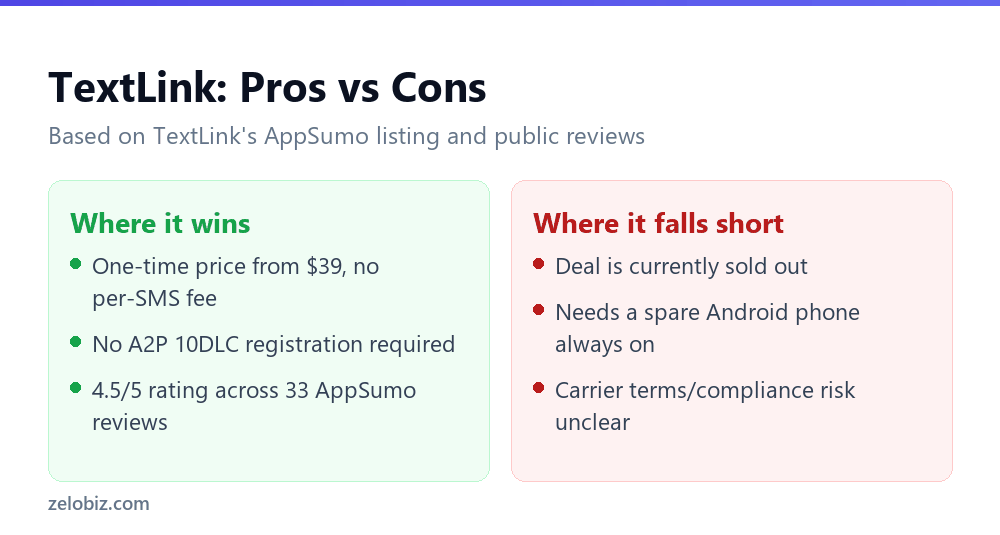
Pros and cons
Pros
- Meaningfully cheaper than registering for traditional A2P bulk messaging or paying Twilio’s per-message rates
- Strong, consistent public review score relative to other lifetime-deal SMS tools
- Unlimited messages and users on every tier, with device count as the only real differentiator
- API access included even on the lowest tier, useful for a developer wanting to automate outreach
Cons
- The AppSumo deal is currently sold out
- Requires a spare Android device to stay powered on and connected at all times per active SIM, which is real hardware overhead compared to a cloud-based SMS platform
- Bypassing formal A2P registration by routing through a personal-style SIM connection raises real questions about carrier terms of service and long-term compliance that are worth researching for your specific country and carrier before relying on it for business-critical messaging
- Multiple reviewers flag thin documentation and slow support responses
How TextLink compares to the alternatives
SimpleTexting and EZ Texting are both mainstream, carrier-compliant SMS marketing platforms with built-in automation, contact segmentation, and dedicated support teams, and both charge ongoing subscription fees that scale with contact list size and message volume. Twilio sits at the more technical end, offering the most flexibility for developers willing to build their own messaging logic, but its per-message and per-number costs can climb quickly for a small business, and it explicitly requires proper A2P registration to send bulk messages compliantly in the US.
TextLink’s device-based approach undercuts all of them on price, but it is solving the cost problem by working around the registration process those platforms comply with, not by being a fundamentally cheaper version of the same compliant infrastructure. That is a meaningful distinction to hold onto while comparing dollar figures across these tools, since the price difference reflects a different regulatory approach, not just a better-negotiated deal on the same underlying service. That distinction matters more the larger and more business-critical your SMS program becomes. A side project or a small local business sending occasional updates to a customer list is a very different risk profile than a company running its primary customer communication channel through a workaround.
Who this is actually for
TextLink fits a small business, freelancer, or local service provider that wants affordable bulk SMS for appointment reminders, promotions, or customer updates, and is comfortable keeping a dedicated Android device connected as part of the setup. It is a weaker fit for a business that needs guaranteed carrier compliance for regulated or high-volume messaging, or one that cannot tolerate a device going offline as a single point of failure for its SMS channel.
Choosing a tier based on real device count, not budget alone
Because every tier shares the same feature set, unlimited messages, users, and API access, the only real decision is how many Android devices your sending volume actually needs, not which tier has the most bells and whistles. A single device can realistically handle a modest volume of messages before running into practical throughput limits, so a business planning any real campaign volume should think in terms of messages per device per day, not just total contacts, when picking between the five tiers. Buying more devices than you can physically manage defeats the purpose of the low entry price, since idle devices are still hardware you have to maintain for no benefit.
A compliance note worth taking seriously
Carriers introduced A2P 10DLC registration specifically to reduce spam and give legitimate businesses reliable delivery, and tools built around bypassing that registration exist in something of a gray area depending on the country, carrier, and how the tool is used. This is not a claim that TextLink is doing anything illegal, reviews describe it working reliably for many buyers, but anyone planning to route significant business SMS volume through a personal-style device connection should read their carrier’s acceptable use policy and understand what happens if a carrier flags or throttles that number, before building a customer communication channel on top of it.
Frequently asked questions
Is the TextLink AppSumo deal still available?
No. As of this review, the listing shows as sold out, though it is covered by AppSumo’s “We Got Your Back” guarantee for buyers who purchased while it was live.
Does TextLink require A2P 10DLC registration?
No, that is the core of its pitch: it routes messages through a connected Android device and SIM card instead of traditional carrier bulk-messaging registration. Review your carrier’s terms before relying on this for business-critical messaging.
How many devices can be connected on the lifetime deal?
It depended on the tier purchased, ranging from 2 devices on Tier 1 up to unlimited devices on Tier 5.
What do real buyers say about TextLink?
It holds a 4.5 out of 5 rating across 33 public AppSumo reviews, with praise for cost and reliability and complaints centered on support responsiveness and documentation.
What happens if the connected Android device goes offline?
Messaging stops until the device reconnects. This is the main operational tradeoff of TextLink’s approach compared to a cloud-based SMS platform, and it is worth planning a way to monitor device uptime before relying on it for time-sensitive messages.
Verdict
TextLink is not the SEO or backlink tool an earlier version of this page described. It is a genuinely well-reviewed, low-cost bulk SMS tool for businesses that want to avoid the registration overhead and recurring cost of traditional SMS platforms, with the tradeoff that it depends on a dedicated Android device staying connected and works around, rather than through, the formal carrier registration process. For a small business’s occasional customer texts, that tradeoff is probably fine. For a company planning to make SMS a primary revenue channel, it is worth reading the compliance fine print and possibly starting with a smaller device tier before committing to the unlimited plan.