
Most lists of AI services to sell describe capabilities. Content generation, chatbot setup, workflow automation. Those are things AI can do, which is not the same as things a small business will hand money over for.
The gap between the two is where most attempts fail. A capability is something a client could get themselves for the price of a subscription. A service is a finished outcome plus somebody responsible when it goes wrong.
Short answer: Small businesses pay for a specific finished job, set up inside their own systems, with someone accountable for keeping it running. They do not pay for access to AI, for tool recommendations, or for content they could generate themselves. Sell the outcome and the responsibility, not the technology.
Nobody Is Buying AI
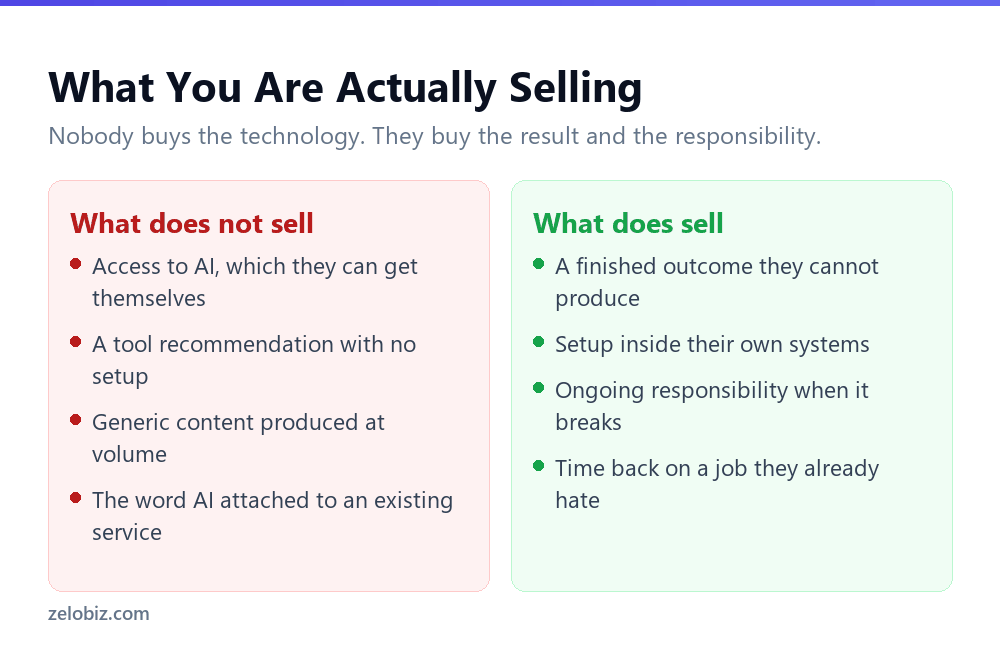
This is the thing to internalise before anything else. A small business owner does not want AI. They want the invoice chasing done, the enquiries answered overnight, or the monthly report to appear without them building it.
AI is how you deliver that cheaply enough to make a margin. It is not the product, and leading with it usually hurts. The moment a client understands the service as buying AI, they start wondering why they do not just buy the subscription themselves.
The services that sell are described in the client’s language. Not intelligent document processing, but getting supplier invoices into the accounts system without anyone typing them. Same work, entirely different reception.
Six Services That Actually Get Bought
These recur because each solves a problem the owner already knows they have, and each involves work inside systems they already run.
Look at the last column. In every case there is real human work left, and it is not trivial. That column is the service. If it were empty, the client would not need you.
What Actually Moves the Price
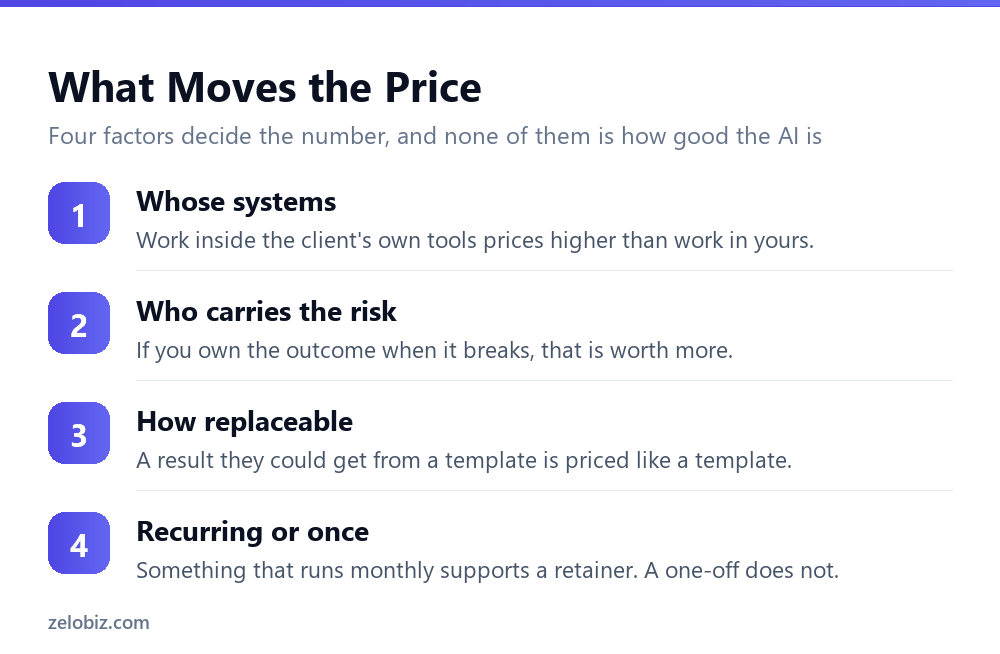
We are not going to publish a rate card, because any number would be invented and your market, country and client size change it entirely. What is useful is knowing which factors move a price up and which pin it down.
Whose systems the work happens in
Work delivered inside the client’s own tools prices considerably higher than work you do in yours and hand over. It is harder, it requires access and care, and it is far more valuable because it fits how they already operate.
Who carries the risk when it breaks
A build-and-walk-away job is a commodity. Taking responsibility for the thing continuing to work is a different service at a different price, and it is the basis of every retainer in this field.
How easily replaced the output is
If the client could get a comparable result from a template or a cheap tool in an afternoon, the price is anchored to that, regardless of how sophisticated your method is. Choose work where the honest alternative is expensive or unpleasant.
Whether it recurs
One-off projects mean permanently hunting for the next client. Something that runs every month, that you maintain, supports a retainer, and retainers are what turn this from freelancing into a business.
⚠️ Watch out: Do not price against what the AI subscription costs you. Clients are not buying compute, and a price anchored to your tool costs will be far too low to cover the support burden that arrives later. Price against the value of the job being done and off their desk.
Getting the First Client Without an Audience
This is the genuine barrier, and it is not solved by better AI skills. Nobody buys a service like this from a stranger with no track record, which is a real problem when you are starting.
- Start with businesses you already know. A former employer, a client from other work, someone whose operation you understand. Familiarity substitutes for the track record you do not have yet.
- Pick one job, not a menu. Offering to help with AI invites a polite no. Offering to get their supplier invoices into their accounts system without typing invites a specific answer.
- Do the first one small and visible. A narrow piece of work that obviously succeeds or obviously does not is worth more than a large ambiguous engagement, because it produces a reference either way.
- Ask what they already pay someone to do. Existing spend on a tedious task is the clearest possible signal, and it means the budget conversation is already settled.
The hardest part is that early work is usually underpriced relative to the effort. That is a normal cost of building a reference, but be honest with yourself that it is what you are buying, rather than mistaking it for a sustainable rate.
Scoping the Work Before You Quote
Most jobs that go badly were mis-scoped rather than badly delivered. Four questions asked before quoting prevent nearly all of it.
What does the process look like today?
Ask them to walk you through it once, end to end, on a real example rather than in the abstract. You will almost always find a step nobody mentioned, and that step is usually where the difficulty is hiding.
How often does the awkward version happen?
Every process has a clean path and a messy one. The supplier who sends a photo of an invoice instead of a PDF. The enquiry that is actually a complaint. Ask what proportion of cases are awkward, because that number decides how much human time the job really needs.
Who checks the output, and what happens if it is wrong?
If the answer is that nobody checks, either you are checking, which needs pricing in, or the client is accepting a risk they have not thought about. Both are worth settling before the work starts rather than after the first error.
What has to keep working after you leave?
This separates a project from a retainer. If something you build runs unattended in their business, somebody has to own it when a connected service changes. Deciding whether that is you, and at what price, is the single most valuable clause in the agreement.
💡 Pro tip: Ask to see twenty real examples of whatever you will be processing before you quote a fixed price. If the client cannot produce twenty, the volume may not justify the work. If the twenty are more varied than described, you have just avoided a bad quote.
What Still Needs a Human
Anyone considering this work should be clear-eyed about how much human effort remains, because the margin lives or dies on it.
Verification is the one people underestimate most. Reviewing AI output properly takes real time, and it does not shrink much with volume. Any pricing model assuming it disappears at scale will fail in the second month.
Why Most of These Businesses Stall
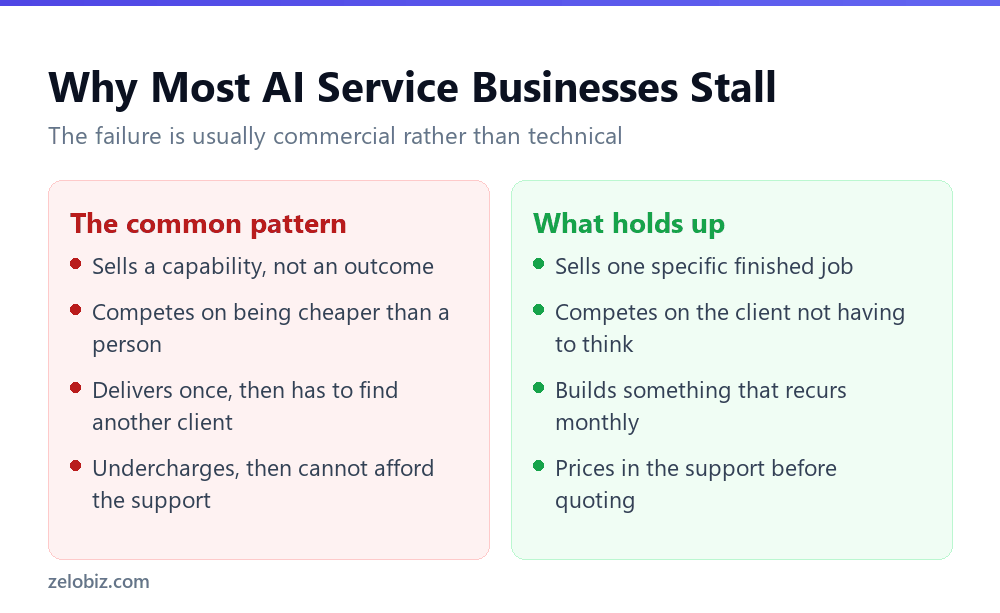
The failures are usually commercial rather than technical. Four patterns account for most of them.
Selling a capability instead of an outcome, which leaves the client wondering why they need you. Competing on being cheaper than hiring someone, which is a race you win by becoming unprofitable. Delivering one-offs, which means starting from zero every month. And underpricing, which is fatal specifically because the support burden arrives after the invoice is paid.
There is no shortcut through any of that. It is ordinary service-business difficulty, and the AI part does not make it easier.
📊 Note: Nothing here promises a particular income, and you should be wary of anyone who does. What determines whether this works is the same thing that determines whether any service business works: whether you can find clients with a problem worth paying to remove, and deliver it reliably enough that they keep paying.
Common Questions
What AI services do small businesses actually pay for?
Specific finished jobs delivered inside their own systems: getting supplier invoices into accounting software, triaging and drafting first responses to enquiries, assembling recurring reports, drafting documents from their templates, handling meeting notes, and cleaning up messy data. They do not pay for access to AI itself.
Should I describe my service as an AI service?
Usually not. Leading with AI invites the client to wonder why they cannot just buy the subscription themselves. Describe the outcome in their own language, such as supplier invoices reaching the accounts system without anyone typing them.
How should I price AI services?
Price against the value of the job being off the client’s desk, not against what your AI subscription costs. Four things move the number: whether the work happens in their systems, whether you carry responsibility when it breaks, how easily the output could be replaced, and whether it recurs.
How do I get a first client with no track record?
Start with businesses you already understand, offer one specific job rather than a menu of services, keep the first engagement small and visible so it produces a clear reference, and look for tasks they already pay someone to do.
What work is left for me if AI does the job?
Scoping what the client actually needs, setting it up in their environment, verifying output before it reaches anyone, maintaining it when connected systems change, and being accountable when something goes wrong. Verification alone is substantial and does not shrink much with volume.
Why do most AI service businesses fail?
Commercial reasons rather than technical ones. Selling a capability instead of an outcome, competing on price against hiring a person, delivering one-off projects instead of building something recurring, and underpricing so badly that the ongoing support costs more than the fee.
Can I run this as a side business?
The delivery work can fit around other commitments, but the maintenance cannot always wait. If you take responsibility for something that runs in a client’s business, you are agreeing to respond when it breaks, and that is worth deciding before you sell it rather than after.
The Short Version
- →Clients buy a finished outcome and someone accountable, never access to AI.
- →Describe the job in their language. Leading with AI invites a do-it-yourself objection.
- →Work inside the client’s own systems prices far higher than work you hand over.
- →Recurring work supports a retainer. One-off projects mean hunting for clients forever.
- →Verification is the real workload and it does not shrink much at volume.
- →Most failures are commercial: capability sold instead of outcome, and underpricing.
The uncomfortable summary is that this is an ordinary service business with a faster delivery method. The AI changes your cost of production. It does not change the difficulty of finding clients, scoping work properly, or being reliable enough that someone renews.