
Affiliate disclosure: This post contains an affiliate link. If you buy through it, Zelobiz may earn a commission at no extra cost to you. That doesn’t change what we say below.
Lazybird showed up on AppSumo in early 2025 as a text-to-speech tool aimed at people who need voiceovers without hiring a narrator or paying for an ElevenLabs subscription. We revisited the deal in 2026 to check what’s actually still true today: whether the lifetime license is still buyable, what it cost when it was, and whether the voice quality holds up against the tools people naturally compare it to.
What Lazybird actually does
Lazybird converts written text into spoken audio using AI voice models. You paste or upload a script, pick from a library of more than 200 voices across upward of 100 languages, adjust pitch, speed, and pronunciation, then export the result as MP3, WAV, or OGG. It also bundles a stock library of images, video clips, and background audio, so a single script can turn into a fairly complete video voiceover project rather than just a raw audio file sitting on its own.
The tool includes a voice cloning feature that lets you train a custom voice model from a short sample recording. On the higher license tier this comes with a full year of access; on the lower tier it’s capped at a shorter trial window before it turns into a paid add-on. There’s also API access for anyone who wants to pipe scripts through Lazybird programmatically instead of using the web dashboard, which matters if you’re generating voiceovers at scale for something like a podcast network or a course platform.
Under the hood, Lazybird isn’t reinventing text-to-speech synthesis. It licenses and packages existing neural voice models behind a simpler interface and a flat pricing structure, which is a common approach for AppSumo tools in this category. The value isn’t in a proprietary voice engine, it’s in bundling access, editing tools, and a media library into one dashboard for a single payment. That distinction matters when you’re deciding whether to wait for this deal to return or just sign up for a mainstream provider directly, since the underlying voice technology is not unique to Lazybird itself.
Is the AppSumo deal still available?
No. As of this review, the Lazybird listing on AppSumo shows “Sold out,” with the standard “This deal is unavailable” notice AppSumo displays once a lifetime deal closes out. There’s no waitlist purchase path currently, only an email signup for notification if the deal returns.
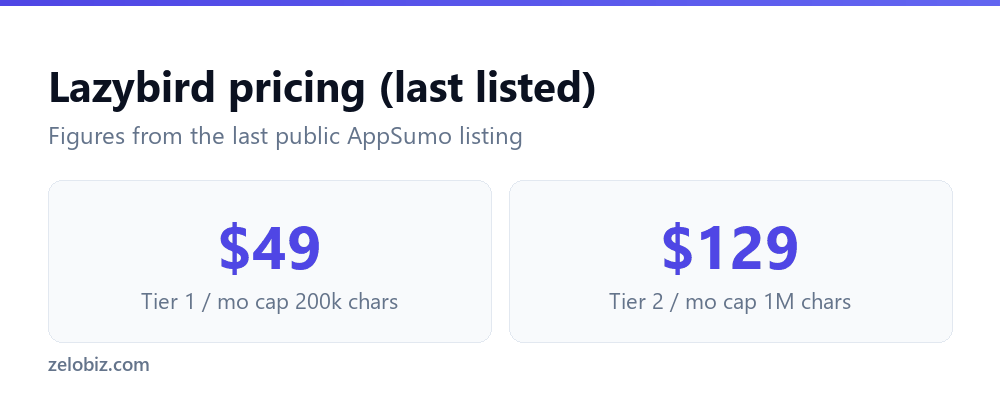
When it was live, Lazybird sold across two license tiers:
| Tier | Monthly character allowance | Voice cloning | Listed price |
|---|---|---|---|
| Tier 1 | 200,000 characters/month | 3-month trial, then paid add-on | $49 one-time |
| Tier 2 | 1,000,000 characters/month | Included for 1 year | $129 one-time |
Both tiers carried a 60-day money-back window and required activation within 60 days of purchase, which is standard AppSumo policy rather than anything specific to Lazybird. If you already own a code, it’s still redeemable. This review is written for anyone considering a purchase now, and there currently isn’t one to make. It exists so the next person searching “Lazybird lifetime deal” gets an honest answer instead of a page still pushing a buy button on a dead offer.
What it costs versus a subscription, while it was live
Framed against a monthly ElevenLabs plan, Lazybird’s math worked out in the buyer’s favor for anyone whose usage stayed inside the character caps. ElevenLabs’ comparable tier runs in the range of $22 to $99 a month depending on usage, which adds up to several hundred dollars a year before you factor in any overage charges. Lazybird’s $49 or $129 one-time payment beat that within the first year for most moderate users, assuming the monthly allotment covered their actual output. The catch, and it’s a real one, is that unused characters don’t roll over. A quiet month doesn’t bank capacity for a busier one, so anyone with spiky, unpredictable usage got less real-world value out of the flat cap than the sticker price suggested.
To put the character caps in plain terms: 200,000 characters works out to roughly 30,000 to 35,000 words of script, or somewhere around three to four hours of finished narration depending on pacing. That’s enough for a handful of weekly YouTube videos or a short course module, but it would run out fast for anyone narrating a full audiobook or a daily podcast. The 1,000,000-character tier scales that up to somewhere near fifteen to twenty hours of narration a month, which covers most solo creators and small teams comfortably.
Key features
Once inside the dashboard, the workflow is straightforward: paste text, choose a voice, adjust the sliders for pace and emphasis, then render. A few things stood out compared to a plain text-to-speech plugin. The voice library spans a wide accent range within each language rather than one generic voice per language, which matters if you’re localizing content for a specific region rather than just picking “Spanish” and hoping it sounds natural to a Mexican or Spanish audience alike. Pronunciation editing let you override how the model reads a brand name or acronym instead of guessing every single time you render a new script.
Because exports were unlimited on both tiers, there was no per-minute or per-render fee eating into the value once the license was paid for, which is where a lot of “cheap” AI voice tools quietly claw money back. The built-in media library saved a step for anyone building short-form video content, since you didn’t need to leave the tool to find a background clip or a royalty-free track. It’s not a replacement for a dedicated stock library like Envato or Storyblocks in terms of depth or selection, but it was enough for a quick explainer video or a course lesson without a second subscription.
Setting up a project, step by step
The workflow AppSumo buyers described was consistent across most of the write-ups we read. First, you create a new project and either paste a script directly or upload a .txt or .docx file. Second, you assign a voice from the library, filtering by language and gender, then preview a short sample before committing to a full render. Third, you go through the script line by line if pronunciation needs correcting, which matters most for brand names, technical terms, or non-English words dropped into an otherwise English script. Fourth, you add pacing and emphasis adjustments where a sentence needs to land differently than the default reading. Fifth, you render and export in your chosen format, then optionally pull in a background track or stock clip from the built-in library before downloading the finished file.
None of that is unusual for text-to-speech software generally, but the fact that it’s all inside one dashboard, without switching between a script editor, a separate TTS engine, and a stock media site, is where Lazybird’s convenience argument holds up. Reviewers who tested it during the active window described the render times as reasonable for standard scripts, generally finishing well within the length of the audio itself, though very long scripts understandably took longer to process.
How it compares to the alternatives
The obvious comparison is ElevenLabs, which has better voice cloning fidelity and a larger, more frequently updated model selection, but runs on a recurring subscription that scales with usage, so total cost climbs fast for anyone generating a high volume of audio. Murf and WellSaid Labs sit in a similar subscription bracket and lean more toward corporate training and presentation voiceovers rather than content creation. Speechify targets a more consumer, text-to-audio-reading use case and isn’t really built for producing polished, published voiceover tracks.
| Tool | Pricing model | Best for |
|---|---|---|
| Lazybird | One-time payment, fixed monthly cap | Predictable, moderate voiceover volume |
| ElevenLabs | Monthly subscription, usage-based tiers | Highest voice fidelity, cloning accuracy |
| Murf | Monthly/annual subscription | Corporate training, presentations |
| WellSaid Labs | Monthly subscription, enterprise tiers | Brand-consistent enterprise voice |
Lazybird’s pitch was that a one-time payment covers a fixed monthly character allowance indefinitely, which works well if your usage is predictable and stays under the cap, and works less well if you regularly need more than a million characters a month, since there was no path to scale past Tier 2 without buying a second code.
What users say
Independent write-ups from AppSumo deal reviewers who tested Lazybird during its active window generally rated the voice quality as solid for the price, closer to a budget alternative to ElevenLabs than a direct match for it in fidelity. The most common complaint centered on that monthly character cap resetting rather than rolling over, meaning unused capacity from a quiet month didn’t carry into a busier one. We didn’t find a large, independently verifiable body of reviews on third-party platforms like G2 or Trustpilot specifically for Lazybird, which is typical for a newer AppSumo-only product. Most of what’s public lives in AppSumo’s own review section and a handful of deal-tracking blogs, so treat any star rating you see for it as a smaller, self-selected sample rather than a broad market verdict.
Pros
- One-time payment instead of a recurring subscription
- Wide voice and language selection with granular pronunciation control
- Unlimited exports on both tiers, no per-render fee
- Includes a usable stock media library for video projects
- 60-day money-back window when the deal was active
Cons
- Currently sold out, with no confirmed return date from AppSumo or Lazybird
- Monthly character allowance resets rather than banking unused capacity
- Voice cloning is time-limited on the lower tier
- No option to scale past the Tier 2 character cap without buying a second code
- Thin third-party review coverage outside AppSumo itself, making it harder to verify quality claims independently
Who it was for
Lazybird made sense for course creators, YouTubers, and small marketing teams who needed a steady, moderate volume of AI voiceover work and wanted to avoid a recurring ElevenLabs bill. It was a weaker fit for agencies producing audio at high volume, since the character caps create a hard ceiling that a subscription tool simply doesn’t have, and a weaker fit for anyone whose output varies wildly month to month, since there’s no rollover to smooth that out.
Verdict: is Lazybird worth it?
Since the deal is sold out, the practical question isn’t whether to buy it today, it’s whether to sign up for a return notification and wait. Based on what the tool offered while it was live, the pricing was competitive for anyone whose voiceover needs fit inside the character caps, and the lack of a recurring fee is a genuine advantage over ElevenLabs-style subscriptions for that specific use case. If AppSumo relists it, it’s worth a look. If you need voiceover work right now, ElevenLabs’ or Murf’s entry-level plans are the more realistic starting point until Lazybird comes back, if it comes back at all. AppSumo deals close out permanently more often than they return.
Frequently asked questions
Is Lazybird still available on AppSumo?
No. The deal is marked sold out on AppSumo as of this review, with no active purchase option and no confirmed restock date.
What happens if I already bought a Lazybird lifetime code?
Existing codes remain valid. AppSumo’s standard policy requires activation within 60 days of purchase, and the 60-day refund window runs from the purchase date, not from when the deal later sells out.
What’s a realistic alternative while Lazybird is sold out?
ElevenLabs and Murf both offer free or low-cost entry tiers that cover occasional voiceover needs, though neither matches Lazybird’s one-time-payment structure.
Does Lazybird support commercial use?
Yes. The license as sold covered commercial voiceover work, which is standard for AppSumo software deals in this category.
Will the deal come back?
There’s no way to confirm that in advance. AppSumo sometimes relists a sold-out deal months later and sometimes never does. The only reliable way to find out is the notification signup on the product page itself.
Check the current status of the deal on AppSumo’s Lazybird page before assuming it has returned. This review will be updated if the deal comes back and pricing changes.