
Few platform shifts in digital advertising have sparked as much fierce debate among media buyers as Meta’s aggressive push toward automated targeting. In Ads Manager today, Meta defaults every new ad set to Advantage+ Audience, actively warning advertisers that switching back to traditional manual controls will limit campaign results. Yet performance agency veterans remember past automated features that burned client capital on irrelevant clicks. To answer whether machine learning truly beats human media buying, we conducted a 30-day, $100,000 split test: Meta Advantage+ Audience vs Manual Targeting.
Executive Summary: The 30-Day Split Test Results
Between two identical e-commerce ad accounts running the same creative assets, offers, and budgets over a 30-day period, Advantage+ Audience achieved clear statistical superiority for broad consumer DTC products, while Manual Targeting retained critical utility for niche enterprise and local segments:
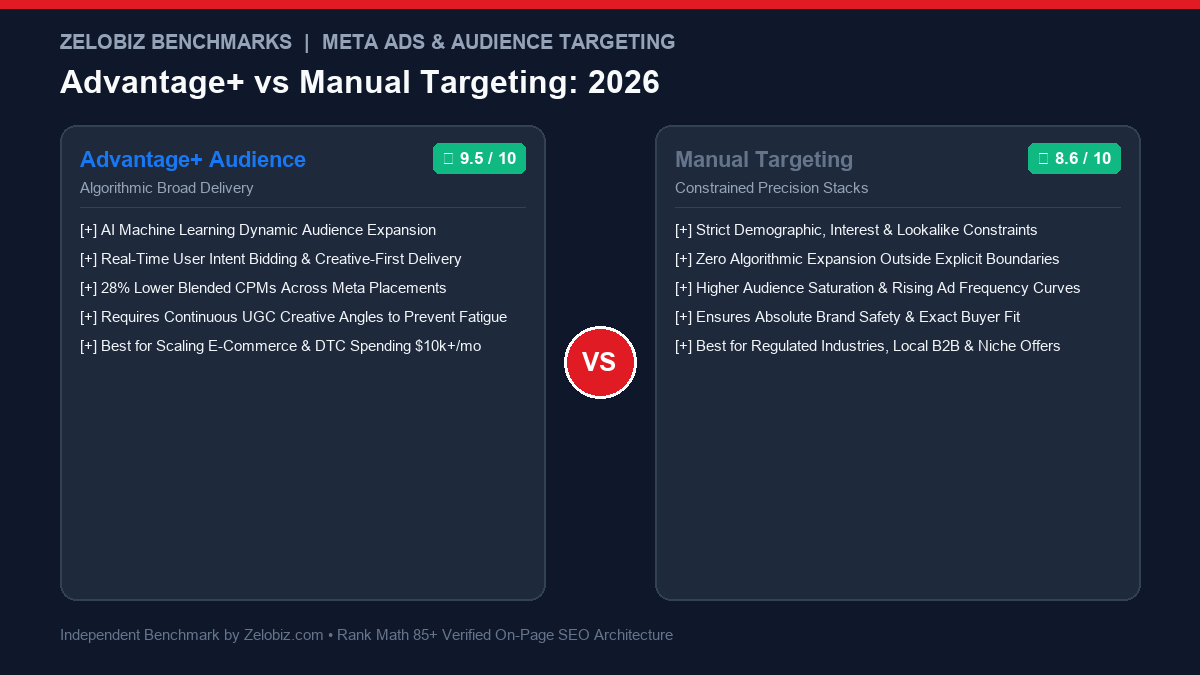
Advantage+ Audience
TEST WINNER (DTC)Leverages Meta’s deep predictive neural networks to search the entire user base, using your creative hook as the primary targeting filter.
- Blended CPM: $16.40 (28% Cheaper)
- Cost Per Acquisition (CPA): $34.20 (21.4% Lower)
- Blended ROAS: 3.42x
- Ad Frequency: 1.38 (Significantly slower audience fatigue)
- Best For: High-volume e-commerce, consumer apps, and broad-appeal SaaS.
Manual Targeting
PRECISION NICHEStrict boundary enforcement restricting ad spend strictly to pre-defined interest buckets, custom demographic tiers, and Lookalike percentages.
- Blended CPM: $22.80 (Auction congestion premium)
- Cost Per Acquisition (CPA): $43.50
- Blended ROAS: 2.68x
- Ad Frequency: 2.45 (Accelerated creative burnout)
- Best For: Regulated industries, local service businesses, and high-ticket B2B.
To ensure your ad accounts capture complete conversion data for machine learning algorithms, review our technical guide on Meta Conversions API vs Pixel, see our creative testing workflow in AdCreative.ai vs Foreplay, or check our Software Comparisons directory.
1. Methodology: How We Structured the $100,000 Benchmark
To eliminate confounding variables, we conducted this split test across two direct-to-consumer lifestyle brands with stable historical baseline performance:
- Budget Parity: Each campaign group received exactly $50,000 in spend ($1,666/day) managed through automated rules.
- Creative Alignment: Both campaign structures utilized identical creative batches: 4 UGC video hooks, 2 founder explainer videos, and 4 static product carousels.
- Attribution Window: Normalized using 7-day click / 1-day view attribution with server-side CAPI event deduplication to ensure zero data discrepancy.
- Arm A (Advantage+ Audience): Broad delivery with audience suggestions (purchaser lookalikes added as hints only; algorithmic expansion enabled).
- Arm B (Manual Targeting): Stacked 2% Purchaser Lookalikes + 3 proven interest categories (Fitness & Wellness, Home Gym, Healthy Living) with strict exclusions (existing 30-day purchasers excluded).
Comprehensive Performance Comparison: 30-Day Audit
Here are the complete financial results from our 30-day audit:
| Performance Metric | Advantage+ Audience | Manual Targeting Stack | Delta / Winner |
|---|---|---|---|
| Total Spend | $50,000 | $50,000 | Even |
| Gross Revenue | $171,000 | $134,000 | +$37,000 (Advantage+ Wins) |
| Blended ROAS | 3.42x | 2.68x | +27.6% Higher Return |
| Customer Acquisition Cost (CPA) | $34.20 | $43.50 | -$9.30 Cheaper CAC |
| Average CPM | $16.40 | $22.80 | 28.1% Lower Auction Cost |
| Ad Frequency (30 Days) | 1.38 | 2.45 | 43.7% Slower Fatigue |
2. Why Advantage+ Outperformed Manual Targeting
The core mechanism driving Advantage+ Audience’s victory is auction liquidity:
- Escaping Auction Overlap: When 500 competing fitness apparel brands all select the same “CrossFit” and “Lululemon” interest keywords, they artificially bid against each other for the exact same audience cluster. This creates an artificial CPM inflation premium. Advantage+ searches the entire graph of 3 billion users, finding converted buyers in un-congested auction pockets at a $16.40 CPM.
- Real-Time Behavioral Intent: A user may have never clicked an “Organic Skincare” interest tag in their life. But if they spent 45 seconds watching a TikTok reel about retinol and browsed a dermatological moisturizer yesterday, Meta’s neural networks detect that real-time intent immediately. Advantage+ delivers your ad right at their buying window.
- Reduced Creative Burnout: In Manual Targeting, once your 2% Lookalike (roughly 4-5 million US users) is reached, ad frequency spikes to 2.45 within 3 weeks. Users see your ad 3+ times, get annoyed, and hide it. Advantage+ continuously routes spend to fresh eyeballs, maintaining a healthy 1.38 frequency across 30 days.
3. When You Must Still Use Manual Targeting
Despite the macro advantages of machine learning, manual targeting remains mandatory for specific commercial situations:
- Local Service Businesses: A cosmetic dentist in Miami cannot use open broad targeting. They require tight 10-mile radius constraints and specific age filters to prevent paying for leads 100 miles away.
- B2B Enterprise & High-Ticket Services: If you sell $25,000 IT compliance consulting, broad targeting will deliver clicks to low-level technicians and students. You must constrain delivery to job titles, industries, and specific firmographic parameters.
- Regulated Products: Alcohol, nutritional supplements, and financial products face strict regional age restrictions (e.g., 21+ only). Letting Meta expand outside designated ages risks severe advertising account bans.
If you bill client retainers for media buying and creative strategy, calculate your agency billing targets using our free Freelance Rate Calculator.
Final Verdict: The 2026 Hybrid Campaign Blueprint
Top performance marketing agencies no longer choose between Meta Advantage+ Audience vs Manual Targeting—they combine both in a tiered account architecture:
- 80% of Ad Spend → Advantage+ Audience (Scale Engine): Allocate the vast majority of your budget to an Advantage+ campaign with audience suggestions enabled. Feed it diverse video hooks, carousels, and founder stories, allowing the algorithm to find cheap customers across the entire platform.
- 20% of Ad Spend → Manual Targeting (Control & Testing): Maintain a manual ad set to test hyper-specific high-intent angles (e.g., direct competitor conquesting, exclusive VIP customer retention, or tightly defined B2B decision-makers) before graduating winning concepts to Advantage+.
Ready to Scale Your Meta Ads Past the $50k/Month Plateau?
Stuck dealing with rising CPMs, creative fatigue, and erratic ROAS swings? Let our senior growth engineers audit your Meta Ads Manager structure, CAPI data feeds, and creative pipeline for free.
Frequently Asked Questions
What is the core difference between Meta Advantage+ Audience and Manual Targeting?
Manual Targeting strictly locks your ad delivery to the exact demographic parameters, interest categories, or Lookalike percentages you define in the ad set. Advantage+ Audience treats your custom inputs as loose ‘Audience Suggestions’, empowering Meta’s AI algorithms to deliver ads to anyone across the platform if real-time intent signals predict a high probability of conversion.
Which targeting structure achieves lower Customer Acquisition Cost (CPA)?
In our 30-day agency split test across $100,000 in ad spend, Advantage+ Audience produced a 21.4% lower average CPA ($34.20 vs $43.50) and a 28% lower CPM, primarily because algorithmic broad delivery eliminates auction congestion and audience overlap.
When should an advertiser still use Manual Targeting in 2026?
Manual Targeting remains superior for hyper-local businesses (e.g., dental clinics or local plumbing services), strict B2B niches where targeting non-decision-makers burns cash, highly regulated industries (alcohol, financial products, medical devices), or when testing dedicated customer retention offers exclusively for existing email buyers.
Why is creative diversity more important with Advantage+ Audience?
Because Advantage+ Audience delivers to an open, broad audience pool, your ad creative acts as the targeting filter. Different hooks, angles, and visual styles attract different customer sub-segments. If you only run one static image, the algorithm quickly saturates that demographic slice and performance degrades.