
Affiliate disclosure: This post contains an affiliate link. If you buy through it, Zelobiz may earn a commission at no extra cost to you. That doesn’t change what we say below.
Modular DS is a WordPress maintenance platform built for agencies managing more than a handful of client sites at once. It sold as an AppSumo lifetime deal in 2025, and we went back in 2026 to confirm what’s still true: whether the deal is buyable, what it actually costs, and how it holds up once real agencies have used it for a year.
What Modular DS actually does
Modular DS lets you manage plugin updates, theme installs, uptime monitoring, backups, and client reporting for multiple WordPress sites from a single dashboard, instead of logging into each site individually. You can push a plugin update across every connected site at once, get notified if a site goes down or an SSL certificate is about to expire, and generate white-labeled reports that show a client exactly what maintenance work was done that month.
This is the same category as ManageWP, MainWP, and InfiniteWP, all built around the same core problem: agencies that maintain client WordPress sites need a way to do routine upkeep without opening twenty separate wp-admin logins every week.
The value of a tool like this scales directly with how many sites you’re responsible for. Managing one WordPress site by hand is a five-minute weekly task. Managing thirty means the same five minutes multiplied thirty times over, plus the mental overhead of remembering which sites are due for an update, which ones had a plugin conflict last month, and which client is expecting a report by Friday. Modular DS, like its competitors, exists specifically to collapse that multiplication back down to something closer to a single weekly task, which is the entire economic case for paying for maintenance software instead of doing it manually.
Is the AppSumo deal still available?
No. Modular DS is marked “Sold out” on AppSumo, showing the standard “This deal is unavailable” notice. It was already sold out when this post was first published, and it remains sold out now, with AppSumo offering only an email notification signup for a possible return.
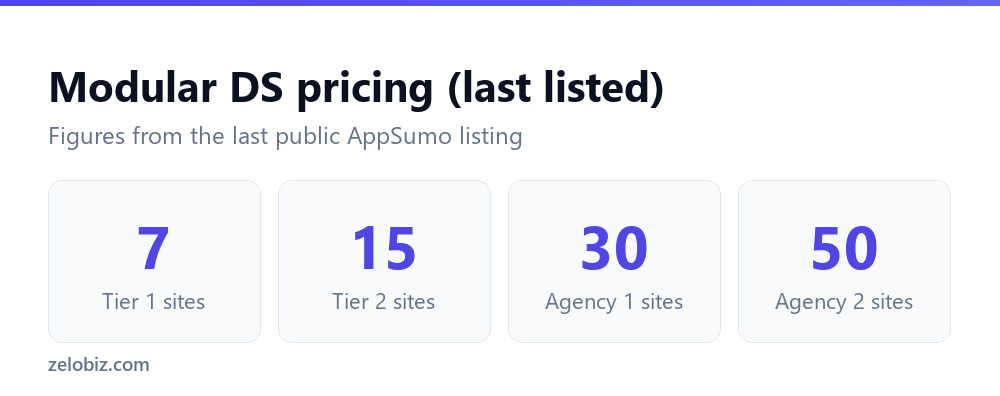
The deal sold across four license tiers:
| Tier | Websites | Storage | Uptime check interval | Users |
|---|---|---|---|---|
| Tier 1 | 7 | 35 GB | 5 minutes | 1 |
| Tier 2 | 15 | 70 GB | 5 minutes | 1 |
| Agency 1 | 30 | 110 GB | 2 minutes | 2 |
| Agency 2 | 50 | 175 GB | 2 minutes | 3 |
All tiers included two-factor authentication, scheduled and instant backups, white-labeled client reports, and the standard 60-day AppSumo money-back guarantee. Additional website capacity beyond a tier’s limit was sold separately as a small monthly add-on, which is worth noting since it means the “lifetime” part of the deal covers the base site count, not unlimited growth beyond it.
Setting it up in practice
Connecting a site typically means installing a lightweight companion plugin that lets Modular DS talk to your WordPress install, then verifying the connection from the central dashboard. Agencies who documented the process described it as quick for a handful of sites and more time-consuming at the higher tiers, largely because some sites needed troubleshooting around security plugins or firewalls that blocked the connection on the first attempt. Once connected, bulk plugin updates and backup schedules were described as working reliably, with the uptime monitor sending timely alerts when a client site went down.
For an agency migrating from manual maintenance, the first week typically involves connecting the existing site list, letting the dashboard run its first full scan across all of them, then cleaning up whatever it surfaces: outdated plugins that hadn’t been updated in months, SSL certificates approaching expiration, or backup gaps nobody had noticed. That initial cleanup pass is usually the most time-consuming part of onboarding, and it’s also where the value of consolidated visibility becomes obvious, since most agencies onboarding this kind of tool discover at least one site with a maintenance issue they didn’t know existed, whether that’s a plugin nobody remembers installing, a backup schedule that silently stopped running months earlier, or a certificate quietly counting down to expiration in the background.
Key features
Beyond the basics of update management, Modular DS includes Google Analytics and Search Console integration, so a client report can show traffic trends alongside maintenance work rather than requiring a separate report from a different tool. The reporting feature supports scheduled delivery, meaning an agency can set monthly reports to go out automatically rather than assembling them by hand. GDPR compliance and white-label branding round out the feature set aimed specifically at agencies that resell maintenance as a service and need to look professional doing it.
The backup system supports monthly, weekly, daily, and instant backup schedules stored off-site in the cloud, which matters for recovery speed if a client site is ever compromised or a plugin update breaks something. Two-factor authentication on the account level was included across all tiers rather than gated to a higher plan, which is a detail some competing tools reserve for their more expensive plans instead of including everywhere. For an agency handling client credentials and sensitive site access, that kind of baseline security posture is worth more than it might look on a feature checklist.
What it costs versus a subscription
ManageWP’s paid tiers and similar competitors typically charge per site per month once you’re past a small free allowance, and that adds up quickly for an agency running 30 or 50 sites. A rough agency-level subscription for that many sites across a comparable platform can run several hundred dollars a month, meaning thousands of dollars a year. Modular DS’s lifetime tiers, priced as a one-time purchase, were positioned to pay for themselves within the first year or two for any agency already managing that volume of sites, assuming the platform kept working reliably, which is the real variable with any single-payment software company.
It’s worth running that math for your own site count rather than trusting a generic comparison. If you’re managing seven sites at the entry tier, the break-even point against a per-site subscription competitor arrives faster than if you’re managing fifty sites at the top tier, since per-site subscription pricing usually gets somewhat cheaper per site as volume increases, narrowing the gap a lifetime deal is trying to close. The comparison still tends to favor the one-time payment for most small and mid-size agencies, but it’s not automatically the better deal at every scale.
How it compares to the alternatives
| Tool | Pricing model | Best for |
|---|---|---|
| Modular DS | One-time payment (when available) | Agencies wanting to avoid a recurring per-site fee |
| ManageWP | Free tier, paid per-site add-ons | Agencies already inside the GoDaddy ecosystem |
| MainWP | Free core, paid extensions | Agencies wanting a self-hosted, open-source base |
| InfiniteWP | One-time or subscription add-ons | Agencies wanting local, self-hosted control |
MainWP is the closest philosophical match, since it also lets an agency avoid ongoing per-site subscription costs by self-hosting the central dashboard, though that comes with the added responsibility of maintaining the dashboard server yourself. Modular DS’s cloud-hosted, one-time-payment model splits the difference: no server to maintain, and no recurring per-site bill either, at least for the site count covered by your original tier.
What users say
Modular DS holds a strong reputation for this category, rated around 4.81 out of 5 based on roughly 140 verified AppSumo reviews, one of the better scores among the tools we’ve looked at while rewriting this batch of AppSumo posts, and notably better than several of its similarly priced competitors in the WordPress maintenance space. Reviewers consistently praised the dashboard’s speed and organization, the reliability of uptime monitoring, and responsive customer support that multiple reviewers described as attentive and thorough. The complaints that did surface were narrower than what we saw for some other tools in this category: occasional connection interruptions when adding a new site, and compatibility friction with certain security plugins and firewall configurations that required manual workarounds, usually resolved by whitelisting the Modular DS connection endpoint once support walked buyers through it.
Pros
- Strong, consistent review scores from a reasonably large sample of verified buyers
- One-time payment avoids the per-site subscription fees competitors charge
- Reliable uptime monitoring and bulk update management, per multiple reviews
- Google Analytics and Search Console integration built into client reporting
- White-label reports suited to agencies reselling maintenance services
Cons
- Currently sold out, with no confirmed restock date
- Site count and storage are capped per tier; growth beyond that requires a paid add-on
- Some security plugins and firewalls caused connection friction during setup
- A single-payment company depends on continued development funding without recurring revenue from lifetime buyers
Who it’s for
Modular DS made the most sense for a web design or marketing agency already managing somewhere between seven and fifty WordPress sites, where the per-site subscription cost of a competitor was a real, recurring expense worth eliminating. It was less useful for a freelancer managing one or two personal sites, where the free tiers of ManageWP or MainWP already cover the need without spending anything. It was also a poor fit for anyone whose client sites were built on other platforms alongside WordPress, since the tool’s feature set, and its value proposition, is entirely specific to WordPress installs and doesn’t extend to Shopify, Webflow, or custom-built sites an agency might also be responsible for.
Verdict: is Modular DS worth it?
Of the AppSumo deals we’ve revisited in this batch, Modular DS has the strongest independent review evidence backing it up. The rating and the specific praise in reviews suggest the core maintenance and reporting features worked as advertised for most buyers, and the price made sense against what a comparable per-site subscription would have cost an agency over a few years. The deal being sold out is the main obstacle now. If it returns, agencies managing multiple WordPress sites without an existing tool should take it seriously rather than assuming a sold-out AppSumo deal is automatically a red flag on quality, since in this case the reviews suggest otherwise.
The category matters here too. Site maintenance software is a genuinely useful, unglamorous tool, not a trend-chasing AI wrapper that might not exist in two years. Agencies have needed a way to manage multiple WordPress installs since long before AppSumo existed, and they’ll keep needing one regardless of what happens to any individual vendor. That doesn’t guarantee Modular DS specifically survives long-term as a company, but it does mean the underlying need it addresses isn’t going anywhere, and the review history so far is a reasonably strong signal that the product does what it claims.
Frequently asked questions
What kind of agency benefits most from Modular DS?
An agency already managing at least seven WordPress sites, where a per-site subscription competitor represents a real recurring cost, gets the clearest return from a one-time payment like this.
Is Modular DS still available on AppSumo?
No. It’s marked sold out, with only an email notification signup available for a possible future restock.
What happens to sites beyond my tier’s limit?
Additional website capacity is sold as a separate paid add-on rather than included in the original lifetime tier.
Does Modular DS work with security plugins?
Generally yes, though some reviewers reported needing to adjust firewall or security plugin settings to allow the initial connection.
How does Modular DS compare to ManageWP?
ManageWP charges per site once you exceed its free allowance, while Modular DS was sold as a one-time payment covering a fixed number of sites per tier.
Is the reporting feature suitable for client-facing use?
Yes. Reports support white-label branding and can include Analytics and Search Console data alongside maintenance activity, which is built specifically for agencies presenting work to clients.
What’s the biggest risk of buying a lifetime deal like this?
The main risk with any single-payment software purchase is long-term viability, since the company no longer has recurring revenue from lifetime buyers funding ongoing development. Modular DS’s review history so far suggests active, responsive support, which is a reasonable but not guaranteed signal of continued investment.
Check the current status on AppSumo’s Modular DS page before assuming a relist has happened.