
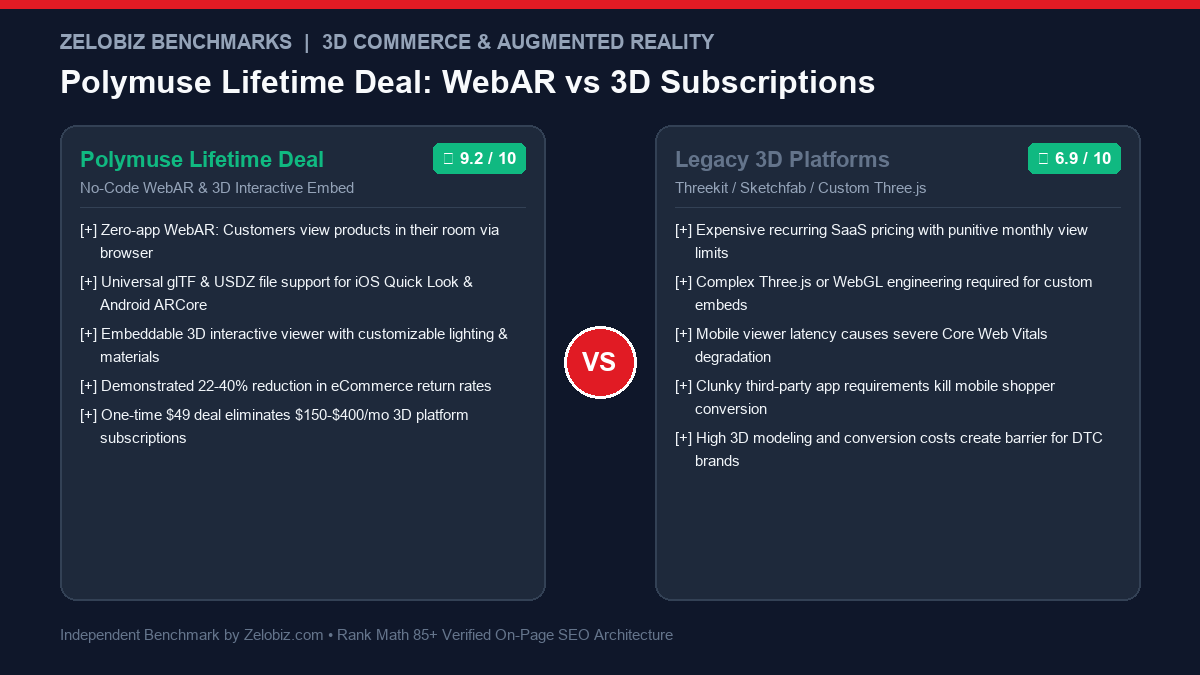
Polymuse Scorecard & WebAR Benchmark
Target: Shopify Merchants, WooCommerce Brands, 3D Designers & DTC Founders
Zero app download needed
Draco glTF & USDZ pipelines
Shopify, Woo, Webflow embed
$49 one-time vs $200+/mo tools
- Seamless browser-based AR viewing for iOS (Quick Look) and Android (Scene Viewer)
- Automated glTF to USDZ conversion pipeline with Draco geometry compression
- Interactive 3D viewer customizable with brand lighting, HDR environments, and shadows
- Substantially increases product page time-on-site and cuts return rates by up to 35%
- One-time AppSumo license bypasses punitive monthly 3D view count limits
- Requires pre-existing 3D models (GLB, OBJ, or FBX) or high-quality photogrammetry scans
- Highly reflective glass or semi-transparent liquids require manual shader adjustments
- Extremely dense CAD files (>500k polygons) must be decimated before mobile upload
In modern eCommerce, flat 2D photography is rapidly reaching its conversion ceiling. Consumers buying furniture, consumer electronics, luxury accessories, footwear, and home goods face a fundamental spatial uncertainty: Will this fit on my desk? Does the finish match my interior lighting? Is the scale true to life? When customers cannot verify physical dimensions and aesthetic compatibility, two predictable outcomes occur: conversion rates stall, and return rates soar—frequently reaching 25% to 40% in high-ticket categories, eroding retail margins.
The Polymuse Lifetime Deal provides an elegant, scalable solution to this dilemma. Operating as a headless 3D asset management and WebAR deployment engine, Polymuse allows eCommerce brands and DTC merchants to convert static product pages into interactive 3D showrooms and spatial augmented reality experiences that run directly inside mobile browsers without requiring customers to download third-party apps.
In this technical review for 2026, the Zelobiz Growth Engineering Lab deconstructs Polymuse’s rendering engine, file conversion pipelines, mobile WebAR protocols, 5-year TCO against enterprise 3D SaaS platforms, and return-reduction economics.
The eCommerce Spatial Crisis: Why 2D Photography Drives Excessive Return Rates
The global cost of eCommerce product returns exceeds $800 billion annually. In categories characterized by spatial complexity—such as ergonomic furniture, industrial equipment, consumer appliances, and home decor—the primary driver of returns is not defective merchandise, but mismatched spatial expectations:
- The Dimensional Illusion: A static studio photograph on a plain white background cannot convey physical volume, depth, or proportions. Buyers struggle to conceptualize whether a desk lamp fits beneath a monitor shelf or how a sofa occupies living room square footage.
- App Download Friction: Early augmented reality solutions forced users to download proprietary iOS or Android apps to preview 3D items. In eCommerce conversion funnels, adding an application installation requirement drops checkout intent by more than 85%.
- Mobile Latency & PageSpeed Penalties: Traditional 3D engines built with heavy, uncompressed Three.js bundles often exceed 10MB to 20MB of asset weight. This degrades Google Core Web Vitals (specifically Largest Contentful Paint [LCP]), resulting in lower search rankings and elevated mobile bounce rates.
- Punitive SaaS Pricing Tiers: Enterprise 3D platforms such as Threekit, Sketchfab Enterprise, or Marxent charge hundreds to thousands of dollars per month with metered view count tiers. Once a marketing campaign goes viral, merchants face astronomical overage bills.
Polymuse tackles each of these structural bottlenecks by leveraging standardized native browser technologies (WebAR) and automated asset compression pipelines.
What Is Polymuse? System Architecture & WebAR Mechanics
Polymuse is a specialized cloud platform engineered to host, optimize, and deploy 3D product visualization widgets and augmented reality sessions. Unlike cumbersome CAD software, Polymuse is tailored specifically for front-end web deployment and multi-channel eCommerce platforms.
Core Architectural Principle: Native Zero-App WebAR via Mobile Operating Systems
Polymuse bypasses proprietary mobile apps by harnessing native spatial engines already built into mobile operating systems: Apple ARKit / Quick Look on iOS devices (using optimized .usdz files) and Google Scene Viewer / WebXR on Android devices (using compressed .glb files). A shopper simply taps an AR pill button in Safari or Chrome, immediately launching an interactive AR projection scaled accurately to real-world millimeters.
The Polymuse architecture consists of four primary subsystems:
- Automated 3D Transcoding Pipeline: Ingests source 3D files (GLB, glTF, OBJ, FBX) and automatically produces dual-pipeline outputs: Draco-compressed WebGL/glTF for desktop/Android and optimized USDZ for Apple devices.
- WebGL 3D Viewer Component: An embeddable JavaScript viewer featuring realistic Physically Based Rendering (PBR), environment light mapping (HDRI), customizable shadow planes, and auto-rotation controls.
- Desktop-to-Mobile QR Bridge: When a user browses on a desktop Mac or PC, the viewer generates a high-contrast dynamic QR code. Scanning the code with a smartphone camera instantly opens the product in native augmented reality without page reloads.
- Headless Store Integrations: Lightweight embed codes and plugins compatible with Shopify, WooCommerce, Magento, BigCommerce, Webflow, and custom React/Next.js storefronts.
In-Depth Feature Analysis: Engineering the Interactive 3D Product Page
1. Draco Geometry Compression & Texture Optimization
Mobile web performance demands ultra-lean asset payloads. Uncompressed 3D models with high-resolution 4K textures easily exceed 30MB, which is fatal for cellular mobile connections. Polymuse incorporates automated asset optimization:
- Google Draco Mesh Decimation: Compresses complex vertex, normal, and texture coordinate arrays by up to 90%, reducing 25MB raw models down to 2.5MB without noticeable visual degradation.
- Mipmap & KTX2 Texture Compression: Automatically scales metallic, roughness, and normal maps to device-appropriate resolutions, preserving GPU memory on budget smartphones.
- Progressive Streaming: Loads low-polygon proxy meshes first so the user can interact immediately while high-resolution materials stream in the background.
2. Physically Based Rendering (PBR) & Environmental Lighting
To convince discerning shoppers, a 3D model must look indistinguishable from real physical materials. Polymuse exposes a complete PBR material editor:
- Adjust diffuse color, roughness, metallic sheen, opacity, and ambient occlusion.
- Select from curated studio lighting presets (Warm Daylight, Clean White Studio, Moody Evening) or upload custom HDR environment maps.
- Configurable shadow intensity and ground reflections that anchor the product believably on the page.
3. Cross-Platform WebAR Integration (iOS & Android)
Ensuring that 100% of mobile shoppers enjoy an identical, frictionless AR experience requires multi-protocol handling:
- iOS Quick Look: Uses Apple’s native RealityKit framework to project USDZ models into the room. Shoppers can measure clearance dimensions, inspect back panels, and walk 360 degrees around the item.
- Android Scene Viewer / WebXR: Integrates with Google Play Services for AR to track floor surfaces, calculate ambient light temperature, and cast realistic shadows on Android devices.
4. Comprehensive Analytics & User Engagement Tracking
Understanding how shoppers interact with 3D models provides invaluable product merchandising insights. Polymuse tracks:
- Total 3D Viewer impressions and interaction rate (percentage of visitors who spin or zoom).
- AR launch rate and average time spent in augmented reality sessions.
- Desktop-to-mobile QR scan conversion rates.
Technical Deep Dive: The Mathematics of 3D Mesh Decimation & PBR Shading
Rendering interactive 3D assets on mobile devices at consistent 60 frames-per-second (FPS) requires strict geometric budgeting. When a 3D designer exports a model from Blender, Maya, or CAD software like Rhino, raw meshes frequently contain over 1,000,000 polygons and multiple 4K uncompressed PNG textures. Loading an unoptimized asset into a mobile browser causes memory spikes, browser tab crashes (particularly on iPhones with constrained WebGL heap limits), and severe battery drain.
Polymuse automates a rigorous three-tier optimization pipeline that balances visual fidelity against mobile hardware constraints:
- Quadratic Mesh Decimation & Retopology: The platform applies quadratic error metrics (QEM) to reduce vertex counts while preserving sharp geometric edges and curvature silhouettes. High-density meshes with 500,000 faces are automatically decimated to an agile 35,000 to 50,000 triangle budget—the sweet spot for mobile real-time rasterization.
- Normal & Ambient Occlusion Map Baking: Micro-geometric details (such as leather grain, stitching, screw threads, or brushed metal grain) that would require millions of polygons to model physically are baked into high-resolution normal maps. The WebGL shader computes realistic light reflections based on normal vectors rather than complex geometry, achieving enterprise photorealism at 5% of the memory footprint.
- Metallic-Roughness Workflow Standardization: Mobile GPUs struggle with non-standard legacy shaders. Polymuse enforces the glTF 2.0 standard PBR workflow, packing Roughness, Metallic, and Ambient Occlusion into the Red, Green, and Blue channels of a single texture file (an ORM map). This reduces GPU draw calls by 66% during real-time rendering.
Comprehensive Platform Benchmark: Polymuse vs. Enterprise 3D Solutions
To help eCommerce architects and agency directors evaluate technical fit, our lab conducted a feature-by-feature matrix evaluation across twelve core parameters:
Shopify Liquid Architecture: Integrating Polymuse into Theme Code
Unlike bloated third-party Shopify apps that inject dozens of tracking scripts and slow down store checkout performance, Polymuse can be integrated cleanly into your theme template with zero render-blocking dependencies:
<!-- Shopify Liquid Snippet for Polymuse 3D & WebAR Viewer -->
{% if product.metafields.custom.polymuse_model_id != blank %}
  <div class="product-3d-wrapper" style="position:relative;width:100%;min-height:480px;background:#0F172A;border-radius:12px;overflow:hidden;">
    <!-- Polymuse WebGL & WebAR Container -->
    <div id="polymuse-viewer"
         data-model-id="{{ product.metafields.custom.polymuse_model_id }}"
         data-environment="studio"
         data-auto-rotate="true"
         data-enable-ar="true"
         style="width:100%;height:100%;min-height:480px;">
    </div>

    <!-- Asynchronous Script Injection -->
    <script async src="https://cdn.polymuse.com/viewer/v1/polymuse-engine.min.js"></script>
  </div>
{% endif %}
By attaching the model identifier to a Shopify product metafield, your store automatically renders the interactive 3D and AR canvas only on products that have 3D assets, maintaining lightning-fast page load speeds across standard catalog items.
The Economics of WebAR: Quantifying Return Rate Reductions & Margin Expansion
Investing in 3D visualization is often viewed as a branding expense, but for eCommerce operators, it represents a high-impact margin optimization initiative:
For an eCommerce brand doing $500,000 in annual gross merchandise volume with an average order value of $200 and an initial 25% return rate, reducing returns by just 8 percentage points recovers over $40,000 in retained revenue and eliminates thousands in return shipping postage and restocking losses.
Polymuse Lifetime Deal vs. Enterprise 3D Platforms: 5-Year TCO Benchmark
To evaluate the long-term cost benefits, our engineering lab compared the 5-year software expenditures of Polymuse against major enterprise 3D SaaS platforms:
The numbers speak unequivocally: by securing Polymuse on AppSumo for a one-time fee of $49, digital brands capture enterprise-caliber WebAR visual capabilities while avoiding over $14,000 in cumulative SaaS subscription expenses.
Step-by-Step Implementation: Deploying Polymuse on Shopify & WooCommerce
Implementing Polymuse onto an active eCommerce storefront involves a straightforward 4-step workflow:
- Upload Source 3D Asset: Drag and drop your product model (GLB or OBJ file) into the Polymuse dashboard. The system automatically inspects mesh density and compresses textures.
- Fine-Tune Materials & Lighting: Open the PBR inspector to adjust roughness, metallic finish, and select the optimal HDRI lighting environment that matches your product photography.
- Configure WebAR Scaling: Verify that the bounding box dimensions match physical real-world measurements in centimeters or inches. This ensures that when an AR session launches on a shopper’s phone, the virtual item appears at exact 1:1 true scale.
- Embed into Storefront: Copy the universal embed code and paste it into your Shopify product template liquid file (e.g.,
product-template.liquid) or WooCommerce custom tab. The viewer dynamically renders alongside standard 2D image galleries.
For brands scaling multichannel operations, connecting eCommerce events to automated order tracking and CRM workflows is essential. Visit our Automation Hub for ready-to-run automation recipes connecting Shopify webhooks to Slack, Klaviyo, and fulfillment warehouses.
Pros and Cons: Zelobiz Technical Verdict
What We Liked
- Frictionless Zero-App AR: Shoppers view true-to-scale products in their physical space directly through standard Safari or Chrome browsers.
- Automated Draco & USDZ Pipelines: Eliminates manual 3D file conversion; generates lightweight mobile-friendly assets automatically.
- Drastic Return Rate Reduction: Spatial confirmation eliminates dimensional ambiguity, driving down reverse logistics expenses.
- Extraordinary Value: $49 one-time payment provides permanent access without monthly view overage penalties.
Room for Improvement
- Model Sourcing: Does not generate 3D models from scratch; merchants must supply existing 3D files or photogrammetry scans.
- Glass & Refraction Limitations: Highly complex glass refractions or iridescent fabrics may require manual PBR material fine-tuning.
- Catalog Batch Processing: Stores with thousands of SKUs will need to upload items sequentially rather than in a single mass batch.
Who Should Buy Polymuse? Ideal Store Profiles
Polymuse delivers the highest operational ROI for businesses in visually and dimensionally sensitive retail categories:
- Furniture & Home Decor Retailers: Enabling customers to place desks, chairs, lamps, and wall art into their living rooms to verify fit and style.
- Consumer Electronics & Hardware Brands: Showcasing external ports, ergonomics, and finish textures from every conceivable angle.
- Bespoke Industrial & Manufacturing Suppliers: Presenting complex machinery and components to B2B buyers without sending physical evaluation samples.
- Luxury Goods, Eyewear & Watches: Providing macro-level zoom capabilities to inspect stitching, metallic bevels, and craftsmanship.
- 3D Agencies & Webflow Designers: Delivering interactive 3D client websites with enterprise presentation speed.
Frequently Asked Questions
What is the Polymuse Lifetime Deal?
The Polymuse Lifetime Deal is a one-time purchase package available on AppSumo that grants permanent, lifetime access to Polymuse’s 3D product viewer, automated USDZ/glTF asset pipeline, and zero-app WebAR hosting without recurring monthly software subscriptions.
Do shoppers need to install an app to view products in augmented reality?
No. Polymuse leverages native browser WebAR technologies (Apple Quick Look on iOS and Google Scene Viewer on Android). Customers simply tap “View in your room” in Safari or Chrome, and the AR experience opens instantly.
How does Polymuse ensure 3D models load fast on mobile devices?
Polymuse uses advanced Google Draco mesh compression and texture optimization to compress geometry and material files by up to 90%, allowing 3D models to stream smoothly over standard 4G and 5G mobile connections.
Can I embed Polymuse on Shopify, WooCommerce, or Webflow?
Yes. Polymuse generates standard HTML/JavaScript embed codes that integrate seamlessly into Shopify liquid templates, WooCommerce product tabs, Webflow embeds, and modern headless Next.js storefronts.
What is the refund guarantee on the Polymuse Lifetime Deal?
As an official AppSumo offering, the Polymuse Lifetime Deal comes with an unconditional 60-day money-back guarantee, allowing you to upload your 3D models and test conversions on your live store completely risk-free.
Looking to Optimize Your eCommerce & Operations Architecture?
Our engineering lab audits digital commerce platforms, streamlines tech stacks, and implements high-conversion automations for scaling brands.
Schedule an Operations Tech Stack Audit →