
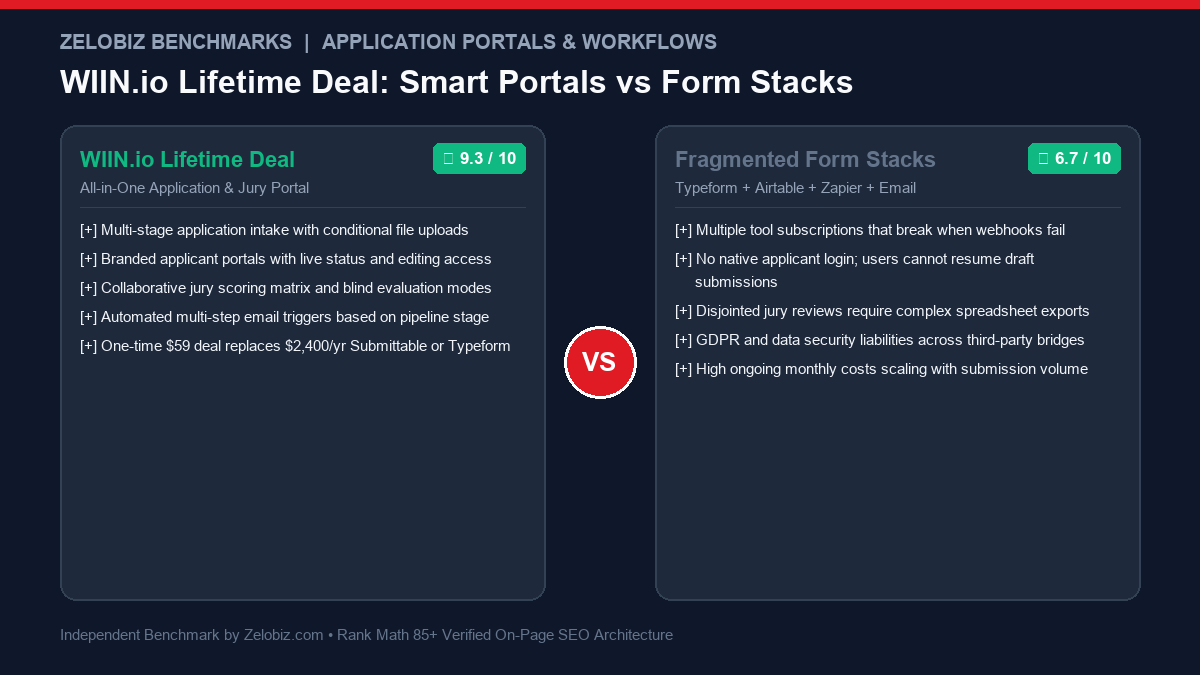
WIIN.io Scorecard & Evaluation Benchmark
Target: Incubators, Grant Managers, Award Organizers, Agencies & HR Teams
Multi-step forms & draft saving
Weighted rubrics & blind review
Custom domains & branding
$59 one-time vs $200+/mo Submittable
- Unified applicant workspace: candidates manage documents, revisions, and status
- Built-in jury evaluation matrix with customized weighting and blind scoring
- Automated stage transitions with customized transactional emails
- Native white-labeling: custom domains, logos, brand colors, and email signatures
- Strict GDPR compliance with European data sovereignty guarantees
- Multi-tier pipeline setup requires initial onboarding and rubric planning
- Evaluator experience is optimized for desktop browsers rather than native mobile apps
- Direct integration ecosystem relies primarily on Zapier and Webhooks rather than native CRMs
Managing high-stakes submission programs—such as startup grants, innovation awards, accelerator applications, scholarship funds, or structured client onboarding—is one of the most operationally fragmented challenges in modern business. Organizations routinely stitch together a patchwork of tools: Typeform or Google Forms for initial data entry, Dropbox or Google Drive for file attachments, Airtable or Excel for pipeline tracking, and endless manual email threads for committee voting. When webhooks break or spreadsheets fall out of sync, applications are lost, applicants grow frustrated, and review committees spend dozens of wasted hours compiling manual scorecards.
The WIIN.io Lifetime Deal resolves this operational friction by unifying the entire submission lifecycle into a single, cohesive operating system. Built from the ground up for calls for projects, grants, and competitive intake, WIIN.io combines dynamic form creation, authenticated applicant portals, automated communication pipelines, and collaborative jury scoring rubrics.
In this comprehensive technical review for 2026, the Zelobiz Growth Engineering Lab stress-tests WIIN.io’s architecture, explores its jury evaluation matrices, calculates 5-year software spend against enterprise incumbents like Submittable, and provides step-by-step guidance on structuring high-conversion intake pipelines.
The Fragmented Form Dilemma: Why Generic Form Builders Fail for High-Stakes Programs
Most organizations default to generic form builders like Typeform, Jotform, or Google Forms when launching an application or client intake program. While adequate for single-page surveys or contact forms, generic builders collapse under the operational demands of structured intake programs:
- No Authenticated Applicant Accounts: Standard forms require users to complete the entire submission in a single session. When candidates are asked to upload balance sheets, pitch decks, tax documents, or project blueprints, form abandonment skyrockets because users cannot save drafts or return later.
- Disjointed Multi-Stakeholder Evaluation: Once submissions arrive, organizers must manually export CSV files and share drive folders with evaluators, board members, or external juries. This creates severe data security vulnerabilities, version control chaos, and subjective review errors.
- Manual Status Notification Overhead: Candidates continually flood support inboxes asking whether their documents were received, whether they advanced to the interview stage, or when decisions will be announced. Generic form builders have no built-in applicant dashboard to show real-time stage progress.
- Enterprise Incumbent Monopolies: Dedicated grant and competition software like Submittable, Good Grants, or SurveyMonkey Apply charge enterprise fees ranging from $2,500 to $10,000+ per year, pricing out boutique accelerators, educational non-profits, creative agencies, and regional innovation hubs.
WIIN.io bridges this exact market gap by packaging enterprise-grade application and jury management into an accessible, no-code architecture available on an exceptional lifetime license.
What Is WIIN.io? Platform Architecture & System Capabilities
WIIN.io is an integrated software platform engineered to orchestrate the entire lifecycle of calls for applications, competitive tenders, startup pitch competitions, and corporate onboarding workflows. The platform operates on a modular, multi-tier permissions architecture designed to serve three distinct user personas:
Core Architectural Principle: Three-Sided Role-Based Infrastructure
Unlike flat form databases, WIIN.io maintains strict role segregation: Applicants log in to an authenticated portal to build and monitor their dossier; Jury / Reviewers log in to a distraction-free scoring console with custom rubrics; and Administrators oversee Kanban pipelines, automated email triggers, and global analytics.
The platform is composed of four primary subsystems:
- Dynamic Form & Dossier Modeler: A drag-and-drop form builder supporting conditional logic, multi-stage sections, secure file repositories (PDF, video, ZIP, high-res images), and automated validation rules.
- White-Label Applicant Portal: A dedicated candidate dashboard where applicants track submission milestones, communicate with organizers, and update supplementary documentation without admin intervention.
- Jury Scoring & Deliberation Suite: A collaborative evaluation environment featuring customizable weighted scoring criteria, qualitative feedback boxes, blind judging modes (to eliminate bias), and automated rank aggregation.
- Workflow Automation & Notification Engine: An automated pipeline orchestrator that triggers stage transitions, sends personalized email updates based on status triggers, and synchronizes data via webhooks.
In-Depth Feature Analysis: Engineering High-Performance Application Workflows
1. Multi-Stage Intake & Persistent Draft Management
In high-value applications, submission dossiers can take days or weeks to compile. WIIN.io provides applicants with a secure account where they can work progressively. Key capabilities include:
- Autosaving & Version History: Submissions save automatically as candidates type, preventing accidental data loss due to browser crashes.
- Conditional Field Branches: Display specific legal disclosures or technical questions based on applicant category (e.g., Early-Stage Startup vs. Growth-Stage Scaleup).
- Strict Deadline Enforcement: Automatically locks forms at midnight in the organizer’s specified timezone, preventing late submissions while granting selective extensions to individual dossiers when justified.
2. Collaborative Jury Evaluation & Rubric Scoring
The core bottleneck of competitive intake programs is reviewing hundreds of submissions objectively. WIIN.io transforms this chaotic process into a streamlined digital workflow:
- Weighted Scoring Rubrics: Define multiple evaluation criteria (e.g., Market Viability [40%], Technical Innovation [35%], Financial Sustainability [25%]) with numerical scales (1-10 or 1-5).
- Blind Evaluation Mode: Conceal applicant names, founding team demographics, and personal identifiers from jury members to ensure strictly objective, bias-free scoring.
- Automated Leaderboards: Aggregates scores across all jury members in real time, calculating mean scores, median deviations, and ranking applicants on a clear leaderboard for final committee deliberation.
3. White-Label Branding & Custom Domain Portals
Brand authority is crucial when asking enterprise clients or elite founders to submit confidential data. WIIN.io offers full white-label capabilities:
- Connect your own custom subdomain (e.g.,
apply.yourorganization.com) with automatic SSL certification. - Customize typography, brand logos, primary button colors, and custom CSS styling.
- Configure custom SMTP email senders so all automated notifications, acceptance letters, and rejection notices originate from your official corporate domain.
4. Automated Pipeline Orchestration & Webhook Integration
WIIN.io features an intuitive Kanban-style pipeline view for program managers. As submissions advance through stages (e.g., Submitted → Technical Screen → Jury Deliberation → Shortlist → Final Award), automated actions fire:
- Trigger dynamic email templates containing personalized merge tags and interview scheduling links.
- Fire outbound Webhooks or Zapier events to automatically create client records in CRMs like HubSpot, Notion, or Airtable.
The Mathematics of Jury Evaluation: Mitigating Scoring Bias with Normalization
One of the most persistent failure points in grant programs, pitch competitions, and competitive awards is evaluator variance. In any review panel, individual judges exhibit distinct scoring behaviors: some evaluators are structurally severe (rarely awarding scores above 7/10), while others are naturally lenient (giving 9s and 10s freely). In unstructured spreadsheet evaluations, this variance distorts rankings—an applicant evaluated by two harsh judges is unfairly penalized compared to an applicant reviewed by lenient judges.
WIIN.io resolves this through multi-dimensional scoring rubric architecture and automated normalization:
- Multi-Criteria Weighted Rubrics: Instead of relying on a single subjective “Overall Rating,” administrators disaggregate the score into discrete criteria. For example, a CleanTech Grant might specify:
- Technological Feasibility (30% weight): Evaluated on a 1-5 discrete scale with explicit criteria anchors for each numerical level.
- Commercial Scalability & TAM (25% weight): Validating market readiness and realistic customer acquisition economics.
- Team Execution Capacity (25% weight): Verifying relevant engineering background and previous track record.
- Environmental Impact & ESG Alignment (20% weight): Auditing lifecycle carbon offset and sustainability projections.
- Blind Evaluation Mode: Unconscious demographic and institutional bias frequently skews early-stage intake. WIIN.io allows organizers to enable Blind Judging, which systematically masks applicant names, corporate entities, gender markers, and university affiliations during the scoring phase. Evaluators assess dossiers strictly on technical merit.
- Standard Deviation & Score Normalization: The platform tracks judge scoring distributions across their assigned cohorts. Organizers can view raw arithmetic averages alongside normalized percentiles, quickly identifying outlier scores and flagging dossiers that require a secondary tie-breaker review.
Comprehensive Platform Benchmark: WIIN.io vs. Enterprise & DIY Stacks
To provide a clear decision framework for operations managers, our lab evaluated WIIN.io across twelve core architectural capabilities against industry standards:
Security, Encryption & European GDPR Compliance Architecture
When collecting intellectual property, patent documentation, tax statements, and executive resumes, data security is non-negotiable. Storing sensitive candidate dossiers in unencrypted cloud spreadsheets or public file buckets exposes organizations to severe legal and regulatory liability.
WIIN.io addresses data governance through rigorous technical safeguards:
- TLS 1.3 Transport Encryption: All applicant data in transit is encrypted using modern cryptographic protocols with perfect forward secrecy.
- Tokenized File Repositories: Uploaded attachments (PDFs, financial models, confidential pitch decks) are stored in private S3-compatible object storage with short-lived, signed URLs. Search engine web crawlers and unauthenticated visitors cannot access or index proprietary applicant files.
- Granular Role-Based Access Control (RBAC): Evaluators can only see submissions explicitly assigned to their judging cluster. They cannot access organizational administrative settings, view applicants in other categories, or modify scoring weights.
- Automated Right-to-be-Forgotten & Retention Policies: Administrators can set automated data retention expiration dates. Once a grant cycle concludes, the platform can automatically archive or permanently purge candidate dossiers in compliance with Article 17 of the GDPR.
B2B Agency Blueprint: Transforming Client Onboarding with WIIN.io
While originally engineered for grants and innovation competitions, savvy B2B growth agencies, web design shops, and consulting firms have adopted WIIN.io as a high-ticket client intake portal:
- Eliminating Scrambled Intake Emails: Instead of sending clients a 20-question Google Form and a separate Google Drive folder link, agencies send a single branded portal invite (e.g.,
https://onboarding.youragency.com). - Milestone-Based Dossier Completion: Clients log in and complete their onboarding dossier over multiple days: Step 1 (Brand Guidelines & Typography), Step 2 (Audience Personas & Offer Details), Step 3 (Ad Account & Analytics Credentials), and Step 4 (Asset Uploads).
- Internal Quality Assurance Scoring: Before kicking off a project, the agency strategy team reviews the client’s onboarding dossier using WIIN.io’s internal scoring rubric to ensure all critical assets are provided before scheduling the official kickoff call.
WIIN.io Lifetime Deal vs. Enterprise Platforms: 5-Year TCO Benchmark
To evaluate the financial return of the WIIN.io Lifetime Deal, our engineering lab compared the total 5-year operating expenditures of WIIN.io against Submittable, Good Grants, and a cobbled DIY form stack for an organization processing 500 applications per year.
The empirical benchmark proves that organizations switching from legacy subscription software to the WIIN.io Lifetime Deal unlock upwards of $11,000 in software savings over five years while completely eliminating the technical maintenance overhead associated with fragile third-party webhook connections.
Step-by-Step Implementation: Building a Call for Projects in 4 Phases
Executing a frictionless submission program in WIIN.io follows an established 4-phase sequence:
Phase 1: Project Scope & Custom Branding Setup
Create a new Program inside WIIN.io. Upload your corporate branding assets, configure custom primary color accents, set up your organizational logo, and map your custom DNS CNAME record (e.g., portal.yourbrand.com). Define official program start dates, submission cutoff deadlines, and terms of service agreements.
Phase 2: Constructing the Dynamic Intake Dossier
Build the submission form using WIIN.io’s modular section builder. Group questions into logical categories: Applicant Identity, Executive Summary, Financial Documentation, and Pitch Video. Enable conditional logic to ensure questions only appear when relevant, reducing cognitive load on applicants.
Phase 3: Defining Evaluation Criteria & Jury Onboarding
Establish your scoring rubric in the Evaluation tab. Assign numerical scales and percentage weights to each question or overall dossier category. Invite external jury members and evaluators by email. Assign evaluators to specific batches or randomize assignments to distribute review workloads evenly.
Phase 4: Launching Pipelines & Activating Automations
Configure automated stage notification emails: an immediate confirmation upon submission, an automated notification when an evaluator requests clarification or missing documents, and bulk decision notices upon completion of deliberations. Link outbound webhooks to your central CRM or Slack channels.
To streamline post-acceptance client onboarding, explore our comprehensive Automation Hub for blueprints linking application approvals to automated Google Drive folders, ClickUp projects, and Notion client dashboards.
Pros and Cons: Zelobiz Technical Verdict
What We Liked
- Native Applicant Accounts: Eliminates form abandonment by allowing candidates to draft, revise, and track submissions over time.
- Structured Jury Console: Centralizes reviewer voting, weighted rubrics, and blind judging without messy spreadsheet exchanges.
- Complete Brand Ownership: Custom domains, white-label portals, and custom SMTP delivery create an enterprise-grade applicant experience.
- Exceptional Cost Efficiency: Lifetime access starting at $59 eliminates thousands in recurring annual software overhead.
Room for Improvement
- Initial Learning Curve: Navigating multi-tier roles (applicants, evaluators, admins) requires a thorough initial setup.
- No Native Mobile App: While responsive web browsing is clean, evaluators reviewing dozens of dossiers on the go would benefit from a dedicated mobile app.
- Limited Native App Integrations: Relies primarily on Webhooks and Zapier rather than deep direct integrations with legacy enterprise ERPs.
Who Should Buy WIIN.io? Ideal Industry Use Cases
The WIIN.io Lifetime Deal delivers immense leverage across multiple operational verticals:
- Startup Accelerators & Incubators: Managing cohort applications, pitch deck submissions, mentor reviews, and selection committee deliberations.
- Grant-Making Foundations & Non-Profits: Processing competitive grant requests, disbursing funding, and managing multi-stage compliance documentation.
- Innovation Awards & Creative Competitions: Collecting creative portfolios, design assets, and video submissions for public or private jury scoring.
- Consulting Agencies & Professional Services: Elevating high-ticket client onboarding from unstructured email chains to a polished, authenticated client portal.
- Universities & Fellowship Programs: Administering academic scholarships, research grants, and study fellowship intake.
Frequently Asked Questions
What is the WIIN.io Lifetime Deal?
The WIIN.io Lifetime Deal is a limited promotional offer on AppSumo that grants lifetime access to WIIN.io’s application management, custom client portal, and jury evaluation platform for a single one-time payment starting at $59, bypassing expensive annual subscriptions.
How does WIIN.io protect applicant privacy and GDPR compliance?
WIIN.io adheres strictly to European GDPR regulations. All applicant data, file attachments, and personal information are hosted on secure, encrypted European servers with granular role-based permissions and explicit consent agreements.
Can multiple team members evaluate submissions simultaneously?
Yes. WIIN.io is engineered for multi-reviewer collaboration. You can invite unlimited evaluators, configure separate scoring rubrics, assign reviewers to specific categories, and prevent jury members from seeing each other’s scores before final deliberation.
Can I connect my own custom web address to the portal?
Yes. WIIN.io allows organizers to map a custom CNAME subdomain (e.g., awards.yourcompany.com) directly to their program portal, complete with automated SSL security certificates.
Is there a trial period or money-back guarantee?
Yes. The WIIN.io Lifetime Deal includes AppSumo’s standard 60-day money-back guarantee, allowing you to configure forms, invite test evaluators, and test the full pipeline risk-free.
Need to Streamline Your Agency Operations & Tech Stack?
Our engineering team audits agency workflows, eliminates disconnected tool stacks, and implements resilient client portals and automations for scaling firms.
Schedule an Operations Tech Stack Audit →