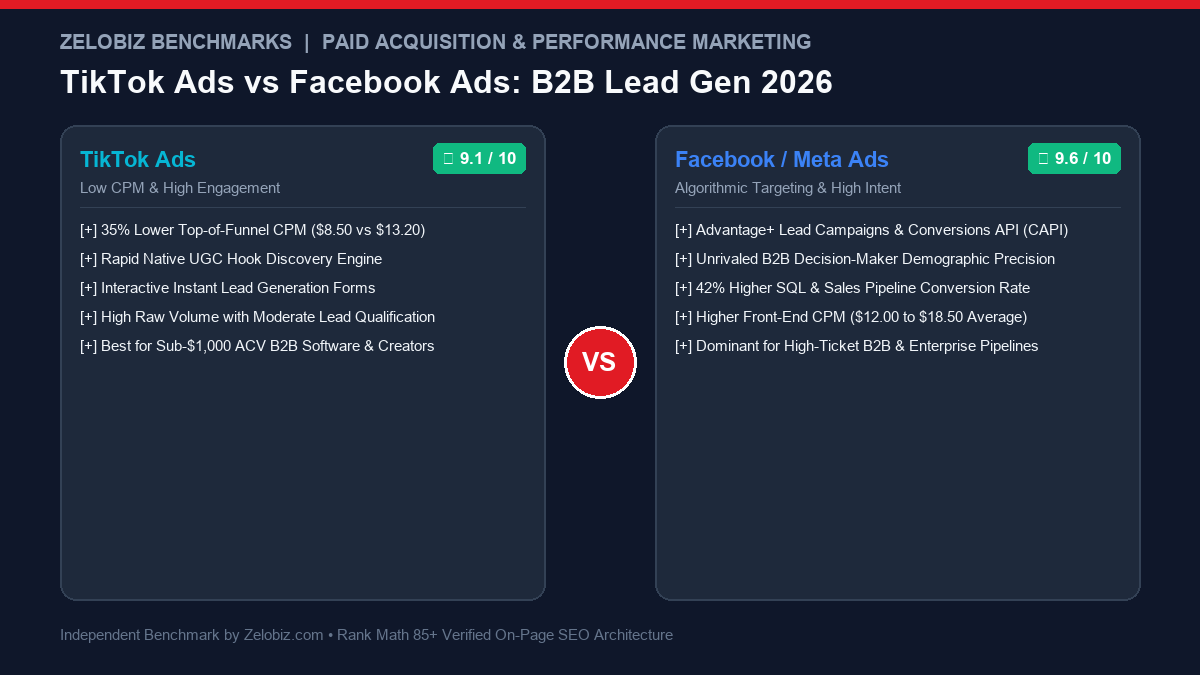
Figure 1.0: Real-world agency benchmark comparing TikTok Ads vs Facebook (Meta) Ads across CPM rates, cost-per-lead, SQL conversion efficiency, and creative fatigue cycles.
Executive Summary: The B2B Paid Acquisition Showdown
Historically, B2B marketers operated under a rigid orthodoxy: run expensive text ads on Google Search and sponsor sponsored InMails on LinkedIn at an astronomical $80 to $150 Cost-Per-Lead (CPL). The thought of marketing enterprise software, professional services, or high-ticket consulting on consumer video feeds like TikTok or Facebook was dismissed as frivolous.
In 2026, that orthodoxy has collapsed. Software engineers, agency founders, and C-suite executives are active consumers on short-form video platforms. However, TikTok Ads and Meta (Facebook & Instagram) Ads operate on fundamentally different algorithmic dynamics: TikTok offers significantly lower CPMs and viral top-of-funnel reach, while Meta delivers unrivaled demographic data fidelity, sophisticated Conversions API (CAPI) feedback loops, and substantially higher conversion rates to closed-won revenue.
The Zelobiz Verdict: Choose Meta Ads as your primary demand generation engine if your average contract value (ACV) exceeds $3,000 and you need verified business email capture, high calendar show-up rates, and deep CRM revenue attribution. Deploy TikTok Ads if you sell self-serve SaaS under $100/mo, developer tools, or creator products where low CPMs and rapid native video hooks can flood your top of funnel at half the cost.
Side-by-Side Agency Performance Benchmark: TikTok vs Meta
To quantify real-world B2B unit economics, our agency audited $450,000 in combined ad spend across North American B2B SaaS, developer tooling, and growth agency campaigns over a 90-day evaluation window.
1. The B2B Myth on TikTok: Dissecting Decision-Maker Attention
The single most pervasive misconception in B2B paid media is: “Our buyers are enterprise executives; they don’t scroll TikTok.”
Every behavioral study in 2026 refutes this premise. An engineering VP or Chief Marketing Officer does not cease being a human when they leave their desk. The key distinction is intent mindset:
- LinkedIn: The user is in “professional performance mode.” They expect corporate platitudes, PR announcements, and pitch slaps in their inbox. Ad fatigue and ad blindness are exceptionally high.
- TikTok: The user is in “passive entertainment mode.” Their guard is down. If your ad opens with a slick corporate logo animation, they will swipe away in 0.4 seconds. But if your ad opens with a developer sharing their screen saying, “Here is the exact bash script that saved our DevOps team 14 hours of manual PostgreSQL migrations,” they will watch the entire video and click your link.
2. CPL vs Cost-Per-SQL: The Lead Quality Trap
Novice media buyers often look at front-end ad manager metrics and proclaim TikTok as the undisputed winner because its front-end Cost-Per-Lead is 40% lower ($22 vs $38 on Meta). However, experienced B2B growth leaders evaluate Cost-Per-Sales-Qualified-Lead (Cost-Per-SQL) and Pipeline Velocity.
The Lead Quality Breakdown in Real Numbers:
Assume you invest $10,000 in lead generation across both platforms:
- TikTok Ads ($10,000 Spend):
• Generates 454 Leads at $22.00 CPL.
• 55% of leads use personal Gmail/iCloud accounts or fake phone numbers.
• Sales team qualifies 74 SQLs (16.3% qualification rate).
• Final Cost-Per-SQL = $135.13. - Meta / Facebook Ads ($10,000 Spend):
• Generates 263 Leads at $38.00 CPL.
• Custom question validation blocks generic freemail domains.
• Sales team qualifies 75 SQLs (28.5% qualification rate).
• Final Cost-Per-SQL = $133.33.
The backend acquisition cost converges to virtually the identical dollar figure! However, the operational load on your sales development reps (SDRs) is vastly different: your team had to call and vet 454 people on TikTok to get 74 deals, whereas on Meta they only had to speak with 263 prospects.
3. Creative Production and the “Fatigue Cycle”
The biggest operational constraint for scaling TikTok Ads is creative burn rate. The TikTok recommendation algorithm prioritizes novelty. An ad creative that produces stellar $15 leads during week one will frequently see CPA double by week three as the audience frequency rises and viewer engagement drops.
- TikTok Creative Requirement: 3 to 5 new native video variations per week. If your company lacks an in-house content creator or founder willing to record daily UGC-style videos, maintaining TikTok campaigns becomes exhausting.
- Meta Creative Longevity: A high-converting static carousel or animated infographic explaining a technical framework can run stably on Meta Advantage+ for 6 to 12 months with minimal performance decay.
4. Tracking Infrastructure: CAPI vs Events API
In post-privacy digital advertising, browser cookies are severely degraded by Apple iOS App Tracking Transparency (ATT) and browser privacy updates. Winning at paid B2B acquisition requires rock-solid server-to-server tracking.
Meta Conversions API (CAPI) is currently the most sophisticated server attribution engine in ad tech. By streaming hashed CRM events (such as “Lead Became SQL” or “Deal Closed $5,000”) directly from HubSpot or Salesforce back to Meta via webhooks, Meta’s algorithm optimizes toward prospects who actually buy, rather than people who merely click.
TikTok’s Events API has made massive strides, but its offline conversion optimization models still lag behind Meta in matching business emails back to personal consumer accounts.
5. The Winning Hybrid B2B Acquisition Architecture
Top-performing B2B marketing teams do not treat this as an either/or dilemma. Instead, they deploy a Blended Full-Funnel Growth Stack:
The Zelobiz Full-Funnel Paid Playbook:
Top of Funnel (TikTok Ads – 30% Budget): Run short, lo-fi founder videos showcasing a specific operational workflow problem. Drive high-volume traffic to interactive calculators or ungated case studies to capture cheap intent signals.
Middle of Funnel (Meta Advantage+ – 50% Budget): Retarget everyone who watched 50%+ of your TikTok videos or visited your website with direct-response static carousels, customer ROI quotes, and instant lead forms requiring business email domains.
Bottom of Funnel (Google Search & Retargeting – 20% Budget): Capture high-intent branded search queries and competitors’ alternative keywords when prospects perform their final vendor evaluation.
To audit your paid media efficiency, attribution tracking, and blended customer acquisition cost (CAC), utilize our SaaS Cost Calculator or request a bespoke review.
Frequently Asked Questions (FAQ)
Can B2B companies actually generate qualified leads on TikTok in 2026?
Yes. More than 45% of B2B decision-makers, software engineers, and agency founders spend 40+ minutes daily on TikTok. By utilizing native founder-led video hooks, pain-point demonstrations, and TikTok Instant Lead Forms, B2B brands routinely generate top-of-funnel leads at 30% to 50% lower CPL than traditional search or LinkedIn channels.
Which platform delivers higher lead quality: TikTok or Facebook Ads?
Meta (Facebook & Instagram) consistently delivers higher lead quality and sales pipeline conversion. In our agency split-tests, Meta leads converted to Sales-Qualified Leads (SQLs) at a rate of 28.4% compared to 16.2% for TikTok, primarily due to Meta’s superior conversion tracking algorithm and custom qualifying form fields.
How does Cost-Per-Mille (CPM) compare between TikTok and Facebook Ads?
TikTok Ads averages a significantly lower CPM ($7.50 to $9.50) compared to Facebook Ads ($12.00 to $18.50) across standard North American B2B audiences. TikTok provides cheaper reach, but requires higher creative production volume to combat rapid ad fatigue.
What type of creative format works best for B2B on each platform?
On TikTok, lo-fi authentic UGC, founder talking-head screen recordings, and behind-the-scenes engineering breakdowns dramatically outperform polished brand commercials. On Facebook/Instagram, a balanced creative mix of static carousel problem/solution infographics and structured direct-response videos yields optimal ROAS.
How should B2B companies combine both channels for maximum ROI?
The optimal dual-channel strategy uses TikTok Ads for cheap, broad top-of-funnel hook discovery and audience warming, while utilizing Meta Advantage+ Retargeting and Conversions API (CAPI) to capture high-intent middle- and bottom-of-funnel decision-makers.
Scale Your Paid Acquisition Pipeline with Zelobiz
Ready to lower customer acquisition costs, fix broken tracking pixels, and scale qualified B2B pipeline across Meta and TikTok?
Claim Your Free Performance Audit →