
In modern performance marketing, relying on client-side browser pixels is financial negligence. Between Apple’s Safari Intelligent Tracking Prevention (ITP 2.4), Google Chrome’s third-party cookie restrictions, and DNS-level ad blockers, standard Meta and Google ad pixels routinely drop 25% to 40% of conversion data. When ad platforms lack conversion feedback, their algorithmic bidding engines (Advantage+ and Smart Bidding) optimize blindly, driving up Customer Acquisition Costs (CAC) across the board.
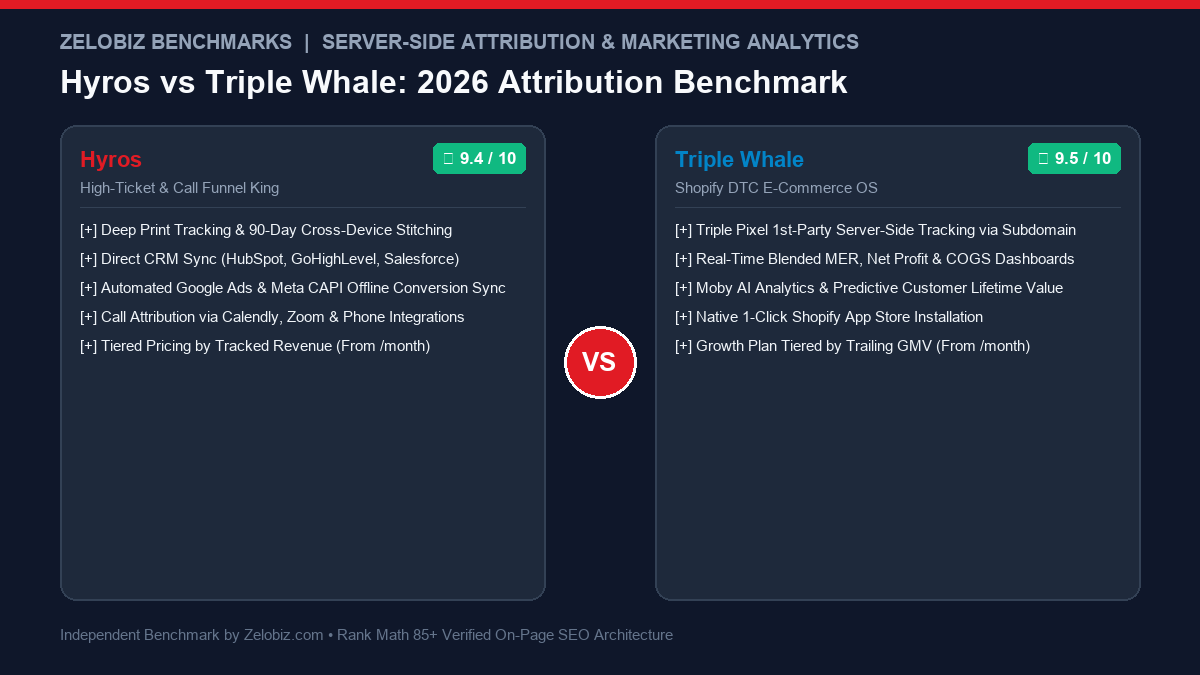
To reclaim attribution accuracy, engineering-led growth teams deploy server-side attribution engines. In 2026, two platforms dominate this market with diametrically opposed architectures: Hyros and Triple Whale. While marketing forums frequently pit them against each other, they were engineered to solve fundamentally different operational problems.
In this technical teardown, we benchmark Hyros vs Triple Whale across tracking telemetry, server-side data ingestion, CRM offline conversion sync, and total cost of ownership (TCO) to help you choose the right attribution engine for your revenue architecture.
For the overarching infrastructure blueprint connecting server containers, custom subdomains, and CRM feedback loops, read our master guide on First-Party Server-Side Attribution & Tracking Architecture (2026).
Executive Summary: Core Architectural Difference
The fundamental distinction between Hyros and Triple Whale comes down to sales cycle duration and checkout topology:
| Evaluation Metric | Hyros | Triple Whale |
|---|---|---|
| Core Target Audience | High-ticket B2B, consulting, info-products, agency services, and call funnels | Direct-to-Consumer (DTC) e-commerce brands built on Shopify |
| Sales Cycle Optimization | 30 to 90+ days across multiple devices, email sequences, and phone consultations | Instant impulse purchases and short funnels (0 to 14 days) with high transaction velocity |
| Primary Tracking Tech | “Print Tracking” combining IP hashing, browser fingerprints, and deep URL parameter preservation | “Triple Pixel” first-party server-side pixel hosted on a custom CNAME subdomain |
| CRM & Offline Sync | Bi-directional sync with HubSpot, GoHighLevel, Salesforce, Calendly, and Stripe | Deep 1-click sync with Shopify, Klaviyo, Recharge subscriptions, and Gorgias |
| Ad Platform Feedback | Feeds offline closed revenue directly into Google Ads OCT and Meta Conversions API (CAPI) | Feeds server-side purchase events into Meta CAPI, TikTok Events API, and Google Ads |
| Financial Reporting | Closed contract value, call booking rate, ad-assisted deal revenue | Blended Marketing Efficiency Ratio (MER), Net Profit after COGS, inventory analytics |
| Starting Investment | ~$349/month (tiered by tracked revenue; quarterly/annual contract) | ~$129/month (tiered by 12-month trailing GMV; monthly rolling available) |
If you run a Shopify DTC store shipping physical goods with hundreds of orders per day, Triple Whale is the gold standard e-commerce operating system. If you generate revenue through phone calls, Zoom demos, high-ticket webinars, or 60-day enterprise sales cycles, Hyros is the undisputed attribution engine.
1. Tracking Architecture & Data Ingestion Teardown
To understand why these platforms succeed where Google Analytics 4 (GA4) and native Meta pixels fail, we must evaluate how each ingests and reconciles user identity.
Hyros: Deep Print Tracking & Cross-Device Stitching
Hyros does not rely solely on cookies. Its proprietary “Print Tracking” engine generates a persistent cryptographic fingerprint for each visitor by hashing:
- Client IP addresses and ISP routing tables
- User-agent device signatures and hardware canvas telemetry
- Standardized UTM parameters (
utm_source,utm_medium,utm_campaign,utm_content,utm_term) - Platform-specific click IDs (
fbclid,gclid,ttclid,wbraid,gbraid) - First-party user identifiers submitted via lead forms (email, phone number, physical address)
When a prospect clicks an ad on an iPhone inside the Instagram in-app browser, downloads a PDF lead magnet, opens an email on a MacBook three weeks later, books a Calendly call, and closes a $6,000 contract on Stripe 45 days after the initial click, Hyros stitches the entire journey into a single unified record. It matches the final transaction back to the exact ad creative and keyword that initiated the interaction.
Triple Whale: Triple Pixel & First-Party Subdomain Delegation
Triple Whale approaches attribution through first-party subdomain delegation. Instead of loading tracking scripts from a third-party CDN (which ad blockers and Safari ITP restrict to 24-hour expiration), you configure a CNAME DNS record (e.g., track.yourbrand.com) pointing to Triple Whale’s cloud infrastructure.
This allows the Triple Pixel to set true first-party cookies that endure for up to 30 days under Safari’s 7-day cap mitigation protocols. The Triple Pixel records:
- Every click, cart addition, and checkout attempt in real time
- Direct webhook events streamed from Shopify’s backend servers
- Zero-party post-purchase survey responses via integrated Grapevine widgets
Triple Whale correlates browser events with backend Shopify webhooks to achieve virtually 100% order matching on Shopify stores. To explore how this compares to enterprise machine-learning attribution models, read our comprehensive benchmark on Triple Whale vs Northbeam.
2. Ad Platform Feedback Loops: Training the Bidding Algorithm
Viewing accurate data in a private dashboard is only half the battle. The true return on investment (ROI) of an attribution platform comes from sending verified conversion data back into Meta Ads Manager and Google Ads to feed Smart Bidding and Advantage+ algorithms.
Hyros: Offline Conversion Tracking (OCT) Mastery
Hyros’s biggest competitive moat is its bi-directional ad account feedback engine. For high-ticket lead generation, training Meta and Google on raw “Lead” events destroys account performance because the algorithms optimize for cheap, low-intent clicks—tire-kickers and bot submissions.
Hyros solves this by injecting Offline Conversion Tracking (OCT) events back into Google Ads and Meta Ads Manager via server-to-server APIs:
- When a sales rep changes a deal status in HubSpot to “Closed Won ($10,000)”, Hyros immediately matches the deal to the original
gclidorfbclid. - Hyros transmits a server-side
Purchaseevent back to Google and Meta with the exact dollar value and customer parameters. - Google’s Target CPA / Target ROAS Smart Bidding engine adjusts its predictive bidding model to target prospects who resemble paying high-ticket customers rather than users who merely submit free forms.
To master manual server-side conversion pipelines, consult our technical implementation guide on Meta Conversions API (CAPI) vs Browser Pixel.
Triple Whale: First-Party Server-Side CAPI Feed
Triple Whale acts as an automated Server-Side CAPI Gateway for e-commerce. It intercepts Shopify orders at the server level, hashes customer match parameters (SHA-256 encrypted email, phone, billing zip, and client IP), and transmits them to Meta, TikTok, and Pinterest with an Event Match Quality (EMQ) score consistently above 8.5/10.
While you can achieve similar CAPI performance using self-hosted server containers (as detailed in our architectural breakdown of Stape.io vs Google Cloud Run for sGTM), Triple Whale eliminates the maintenance overhead by automating deduplication across browser and server payloads natively inside Shopify.
3. Feature & Capability Showdown Matrix
| Feature / Capability | Hyros | Triple Whale |
|---|---|---|
| Shopify Native Integration | Good (Webhook + script tag) | Industry Leading (1-Click App Store) |
| Call & Demo Tracking | Industry Leading (Calendly, Zoom, Phone) | Limited / Not Supported |
| CRM Integrations | Deep (HubSpot, GoHighLevel, Salesforce) | Basic (Klaviyo focused) |
| Multi-Touch Attribution Models | First-Click, Last-Click, Scientific (Call-Weighted) | Linear, First-Click, Last-Click, Triple Attribution |
| Real-Time Net Profit / MER Dashboard | Basic (Ad Spend vs Revenue) | Advanced (COGS, Ad Spend, Shipping, Net Margin) |
| Zero-Party Survey Integration | Manual Webhook / Form Mapping | Native (Grapevine Post-Purchase Surveys) |
| AI Analytics Assistant | Rule-based Ad Recommendations | Moby AI (Natural language data querying) |
| Ad Blower / Bot Click Filtering | Built-in AI Click Fraud Filtering | Standard Platform Filtering |
| Attribution Window Lookback | Up to 90+ Days (Print Stitching) | Up to 30 Days |
| Setup Time & Onboarding | 2 to 5 days (Guided onboarding recommended) | 15 to 30 minutes (Self-serve) |
4. Financial Analytics: MER vs Contract Value
One of the biggest differences between these two platforms lies in how they calculate your business health.
Triple Whale: Mastering Blended MER & Net Margin
E-commerce margins are razor-thin. Evaluating individual platform ROAS leads to false scaling decisions because Meta and Google often take credit for the same conversion. Triple Whale focuses heavily on Marketing Efficiency Ratio (MER) and real-time net profitability:
Blended MER = Total Shopify Net Revenue / Total Blended Ad Spend across All Channels
Triple Whale automatically ingests your Cost of Goods Sold (COGS), shipping expenses, payment processing fees (Stripe/Shopify Payments), and multi-channel ad spend. It displays your true cash margin minute-by-minute on your desktop or mobile app. For a deep dive into why relying strictly on channel ROAS burns capital, review our guide on Blended ROAS vs MER calculations or calculate your store’s target metrics using our interactive Breakeven ROAS Calculator.
Hyros: Long-Funnel Pipeline Value
For high-ticket businesses, MER is virtually useless because ad spend today produces cash collections 30 to 60 days later. Hyros evaluates your performance through Cohort Analysis and Ad-Assisted Cash Flow:
- Cost Per Qualified Call (CPQC): Real-time ad spend divided by completed sales calls that meet ICP criteria.
- 30/60/90-Day LTV Cohorts: Tracks how much additional cash an ad campaign generates months after the front-end lead was acquired.
- Organic vs Paid Lift: Identifies which YouTube videos or Meta retargeting ads accelerate deal velocity across slow-moving enterprise pipelines.
5. Pricing & Total Cost of Ownership (TCO)
Both platforms utilize usage-based pricing models, but their cost curves scale across different business metrics.
Hyros Pricing Structure
Hyros prices based on tracked monthly revenue. While custom enterprise quotes apply to high-volume brands, standard public tiers generally follow this structure:
- Tier 1 (Up to $40,000/month tracked revenue): ~$349 / month
- Tier 2 (Up to $150,000/month tracked revenue): ~$799 / month
- Tier 3 (Up to $300,000/month tracked revenue): ~$1,299 / month
- Enterprise ($1M+/month tracked revenue): Custom quote (frequently requires annual commitment)
Commercial Consideration: Hyros offers a documented 90-day money-back guarantee, stating that if their tracking data does not increase your ad ROI or reveal at least 15% in ad waste, you receive a full refund. However, breaking a standard annual contract mid-term without meeting guarantee prerequisites can be difficult.
Triple Whale Pricing Structure
Triple Whale prices based on trailing 12-month Gross Merchandise Value (GMV) across your connected Shopify stores:
- Growth Plan (< $1M annual GMV): ~$129 / month (Billed annually or ~$149/mo rolling)
- Pro Plan ($1M – $5M annual GMV): ~$299 to $499 / month
- Enterprise Plan ($5M – $20M+ annual GMV): Custom quote with dedicated data engineering support
Commercial Consideration: Triple Whale offers modular add-ons (such as Moby AI, post-purchase surveys, and full funnel visualization). Ensure you calculate total add-on fees when modeling your annual software expenditure.
Final Verdict: Which Attribution Engine Should You Deploy?
Choosing between Hyros and Triple Whale does not require guesswork—it is dictated by your revenue model.
Deploy Hyros If:
- You sell high-ticket services, coaching, masterminds, or B2B enterprise software ($1,500 to $50,000+).
- Your primary conversion mechanism is a phone consultation, Calendly demo, or Zoom strategy call.
- Your average customer takes 14 to 90 days to close after clicking an ad.
- You need to feed offline closed deals from HubSpot or GoHighLevel back into Google Ads Smart Bidding to train algorithms on real revenue.
Deploy Triple Whale If:
- You operate a high-volume direct-to-consumer (DTC) e-commerce store built on Shopify.
- Customers purchase directly via credit card on your site with instant or short-window checkouts (< 7 days).
- You need an executive operating dashboard that computes real-time net margins after deducting COGS and ad spend.
- You want zero-hassle server-side CAPI integration for Meta, TikTok, and Google without maintaining AWS or Google Cloud servers.
If your agency or brand is spending over $20,000/month on Meta or Google Ads and suspect your attribution data is degrading, request a comprehensive evaluation of your tracking infrastructure through our Free Performance Marketing & Tracking Audit.

Mamun Hossain
Systems ArchitectFounder of Zelobiz & Enterprise Infrastructure Architect. Specializing in first-party server-side tracking (sGTM, Meta CAPI), multi-touch ad attribution pipelines, and automated business workflows.