
Between per-task automation pricing, usage-based cloud database read fees, and expensive per-host monitoring subscriptions, the modern business software stack has become a compounding financial liability. Scaling an agency or SaaS startup from 5,000 to 100,000 monthly operations routinely drives monthly software bills on platforms like Zapier, Firebase, and Datadog from $150 to well over $1,800 every single month.
To eliminate artificial execution caps and reclaim data sovereignty, forward-thinking systems architects deploy self-hosted, open-source business infrastructure. Operating modern containerized tools on a high-performance, fixed-cost Virtual Private Server (VPS) allows teams to run millions of workflows, store unlimited relational records, and monitor infrastructure health for under $15 per month total.
This comprehensive architectural guide provides the end-to-end blueprint for replacing fragile, high-cost SaaS tools with an enterprise-grade self-hosted stack—without sacrificing uptime, security, or developer agility.
The 3-Tier Enterprise Self-Hosted Architecture
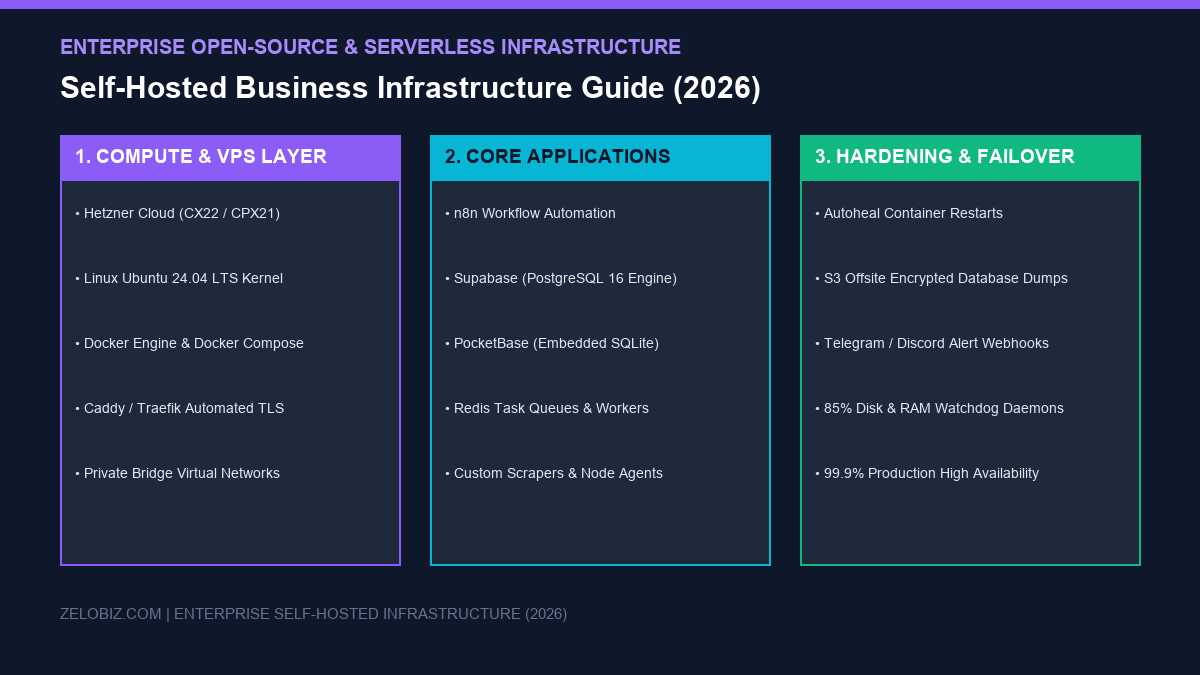
Enterprise self-hosting is built on three decoupled architectural layers:
- Compute & Networking Layer: Dedicated, unmetered Linux VPS instances (e.g. Hetzner Cloud CX22 or CPX21) configured with Docker Engine and Caddy/Traefik reverse proxies for automated Let’s Encrypt TLS encryption.
- Core Application & Data Layer: Containerized open-source services—including n8n for workflow automation, Supabase / PocketBase for database persistence, and Redis for task queue caching.
- Production Hardening & Failover Layer: Automated container healthchecks via Autoheal, automated offsite S3 database backups, and real-time mobile alerting via Telegram/Discord webhooks.
The SaaS Replacement & Open-Source Benchmark Matrix
Every commercial SaaS tool in your tech stack has an enterprise-grade open-source alternative that can be containerized on your own infrastructure:
| Commercial SaaS Tool | Typical Monthly SaaS Fee | Self-Hosted Alternative | Monthly Compute Cost | Implementation Guide |
|---|---|---|---|---|
| Zapier / Make.com | $100 – $600 / month | n8n on Hetzner VPS | €4.49 / month (~$4.85 USD) | n8n Hetzner Setup Guide |
| Google Firebase / DynamoDB | $50 – $300 / month | Supabase / PocketBase | $0 – $4.50 / month (Shared VPS) | Database Benchmark Guide |
| Datadog / BetterStack | $30 – $80 / month | Docker Watchdog + Telegram | $0 (Native bash cron script) | Watchdog Failover Guide |
| Buffer / Hootsuite | $40 – $120 / month | Self-Hosted n8n Scheduler | $0 (Runs inside n8n stack) | Social Scheduler Blueprint |
| Paid Scraping APIs (ScraperAPI) | $49 – $199 / month | Headless Playwright on VPS | ~$4.00 / month (Dedicated node) | Headless Scraper Blueprint |
1. The Compute Foundation: Why Hetzner Cloud is the Industry Standard
While AWS EC2 and Google Cloud Compute Engine penalize developers with complex egress bandwidth billing and high hourly pricing, Hetzner Cloud has emerged as the developer consensus for cost-effective European and US hosting. For less than the price of a single coffee, a Hetzner CX22 instance provides 2 vCPUs, 4GB RAM, and 40GB NVMe storage with 20TB of traffic.
In production testing, a single 4GB VPS comfortably hosts:
- A high-volume n8n container processing 100,000+ monthly task executions
- A production PostgreSQL 16 database with automated connection pooling
- A PocketBase micro-service handling form submissions and internal webhooks
- A Caddy 2 reverse proxy managing automated SSL certificates for all subdomains
To avoid memory contention when handling massive data streams, remember to configure Node.js heap allocations properly as explained in our protocol on fixing n8n Out of Memory (OOM) errors.
2. Zero-Downtime Hardening: Backups, Autoheal & Alerts
The cardinal rule of self-hosting is simple: if your failover pipeline is not automated, your system is not production-ready. Operating an SLA-grade self-hosted infrastructure requires implementing three safeguards:
1. Automated Container Self-Healing
Never manually reboot crashed containers. Deploy the willfarrell/autoheal sidecar container to monitor Docker socket health. Whenever an application container fails 3 consecutive health checks, Autoheal reboots the container in under 5 seconds. Review full container configurations in our Docker Health Monitoring & Telegram Alerts Guide.
2. Offsite Encrypted Database Backups
A VPS backup snapshot is not a database backup. Implement nightly automated pg_dump scripts that compress and stream encrypted SQL archives to an offsite cloud bucket (such as AWS S3, Cloudflare R2, or Wasabi). Follow our complete Bash blueprint in Automating PostgreSQL Daily Backups to AWS S3.
3. Real-Time Resource & Downtime Alerts
Configure a simple crontab watchdog that queries disk utilization and memory health. If disk storage crosses 85% or available RAM drops below 10%, receive an instant alert on Telegram or Discord before services degrade. Explore implementation details in our guide on automated database health monitoring and webhooks.
3. Financial Modeling: The 36-Month SaaS vs Self-Hosted Comparison
Here is the realistic financial comparison for an agency or tech business operating 50,000 monthly automation tasks, maintaining an internal database, and running basic monitoring:
| Cost Driver | Commercial SaaS Stack | Self-Hosted Infrastructure |
|---|---|---|
| Workflow Automation (Zapier/n8n Cloud) | $150 / month | €4.49 / month ($4.85 USD) |
| Backend Database (Firebase/Managed DB) | $50 / month | $0 (Shared on VPS) |
| Infrastructure Monitoring (BetterStack/Datadog) | $35 / month | $0 (Native Telegram watchdog) |
| Offsite Cloud Storage & Backups | $10 / month | $0.50 / month (S3/R2) |
| Monthly Total Software Expenditure | $245 / month | ~$5.35 / month |
| Annual Total Software Expenditure | $2,940 / year | $64.20 / year |
| 3-Year Total Cost of Ownership (36 Mos) | $8,820 USD | $192.60 USD |
| 3-Year Total Cash Savings | — | $8,627.40 Saved (97.8% Reduction) |
Over a three-year operating window, self-hosting redirects over $8,600 in wasted subscription capital directly back into your growth marketing, engineering talent, or profit margins. To audit your entire tool stack, calculate your potential runway savings with our interactive SaaS Cost & Lifetime Savings Calculator.
Explore More Production Blueprints
Transitioning to open-source infrastructure gives you absolute control over your business workflows, client data privacy, and monthly overhead. To continue modernizing your operations, browse our curated blueprints inside the Automation Hub or explore how to configure headless data pipelines with our guide on building a headless web scraper on a $4 VPS.

Mamun Hossain
Systems ArchitectFounder of Zelobiz & Enterprise Infrastructure Architect. Specializing in first-party server-side tracking (sGTM, Meta CAPI), multi-touch ad attribution pipelines, and automated business workflows.