

To start a blog, narrow your topic to a specific niche (not “fitness,” but “strength training for people over 50”), set up self-hosted WordPress with a domain and hosting rather than a free platform, research actual search demand for that niche before writing anything, and publish your first posts targeting real gaps in what’s currently ranking. The technical setup takes an afternoon; the content plan for your first three months is what actually determines whether the blog goes anywhere.
The setup checklist, in the order that actually matters
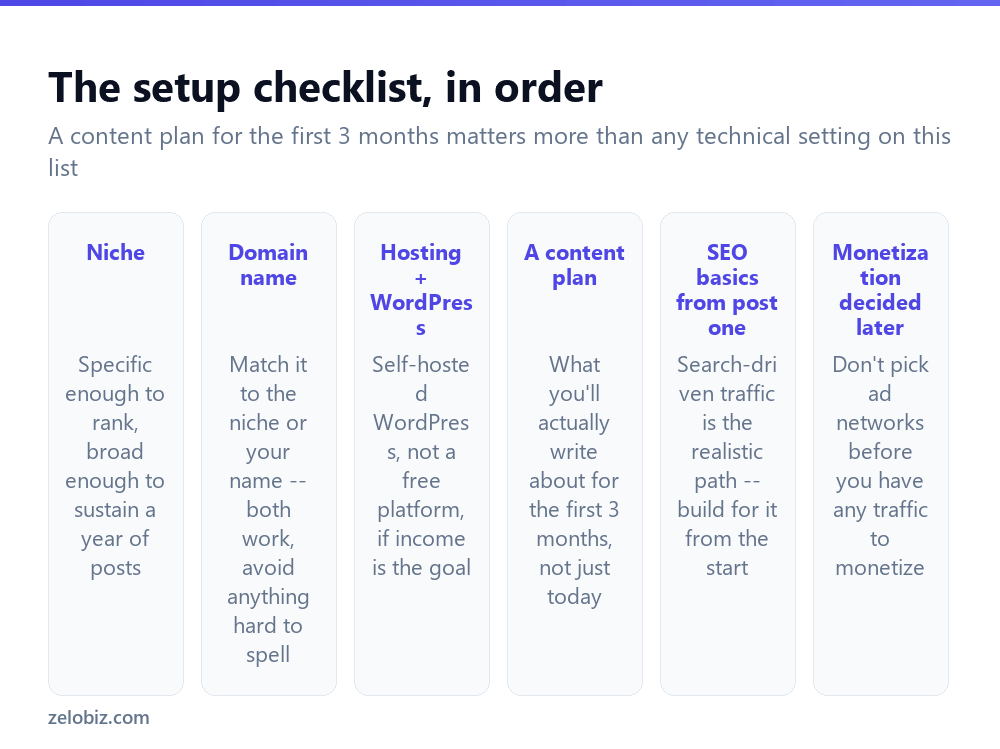
Niche first, before anything technical. A blog trying to cover everything ranks for nothing specific. The right level of specificity is narrow enough to compete for (“strength training for people over 50” rather than “fitness”) but broad enough to sustain a genuine year of posts without running out of angles.
Domain name — either matching the niche directly or your personal name if you’re building a personal brand around the content. Either approach works; avoid anything hard to spell or remember when said aloud, since word-of-mouth traffic depends on people typing it correctly from memory.
Self-hosted WordPress, not a free blogging platform, if income is any part of the goal. Free platforms (a basic wordpress.com plan, Blogger, and similar) restrict monetization options, custom design, and full SEO control in ways that matter once a blog is actually trying to earn.
A content plan for the first three months, not just today’s post idea. This is the step most new blogs skip, and it’s the one that most determines whether momentum survives past the first few weeks of initial motivation.
Monetization method comes last, after there’s actual traffic to monetize — deciding between display ads, affiliate links, or a product before a single visitor arrives is solving a problem you don’t have yet, at the expense of the problem you do have: getting anyone to read it at all.
Choosing a niche that can actually sustain a year of content
The test for a workable niche: can you list 30-40 distinct post ideas within it right now, without straining? If not, it’s either too narrow to sustain, or you haven’t yet researched it deeply enough to see the angles that exist within it.
A genuinely useful trick: look at what established sites in a similar space have published over their history (their sitemap or category pages usually reveal this) — not to copy them, but to see the actual breadth of angles a niche supports once someone’s been writing in it for a while.
Setting up self-hosted WordPress
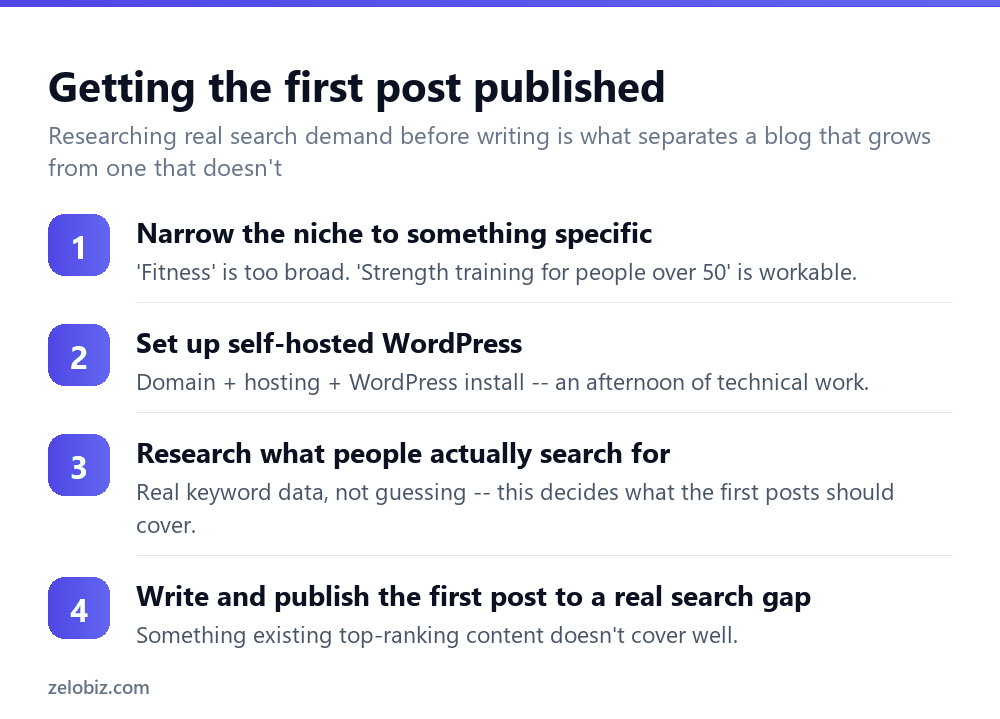
This is covered in full detail in the website guide linked below, but the short version: buy a domain (~$10-15/year), sign up for hosting with one-click WordPress installation (~$5-15/month), and install a theme built for blogging specifically rather than a generic business template.
Beyond the theme, install an SEO plugin (Rank Math or Yoast are the two most common) from day one — retrofitting proper on-page SEO onto dozens of existing posts later is far more work than building the habit from the very first post.
Researching real search demand before writing
The single biggest difference between a blog that grows and one that stalls indefinitely: whether posts are chosen based on actual search demand, or purely on what the writer personally finds interesting.
Free keyword tools (including Bing Webmaster Tools’ own keyword research, and Google’s Keyword Planner) show real search volume for topics within your niche. Prioritize specific, answer-shaped queries over broad ones — a specific “how to” or “what is” query with a clear, checkable answer converts into real traffic and rankings far more reliably than a broad, competitive topic every established site in the niche has already covered extensively.
Write the first several posts targeting genuine gaps — topics with real search volume that current top-ranking pages answer poorly, incompletely, or not at all — rather than competing head-on with entrenched, well-established content on the most obvious, highest-competition topics in the niche.
A realistic timeline
Search-driven blog traffic takes months to build, not weeks, and it’s worth setting that expectation from the start rather than discovering it partway through and losing motivation. A genuinely realistic timeline: the first 2-3 months are mostly writing with minimal traffic while search engines discover and evaluate the new content. Meaningful, compounding growth typically starts somewhere in months 4-8 for a consistently published, well-targeted blog, assuming the posts are genuinely answering real search demand rather than guessing.
Consistency matters more than volume in this early period — a steady one or two well-researched posts a week, sustained for months, outperforms an intense initial burst that fizzles out by week three.
A worked example: choosing between two related niche ideas
Say you’re considering either “home organization” or “small-space apartment organization” as a niche, and trying to decide which gives a new blog a better real chance.
“Home organization” is broad and heavily saturated — large, established sites with years of content and strong domain authority already dominate the obvious searches within it. “Small-space apartment organization” is narrower, but that narrowness is exactly what makes it workable: fewer established competitors have built deep, thorough content specifically for that angle, even though plenty of general home-organization content technically touches on it in passing.
The practical test from earlier applies directly here: can you list 30-40 genuine post ideas within “small-space apartment organization” specifically — closet systems for small bedrooms, vertical storage for tiny kitchens, organizing a studio apartment, renter-friendly solutions that don’t require drilling into walls? If yes, it clears the bar for sustaining a real content plan, and its narrowness is a genuine competitive advantage rather than a limitation, precisely because fewer sites have gone deep on that specific angle even though many touch on it briefly. That gap between broad coverage and genuine depth is exactly what a new blog can realistically compete on, without needing to out-produce far larger, more established competitors.
Why new blogs stall
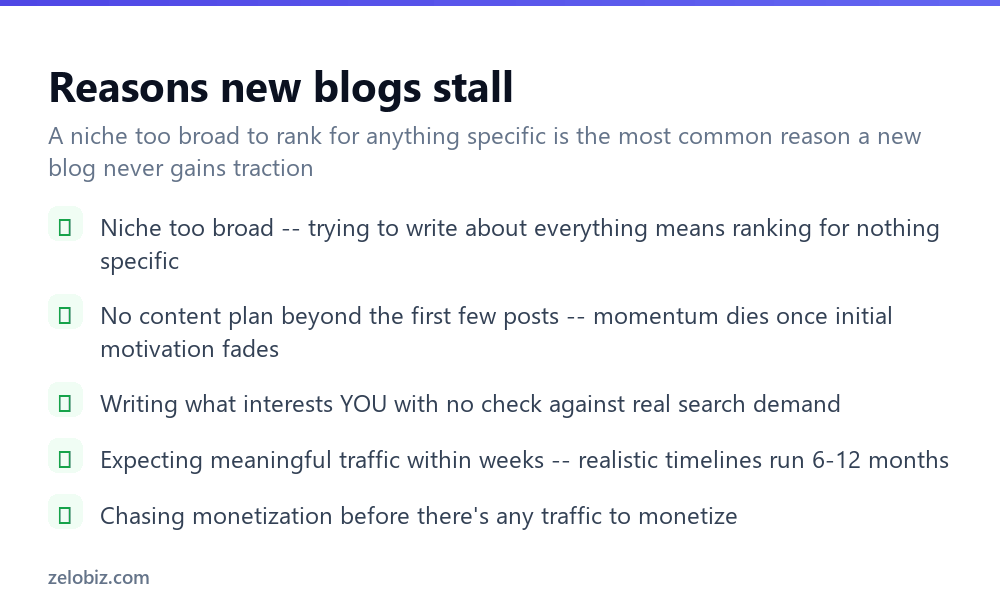
Niche too broad — trying to cover everything within a general interest area means competing directly with far more established, resourced sites on every single topic, with no specific angle of your own to stand out.
No content plan beyond the first handful of posts — momentum dies once the initial burst of motivation fades and there’s no ready plan for what comes next.
Writing what interests you with no check against real demand — genuinely engaging writing about a topic nobody is searching for still won’t generate search traffic, regardless of quality.
Expecting meaningful traffic within weeks — and concluding the whole effort isn’t working when it hasn’t happened yet, well before the realistic timeline above has even elapsed.
Chasing monetization before there’s traffic to monetize — spending early effort optimizing ad placement or researching affiliate programs for a blog with a handful of monthly visitors, instead of on the content and SEO work that would actually grow that number.
A quick reference
Torn between two niche ideas: run the 30-40 post-idea test on each and pick whichever passes it more comfortably. Motivation fading after the first few posts: that’s normal, and it’s exactly why a written three-month content plan matters more than relying on ongoing inspiration. Traffic still flat after two months: that’s within the expected early window, not yet a sign of failure — revisit the timeline before concluding the niche or approach was wrong.
- ✓Choose a niche specific enough to rank, broad enough to sustain a year of content
- ✓Research real search demand before deciding what to write
- ✓Install an SEO plugin from the very first post, not retroactively later
- ✓Set realistic expectations: months, not weeks, before meaningful traffic
- ✓Stay consistent with a sustainable posting pace rather than an initial unsustainable burst
- ✕Picking a niche so broad it competes with everyone on everything
- ✕Writing purely from personal interest with no check against actual search volume
- ✕Expecting real traffic within the first few weeks
- ✕Spending early effort on monetization strategy before there’s any traffic to monetize
- ✕Publishing an intense initial burst of posts that isn’t sustained for the following months
Frequently asked questions
How do I start a blog from scratch?
Choose a specific niche, set up self-hosted WordPress with a domain and hosting, research real search demand for topics in that niche, and publish consistently targeting genuine content gaps.
Should I use a free blogging platform or self-hosted WordPress?
Self-hosted WordPress, if income is any part of the goal. Free platforms restrict monetization, design, and full SEO control in ways that matter for growth.
How long does it take for a new blog to get traffic?
Realistically 4-8 months of consistent, well-targeted posting before meaningful, compounding traffic growth, assuming posts target real search demand.
How do I choose a blog niche?
Pick something specific enough to actually rank for, but broad enough to sustain 30-40 distinct post ideas without straining — test this before committing.
Should I research keywords before writing blog posts?
Yes. Writing based on real search demand, using free tools like Bing Webmaster Tools or Google Keyword Planner, is the single biggest factor separating blogs that grow from ones that stall.
When should I think about monetizing my blog?
After there’s real traffic to monetize, not before. Early effort is better spent on content and SEO that grows traffic than on monetization strategy for visitors you don’t have yet.
- →Set up the technical foundation first: how to make a website
- →A faster-paying alternative while you build: how to make money online
- →Pair written content with video: how to start a YouTube channel
- →Sell products alongside your content: how to sell on Etsy